Alright guys, I’m not a high-level researcher, but I managed to gather all verified photos of damaged B-17s directly from official military archives. I kindly ask you to compare the damage visible in these photos with the claims you’ve been making. Every single one of these photos is fully authenticated, and most of these aircraft successfully landed back at their airfields with these exact levels of battle damage.
Also, if you’re wondering why I’m only sharing photos of B-17s, it’s because the entire discussion has been revolving around the B-17 from the beginning, and all the previous photos and videos shared were focused on it as well. That is the sole reason why I am sharing these specific photos
And I would especially like to extend my heartfelt thanks to RoyalWaffles. Despite people who have ignored and dismissed what we’ve been arguing and defending on these forums for years just for their own interests, they continued to stand up for it and kept the topic alive. Once again, thank you very much
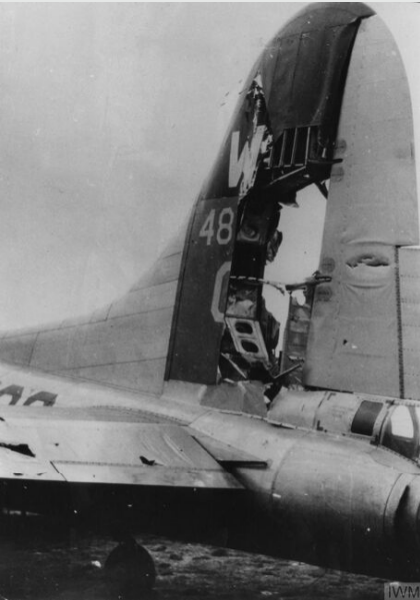
I wanted to start with a special photo. As you can read in the description below, this is the damage inflicted by a Messerschmitt Me 262—most likely caused by a Minengeschoss round. Despite this massive damage, this aircraft successfully landed back at its airfield.
From what I’ve seen elsewhere, it would take about 2 hits for it to end up in this state
The battle damaged tail of a B-17 Flying Fortress (N8-Q, serial number 44-6899) of the 398th Bomb Group damaged by an Me 262 at Manston, 10 April 1945. Handwritten caption on reverse: ‘46899 N8-Q 600BS 10/4/45 Me262 damage - no casualties. Manston a/f. Lt. Shaffer. 398BG. USAAF 60. Credit Archer.’
https://www.iwm.org.uk/collections/item/object/205368108
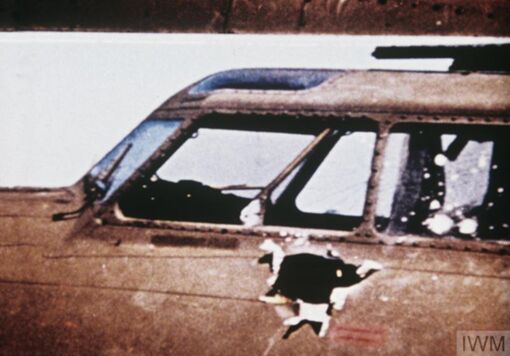
The battle damaged cockpit of a B-17 Flying Fortress nicknamed “Old Bill” of the 305th Bomb Group, May 1943. Written on slide casing: ‘20 mm damage, 5/43 Old Bill.’
https://www.iwm.org.uk/collections/item/object/205365967
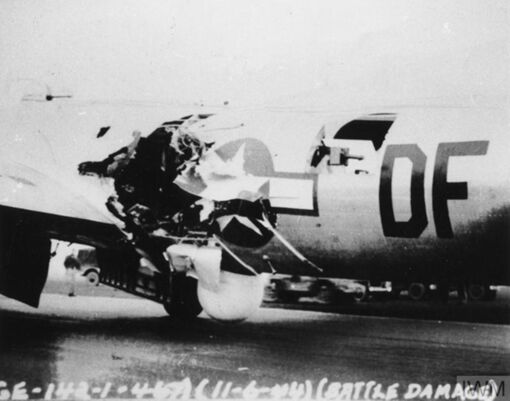
The damaged fuselage of a B-17 Flying Fortress of the 91st Bomb Group. Official caption printed on front: “(GE-142-1-467)(11-6-44)(Battle Damage).” Handwritten caption on reverse: ‘48135 91[BG], 6/11/44.’
https://www.iwm.org.uk/collections/item/object/205363721
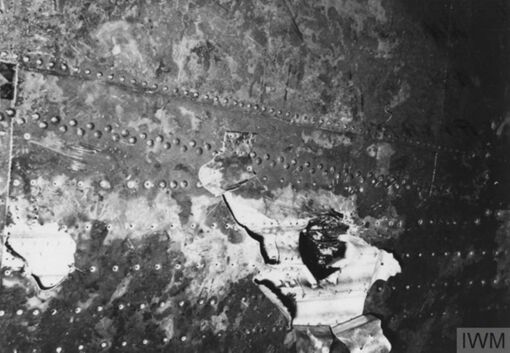
The wing of a B-17 Flying Fortress of the 351st Bomb Group, damaged by 20 mm cannon fire from a Focke-Wulf 190 during a raid over Anklam, 9 October 1943. Handwritten caption on reverse: ‘(10) Damage to our right wing by 20mm from FW-190 over Anklam, Oct. 9, 1943.’
https://www.iwm.org.uk/collections/item/object/205364774
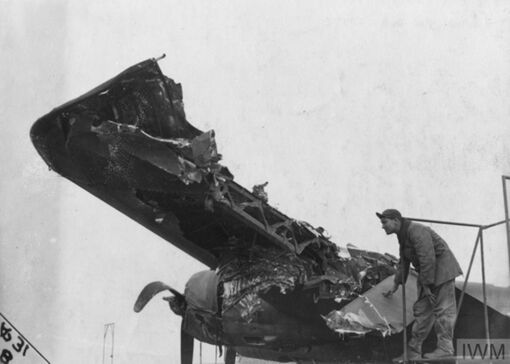
this is another one of those exceptional photos. This photo shows a B-17 that landed with severe damage across almost its entire left wing, having lost an estimated 60% of its engine power on that engine prior to landing. While this aircraft made an emergency landing before it could reach an airfield, it clearly shows that it didn’t just disintegrate in the air like a piece of LEGO
An airman inspects the damaged wing of a B-17 Flying Fortress which suffered a ground collision. Image stamped on reverse: ‘Associated Press.’ [stamp], ‘Passed for publication 11 Oct 1943.’ [stamp] and ‘287788.’ [censor no.] Printed caption on reverse: ‘“FORT” CRASH-LANDS, COLLIDES WITH ANOTHER. Associated Press photo shows: This is what happened to the wing of a grounded Flying Fortress when one of the bombers damaged in the great raid on the Polish port of Gdynia, crashed into it while making a forced landing on its return.’
https://www.iwm.org.uk/collections/item/object/205371550[image]
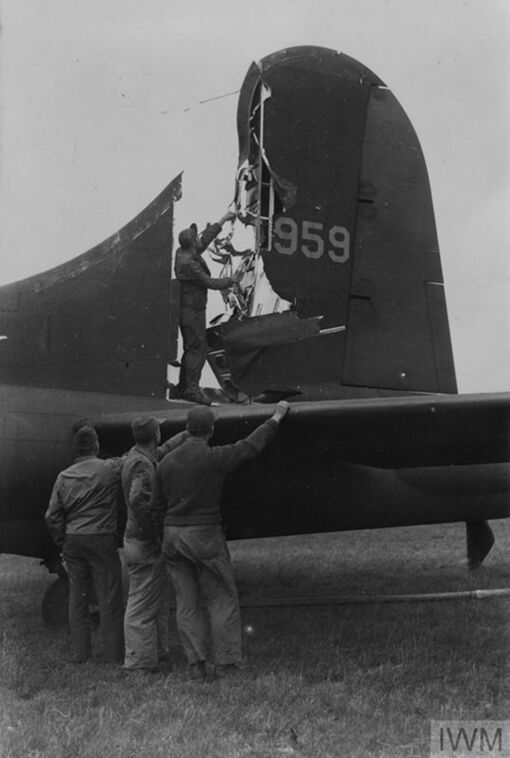
Ground crew of the 306th Bomb Group inspect the damaged tail of a B-17 Flying Fortress. Passed for publication 15 Jul 1943. Handwritten caption on reverse: ‘17/7/43.’ Printed caption on reverse: ‘Fortress Comes Home With Tail Almost Severed. After a recent raid on enemy territory, a Flying Fortress bomber managed to limp home with its tail almost severed. Photo Shows:- Inspecting the damaged Fortress bomber on its home airfield after its return.’ On reverse: Planet News Ltd, US Army Press Censor ETO and US Army General Section Press & Censorship Bureau [Stamps].
https://www.iwm.org.uk/collections/item/object/205364453
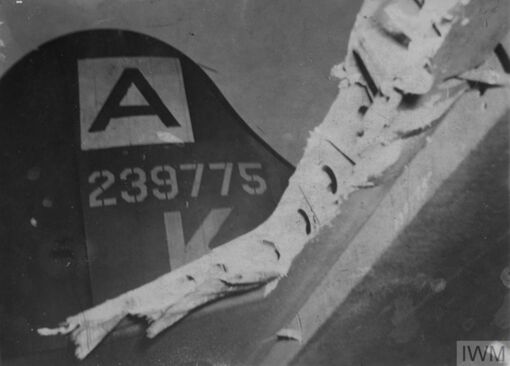
The damaged tail of a B-17 Flying Fortress (serial number 42-39775) nicknamed “Frenesi” of the 94th Bomb Group. Printed caption on reverse: ‘Damaged Fortress Gets Home. Associated Press Photo Shows:- The right elevator of the Flying Fortress “Frenesi” after it had been torn by a 20mm cannon shell in the great raid on the Me110 assembly plant at Brunswick, Germany, on January 11. FL/AB 263982. 14-1-44-Y.’ On reverse: Associated Press and US Army General Section Press & Censorship Bureau [Stamps].
https://www.iwm.org.uk/collections/item/object/205363896
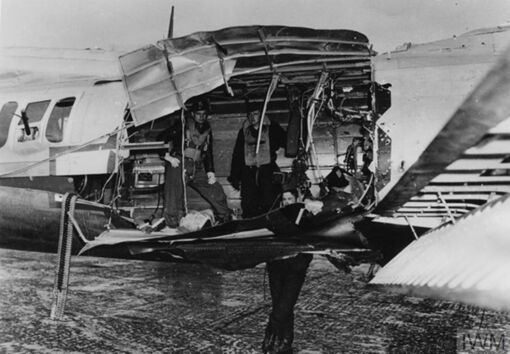
Damage caused by an 88mm or 105mm Flak shell. Despite this, the aircraft still managed to land
Also, the aircraft in the photo below returned from the exact same mission
A B-17 Flying Fortress of the 351st Bomb Group damaged by flak shell, 27 September 1944. Handwritten caption on reverse: ‘27/9/44, 294.’
https://www.iwm.org.uk/collections/item/object/205364777
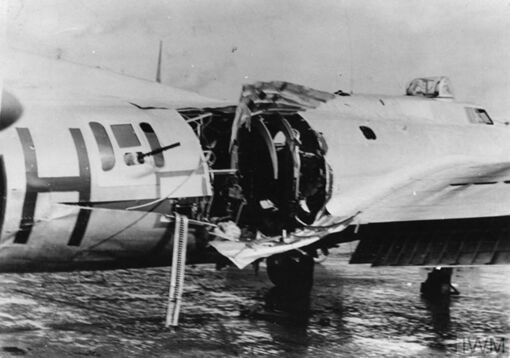
A B-17 Flying Fortress of the 351st Bomb Group damaged by flak shell, 27 September 1944. Handwritten caption on reverse: ‘105mm flak hit - blew out ball and waist. 27/9/44.’
https://www.iwm.org.uk/collections/item/object/205364776
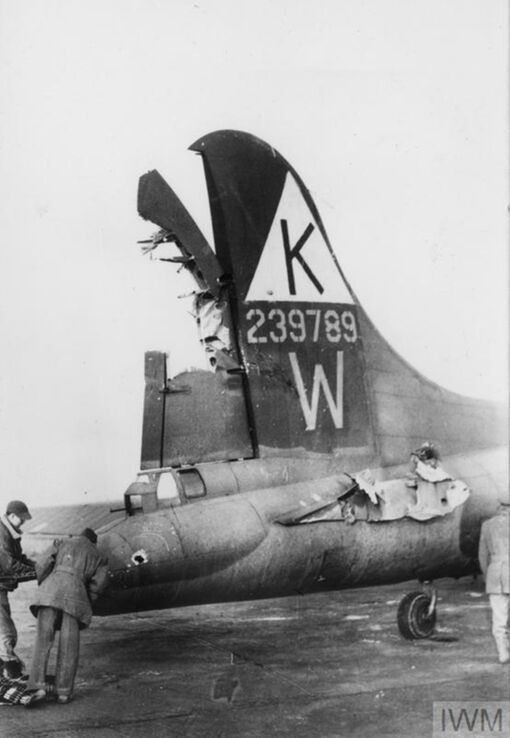
Airmen of the 379th Bomb Group insepct the damaged tail of a B-17 Flying Fortress (serial number 42-39789). Handwritten caption on reverse: ‘379th Kimbolton. Mission accomplished, an amazing display of courage + skill by Second Lieutenant William Elliot, USAF (8th) from Penca, Ohkla, he bought his battered Flying Fort back from Bremen to land in England with left horizontal stabiliser shorn off, rudder smashed beyond use, one engine dead + 5 gun positions knocked out of position.’
https://www.iwm.org.uk/collections/item/object/205369747
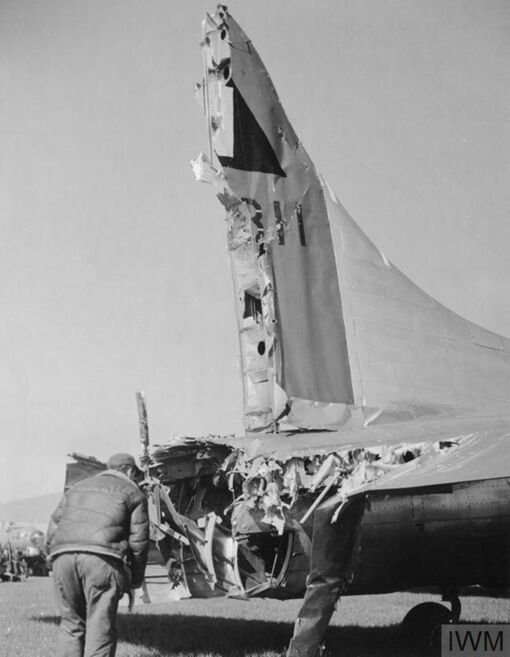
An airman of the 398th Bomb Group inspects the damaged tail of a B-17 Flying Fortress (serial number 44-8811).
https://www.iwm.org.uk/collections/item/object/205361742
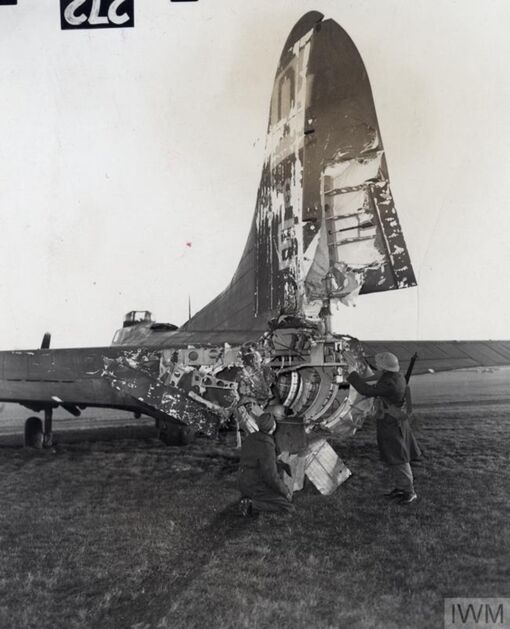
A British enlisted man inspects the battle damaged tail of a B-17 Flying Fortress of the 100th Bomb Group, August 1944. Image stamped on reverse: ‘42803.’ [censor no.] A printed caption was previously attached to the reverse, however this has been removed. Handwritten caption on reverse: ‘8-44.’
https://www.iwm.org.uk/collections/item/object/205383329
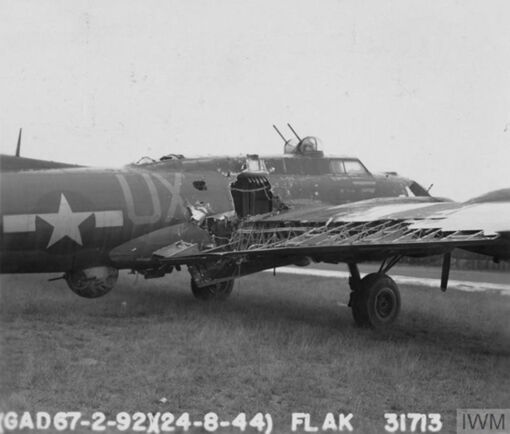
An extensively flak-damaged B-17 Flying Fortress of the 327th Bomb Squadron, 92nd Bomb Group. Official caption on image: “(GAD67-2-92) (24-8-44) FLAK 31713.”
https://www.iwm.org.uk/collections/item/object/205363763
Regarding this photo, I want to clarify that I am not claiming 20mm or 30mm cannons dealt no damage—of course they did. However, they certainly weren’t destroying the aircraft in just 5 to 6 rounds as you claim
In the upcoming photos, you will see even more detailed shots
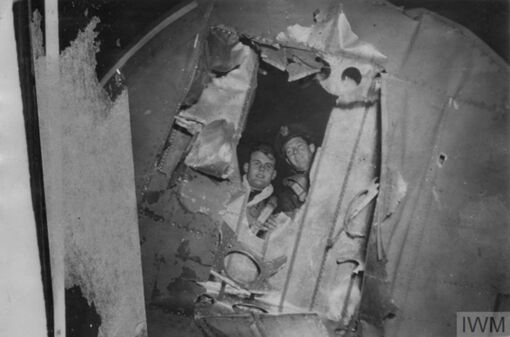
Lieutenant Jabez F. Churchill (co pilot) and Lieutenant William F. Cely (pilot) of the 94th Bomb Group look through a shell hole in their B-17 Flying Fortress nicknamed “Frenesi”. Printed caption on reverse: ‘Fortress Get Home With Damaged Nose. Associated Press Photo Shows:- Lt. Jabez F. Churchill (left), of 903 Cherry Street, Santa Rosa, Calif., and Lt. William F. Cely, of 674 8th Avenue East, Houston Texas, co-pilot and pilot respectively of the Flying Fortresses, “Frenesi”, peer through a big hole in the left wing of their bomber which was torn by a 20mm shell burst in the hot battle with German fighters at Brunswick January 11. “Frenesi” was so badly damaged that she had to be junked five of the crew flew her back to England. FL/AB AP 263895. 14-1-44-Y.’ On reverse: Associated Press and US Army General Section Press & Censorship Bureau [Stamps].
https://www.iwm.org.uk/collections/item/object/205363879
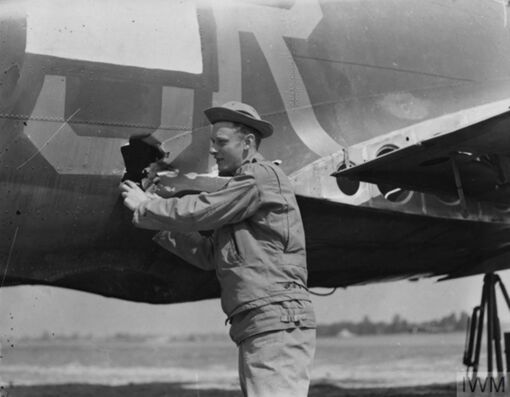
Staff Sergeant George Gronhe of the 547th Bomb Squadron, 384th Bomb Group repairs a damaged B-17 Flying Fortress (SO-R). Passed for publication 19 Aug 1943. Handwritten caption on reverse: ‘4. SO:R, 384BG. Patches at Boxted.’ Printed caption on reverse: 'Battered But Victorious. This is a Flying Fortress that just returned from a mission. Bullets have torn holes in the fuselage and the wings, but the ‘plane carried out its mission and the ground crew at the base wasted to repair their aircraft. Keystone Photo Shows:- St. Sgt. George Gronhe, Detroit, Mich., looknig at the hole in the Fortress. U.S. Pool/F. Keystone SG.’ Censor no: 279567. On reverse: Keystone Press Agency, US Army Press Censor ETO and US Army General Section Press & Censorship Bureau [Stamps].
https://www.iwm.org.uk/collections/item/object/205364922
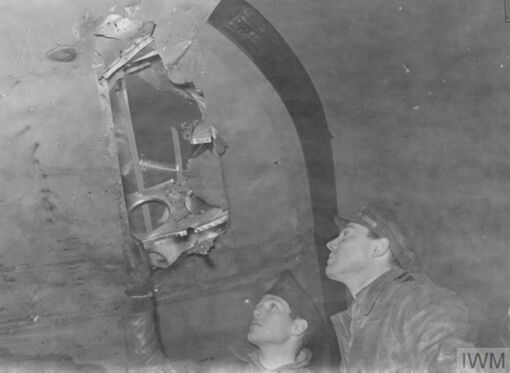
Lieutenant Arthur W Mack and Lieutenant Francis M McCullagh of the 306th Bomb Group examine a cannon hole in their B-17 Flying Fortress nicknamed “Four Leaf Clover”. Passed for publication 12 Jan 1944. Printed caption on reverse: ‘Fortress Returns From Toughest Day Raid “Raked From Tail To Nose”. Some of the fiercest air battles of the war were fought yesterday, January 11, when Fortresses and Liberators attacked vital targets in North-West Germany in great strength. Swarms of fighters came up to challenge them, the defences including planes trailing bombs on long cables, rocket planes and rocket flak. One of the Fortresses, “Four Leaf Clover”, reached home raked from tail to nose and from wingtip to wingtip. Not one of its engines escaped damage and one of them was on fire when, with half of its rudder shot away, it landed by automatic pilot. Three crew-members, the top-turret gunner, tail-gunner and radio-operator were injured. Associated Press Photo Shows:- Lt. Arthur W. Mack, left, of 4550-161st Street, Flushing, N.Y., and Lt. Francis M. McCullagh, of 1040-57th Street, Brooklyn, N.Y., examine the hole made by a 20mm cannon shell in the outer tip of the left wing of the plane during yesterday’s (January 11) raid on North-West Germany. IRV 263808. 12-1-44-Y.’ Censor no: 299752. On reverse: Associated Press and US Army General Section Press & Censorship Bureau [Stamps].
https://www.iwm.org.uk/collections/item/object/205364818
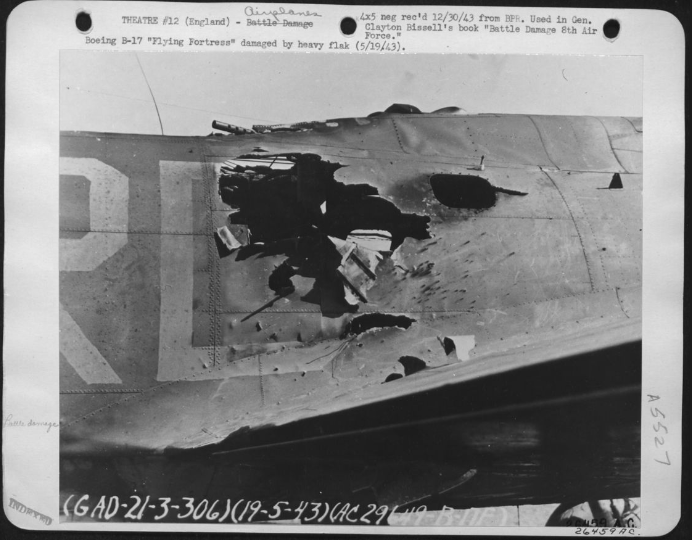
airplanes
4x5 neg rec’d 12/30/43 from BPR. Used in Gen.
THEATRE #12 (England) - Battle Damage
Clayton Bissell’s book "Battle Damage 8th Air
Force.
Boeing B-17 “Flying Fortress” damaged by heavy flak (5/19/43).
Battle damage
264.590

airplaner
THEATRE #12 (England) - Battle Damage
Copied 12/30/43 from General Clayton Bissell’s
book, "Battle Damage 8th Air Force. 11
Boeing B-17 “Flying Fortress” Flak hits on tail gunner position and rudder.
Battle damage
26487AC
INDMXMD
26487AC.
https://catalog.archives.gov/id/204842055
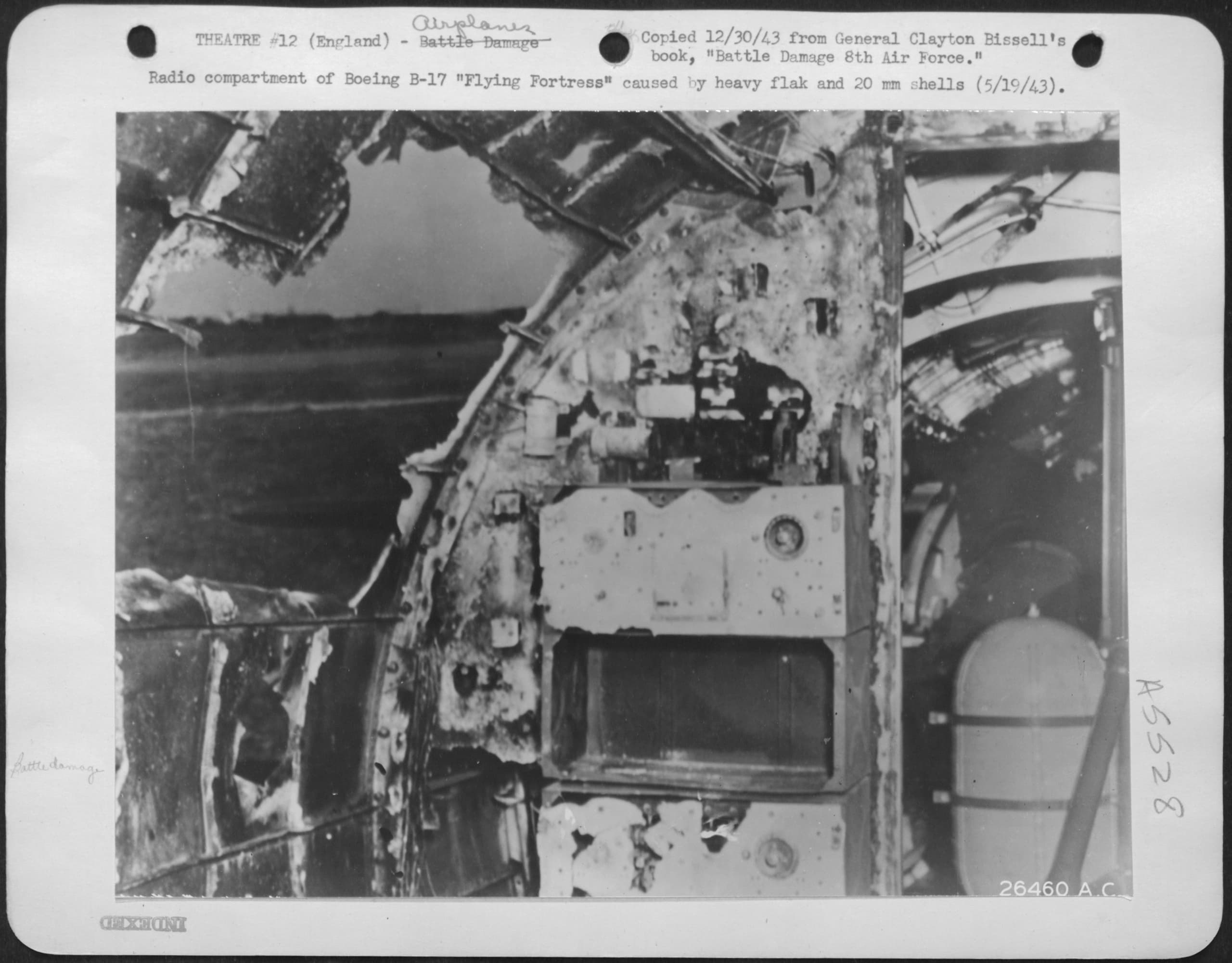
airplanes
THEATRE #12 (England) - Battle Damage
Copied 12/30/43 from General Clayton Bissell’s
book, "Battle Damage 8th Air Force. 11
Radio compartment of Boeing B-17 “Flying Fortress” caused by heavy flak and 20 mm shells (5/19/43).
Pattedomage
26460 A.C.
https://catalog.archives.gov/id/204842001?objectPanel=extracted
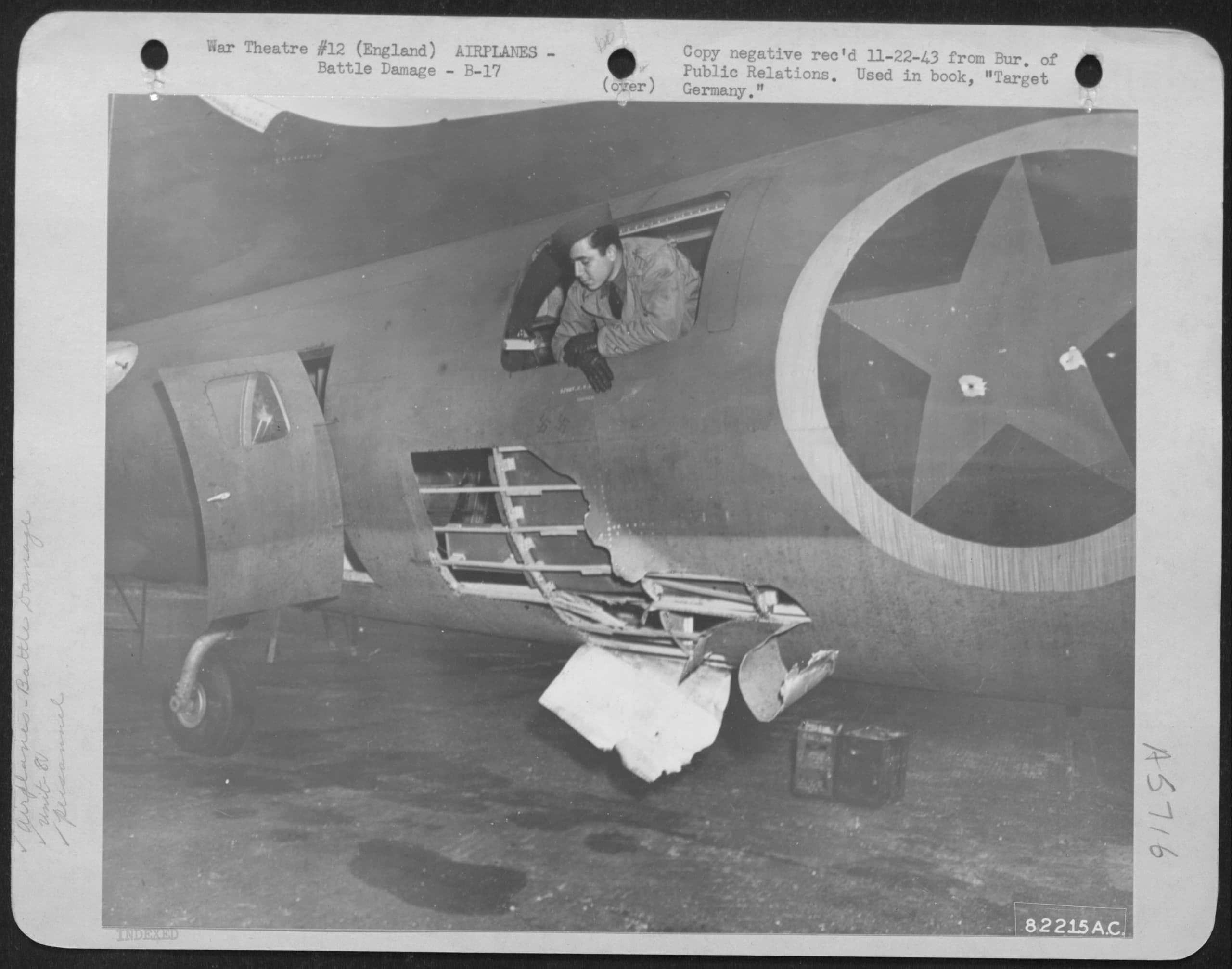
At an Eighth Air Force Base somewhere in England, S./Sgt. Anthony L. Santoro looks
out the waist window of his B-17 “Flying Fortress” at the damage caused by a German
20-mm shell.
https://catalog.archives.gov/id/204842766
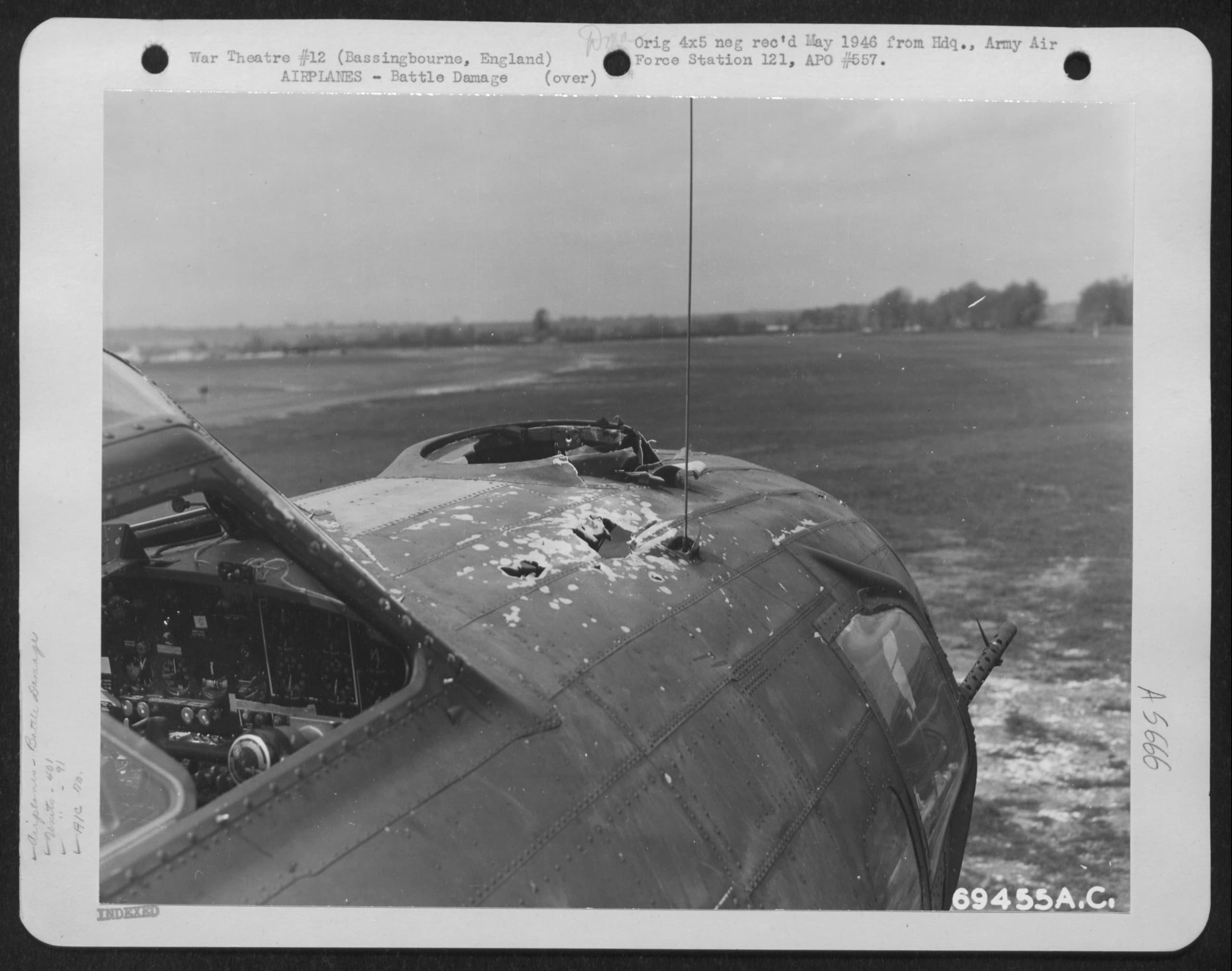
An 88 mm shell hit the nose of this Boeing B-17 “Flying Fortress” (A/C No. 958) of the 40lst
Bomb Squadron, 9lst Bomb Group during a mission over enemy-held territory in Europe on 25 April
1944. Bassingbourne, England.
5666
https://catalog.archives.gov/id/204842620
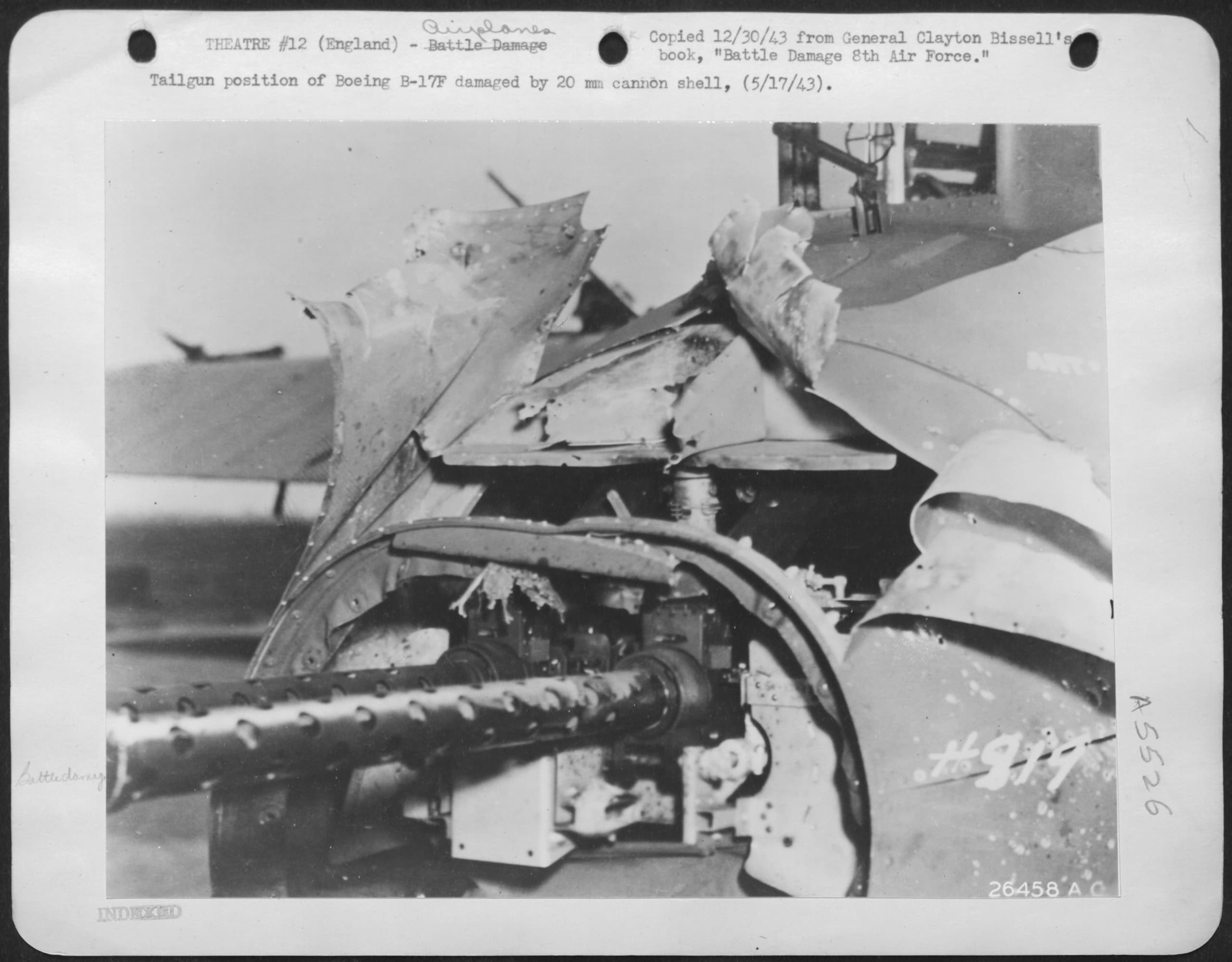
airplanes
THEATRE #12 (England) - Battle Damage
Copied 12/30/43 from General Clayton Bissell’s
book, "Battle Damage 8th Air Force. "
Tailgun position of Boeing B-17F damaged by 20 mm cannon shell, (5/17/43).
Battledang
26458 Aairplanes
https://catalog.archives.gov/id/204841997
That’s all for my research. Thank you to everyone who took the time to read