- Tu-1
tbh I think Tu-1 should get the buff and leave 5.0, where it just shouldn’t be. Back to 5.3/5.7 where it rightfully belongs
- Tu-1
tbh I think Tu-1 should get the buff and leave 5.0, where it just shouldn’t be. Back to 5.3/5.7 where it rightfully belongs
hahaahahah yeah thats 1 round now add another 2 for B 17 and the tail is poof
“Yes this rando on the internet on twitter is actually a certified expert on the matter because his view aligns with my own”
by
Weiss, Herbert K.; Stein, Arthur
and
Technical Note No. Arm.440 (O.R.S. F.T.377)
Is what ill be trusting thank you very much. As the thread is about the structural integrity of bomber airframes, and you’ve persistently lost sight of that to push your own personal goals
thats literally an 88
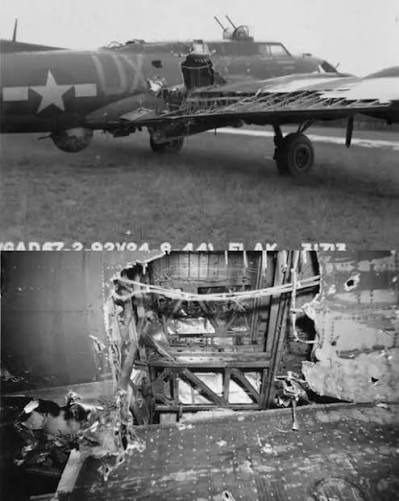
This is snakehips, she had an 88 flak round blow up inside her open bomb bay
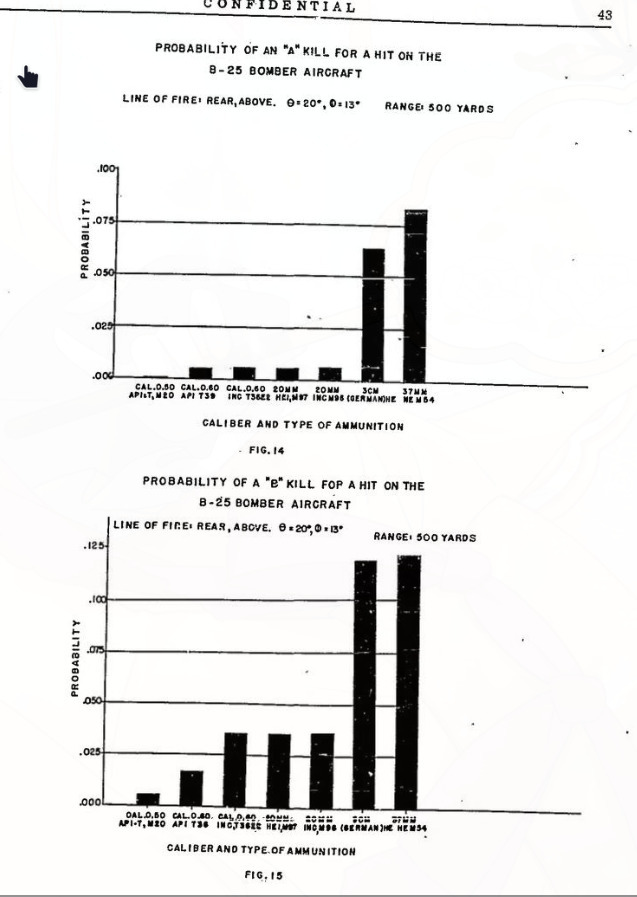
Buddy, this is just that person’s guess, claim, or opinion—whatever you want to call it. If, as the guy says, a 25% kill probability is actually documented, then please show the document. If you can’t present the document, don’t share these kinds of baseless posts.
He’s a fairly well respected WW2 aviation historian and mechanical engineer. He also has the microfilm reel of the US Strategic Bomber Survey… something you have clearly never engaged with.
No this is a common occurence with him
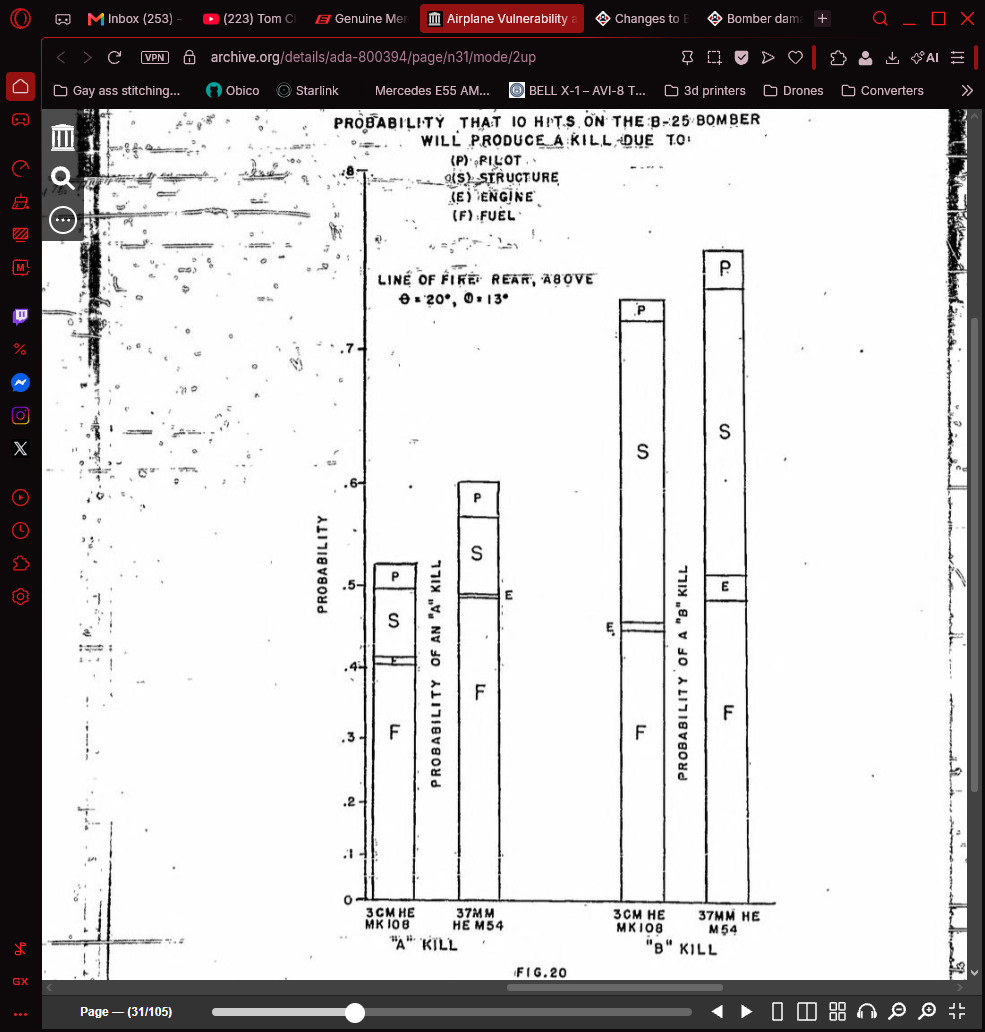
Well then get the film, record it, send it to gaijin lmao, until then you DONT have it, and thus have no proof ioutside of your weird and obscure little sheet of paper, the documents ive posted are entire REPORTS boasting the suvivability of a bomber as small (relatively speaking) as the b25, and that thing was taking far more than 3-5 mk 108s, hell, 10 only had a 53 percent chance to Structurally destroy it. And you KNOW this because you have admitted to reading it yourself, and yet you withheld that information for your own personal gain. Ive been nothing but transparant. Your personal bias makes your arguments null and void
You don’t know what a microfilm reel is do you?
Does the technology on which the information is recorded alter the information itself? If not, I dont care and neither should you because its completely irrelavant to the conversation. thanks
Many people are talking about bomber durability, arguing that bombers are currently able to withstand too much damage and that this is historically inaccurate.
To some extent, that argument may be valid. However, we also need to consider that the situation we have in War Thunder does not accurately represent the historical conditions under which these bombers operated.
During World War II, heavy bombers such as the B-17 Flying Fortress did not normally conduct major strategic bombing missions completely alone. Early Eighth Air Force operations in Europe could still be relatively small — for example, the first Eighth Air Force B-17 raid against Rouen in August 1942 involved 12 B-17s. However, as the bombing campaign expanded, formations quickly grew to dozens and eventually hundreds of bombers.
In October 1943, for example, 291 bombers departed on the mission against Schweinfurt. By February 1944, during Big Week, operations involving more than 1,000 heavy bombers in a single day were already taking place.
These bombers also flew in defensive formations, such as the famous “combat box,” specifically designed to allow their defensive guns to provide mutual protection against enemy fighters. Because of this, directly comparing the survivability of a single B-17 in War Thunder with that of an isolated historical B-17 does not represent the full picture.
In War Thunder, we normally have a single player controlling one bomber, without dozens or hundreds of other bombers around them providing overlapping defensive fire and, in many cases, without an organized fighter escort.
Because of this, there needs to be some balance between historical realism and gameplay. If bombers are given exactly the vulnerability they might have had when isolated in real life, while receiving none of the historical advantages provided by large defensive formations, they could become practically useless in the game.
If we want bomber durability to become more historically realistic, then we should also consider recreating some of the conditions that historically helped these aircraft survive, such as large bomber formations, overlapping defensive fire, and fighter escorts.
There was a case a b17 in the pacific was swarmed by what, 18 zeroes? Youd figure it wouldve died from that but it flew home, now ofcourse not EVERY b17 would survive, and im not saying a bomber should survive 18 fighters in wt, but it should be a bit of a challenge for one fighter to take one on, which is about where we are in terms of durability currently
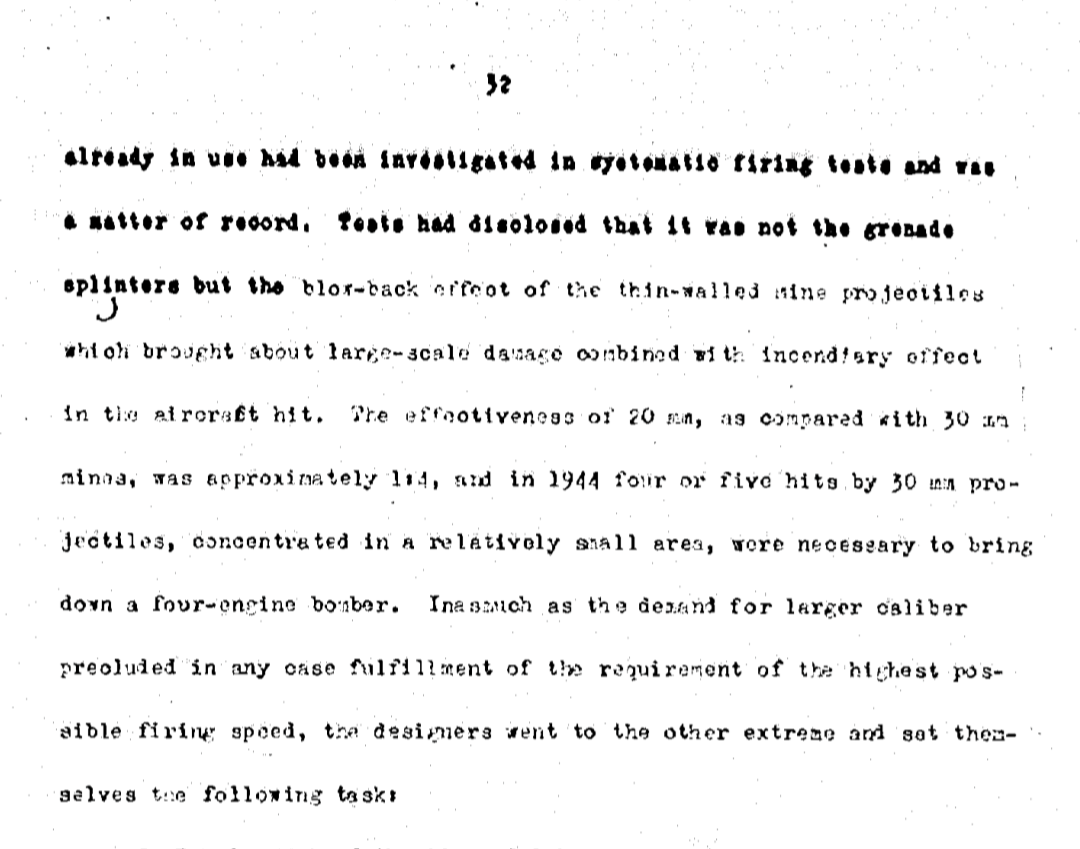
The statistic you are citing is a calculation that is based on an entirely random distribution of shots over the entire visible area of the plane. The whole purpose of the study is to form a comparative basis to compare cannon calibers and not necessarily determine precisely how many rounds to bring down an aircraft. Even the authors of the study are aware that some of their methodology used in the study may be flawed.
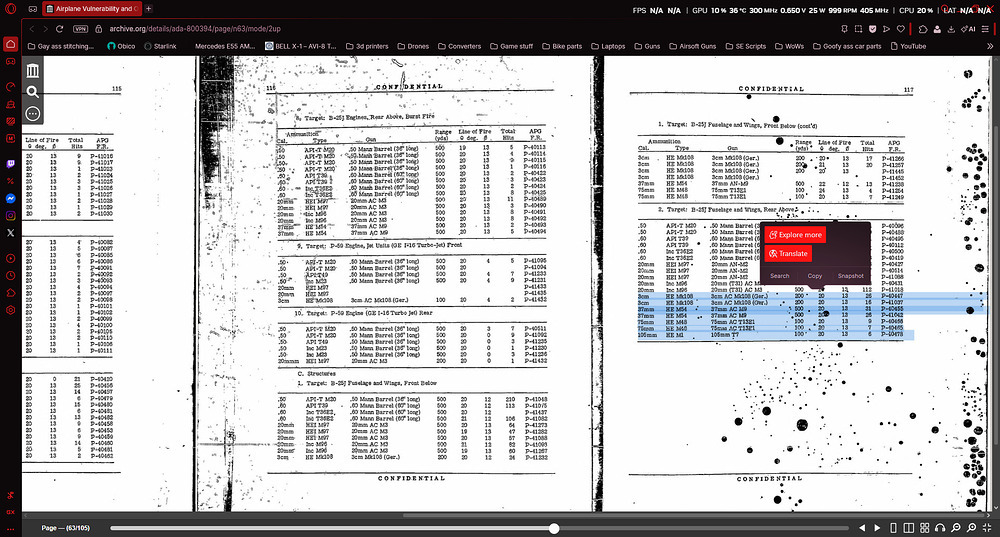
You couldn’t even read the study correctly and assumed that they had fired 6 105mm shells into the same aircraft and then repeated your conclusion here as fact. They didn’t do that. They fired into different aircraft and then evaluated individual results to base their random distribution predictions on.
Note that the 50mm clip of firing at different spots on the B-17 that you didn’t like duplicate near random distribution. It will be a shock to learn that actually concentrating fire into the same place will cause more damage in reality.
US Strategic Bombing Survey reports were based on actual documented combat losses and not purely in lab testing conditions of the ideal caliber study. For instance one of the shortcomings of the ideal caliber study is that both pilots have to be “killed” in order to count because it makes the assumption that a wounded pilot can still adequately fly the aircraft under all circumstances. Similar can be said with how they account for engine kills.
1, random shot distribution, its from the same angle and the 105 was from a mere 100 yards with the exact same firing test number and airframe. Point voided
2, AS above, point voided
3, youve been crying the entire time how a 50mm should ONE SHOT OBLITERATE a bomber and now you’re over here saying ofcourse it didnt die i didnt concentrate fire… One or the other dude
4, I dont care, youve been reposting the same page thats probably also taken out of context in its entirety while I could pull any one page out of this report and prove you wrong, Ive even posted pages referring to engine durability where these big radials are dying to 2-3 20mm rounds, does that make bombers more fragile? Yes, it shows weakpoints are very real, and very weak, and im not afraid to hide it for personal gain. But even then it doesnt disprove the other sheets of my report regarding the strength of the airframe itself. Which has been the main focus of the entire thread. Seriously, I dont think ive seen a single person complain about the engines being too fragile, its literally only been about how much damage can the structure itself take before breaking apart
You’ve been a heavily biased brick wall for the past 500 messages and I’m done entertaining it. Get your hands on a recording of your film and post it, otherwise you have no scientific proof of any of your claims, and wont have any until you bring something new to the table. ZIP
With a change as basic as removing the “First one to grab it gets it” mechanic for bombing targets - which forces bombers to race against each other - we might actually start seeing formations in the game.
This one?
50 PASSES?! The poor bastards on that b17!
And to finish, this will be my last post in this discussion.
If you have not actually tested the bomber in the test flight area, I recommend doing so before judging it only by how much damage it appears to withstand.
Take a bomber and fly directly over the anti-aircraft defenses (AA), allowing them to fire at and damage the aircraft. Then look not only at the external damage model, but also at the internal damage and how the aircraft’s systems are gradually affected.
After taking a significant amount of damage, there comes a point where the bomber becomes almost uncontrollable because its flight-control systems and control surfaces become severely compromised. The flaps can also be damaged or destroyed, making it even harder to keep the aircraft stable or perform a safe landing.
In other words, the fact that the bomber is still physically in the air does not mean that it is still functioning normally. If you actually look at the internal damage, it becomes much easier to see how many components may already be destroyed or severely compromised.
On top of that, the AI-controlled crew currently provides very little help with defense. As gunners and other crew members are killed or incapacitated, the bomber loses much of its defensive capability. Once most of the crew is gone, the aircraft effectively becomes a defenseless target.
So simply seeing a bomber remain airborne after taking multiple hits does not necessarily mean that it is still combat-effective. It may still be flying, but it can already be heavily damaged, extremely difficult to control, and almost incapable of defending itself.
Surviving the hits is not the same as remaining operational.