fair point. i guess about twice the time to be structurally finished vs a cans aluminium when exposed to a fire at same thickness. Wont be very long still. certainly wont be an entire WT match long
1 Like
If you guys are discussing fire vs aluminium, I’d just like to mention, it’s not just about things literaly melting. High temperature is greatly detrimental to aluminium’s ability to withstand compression, tension etc. And aluminium is pretty damn good at heat transfer, which will make the affected areas even bigger.
Of course bomber has quite a bit of excess strength for maneuvering etc., but it will only get you so far.
Also, while fire will destroy hydraulics just fine. Control surfaces, lines and rods can be easily jammed simply via thermal expansion.
Damn, the entire wing may fall apart, if some parts get to high temps while the rest remains relatively cold. Aluminium expands TWICE as much as steel, and we are talking about large parts, so expanding parts will generate a ton of stress, and you seriously don’t want to experience cracking welds. Then there’s aircraft skin, that should be tensioned, as it carries a non-insignificant part of the wingload. If you heat it up, and it loses tension, load distribution becomes even more problematic.
In other words - there are quite a few factors that lead to heat-induced wing failure.
5 Likes
1000% should have said that, but i thought it was a given. Metal softens up even under only a little heat, good example is the world trade center which didnt melt but was severely weakened by fire causing its collapse 25 years ago.
you dont need to completely melt it, just weaken it enough
2 Likes
I mean, yeah, it’s a given, but even with 9/11 even educated people miss this one and think it all works 0/1, either full strength or melts. I had a friend who thought like that, who was otherwise a bit above average (nothing special, but dude was not typical dumb person).
And heat expansion topic is generally not really considered, while it could become an issue.
I have unfortunately absolutely no idea, what exactly would happen if we heated up part of the wing via fuel fire.
If we assume this one to be true:
expands roughly 0.023 mm per meter of length for every 1°C rise
then if theoretically a 4m piece of aluminium gets heated up by 200 degrees (which is extreme oversimplification, I have no idea, again, how large part of the wing would f.e. fuel tank fire affect and what kind of temperature increase would be there, sure as hell some parts would be much hotter than others) then we get 18mm expansion.
That’s not huge, but I guess it could cause some problems down the line.
1 Like
What you’re saying makes perfect sense, but wouldn’t the heat spread throughout the entire plane? I remember at least the B17 or B24s having such a system (I’m not sure).The temperature of the air at the altitude where the planes are flying is also an important factor, and we know that the gaijin encodes this factor.
Well, tried new SAP-HE Mk103 belt with Do-335B2 which has 3xMK103. After landing over 100 hits to one wing of B-29, it was still attached. These shells have either HE-incendiary mix or a TON of HE ( 64g), and penetrate 19mm of armor steel at 500m. They are absolutely useless, and they don’t work well vs Ju-88A either.
Fuselage shots also suck.
the only thing that works is shooting the pilot from the front.
2 Likes
Simply put the change is a bit of a joke.
4 Likes
Well, “luckily” Minepanzegranate is just an absolute dogshit round, so it not working vs bombers is simply caused by Gaijin’s hate towards anything that can’t be found among ammo types used by Soviets/russians.
Of course it’s just a nice coincidence that this specific round should be an solution to heavy bomber problem, while in game it can’t kill anything.
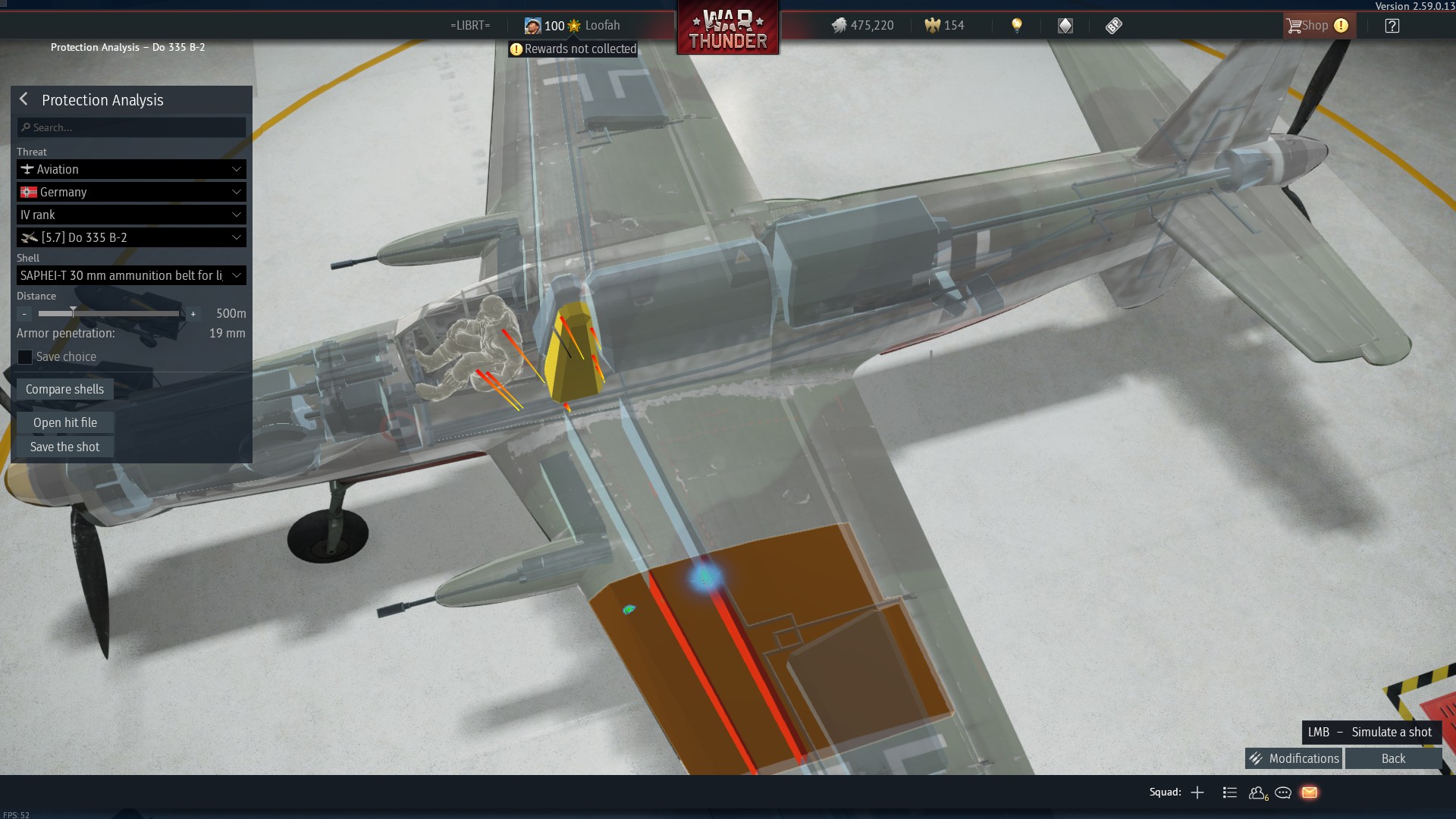
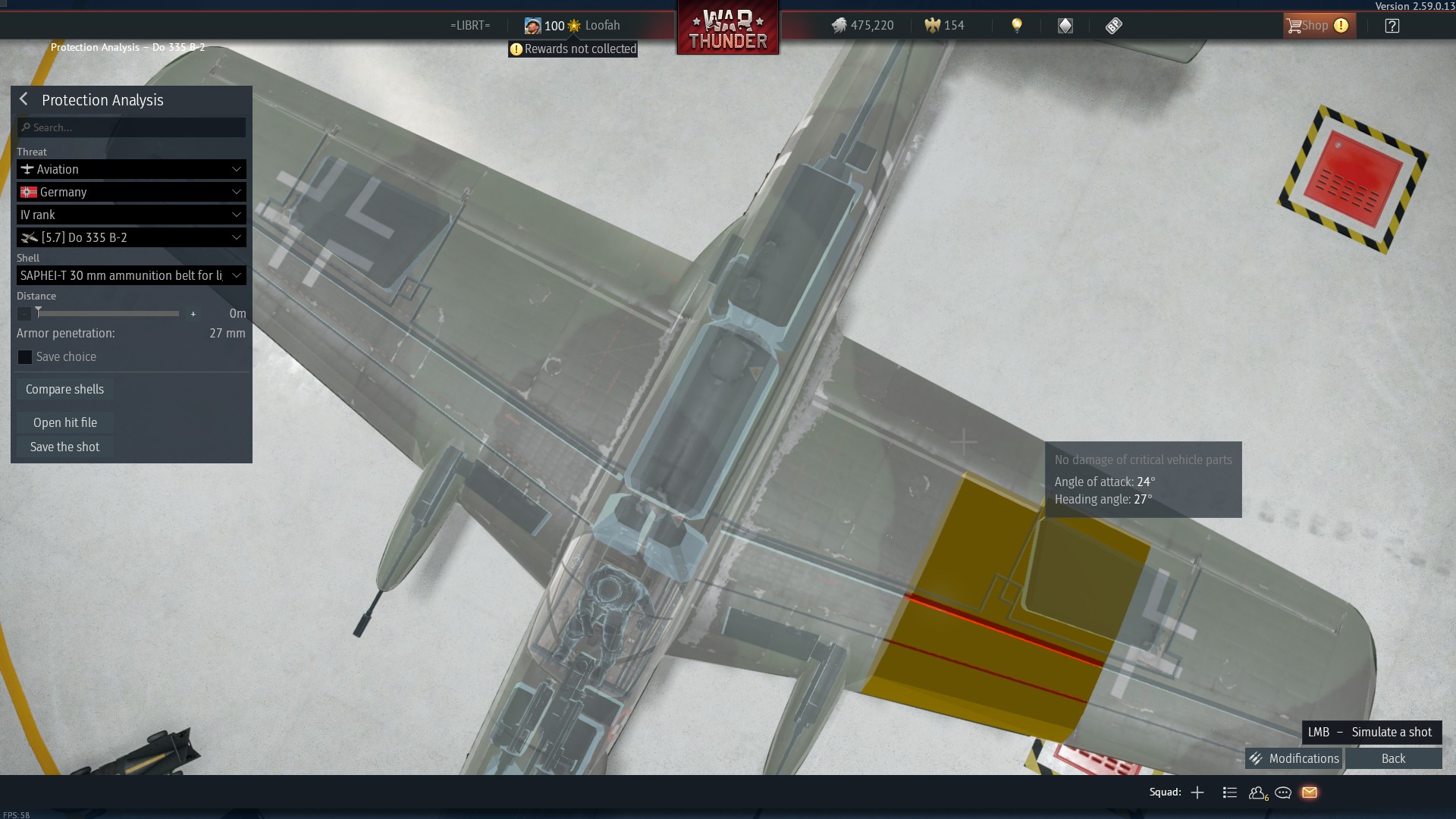
These shells penetrated the spar then exploded. All of the wing/spar damage was caused by the penetration, explosion does ABSOLUTELY NOTHING (64g of TNT).
1 Like
It’s pure fanatsy at the moment. I saw a LA-200 passing by a TU-4. Barely any damage and that’s 3 37mm cannons.
It is as if bombers are covered in invisible, weightless armour steel multiple millimeters thick.
Every granddadbombers dream but pure fantasy.
3 Likes
In ASB now everyone is running bombers. Why? It can more reliably take down other bombers than a fighter (of which you need to either have good positioning, some luck, multiple fighters, or all of the above).
Bombers should be more survivable, yes, but that means they shouldn’t fold like origami after the first hit. All the rest such as engine damage, penetration values, armor, should be normal. Since this can be applied for spars and skin, there is ofc an issue as the fuselage is only skin. Modelling the frames and stringers and other scaffolding would take about million years, so that is off the table.
So the damage dealt should maybe be about 50% chance, not whatever minuscule thing it is now, or a more advanced system would be to add way more drag to the damage incurred. Another option would also be to have maximum stress dependant on damage: Full HP component survives a 10G pull, orange breaks after 5G, red after 2G (random numbers). This should be feasible even with current DM in WT, i believe so.
Edit: also removing gunner aim and letting the AI do it in ASB could maybe solve a part of the issue, however some changes should be made, and maybe introduce systems like naval has where you can dictate if you want long range spray with reduced accuracy or close range accurate fire, intensity of ammo expenditure and maybe even what type of aircraft to prioritize.
Currently it works like that: Me-262 needs like 14+ 50mm HE shots to down B-29 (it won’t die quickly, but it may die eventually)
Probably 9+ to down G8N1. Maybe more, can’t really test that at the moment.
G8N1 needs to hit 262 once. B-17 or B-29 may need some more, but it’s not bad.
The only planes that kinda work vs bombers are:
Yak-9K, Yak-9UT, TIS MA, Tu-1, Su-8.
If it sounds like all are Soviet, it’s because they are. And they also work vs fighters, though 9k ans 9UT “so, so”, while the bomber-attackers can either shrug off all the damage OR just kill everything via head-ons and gunners.
Soviet 45mm seems to deal a lot more damage than German 50mm, despite latter having A TON more explosive charge on top of twice the kinetic energy.
4 Likes
Because, yes. If you go to damage simulation, all bombers’ skin are now ~4-9mm RHA equiv.
Literally flying BTRs.
4 Likes
I saw la-200 shooting down 3 tu-4
How, i’m genuinly trying, what ammo, where to aim
Your DHL A300 example is actually quite useful here, and the fact that it was an aluminum wing is worth emphasizing. Structural references for the A300 family describe a conventional aluminum alloy wing box, with 7075 alloy used for the upper wing panels and 2024 alloy for the lower panels.
So I don’t think the lesson from that incident should be that an aluminum wing will simply burn through after a short and predictable amount of time. Clearly, it does not necessarily work that way.
At the same time, I don’t think the opposite conclusion, that a sustained fuel fire is relatively harmless as long as the wing remains visibly intact, is supported either.
There is a particularly interesting Boeing 707 accident that shows both sides of this quite well.
On 31 March 1992, Trans-Air 5N-MAS lost both engines on the right wing in flight. A large fuel leak subsequently developed and the right wing caught fire. The aircraft nevertheless remained controllable and eventually landed.
The BEA investigation found that the fire itself had already caused extensive damage. Wing skin panels were distorted, warped and cracked, the trailing edge between the two engines was completely burned, both flaps had disappeared, their operating mechanisms were burned, and the inboard aileron was severely damaged.
More importantly, the BEA concluded that the intense fire heated the upper wing skin sufficiently to reduce its mechanical strength. The overheated skin then failed, creating openings through which the fire gradually reached kerosene vapors associated with No. 4 fuel tank.
The tank then exploded.
Post-accident examination found that the internal explosion displaced the tank ribs and significantly reduced wing stiffness. The lower chord of the front spar developed a crack up to 50 mm wide, while the upper chord of the rear spar was cracked for at least 1.25 metres. The investigators specifically described the explosion as having “seriously damaged the front and the aft spar of the wing.”
Yet even after all of that, the aircraft still landed.
I think this is important because it demonstrates why fire damage cannot really be represented by a simple timer where a wing burns for X minutes and then falls off. An aircraft may survive a very severe fire, while at the same time suffering progressive structural and system damage that leaves it extremely close to structural failure.
There are also cases where a fuel tank explosion did cause immediate catastrophic structural failure.
Pan Am Flight 214 in 1963 is one example. Lightning ignited the fuel and air mixture in the No. 1 reserve tank of a Boeing 707. The Civil Aeronautics Board concluded that the resulting explosion caused the explosive disintegration of the left outer wing and the subsequent loss of control.
TWA Flight 800 provides another example. The NTSB concluded that the center wing tank’s flammable fuel and air mixture exploded, and its structural investigation determined that the breakup of the aircraft began when a structural member in the center wing tank fractured as a result of the internal overpressure.
So I think the A300 incident and these accidents actually complement each other rather than contradict each other.
The DHL A300 shows that even a primarily aluminum alloy wing can remain attached during a prolonged and severe fire. It is therefore good evidence against simply making every wing fire destroy the wing after an arbitrary number of seconds.
But the 707 accidents and TWA 800 show that fire can progressively weaken and destroy aircraft structures, and that an actual internal fuel tank explosion can damage ribs and major spars or, under sufficiently severe conditions, directly initiate catastrophic structural breakup.
Another thing worth considering is that aluminum does not have to melt before this becomes a problem. NACA performed elevated-temperature strength and creep tests specifically on 2024-T3 aircraft aluminum, and the results show that its load-carrying behaviour changes significantly with temperature and exposure time.
So for the damage model I think these should really be treated as separate mechanisms… fuel leakage, an external fuel fire, prolonged heating of structural components, damage to controls and systems, fuel tank rupture, and an actual internal fuel/air explosion should not all be represented by the same generic “fuel tank on fire” state.
1 Like
This aircraft was not getting shot at by cannon fire. So any conclusions taken must take that into account.
This is closer to what we’d experience in-game, especially from the large cannons such as 50mm and 75mm, or missile damages.
The important distinction here is between the energy required to directly destroy the aircraft structure and the energy required merely to ignite a flammable fuel-air mixture inside a tank.
TWA Flight 800 is a good example of that distinction. The aircraft was not destroyed because the original ignition source itself released an enormous amount of energy. The NTSB concluded that a flammable fuel-air mixture inside the center wing tank was ignited, most likely by an electrical fault. FAA testing and analysis also found that, under the temperature and vapor conditions present in the tank, relatively low ignition energies were sufficient. Once ignition occurred, combustion of the fuel-air mixture generated the internal pressure that actually broke the tank structure apart.
This means that a TWA 800 type mechanism does not inherently require a 50mm or 75mm projectile. If a fuel tank already contains a flammable ullage mixture, a projectile below 50 mm can potentially provide the ignition source. Even .50cal incendiary or API ammunition could potentially do so under suitable conditions. That does not mean a single .50cal hit will normally make an aircraft explode, only that there is no physical caliber threshold at 50 mm before an internal fuel-air explosion becomes possible.
Seems this was already understood during WWII. The US Navy developed self-sealing fuel tanks specifically around protection against .50cal gunfire. During gunfire testing, they found that .50cal impacts could produce severe hydraulic ram(HRAM) inside a fuel-filled tank, and on some occasions even an armor-piercing projectile caused the test tank to catch fire because the impact produced sufficiently hot aluminum particles or flashes around the penetration.
The same testing also showed why this cannot be reduced to projectile caliber alone. A 20mm explosive projectile could actually detonate while immersed in liquid gasoline without necessarily causing the gasoline itself to explode, because the liquid absorbed much of the detonation energy. At the same time, released gasoline mixed with air could subsequently be ignited by incendiary or tracer ammunition. In other words, the condition of the fuel and the fuel-air mixture was at least as important as the nominal caliber of the weapon.
That is why WWII combat aircraft increasingly used several layers of protection. Self-sealing tanks were intended to limit fuel loss after penetration, non-metallic tank supports and separation between the fuel cell and surrounding structure reduced the chance of sparks igniting leaking fuel, and engine compartments were fitted with fire-detection and extinguishing systems. Postwar analysis of WWII combat losses found that fuel-system damage was one of the major types of damage likely to result in aircraft loss, and that the majority of lost aircraft were on fire.
The same problem remained relevant on postwar strategic bombers, although the methods used were different.
The B-52G and B-52H changed from the flexible bladder-type tanks of earlier B-52 variants to integral wet-wing tanks. In other words, parts of the wing structure itself form the fuel tank. The B-52H fuel system also includes fire shutoff controls that can isolate engine fuel supply during a fire. This is useful for limiting the continuation or spread of an engine fire, but it does not make an integral wing tank immune to ballistic penetration or an internal fuel-air ignition event.
The original Tu-95 is an even clearer example of how seriously this threat was treated. It used dozens of flexible rubber fuel tanks and was fitted with a dedicated neutral-gas system. Carbon dioxide from eight bottles was supplied to the ullage space of the fuselage and wing tanks specifically to prevent fuel vapors from igniting when the tanks were penetrated by gunfire. That is almost exactly the type of secondary event being discussed here: the projectile may penetrate and damage the tank, but the system attempts to stop that penetration from turning into a fuel-vapor fire or explosion.
1 Like
I bet you can still but it is not goign to be as reliabel as it shoud be.
Full HE belt. I fired all over the place, attacked BV-238 frontally and he lost his tail, killed also mamaged to de-wing H8K3 with a single shot, he had sustained quite a bit of damage while killing 3 of my teammatess, but that wing was yellow when I mamaged to land shots.
Meanwhile, it takes a metric …ton of 50mm HEI-T to down a goddamn Ju-88A, so there’s that.
1 Like
They fix the HE shell now?