- Yes
- No
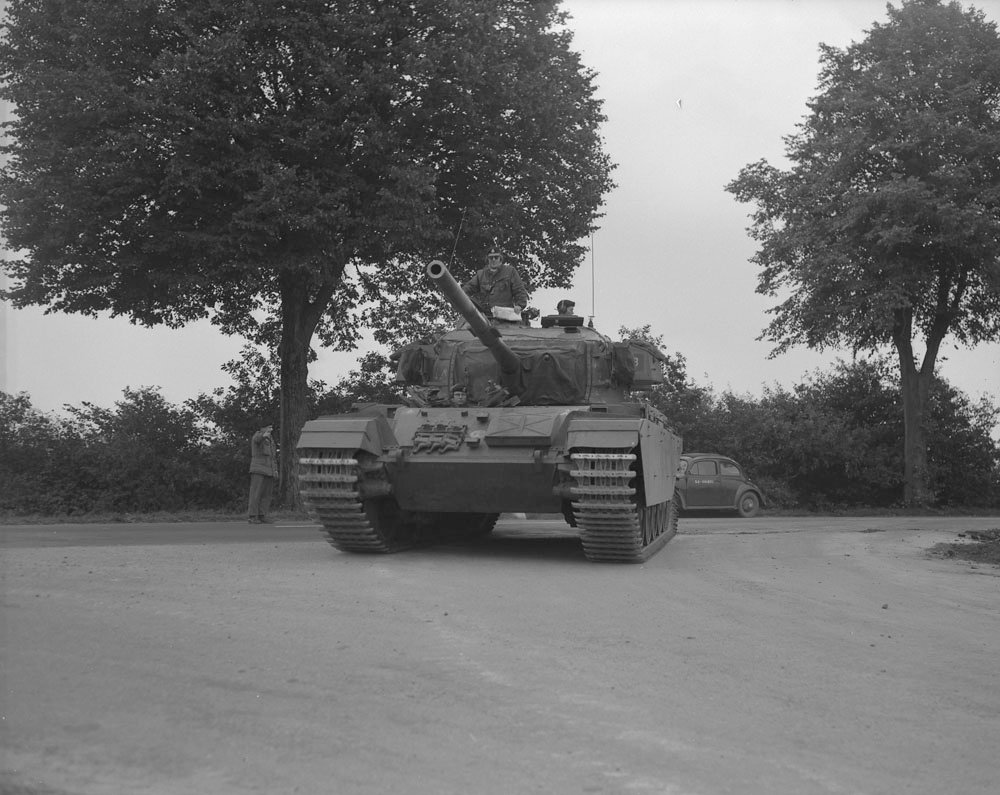
Hello, this time it’s the Mk 5/1, something done to all MK 5s in Europe.
History:
Canada had entered the Korean War with outdated and worn-out tanks. This fact had forced the St. Laurent government to make operational purchases that were needed to sustain the forces in Korea. The conflict would only highlight and immediately need to both equip and standardize the Royal Canadian Armoured Corps, in both locations they were serving, at home and in Europe. After witnessing the tank models used in the Korean War, both the government and the Canadian Army had a great interest in the Centurion Mk 3, which was operated by the UK in the Korean War.
Well, the Canadian government would officially order 274 Centurion Mk 3 tanks, with the first batch of 21 of them being delivered to the Royal Canadian Dragoons in March of 1952. Well, the rest of the 253 Centurions would be delivered in batches throughout the rest of 1952 and 53; RCAC would not finish training on them in time for the Canadian Centurions to participate in the Korean War. They would instead spend the majority of their life at home and in Europe taking part in training exercises. 1954 would see Canada acquiring 9 Centurion Armoured Recovery Vehicles from Vickers Defence Systems.
60 Centurion Mk 5 models would be ordered and delivered to the Canadian forces between 1955-57, which likely had relations to the fleet-wide upgrade that occurred, bringing the Mk 3s to Mk 5 standard. This also came with and expance of the armoured regiments, with the addition of the 8th Canadian Hussars (Princess Louise’s) and Fort Garry Horse on the 29th of January of 1957 and the 11th of October 1958, respectively. All of the original 274 Centurions Mk 3s had undergone a fleet-wide upgrade to Mk 5 standard by 1958. The changes found would see their Beas Mk III machine guns replaced by .30 cal M1919A4, Wireless Set No. 19 Radios replaced by the Larkspur C42 and AN/PRC-510 Radio set. Once the conversion was completed, the vehicles in Europe would get an up-armoured frontal glacis and be made into the Centurion Mk 5/1 standard.
1962 would see all of the Centurions in Europe and a number of Centurions in Canada fitted with the L7A1 105mm gun. This change would bring the ones in Europe up to the Mk 6 standard and those in Canada a mix of Mk 6 and 5/2 standard. Changing the 20-pdr with the L7A1 required some other changes, namely the reorientation of the loader’s hatch by 180 degrees and being relocated to the outside edge of the turret roof for the needed room for the breech assembly. Out of the 7 Centurions converted to the Mk 5/2 standard, 1 would be allocated to the Army Equipment Engineering Establishment (AEEE), which underwent a renaming on the 22nd of March 1967 to Land Engineering Test Establishment (LETE). This tank would be used as a reference for all of Canada’s future upgrades and modifications to its Centurions. Due to this, it would be upgraded to the MK 6 and 11 standard over the years, with its final fate being donated to the Canadian War Museum on the 5th of December 1977. The Centurion in Europe and select ones in Canada would be modified to take an external 100-gallon (455L) fuel tank that is mounted on the back of the vehicle by 1963. The modification had replaced a cumbersome auxiliary fuel trailer that was standard among the Centurion operators. Variants with the upgrade don’t have a name, but post-service nomenclature would add the suffix LR (Long Range) to tanks with this modification.
An upgrade program to bring the fleet in Europe to the Mk 11 standard would begin in 1965. Changes needed for the conversion would be the fitting of an infrared (IR) equipment kit and an M2HB machine gun to be used as a ranging machine gun (RMG), which augmented the already existing coaxial mount. By the end of the program, a total of 91 Centurions in total would have been upgraded. With 75 of them being in Europe, 10 split evenly between Gatetown and RCAC School, 5 in Sarcee and the one vehicle at the Army Equipment Engineering Establishment. Out of the 91 vehicles, only 85 would be brought up to the Centurion Mk 11 standard, with the remaining 6 being brought up only to the Mk 6/1 standard. Well, all of the vehicles would have their L7A1 replaced by the L7A2 main gun, and the addition of a thermal blanket sleeve to prevent warping of the barrel. 1967 would see B Squadron of Lord Strathcona’s Horse (Royal Canadians) bring Canada its first victory in the Canadian Army Trophy since the NATO gunnery competition had started in 1963. The Larkspur C24 and AN/PRC-510 Radio Set would see themselves replaced by the AN/VRC-12 and AN/GRC-109 Radio Set in 1968, which marked the final radio replacement of the Canadian Centurions before they were retired. In the same year, there would be a second upgrade that replaced the .30 Cal M1919A4s with the C1 General Purpose Machine Gun (GPMG), which was part of the new 7.62x51mm NATO standard.
The early 1970s would see years of planning Canada’s future without Centurions rapidly collapse. It had started with Canada pulling out from its observer status from the MBT-70 program due to the Mobile Force concept, which had upended plans that the Army was looking at buying the US variant of the MBT-70. The refocusing onto the Mobile Force concept would not be rewarded, with negotiations with Alvis for the Scorpion falling through. This was followed up with other issues for the Sheridan and Cadillac Gage Commandos also falling through. The Centurion was meant to be replaced in the late 1960s but would end up being used into the next decade, even tho serviceblty rates were plummeting. Both the idea of the temporary lease of M60A1s and the purchase of Chieftains from the UK were rejected for one reason or another. Well, discussions of purchasing the Lepored 1A2 were looking promising; the Army still lacked the backing of the Department of National Defence (DND), the Treasury Board, and the Trudeau cabinet, and well, the Prime Minister himself was resistant; all of it was about to change.
The conclusion of the Yom Kippur War had seen Israeli Centurions achieve operational and tactical success over Egyptian tanks, which would give Canada a renewed understanding of the need for an MBT, which allowed it to dominate discussions. This was a shift felt not only in the Army but DND and in a limited extent the Trudeau cabinet itself. This allowed planners to review the potential options for an MBT fleet at home and in Europe. While negotiations would continue with Krauss-Maffei for the purchase of the Leopard 1A4 (which had supplanted the previous 1A2), the army had to look at the immediate concerns with the Centurions. 24 of the Centurion Mk 11 tanks would see a go-ahead for the rebuild on the 28th of May in 1974. This would see the tanks shipped to 574 Tankwerkplaats in Amersfoort/Leusden, Netherlands, in June of that year, with the first rebuilt Centurion Mk 11 rolling off the line in September of 1974 and the final one on January 31st of 1975. This project was done in the hopes it would buy the army time to win over those needed to approve either a major upgrade of the Centurions or the Lepored 1 fleet. There would be three proposals to modernize the Centurions that would be considered by the freshly formed Project Management Office, one for Krauss-Maffei and the other two for Vickers Defence. The army would end up selecting one of the Vickers proposals as the more realistic option due to a number of unknowns, as neither company had done a Centurion modernization on the scale Canada was looking for before Canada began looking. All in all, any idea to modernize the Centurions would fall through, being deemed too costly compared to buying new tanks.
The Project Management Office would recommend the purchase of Leopored 1A4s, but due to fears that the limited production would hurt its chances would change their recommdation to the Leopard 1A3 only an hour before the official review. This would lead to a successful board review that had only minor amendments; the Army and DND would secure the support of Prime Minister Trudeau and his cabinet. With approval for the Treasury Board, funds would be authorized for 120 Leopard C1s, Beaver AVLBs, and Taurus ARV for $210 million. The Canadian Centurions in Europe would seem themself petired after a parade in Lahr, West Germany on the 2nd of June 1977. These would see replacements by rental Leopard 1A2s as there was a wait for sufficient Leopard C1s. In Canada, however, Centurions would see limited use until 1979, when enough Leopard C1s had been delivered.
Gesellschaft für Logistischen Service would handle the disposal of the Centurion fleet. Even so, they had a delay in selling the vehclies do to the requirements by the External Affairs Canada, which took basically a year and a half to set up end-user certificates so the tanks wouldn’t fall into “unsavoury hands”. After the wait was finished, the tanks would sell quickly; however, it wouldn’t bring in the expected revenue. As the army was hoping for $5 or $6 million, compared to an early quote of $3.5 million, by the end of the sales only $2 million would be earned. Before 1979 was finished, all of the Canadian Centurions and spare parts would have been sold, preserved or disposed of.
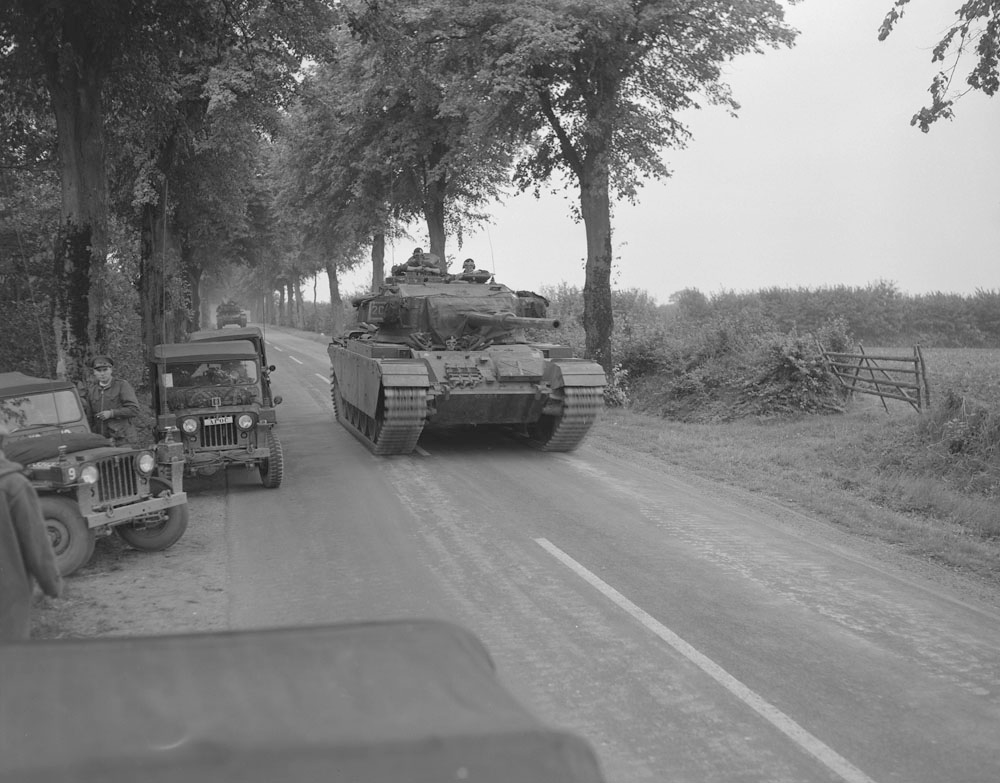
More pics
Specs:
Mass 50 long tons (51 t)
Length
Hull only 24 ft 9.5 in (7.557 m)
With gun forward 32 ft 3 in (9.83 m)
Width
11 ft 1 in (3.38 m) with side plates
10 ft 9 in (3.28 m) without side plates
Height 9 ft 7.75 in (2.94 m)[3]
Crew 4 (commander, gunner, loader, driver)
Armour 51–152 mm (2.0–6.0 in)
Main
armament
20 pdr (84 mm) rifled gun
Secondary armament
Co-axial .30 cal Browning machine gun (Mark 5 onwards)
Engine Rolls-Royce Meteor 4B
650 hp (480 kW) at 2550rpm
Power/weight 13 hp/t (9.2 kW/t)
Transmission 5-speed Merrit-Brown Z51R Mk. F gearbox
Suspension Modified Horstmann
Ground clearance 1 ft 8 in (0.51 m)
Fuel capacity 120 imperial gallons (546 L; 144 US gal)
Operational
range
32.5 mi (52.3 km) cross country, 62.5 mi (100.6 km) on road (Marks 3, 5, and 6)
Maximum speed 21.5 mph (34.6 km/h)
Sources
D. Dingwall, The Centurion in Canadian Service
J. K. Marteinson & M. R. McNorgan, The Royal Canadian Armoured Corps: An Illustrated History
J. K. Marteinson, We Stand on Guard: An Illustrated History of the Canadian Army
G.J. Koeller, Leopard Project Post-Project Report, April 1981
Royal Canadian Dragoons, The Springbok (Lahr, West Germany, July 1977)
Dragoon: The Centennial History of The Royal Canadian Dragoons 1883-1983
D.V. Hampson, Leopard Project - Briefing to PCB 22 November 1979
D.V. Hampson, Leopard Project - Briefing to PCB 12 January 1978
L. Lilley, Modification of the Centurion Tanks, Netherlands Army, 15 May 1968
R.T. Pretty, Jane’s Weapon Systems 1976 Seventh Year of Issue
C. Foss, Jane’s Armour & Artillery 1990-1991
RCEME Technical Bulletin Vol 01 No 1 May 56
RCEME Technical Bulletin Vol 01 No 2 Oct 56
RCEME Technical Bulletin Vol 03 No 2 Oct 58
RCEME Technical Bulletin Vol 06 No 1 Feb 61
RCEME Technical Bulletin Vol 07 No 1 Jan 62
LORE Technical Bulletin (Bulletin Technique Du GM Terre) 1978 Issue 1
LORE Technical Bulletin (Bulletin Technique Du GM Terre) 1978 Issue 2
G.G. Riddell, Retrofitting of Tanks for Canadian Mechanized Brigade Group in Europe, 27 August 1975
Extension of Life of Centurion Tanks until Dec 76, September 1973
J. Richardson, Replacement of the Centurion Tank, Cabinet Document 1228-72
Cabinet of the Government of Canada, Replacement of the Centurion Tank, Privy Council Office, 25 January 1973
Canadian Army Journal, Vol.19, No.1, 1965
Canadian Army Journal, Vol.15, No.3, 1961
Canadian Army Journal, Vol.8, No.1, 1954
Canadian Army Journal, Vol.6, No.2, 1952
https://www.reddit.com/r/CanadianForces/comments/qsgw70/the_centurion_tank_in_canadian_service/
https://thecanadianencyclopedia.ca/en/article/centurion
Canadian Armour: Centurion Main Battle Tank - SilverHawkAuthor Website Military History Materials
From Centurion to Leopard 1A2 by Frank Maas - The Laurier Centre for the Study of Canada
www.canadiansoldiers.com
Centurion Family - Danish Army Vehicles Homepage