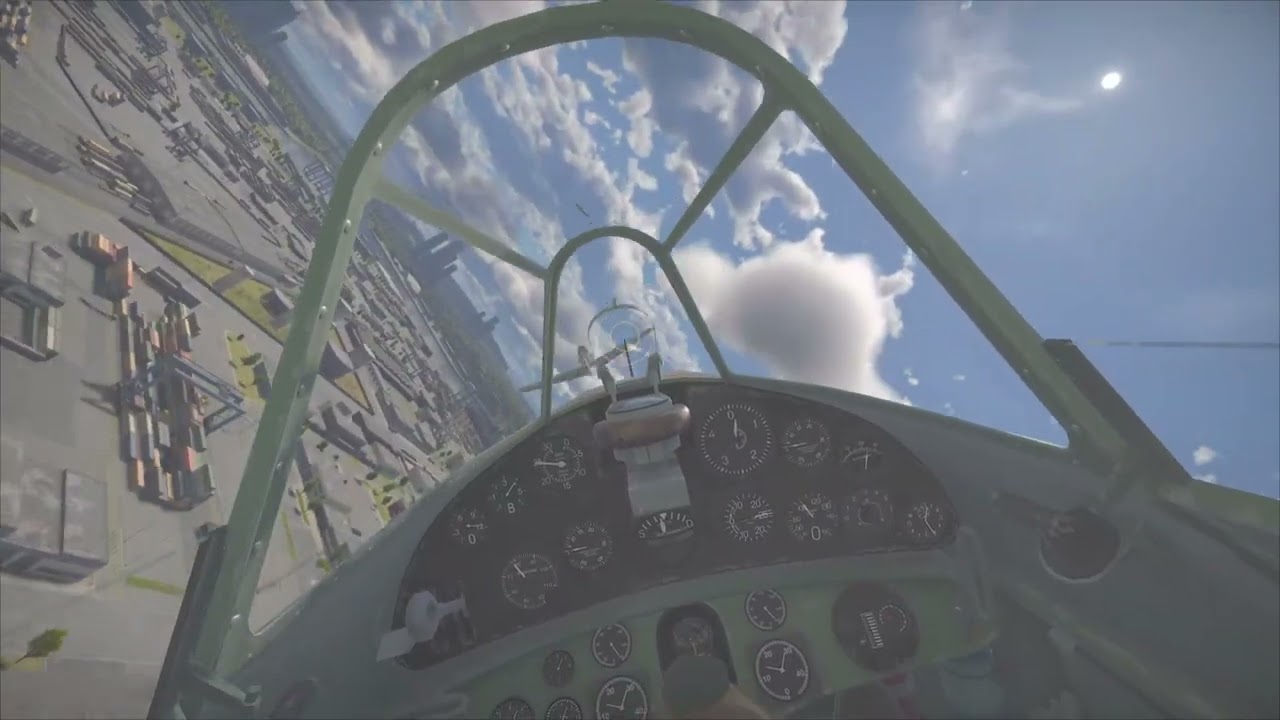
Cannons doing too much damge

Needed is a strong word.

The 30mm was specifically developed because a bomber could take quite a lot of 20mm hits, as only fuel tanks were vulnerable enough to reliably bring it down, while other hits were at most inconvenient.

The 20mm never was specifically an anti-bomber armament.

This is particularly apparent with the development of 20mm Mineshells, which were described as not destructive enough to bring down a large bomber structurally, but would make it more likely to destroy a fighter, simply from structural damage, making the entire plane a target and not just specific components.

In that sense the 20mm always an effective anti fighter armament that also worked well enough against bombers but 30-37mm cannons were really the anti-bomber armament.

As for the amount of 20mm cannons,
while one could bring down a plane with success, the general rule is simply more guns equals better chance.

The US development showed that you want at least 3000 RPM in 20mm cannons, better 6000.

Especially since with faster aircraft firing windows decreased.

The USSR chose 23+37mm canons to intercept bombers while the US went with high velocity 20mm cannons for air superiority fights.

Most WW2 20mm cannon armed fighters would have two, while twin engined heavy fighter and night fighters would generally have four or even more firepower. Only few would merely have a single 20mm.

A Dora with 13mm and 20mm armament was most suited to engage fighters while one with a 30mm was much better equipped to engage bombers as well.

And considering how a P-47 could easily take several 20mm hits, the 30mm also wasn’t a bad idea against certain heavy fighters.

1 Like

Well, what can you expect to achive at 500-600m with 96g shells that carry 4.13g explosive filler against, what’s basically a flying engine with an armor plate behind it?

There’s no target there that the shells can damage.

AP won’t penetrate the armor from that range so the pilot is perfectly save, the engine incredibly difficult to hit and fuel tanks are protected by armor from any Explosionen fragments unless it’s a lucky hit in the side.

Technically the fuel tank would be vulnerable to AP, if Gaijin is correct with the armor values.

Of course the damage is the result of the bad weapon damage mechanics of 2015 but realistically you can’t expect much different results.
Maybe a fuel fire or leak, when you’re lucky.

Why do you think the IL-2 earned its name as flying tank?
Or why it was recommended to load 50% AP rounds when engaging IL-2s, despite both the penetration data and Soviet test showing that the MG 151/20 only penetrates the 12mm back armor below 150m.

So the solution wasn’t to load 100% Mineshells and then blow the tail appart.

But blowing some holes that would make AP rounds impact the armor directly changes the result quite drastically.
Of course getting close or changing the angle of attack also makes a big difference.

that’s where AP /AP-I / SAP-I is supposed to come into play.

Penetrating the skin and possibly the pilot’s entire skull, fuel tanks, oil tanks or control traction.

Explosive rounds need to stop being the answer to all problems
They can be used as basic “cripplers” blowing off ailerons, rudders and elevators. Which would affect how effective defensive manouvers become and leave enemies more vulnerable
Making holes that slow planes down, make them bleed more speed, require more care (rolling over when turning).

20mil cannons would be separated in what rounds one would favour, in case of the shvak you would prefer the mix with a little extra AP-I.
The mg151/20 would want a little more explosive power, but it should never ditch the AP-I rounds.

Pure piercing or pure explosive belts should be avoided is most cannons, maybe when caliber starts moving up to 30mil and up then it could start to lean towards more explosive.

Until Korea at least, planes got a little more sturdy in those times.

The whole entire control linkage in the tail would be shredded. The horizontal stabilizer would look like swiss cheese in real life. This has affects on flight performance and controllability don’t you think?

Largely due to propaganda. The IL-2 was shot down in droves by German fighters. Even those armed with only a single 20mm cannon.

Under the 2015 damage model arrangement the only consistently usable weapons were M2 .50 cals and MG 151. So basically everyone else was hoping for good damage RNG to actually be able to do something.

Back then you could basically ignore Russian planes because the damage was inconsistent / non-existent. It was at a point where default belts were considered the most viable.

It’s actually really funny to go back and watch old footage and see what a damage sponge everything was if you happened to have a plane with bad guns. It’s silly that you would want damage to come down to random dice roll but only for some planes.

This is how we ended up with the Yak-3U at 5.3BR.

For a single aircraft, in a single pass, with acceptable success rates.

Which is what I said.

Which I also said, because most real pilots had abysmal hitrates.

This was well after WW2.

How does this disprove what I said?

You mean the rudder, elevator, and stabilizers? The control linkages behind them? Which are all being hit several times while under the stress of high-speed flight? The pilot, engine, and fuel may be safe but the other half of the stuff keeping it in the air aren’t.

Most shot-down plane in history by the way

I think that more of a result of soviet doctrine + Role + one of the most produced aircraft of all time.

That miles better than the current “0.15 sec burst and both wings are amputated / tail falls off.”

1 Like

That doesn’t change the “flying tank” being shot down in droves, and very often by 109s with a single cannon.

The tail control being completely lost has the same result as losing your tail - you explode. But one rewards the attacker immediately instead of 5min later when you hit the ground, and prevents kill stealing.

Thats like your opinion mate.

If you could just pump the tail full of HE, there would be no point of AP.

And ShVAKS historically fired a 1:1 mix of HEFI-T and API.

Despite penetration tests showing that their 20mm API had even worse penetration than 12.7mm API when it first impacted the fuselage.

But the reality is that control cables don’t simply get cut from small HE fragments, unless the shell exploded right next one.

Sure but it wouldn’t change that the plane would simply get away, which you so dread when you fire at an aircraft and it can fly back and repair.

Tip: Don’t expect shells with 4.13g explosive fillers to do wonders.

The Soviet 20mm HEFI-T is by the very similar to the German equivalent.
A Hispano already holds more than twice the filler and it’s more than four times with the 20mm Mineshell.

And while such shells work perfectly fine with sending fragments around and setting fuel on fire, the structural damage is going to be minor in comparison.

A 20mm Mineshell blows a hole 10 times the size in a wing than a ShVAK shell.

So you also need nearly 10 times the amount of hits to cause the same structural damage.

What propaganda? Just because the plane can take a lot of hits doesn’t mean it’s not going to get shot down.

And do you know how they ended up getting shot down?

Do I need to remind you that an IL-2 is a ground attack plane and they would come under fire from 20mm and 37mm AA guns?

Or that they needed to add a defensive gunner, because they ended up getting shot down in such large numbers?

It’s also not only Bf 109s flying around, you know.

And there also was the option for the 15mm gun, which actually had higher armor penetration and sufficient firepower to blow wooden fighters to pieces. Ideal weapon for the eastern front.

Some planes?

I didn’t choose what guns are put onto a plane.

Am I responsible that Hispano AP or SAPI can penetrate a Bf 109s or Fw 190s pilots armor plate from 600m, while a ShVAKs can barely do it at 100m?

The B-20 is just a 12.7mm Berezin with 20mm barrel, a lighter ShVAK.
But it didn’t see the light of day until 1944 when it was already going to be replaced by the much harder hitting NS-23.

The T-34 wasn’t an ideal tank but after the war broke out they had to stick with it till the end.

That’s just how it was.

When the game starts to favor high altitude planes, am I at fault that 99% of Soviet planes are tuned for low altitude fights?

It’s just how it is.

And don’t pretend like, that just because a plane can survive getting shot under one particular circumstance, the guns aren’t capable of scoring kills in others. Because that’s how it is.

You can either not maneuver and have your tail controls turned into Swiss cheese or you can try to evade and risk a deflection shot hitting pilot, engine and other vulnerable parts of the aircraft.
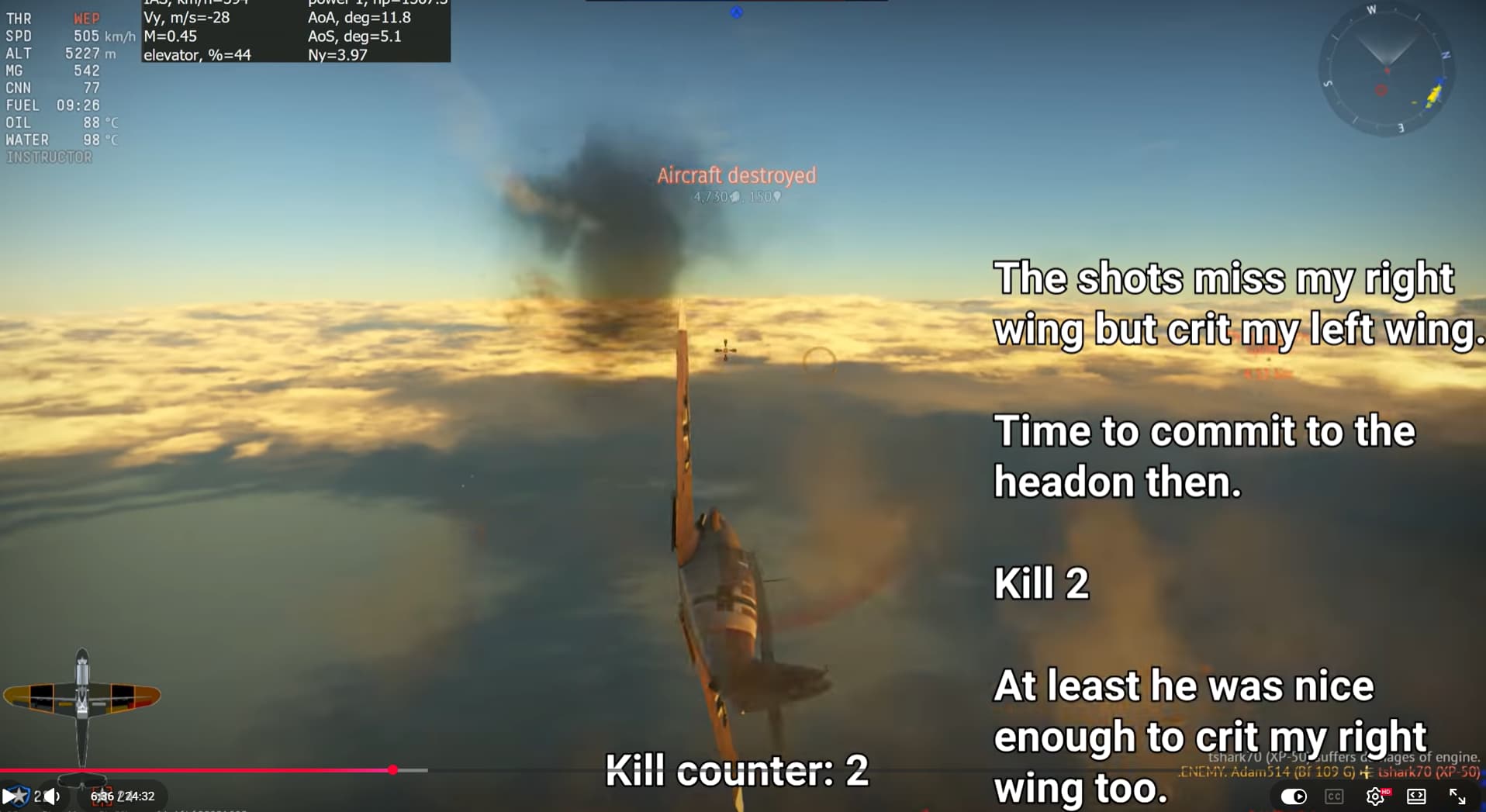
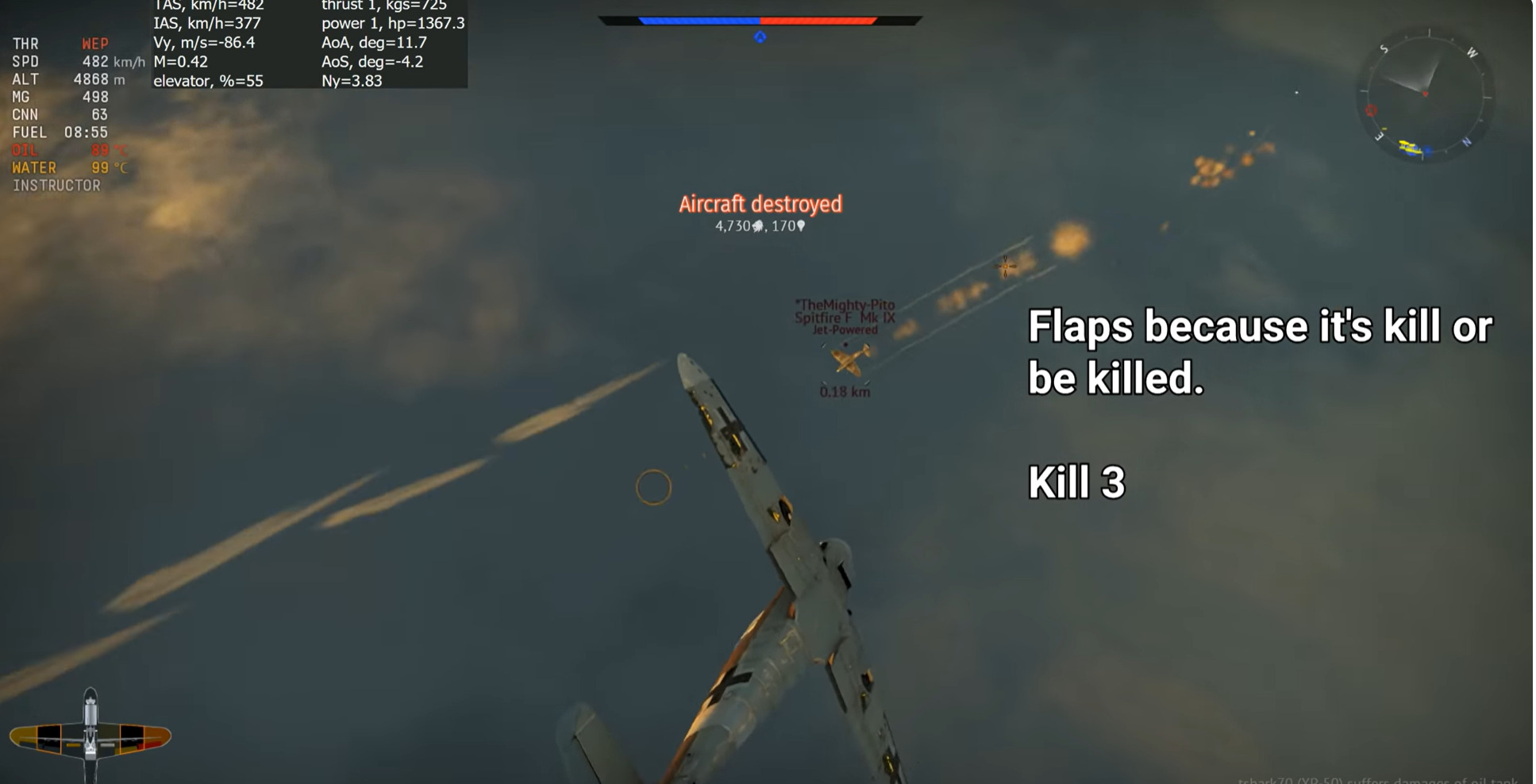
Also most produced plane of WW2 and the same story with the T-34.

Which doesn’t prove anything other that they were expendable to reach their goal.

Why didn’t the US suffer that many casualties?

Oh right, maybe because the Germans were busy fighting on another front.

Also mentioned by FeetPics.

Would really like to hear the source that confirms this.

But sure, why not. Did I say they were invulnerable?

They just could take a lot more damage than any other plane. But they are still ground attack planes that can’t defend themself against fighters with a higher energy state.

Of course both of you will only say they shot down a lot but not how it was achieved.

If a Bf 109 went through it’s 200 rounds of 20mm or 15mm ammo to down an IL-2 it’s your proof they shot down IL-2s but when it’s put in the game it’s suddenly unacceptable that you had to spent all your ammo on a single plane.

A reminder that the usual ammon load for a MG 151/20 was 80 HEFI-T, 80 Mineshells and 40 AP shells.
Under ideal circumstances it would be 100 Mineshells and 100 AP rounds to go after Il-2s specifically.

So on average its going to be 5 Mineshell and 5 AP hits on an IL-2, with our good friend 5% hit rate.

Workable when you don’t have a defensive gunner to worry about and can get real close but with a gunner shooting back, a single 20mm is kinda lacking.

There’s a clear difference between:

  • Tail gets hit two times by 20mm and falls off
  • Hits near control cables disable tail controls

The likeliness of tail hits also destroying tail controls is much lower than just hitting the tail.

Right now a 23mm hit will 100% rip the tail off a plane, one or two on a large bomber.

This again begs the question why Germany wanted 37mm Mineshells for their 37mm AA gun when a regular 37mm shell already makes tails and wings fall off in a single hit?

Or why an IL-2 has an armored fuselage but somehow control cables aren’t protected by armor.

I imagine it has something to with cost vs. benefit.
Putting armor on pilot, engine, fuel and radiator seems to be much more important.

With the number of hits the whole entire tail surface would look like swiss cheese. Under old damage modeling and under current damage model it is perfectly viable to fly around in a plane that is shot to pieces with only minor reductions in top speed.

This is a perfectly flyable plane according to the game and has next to no ill effects. Keep in mind the reason he is damaged is because he fully committed to a head on with XP-50 and won damage RNG game.

Plane is shot to pieces and can still pull 4G deflection shot at high altitude with no issues. Multiple holes in the wing that you could fit your head through by the way. But single shot to Spitfire rips the tail off. These are the good ole days you harken back to by the way.

The fact that they had to add a defensive gunner and that the plane had the overall lowest sorties per loss ratio of the entire war kind of indicates that it might not have been as rugged as claimed. Also there is no indication that German gun-pods were developed to counter the IL-2.

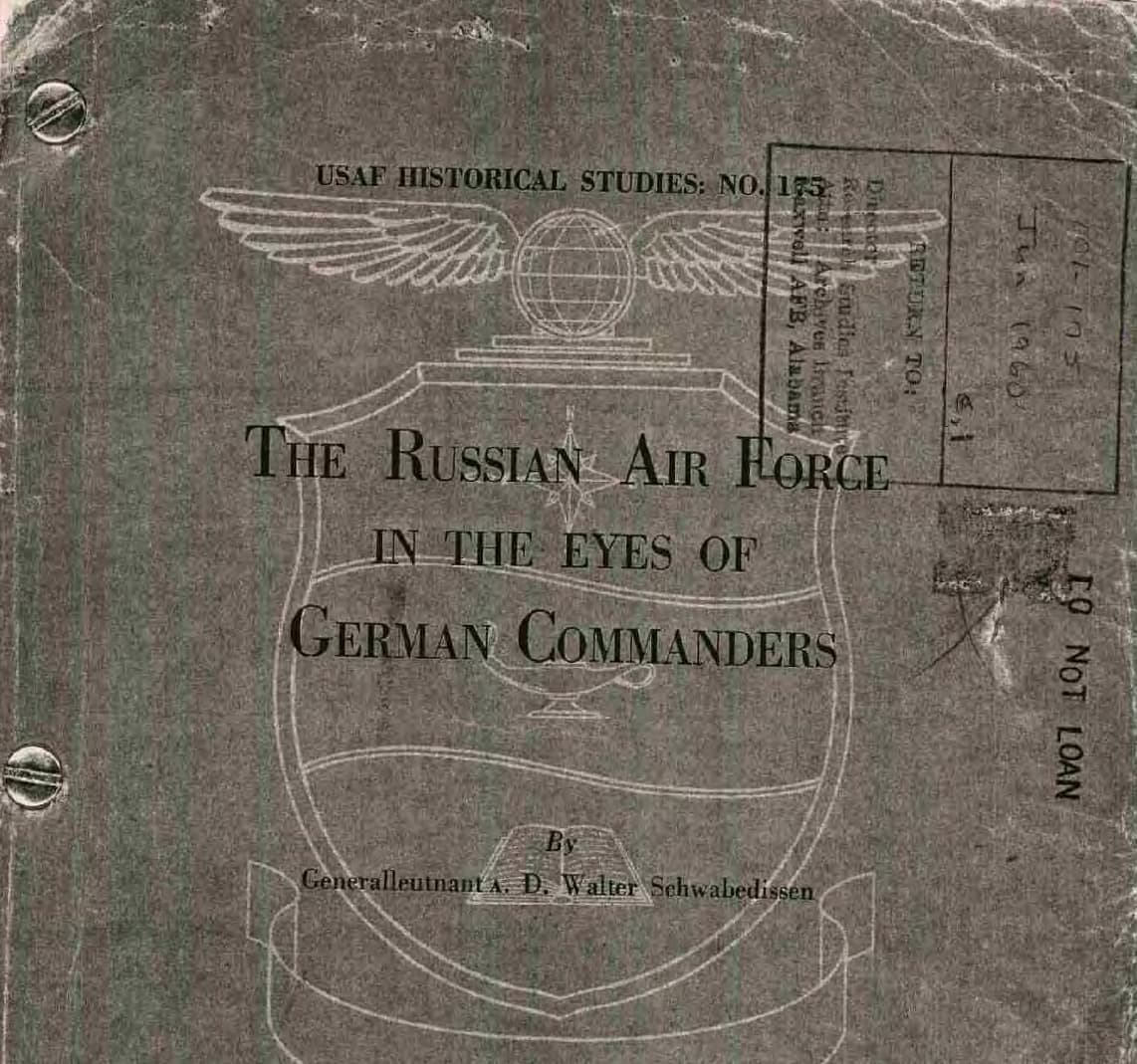
Overall the Luftwaffe had a very low opinion of the VVS throughout the war. This can be easily seen in post-war testimony from Luftwaffe officers in USAF Study No.175. Now how much of this opinion was just due to still-held notions of racial superiority and not based on objective fact is subject to debate. However there is very little in the way of actual scholarly work in regards to the VVS and World War II. In fact that scholarship is so lacking that only vague facts come up in other scholarly works.

I think that the game should have more depth to it rather than the best defensive option being to just fly straight at the runway and know that damage-rng will likely favor me to get back to the base safely and then allow the death-bubble AA to deal with my opponents for me.

I have actually played the game before it was even War Thunder. Back when Birds of Steel was a thing the only viable weapons were MG.151s or Hispanos. Was it fun to ruin everyone’s day with a Bf.109G-6 with gun pods? Sure. Was it actually skilled gameplay when I could effectively ignore whatever the enemy player was doing because they would probably not succeed in killing me? No.

So this is is a straight up lie.

1 Like

Who is talking about gun pods? Bf 109 and Bf 110 manuals explicitly mention that the 20mm gun can be converted to 15mm.

Nah, it’s just hitting the fuselage or tail controls doesn’t saw off the tail.

Same as hitting flaps will make planes tank shots that would have ripped the wing.

A Ta 152 isn’t really a good target for demonstration when the tail is so narrow.

I’ve seen it countless times, players complaining about guns not working and then the server replay showing exactly that the guns did what they were supposed to do.
Just players overestimating how many times they hit, or in your case where exactly the shot hit.

I’ve hit a P-47 in the vertical stabilizer with a Japanese 12.7mm and he started to drag black smoke behind him for 5 minutes, which gave me a false sense of damage inflicted.

Here you hit a tail control, it makes a big explosion and black smoke starts pouring out, but you just overkilled a stabilizer or control surface.

In the last shot or one of the lasts you can see the round hitting the fuselage and not the tail.

Nah, I’ve posted it before, maybe not in this thread but an IL-2 could take as many hits as a B-17 and certainly more than single engined fighters.
Maybe not from a 30mm Mineshells but when talking about fragmentation rounds, a B-17 is a lot more vulnerable than a plane covered in armor plates.

B-17 were also shot down but the amount of punishment a plane can take doesn’t exactly make it easier or harder to get shoot down in general.

It was certainly harder to get guns on a fighter who is maneuvering than a bomber flying straight inside a formation.

So speed, maneuverability and visibility inside the cockpit also contributed to how often a plane would get shot to begin with.

So there’s simply no correlation between a plane, who’s built in very high numbers, who’s purpose was to ground attack and that was designed to be more survival than other planes in that role to not get shot down in large numbers.

Both are just legendary cause of propaganda. The loss rates were indeed staggering, even when you take high production numbers into account.

In WT IL2 is superb, its really maneuverable for such an heavy armored brick and the 23mm breaks any plane into two with one hit.

Why propaganda?

T-34s and KVs were also destroyed, even though they were nearly invulnerable to German AT guns until they finally saw more powerful guns.

It doesn’t make sense to take the end result of a war and then contributed the result to the vehicles ability or lack of it.

If you watched some videos on YouTube about Stukas and IL-2s you would known that they had very good turning circles, because they also had very large wings for their size.

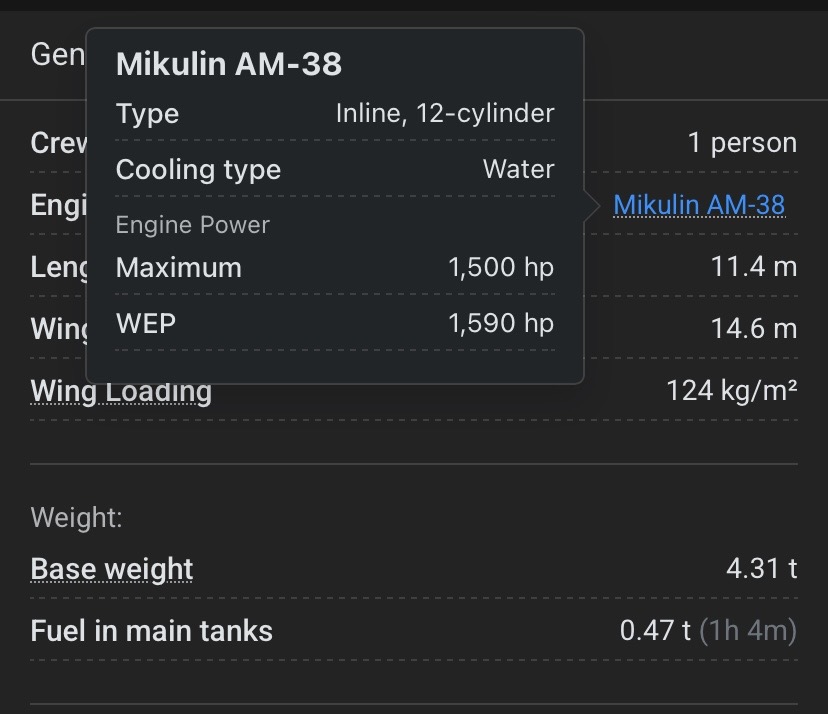
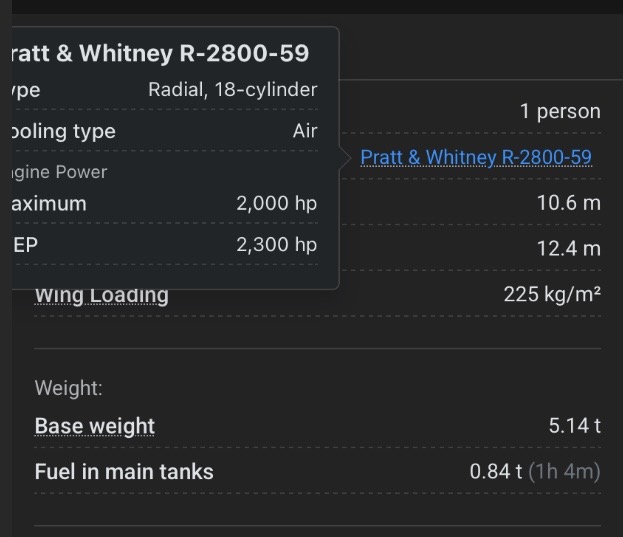
An empty IL-2 is in fact lighter than a empty P-47.
The difference is that an Il-2 only has a 1600hp engine while the P-47 has 2300hp.
And the P-47 has almost twice the wing loading.

So an IL-2 is naturally better at turning for the same energy than a P-47, who actually turns quite well at high speed, which an IL-2 can never sustain.

image
image

Even a Spitfire has higher wing loading than an IL-2 1942.

Yes, that is 100% better than what we have now. Today that first burst would’ve chopped that tail clean off and we both know that for a fact.

The other points I’d mention are that lag seems to be playing an effect here as not all of the bursts are registering and on top of this the aircraft is clearly damaged. The damage icon shows the rudder and elevators are damaged along with the fuselage and left wing. Also bear in mind as mentioned before the Shvak was a historically weak cannon.

Compare that to today:

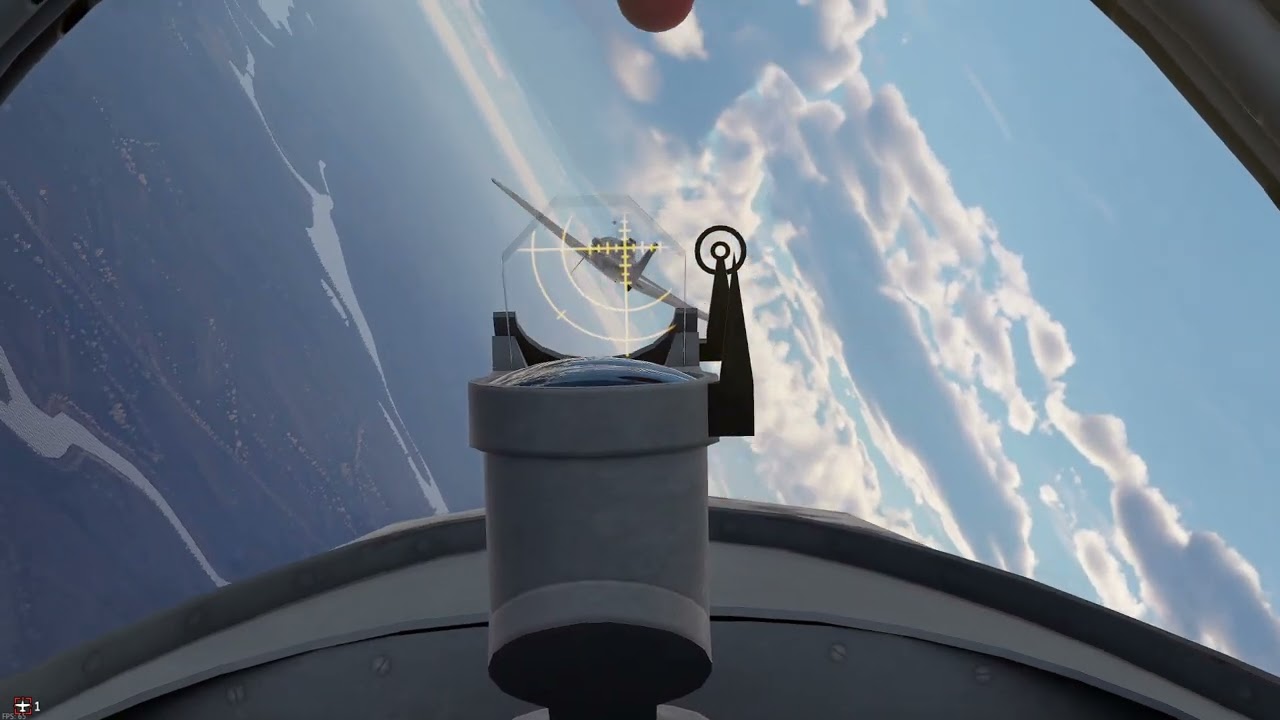
This is in Sim and I’m the first to say I don’t have the best aim, yet I can dissect aircraft, even something as “tough” as a P-47 in a tiny burst with .50’s.

I know I keep spamming this but it’s the best demonstration I can give to what’s wrong with the damage models. Skip to 10:26.

So yes, I would like the 2015 damage model back please. Heck even the 2019 damage model is vastly better than what we have now. Notice the lack of tails falling off on the video below and the wing only fails on the bomber once it had actually taken some pretty severe damage. Today this aircraft would’ve been dead on the first pass.

2 Likes

1st
You need a longer burst of HE rounds to black out a wire
Even now you need 3-4 HE hits to cut it off, the problem is that the tail falls off in 2.
2nd
You can still make it back with careful flap control if lucky, which you will not because the enemy can just follow you and spray you more, you can’t dodge after all. That you let you enemy get away is your fault, even if you run out of ammo, aim better next time.
Also im pretty sure cutting off a control wire counts as severe damage.

Generally speaking I think most people would consider the vertical stabilizer, horizontal stabilizer, the rudder, and the elevator as being the “tail” of the aircraft.

Your whole paragraph is basically saying that we missed the tail and instead hit the tail. It’s nonsensical. You can see that it happens multiple times and there is even instances where the plane takes at least 3 shots to destroy the tail.