Currently, the Washington B.1 has payloads copied directly from the US B-29A-BN. This Discussion intends to;
- Show that the Washington used British bombs in RAF service.
- Demonstrate that British payloads would be viable in-game.
- Encourage community engagement in this topic.
- Yes
- No
Current Bombs
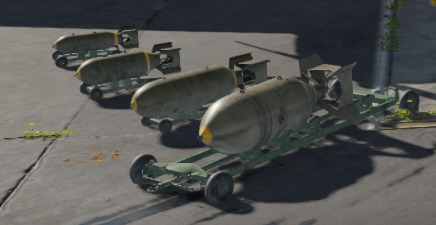
On its introduction to War Thunder, the Washington B.1 has been equipped with the same 500, 1000, 2000, and 4000 lb AN-series bombs as the B-29A-BN
The 500 lb AN-series bomb
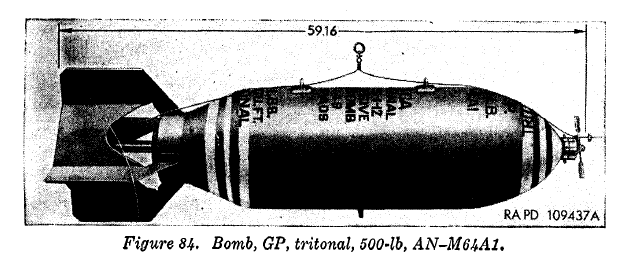
In the 500 lb class, the Washington is equipped with the US AN-M64A1 500 lb general purpose bomb, with Comp B filler. This bomb was used by the United States and the Allies during mid-WW2, and due to its Composition B (aka. RDX/TNT) filler can be placed as a pre-1944 production. Early-war bombs were filled with either TNT or Amatol 50/50, and from 1942 with Comp B, but from 1944 onwards they were predominantly filled with Tritonal.
This bomb was in British service, and was suppliedat least until the termination of the Lend-Lease program on 2 September 1945.
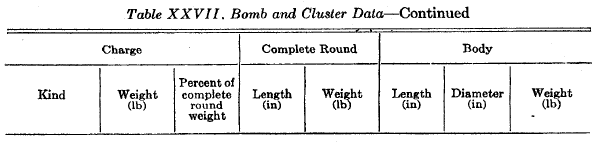
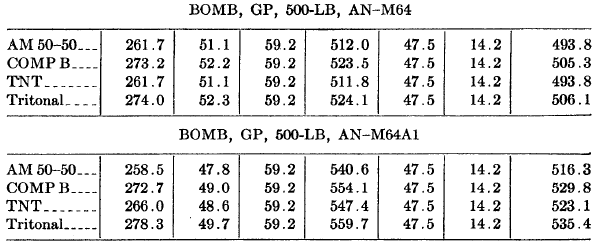
The Comp B bomb has a TNTe of 162.81 kg, while the Tritonal bomb would have a TNTe of 148.95 kg.
The 1000 lb AN-series bomb
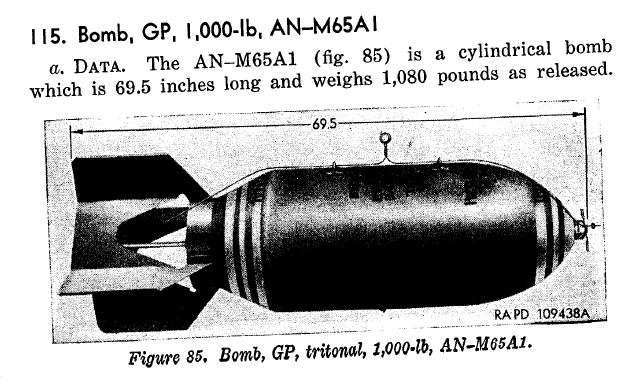
In the 1000 lb class, the Washington is equipped with the US AN-M65A1 1000 lb general purpose bomb, with Tritonal filler. This is a 1944 or later production bomb due to the Tritonal filler. This bomb was in British service, and was supplied until the termination of the Lend-Lease program on 2 September 1945.
The Tritonal bomb has a TNTe of 318.48 kg.
The 2000 lb AN-series bomb
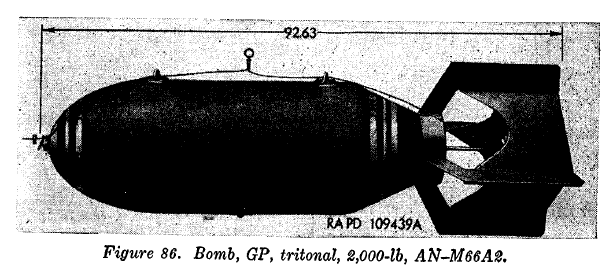
In the 2000 lb class, the Washington is equipped with the US AN-M66A2 general purpose bomb, with Tritonal filler. This bomb is not present in AP 1661B and appears not to have been in British service.
The Tritonal bomb has a TNTe of 632.01 kg.
The 4000 lb AN-series bomb
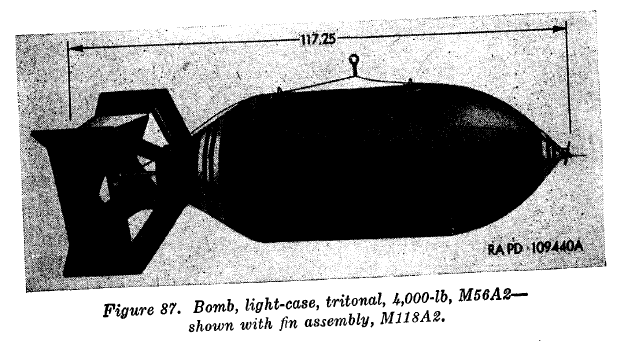
In the 4000 lb class, the Washington is equipped with the US AN-M56 4000 lb light case bomb, with Tritonal filler. This bomb is not present in AP 1661B and appears not to have been in British service.
The Tritonal bomb has a TNTe of 1887.29 kg.
British Bombs
The Washington B.1 was in RAF service from 1951 to 1954 as a bomber capability stopgap until the introduction of the Canberra.
As such, it should be equipped with bombs that match the following standards;
- British service bombs available in the period 1951-1954.
- Bombs compatible with the American dual-lug system.
- Bombs which directly replace or complement the current bomb selection, and fit the aircraft’s role as a heavy bomber.
Firstly it should be noted that the British GP-series bombs, which only feature British single-lug suspension, are not compatible with the Washington’s dual-lug bomb carriers.
Secondly, by 1950 RAF nomenclature was fully transferred from Latin numerals (I, II, III, IV) to Arabic numerals (1, 2, 3, 4), including bombs, so Arabic numerals will be used.
The 500 lb MC bomb
By April 1945 there were 14 different Marks of the 500 lb MC bomb, with Marks 6-13 being equipped with American-type dual-lug suspension.
By March 1954 there were 22 different Marks of the 500 lb MC bomb, for differing purposes and with a wide variety of explosive fillers, but no further bombs had been added with dual-lug suspension.
The Simple Solution
500 lb MC Mk 7
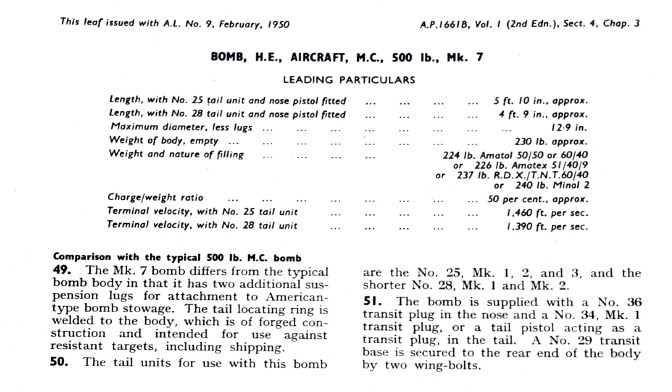
An important note at this point is that the 500 lb MC Mk 7 bomb matches the existing 500 lb HE MC Mk II present on some British aircraft for explosive filler, being filled with 237 lb (107.5 kg) RDX/TNT, with a TNTe of 137.6 kg. The simplest British replacement already exists, and can be easily implemented.

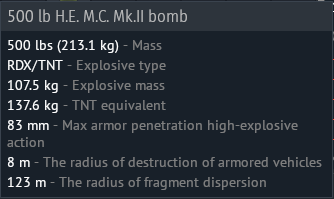
Note; this bomb is currently modelled incorrectly, as it has the visual model of a late 1960s 540 lb MC bomb. The name is also clearly incorrect, as the 500 lb MC Mk II did not feature the dual-lugs seen on the model.
It should just look like this, but with a nose fuze
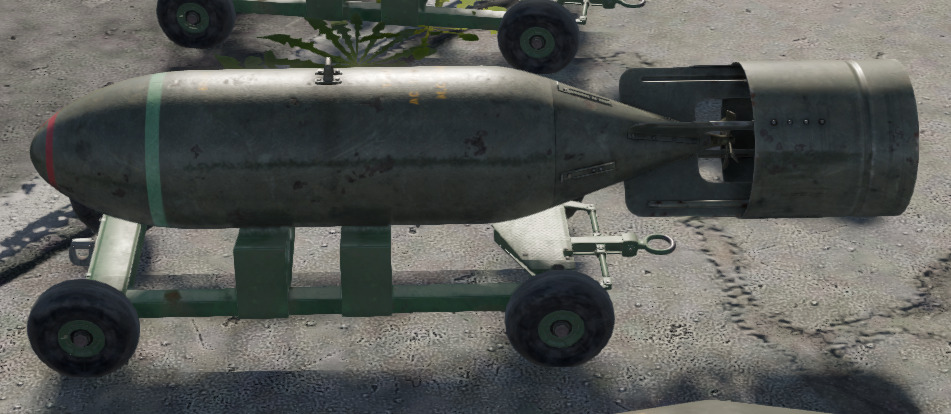
While lacking around 10 kg TNTe when compared to the the AN-64A1, a 500 lb MC Mk 6 or Mk 7 with RDX/TNT would not be significantly under-powered.
The Upgrades
Alternative bombs and filling for the 500 lb class include but are not limited to;
- The 500 lb MC Mk 6, with 240 lb (108.86) Minol 2 (TNTe approx. 141.52 kg), the bomb is 41 lb lighter than a Mk 7 with the same filling.
- 500 lb MC Mk 13, with various fillings up to 250 lb (113.39 kg) Torpex 2 (TNTe approx. 181.43 kg), this bomb is significantly more powerful than the AN-M64A1 and could provide greater bomb diversity.
The 1000 MC lb bomb
By June 1945 there were 3 Marks of the 1000 lb MC bomb, with RDX/TNT, Pentolite D1, and Torpex 2 explosive fillers, with these being the only bombs in the series to receive dual-lug suspension.
1000 lb MC Mks 1, 2, & 3
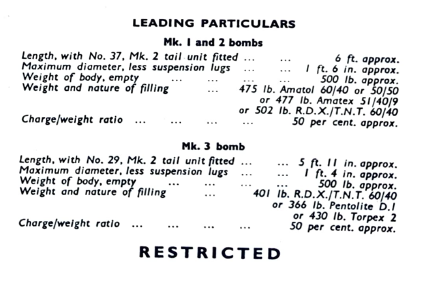
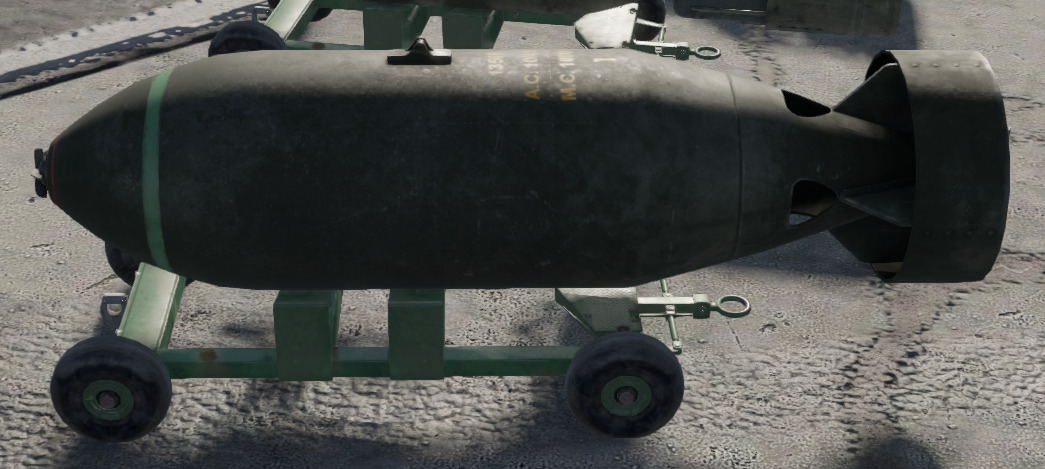
Of these, the 1000 lb MC Mk 3 with 430 lb (195.04 kg) Torpex 2 filler would be the most competitive, with a TNTe of approx. 312.07 kg, comparable to the AN-M65A1’s 318.48 kg TNTe.
The 2000 lb bomb
This category is unique because the British did not produce a direct equivalent to the 2000 lb AN-M66 series. The British 1900 lb GP and 2000 lb HC bombs were considerably longer and thinner than the AN-M66A2 and did not feature dual-lug suspension, meaning they cannot be mounted in the Washington’s bomb bays without significant adaptations.
This bomb is suggested to be removed without replacement.
The 4000 MC & HC lb bombs
To make up for the loss of the 2000 lb bomb, two 4000 lb bombs are suggested;
4000 lb MC Mk 2
Data
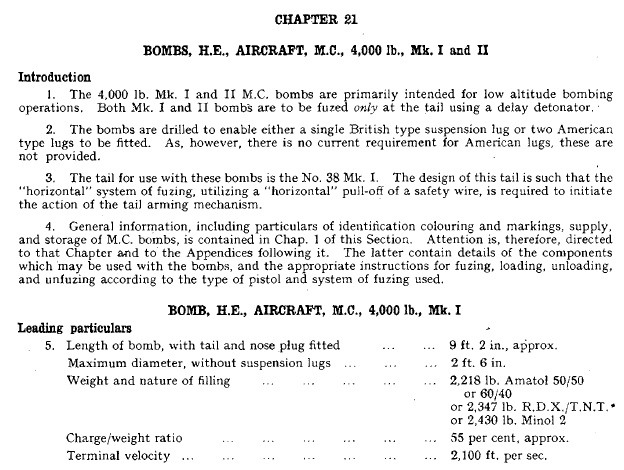
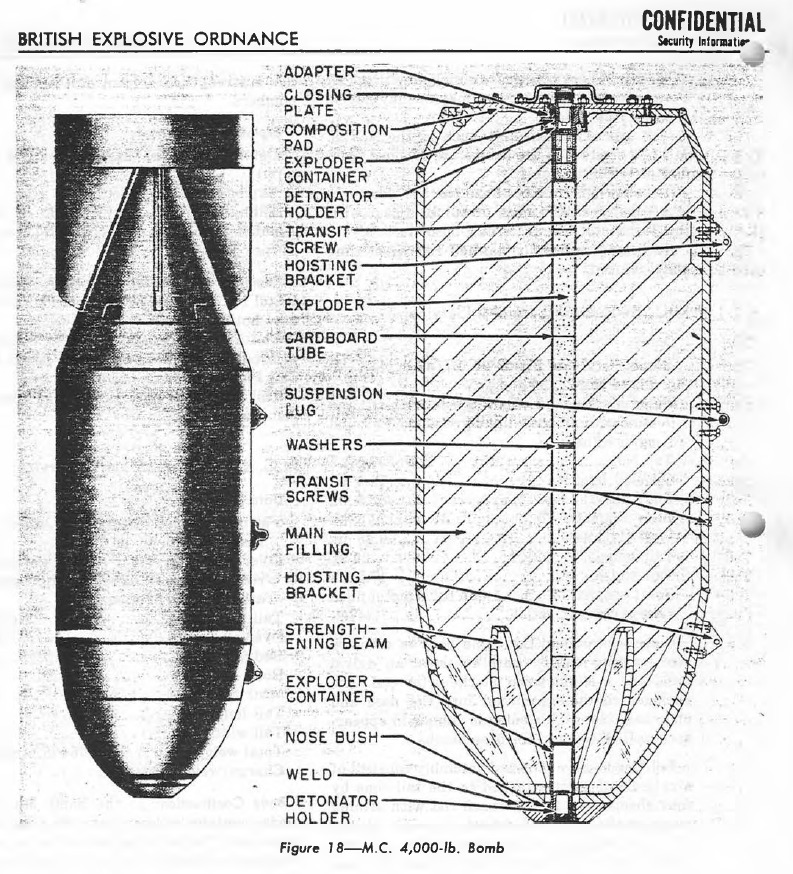
The more conventional British equivalent to the AN-M56, the 4000 lb MC Mk 2 entered service in 1944, but by 1960 appear to have been superseded in operational use by later marks of the versatile 1000 lb MC series. These bombs could be filled with Amatol or Amatex, but were predominantly filled with 2430 lb (1102.23 kg) Minol 2 for a maximum TNTe of 1432.89 kg.
4000 lb HC Mk 5
Data
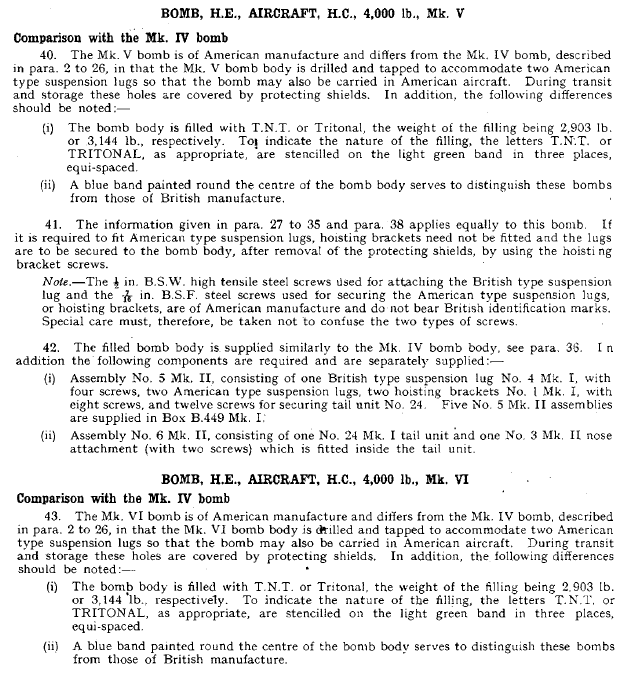
Visually similar to the existing 4000 lb HC bombs, over 38,000 Mk 5 and Mk 6 bombs were produced for Britain in the United States, and were fitted with dual-lug suspension. While the British chose RDX/TNT or Minol 2 fillers for the 4000 lb HC Mk 4, the US-made 4000 lb HC bombs were filled with pure TNT or Tritonal, and it is the Tritonal bomb which will be suggested.
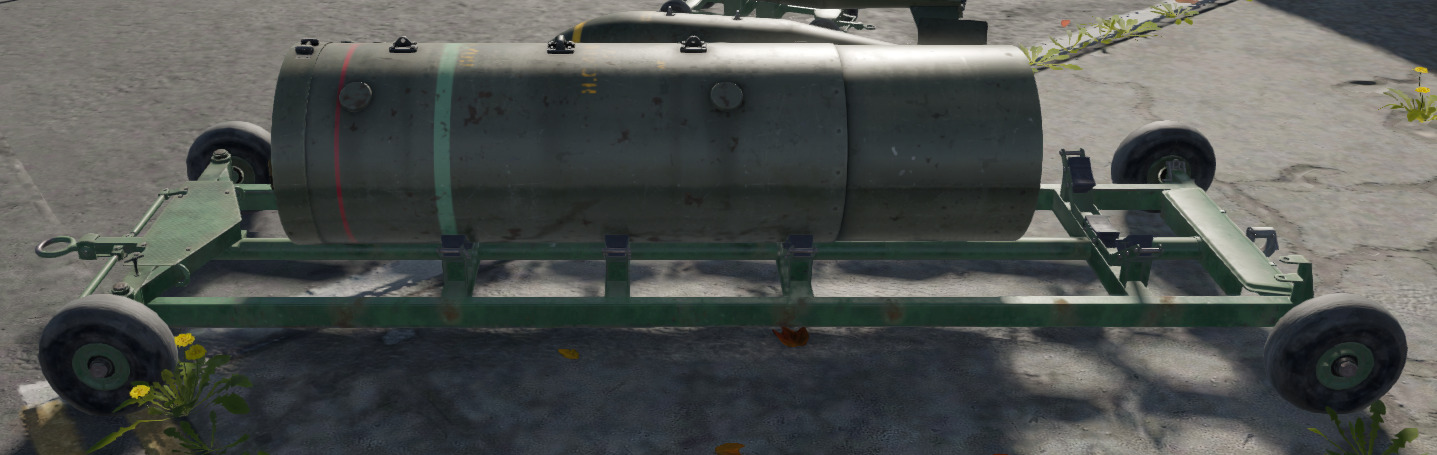
On the 4000 lb HC Mk V, the US lugs replace the existing hoist lugs either side of the central lug. With Washington’s two 12-ft bomb bays, the complete bomb is just over 9.3 ft long and four can be installed in the same staggered pattern as the current AN-M56 bombs.
The 4000 lb HC Mk 5 can be filled with 3144 lb (1426.09 kg) of Tritonal, with a TNTe of 1682.79 kg, some 200 kg less than the AN-M56.
Summary
Full bomb load compared and arranged by TNTe;
500 lb bombs TNTe
- 40 x 500 lb MC Mk 13 (Torpex 2) = 7257.2 kg
- 40 x 500 lb AN-M64A1 (Comp B) = 6512.4 kg
- 40 x 500 lb MC Mk 7 (Minol 2) = 5660.8 kg
- 40 x 500 lb MC Mk 7 (RDX/TNT) = 5504 kg
- 20 x 500 lb MC Mk 13 (Torpex 2) = 3628.6 kg
- 20 x 500 lb AN-M64A1 (Comp B) = 3256.2 kg
- 20 x 500 lb MC Mk 7 (Minol 2) = 2830.4 kg
- 20 x 500 lb MC Mk 7 (RDX/TNT) = 2752 kg
1000 lb bombs TNTe
- 18 x 1000 lb AN-M65A1 (Tritonal) = 5732.64 kg
- 18 x 1000 lb MC Mk 3 (Torpex 2) = 5617.26 kg
- 18 x 1000 lb MC Mk 1 (RDX/TNT) = 5246.28 kg
2000 & 4000 lb bombs TNTe
- 4 x 4000 lb AN-M56 (Tritonal) = 7549.16 kg
- 4 x 4000 lb HC Mk 5 (Tritonal) = 6731.16 kg
- 4 x 4000 lb MC Mk 2 (Minol 2) = 5731.56 kg
- 8 x 2000 lb AN-M66A2 (Tritonal) = 5056.08 kg
From this comparison we can see that yes, the US bombs are noticeably better in the 4000 lb class, but that lesser TNTe bomb loads are also present and that the British do have a notable advantage in the 500 lb class. It is particularly notable that the US 2000 lb AN-66A2 payload has the lowest TNTe of any full bomb load, being greater only than the 500 lb half-loads.
It should be noted that these calculations are made using current in-game TNTe multipliers, which may change in future due to outstanding bug reports.
I think this demonstrates that in game terms, while there are differences (and the US 4000 lb bombs do have a lot of brute force) the available bombs are overall largely the same, with each nation having their strengths. All in all, when the primary source documentation (RAF Squadron Operations Record Books, in the bug report [DEV] Washington B.1 bombs incorrect) shows that British bombs were used on these aircraft I’d prefer to see them portrayed if not as accurately as possible, but as accurately as is reasonable.
Extracts from the Operations Record Books of 35 & 90 Sqns RAF
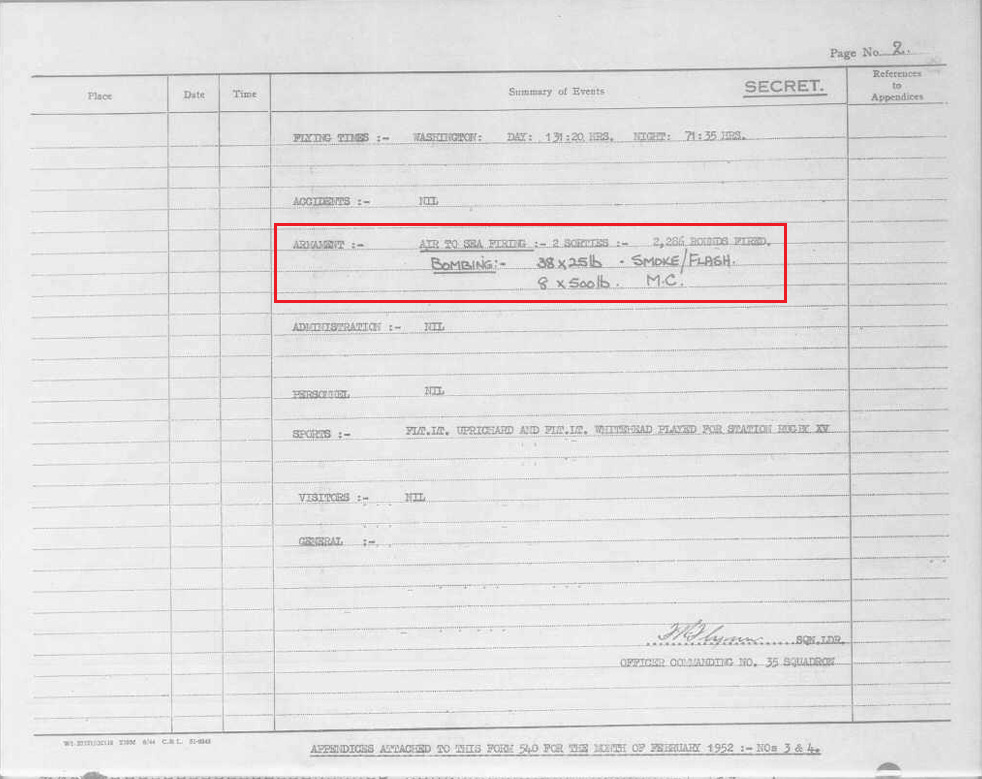
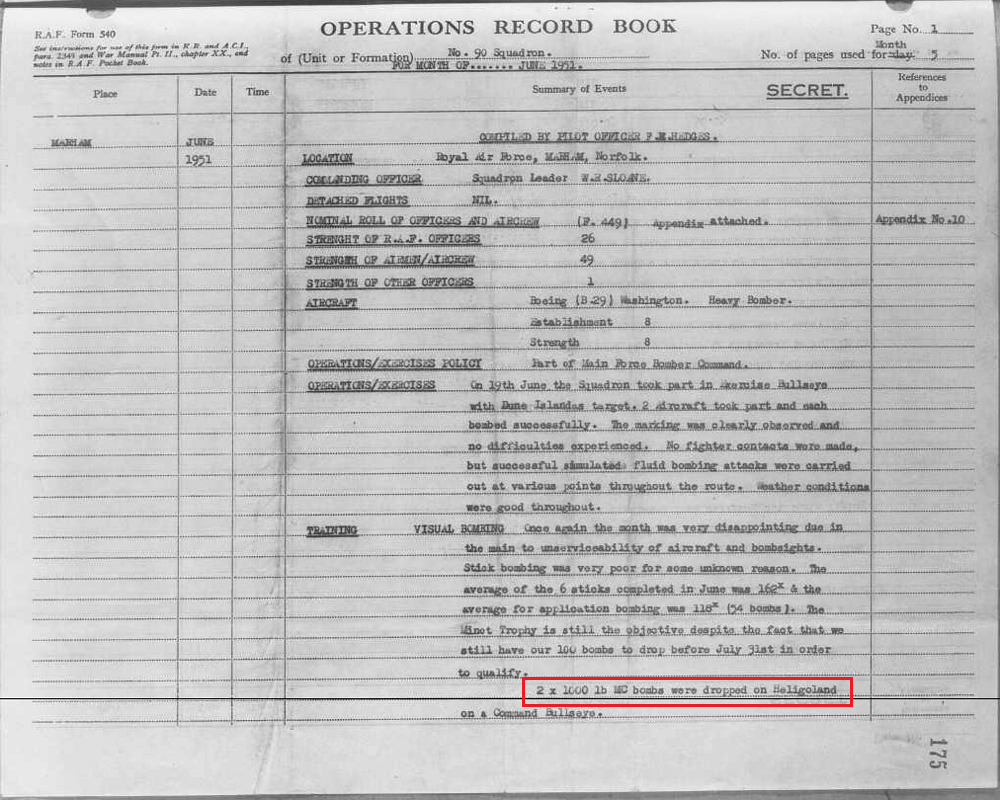
I’d encourage anyone with greater experience than me in playing bombers to provide their thoughts. Is it all about TNTe?
See also;
- RDX Explosive - TNT Equivalence too low
- Torpex Explosive - TNT Equivalence too low
- Composition B and RDX/TNT 60/40 inconsistency
Sources;
- TM 9-1980 BOMBS FOR AIRCRAFT, December 1950
- TM 9-1985-1 BRITISH EXPLOSIVE ORDNANCE, July 1952
- Air Publication 1661B VOLUME 1 (1st Edition), BOMBS, Air Ministry 1943 (w/ amendments to 1948)
- Air Publication 1661B VOLUME 1 (2nd Edition) BOMBS, September 1971
- AIR EXERCISE OVER BRITAIN, British Pathé, 1951