History
The F2A Buffalo was the Navy’s first American-designed monoplane fighter with an arrestor hook and equipment intended for carrier operations. It had beaten the F4F Wildcat in the 1939 competition. The Buffalo was built in three variants for the US Navy: the F2A-1, F2A-2, and F2A-3.
The Navy received only 11 F2A-1s in total. They considered the F2A-1 an interim model to evaluate and use in service until more powerful versions became available. Thus, the XF2A-2 was created, powered by a 1,200 hp Wright R-1820-40 engine. The XF2A-2 prototype completed testing in the fall of 1939. The Navy then contracted Brewster to produce 43 F2A-2s and remanufacture eight F2A-1s to F2A-2 standard. The remanufactured F2A-2s were reissued to VS-201 aboard the escort carrier USS Long Island (CVE-1) for service in the Atlantic.
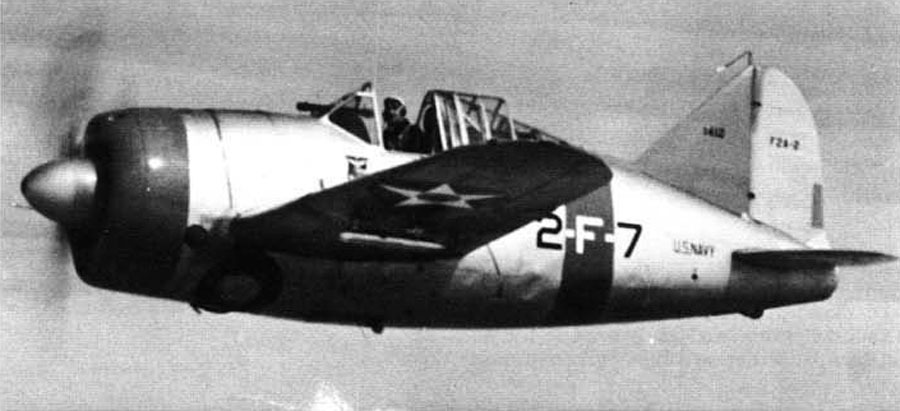
Compared to the F2A-1, the F2A-2 replaced the 950 hp Wright R-1820-34 engine with the more powerful 1,200 hp R-1820-40. The new engine added 350 pounds to the aircraft, and the fuselage was shortened by five inches ahead of the wing to maintain the center of gravity. The cowling was slightly enlarged, and a cuffed Curtiss Electric propeller replaced the Hamilton Standard propeller. A larger propeller spinner was installed. Gun ports, gas vents, air intakes, and exhaust stacks were all revised, primarily to improve engine cooling. Armament was increased from two to four M2 Browning machine guns, and provisions were added for two 100 lb bombs.
The Navy expected the first deliveries of F2A-2s in early spring 1940; however, due to political factors, Brewster prioritized production of the Belgian Model 399B (a land-based equivalent of the F2A-2) ahead of the Navy’s order. The Navy finally began receiving F2A-2s in September 1940, with the last delivered in December of that year.
VF-2 and VF-3 squadrons were reequipped with F2A-2s during early 1941. VF-3, aboard USS Saratoga (CV-3), transitioned from F2A-1s to F2A-2s, with the remaining F2A-1s converted to F2A-2 standard. VF-2, aboard USS Lexington (CV-2), transitioned from the older Grumman F2F to the faster F2A-2 monoplanes.
Interestingly, VF-2’s F2A-2s featured a unique modification: the tall fuselage-mounted radio antenna mast was replaced with a short stub mast mounted on the port wing, reducing vibration and drag. VF-2 was the only squadron to implement this modification.
Both squadrons encountered two major technical issues with the F2A-2 in service. First, the Wright Cyclone engine required frequent overhauls to prevent failures. Second, landing gear failures were common. The issue was traced to hydraulic extension struts that were too weak for repeated carrier landings. Brewster redesigned and reinforced the struts, which improved reliability, although the problem was never completely eliminated.
The F2A-2 did not see combat at the start of World War II. Navy squadrons replaced them first with F2A-3s and then with F4F-3 Wildcats. The remaining F2A-2s were transferred to Marine units such as VMF-223, which were later mixed or reequipped with F2A-3s.
The F2A-3 introduced several changes, including a redesigned nose with a ten-inch extension forward of the fuselage, removal of the propeller spinner, a revised canopy, expanded fuel capacity to 240 gallons, increased armor, and greater ammunition capacity. However, these changes significantly increased weight, resulting in noticeably worse flight performance compared to the F2A-2.
Consequently, the F2A-3’s performance was substantially inferior. Navy and Marine pilots generally preferred the F2A-2, often regarding it as the best Buffalo variant they had flown. One pilot even stated that he would have preferred the F2A-2 over the F4F Wildcat in combat, but would not have taken the overweight F2A-3 into a combat mission.
As the F2A-2 was withdrawn from frontline service without seeing combat, it was relegated to advanced training duties for the remainder of the war. No intact F2A-2s are known to have survived.