Boeing F/A-18E/F Super Hornet - Technical Data and Discussion

All of this only applies to the initial missile spam though, the whole point of the current BVR meta is that each shot will get you closer to the MAR, the F/A-18E will always be at serious disadvantage because while it’s enemies can keep spamming Fox 3s at Mach 1.6+ you will be stuck at far lower speeds and the fact is it’s airframe just doesn’t have the acceleration to keep playing defensive all the time.

Let’s be abundantly clear in the idea that a fighter being 90% defensive isn’t a good thing, yes you can get to the notch quicker than an F-15, you have very good nose authority but none of that changes the basic fact that enemies will always get to shoot their missiles at you first which matters a lot in this meta.

I don’t disagree, but I guess this does get to the point that defensive play forces you to get way too close up and personal with whoever you are trying to fight. You can make the argument that maybe both of these aircraft should stick at 14.3, but with how the vast players are currently playing the game the obvious choice is speed and acceleration rather than nose authority and clearly I feel like neither are good competitors to Rafales, Eurofighters and Gripens.

Sure mate, that’s fine, good players can make bad vehicles work all the time, but it doesn’t change the balancing issues at hand, metrics for what makes a vehicle good should be objectively based not player performance based.
2 Likes

Except out of relevant competition only Su30SM(2) has missile quantity to actually afford spamming missiles, while R-77-1 remain rather easy to notch. Rafale that gets relatively close is much bigger threat, priority even due to MICA doing MICA things.

This is home turf Rafale excels at, letting people walk up to you, keeping potential offenders at edge of radar gimbal limit, ready to enter notch at moment notice while flicking nose back to throw baguette out. Then turned to 11 with SM2 having over the shoulder radar and R77s in OUR quantity.

And for all the trash people love to throw at AMRAAMs, they are good enough in currently happening medium/high alt missile fest, where encounters within 8-10km are rather infrequent and at this distance I wouldn’t trust AMRAAMs to connect in HOBS shot. At the same time, each degree you can bring nose closer to the target reduces minimal HOBS distance for 120s.

I haven’t said I’m good player nor consider myself as one, I just shoot the red ones.

I think you took my hyperbolic statement a bit too literally, I was simply saying they will continue launching missiles at you at higher speeds and they will reach you faster than yours will reach them even if your missile is only 10-15 seconds late to the party, that is already putting you defensive, that was my point. In the vast majority of situations the F-15 seems to be a better choice overall, most people would agree, and most people would not sacrifice speed and acceleration for nose authority. Now we could argue this forever and maybe the F/A-18 somehow fits your personal playstyle, I personally think my stance is the general consensus on the current state of the SH and I’d rather not turn this thread into 30 pages of F/A-18 vs F-15 goofy ahh debate.

I think people tend to be more upset about the fact Cs were presented as an upgrade to A/Bs and turned out to be actually worse at closer ranges and pretty much the same at BVR, I don’t think a buff would change things for the SH though, it will always be an underdog unless Gaijin adds the 174 but then it would become broken.

It will be “broken” because it will be notched like any other missile, while you trade two duds for one. I highly doubt Gaijin will alter ARH seekers in order to preserve current counterplay options.

And C5 on first dev of its life cycle was indeed neat upgrade over A/B, then Gaijin happened.

do you know if the aim 174 is 2 way datalink?
I bet gaijin are finally gonna model 2 way datalink missiles differently

When F18F Australia will be available in Great Britain Tech Tree ?

Depends, the Aim 120 D can go up to 159km which be busted especially with gps built in.

1 Like

but it is still 35g so bad for drag turning

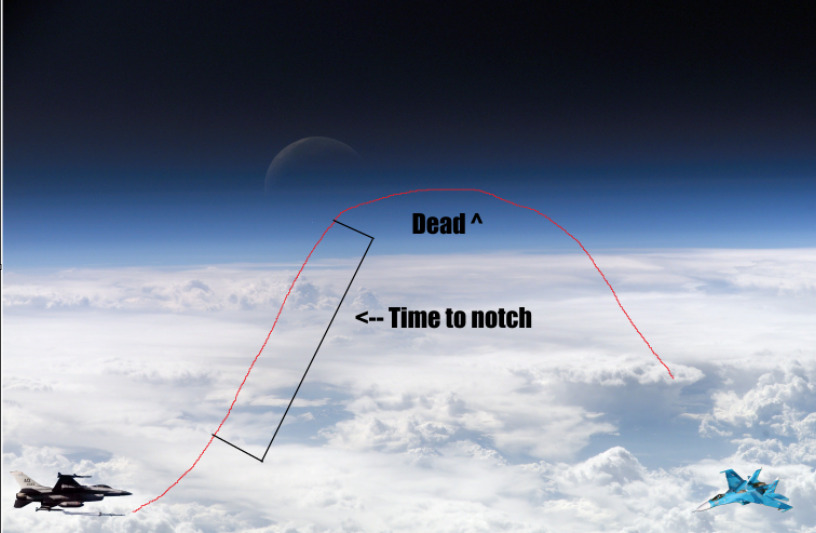
Remember most modern day missiles for BVR, climb to max altitude then go for then target. So they will have plenty of energy
image - my greatest paint 3d creation

1 Like

notch isnt dependent on energy, it is based on seeker losing lock, so this diagram is inaccurate, as it can be done much later in flight than shown

The seeker is at the max look down in the loft so your best chances are at that time, notching a missile thats looking straight down at you is extremely hard.

not really, the hard part about that is finding the right angle

also they do not dive straight down on top of you, they come down at a still steep but shallower angle

Yes, the angle isnt perfect but together with GPS and advanced radar tracking its a very hard to notch that. My graph was only to show the best time to get the notch off. If the missile is in the terminal stage and coming down at you, its a matter of seconds before you’re a fireball falling to the ground.

but its not accurate

at the very least all of this should also be time to notch
image

Main reason for that is at that attitude even if it loses track it will most likely gain lock again very easily due to that fact of how high it is compared to the enemy aircraft. Effectively the missile still would have time to re acquire lock.

You already have two way datalink, as missile reports its seeker state to the launching aircraft.

If you’ve meant reconnecting datalink, this might be both gameplay reason and technical limitation - SARH with datalink ie AIM-7P and R27ER have this feature and it does allow missile to be redirected to entirely different target, which might slightly mess up with ARH and guiding multiple of them via TWS. And gives datalink SARH distinct advantage

We already have Derby as local space climber and, uh, its not good.

I thought 2 way datalink is unique to stuff like aim 120d, pl-15, r-77m/r-37m, mica em ng, etc
and their earlier versions don’t have this 2 way datalink

2 Likes

Thats just the game not modeling good

1 Like

According to the US government (for US weapons) and MBDA (for European weapons), two-way datalink is stated to be missiles that have capability to be actively guided by other battlefield assets (such as friendly fighters, AWACs, SAMs, ships, etc.). The first two-way datalink air to air missile was AIM-9X Block 2 and then AIM-120D for the US*.

2 Likes

If that is actual definition of “two way datalink” then I stand corrected. Whether it will be modeled by Gaijin and in what capacity, remains to be seen. 9X block 2 already exists and battlefield datalink isn’t a thing, though missile itself has datalink capability.

Missile has high drag, yes. However as I’m fiddling with statshark, not the best tool but at least consistently not the best, setting loft angle from 22,5 to 27,5 (Derby value) for 120C5 usually result in speed loss compared to unmodified missile, despite climbing higher. Derby with 22,5 loft angle also arrives sooner and with significantly higher impact speed than regular Derby, for “BVR” scenarios like 11km alt, 1800kmh TAS, 50km launch distance. R-77-1 with loft angle of 24->29 also suffers in energy retention. Stupid values like 22,5-> 52,5 usually results in missile falling out of the sky during or shortly after climb.

Speed loss is smaller for low altitude launches, in some cases there was even small speed gain. So, for low air drag missiles like AMRAAMs extra loft is “it depends”, while for others you usually don’t want more loft. Another consideration, lofting extends time to impact, and here MICA in high alt, high speed within 30km shots reigns supreme, as it doesn’t bother with lofting, despite otherwise crippling air drag.

So… current values provided by the snail are actually probably decent middle ground, with Derby likely wanting to loft less. At the same time, when there’s significant altitude difference between attacker and target (4km or more?) lofting logic bricks itself and missile flies straight, resulting in drastically worse energy retention than missile launched at lower alt, but properly lofting.

To make things funnier, manual lofting by hitting ±45 degree climb of “broken loft” missiles seems to outperform intended loft trajectory.
-level flight, 9.1km alt, 1100kmh IAS (dunno about TAS as replay shat itself), about 3km altitude over target
-about 45 degree climb, 11.4km alt, 950kmh IAS for launch conditions

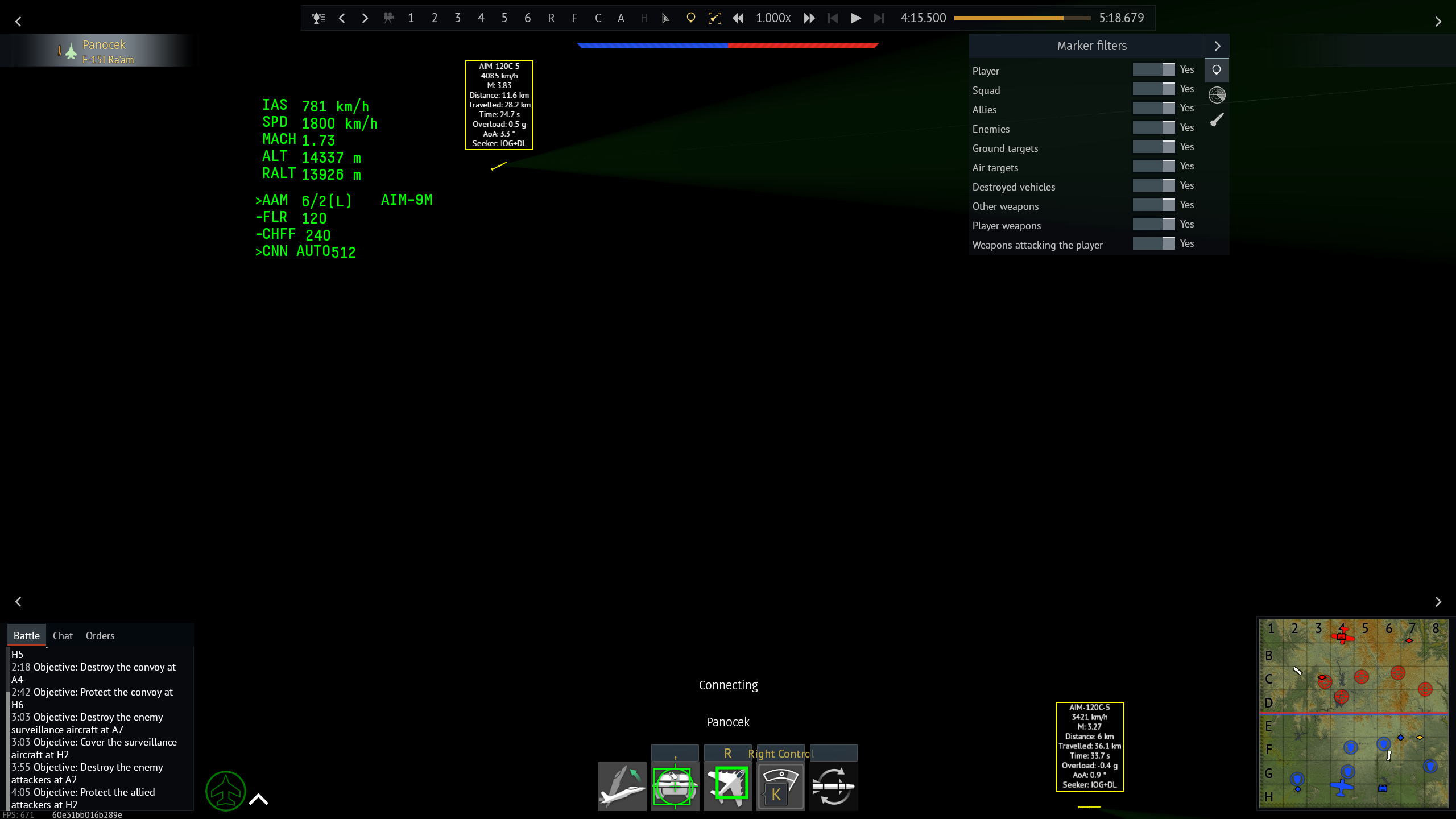
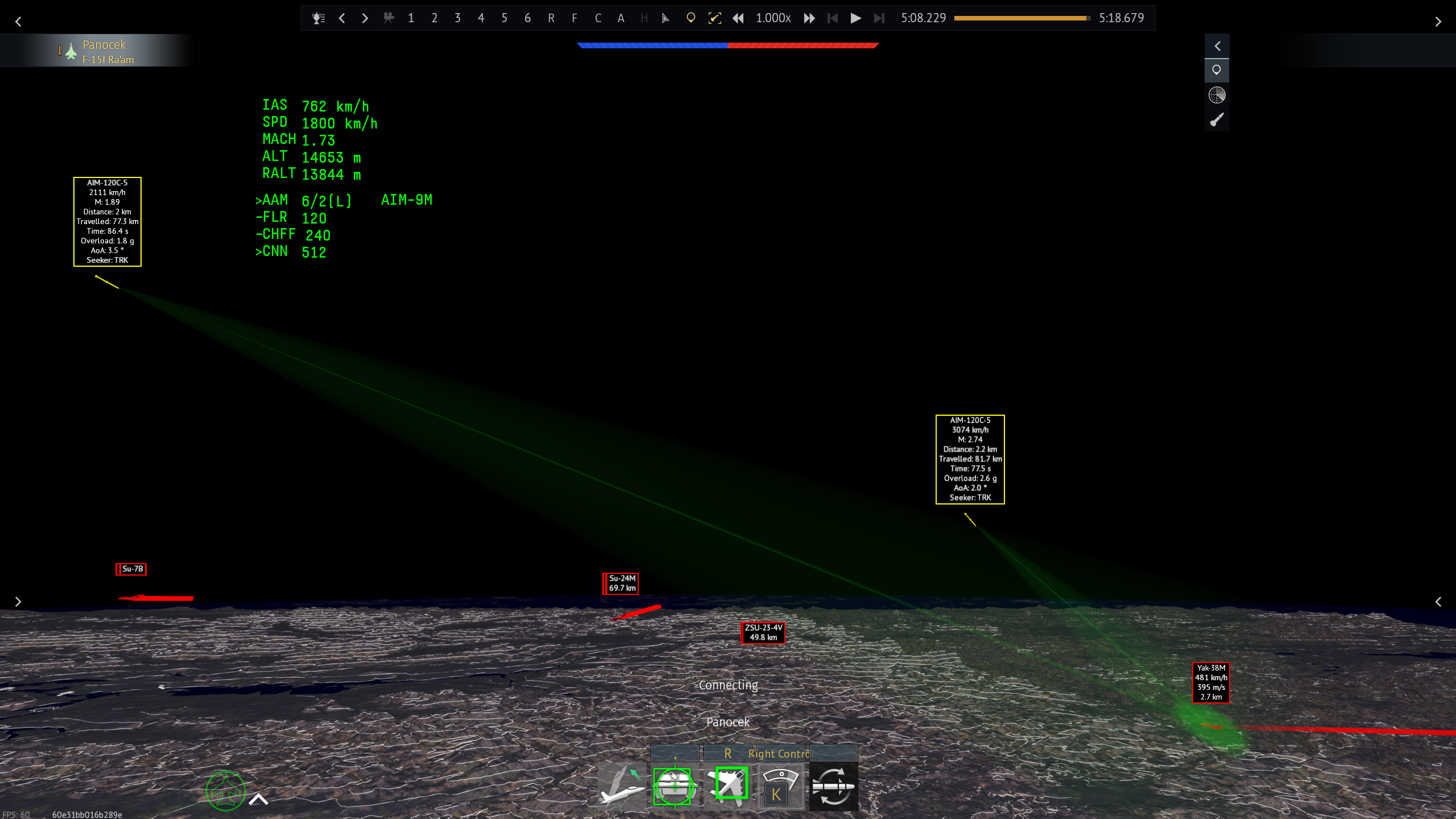
“normally lofting” missile leveled off around 15km alt, comparing to aircraft flying tad above 14km, other is still journeying into space

shortly before impact on non evading target

With this trajectory being kinda spicy, possibly entering RWR blindspots on Flankers

1 Like