I don’t understand why the devs add planes that don’t work properly because their flight model is incorrect, and on top of that, they have an engine overheating bug.
I would urge the devs to start working on fixing problems, which are already piling up in the hundreds of thousands. In this state, it’s not very pleasant to start playing and have the game’s problems make you quit after just a few matches. I wouldn’t spend money on this broken game in a million years unless they fix something. Seriously, these devs are experts at ruining the player experience.
https://community.gaijin.net/issues/p/warthunder/i/iIJoVtXHc1Zq
3 Likes
I played more props again and i can just say that german props are realy mostly worse than anything else they always get out climbet out turned out speed by even lower planes and turn fightera are also better in wt couse the Gs are put 1.5 higher than irl so planes can turn even harder without blacking out or breaking wings
I honestly feel like something’s missing to balance the planes. I don’t know if it’s the G-forces, or that the German planes handled better than in the game, or that their energy retention was better, but something seems off. Lately, I’ve been reading books about the Bf-109 and Fw-190, and they consistently portray the combat as more or less even against planes from other countries. Thanks to the Germans’ experience, they have a certain advantage, making it clear that the Spitfire and Bf-109 remain roughly equal in terms of models (the Spitfire having better turning capabilities and the Bf-109 slightly better climb rate and faster speed), and the Fw-190 being superior to the Spitfire until the arrival of the MkIX, which leveled the playing field. Then there are the Americans, with the P-47 and its endurance and dive speed, while the P-51 is very fast and more maneuverable than the… P-47. In these cases, the winner was the one who knew their aircraft best and had an energy advantage.
In the Soviet case, German aircraft consistently had superior performance, with the Yak-1B, Yak-9, and Lagg3-66 being the most effective. Only with the arrival of the La-5FN, Yak-3, and La-7 did the Soviets acquire aircraft capable of matching the Germans’ performance.
However, in the game, the British easily outperform all the Bf 4s and Fws with their LF, while the final Soviets also easily outperform the Germans. I don’t know if this is due to errors in G-forces, incorrect energy retention in the models, incorrect accelerations, etc.
As a curious fact, the Soviets, even with their Yak-3s and La-7s, did not represent much of a threat to the Western Front in the air, since the Germans trained novice pilots in combat on the Eastern Front and then transferred them to the Western Front after a while, due to the difference in the difficulty of the fighting.
An LF IX will butcher most 109’s and 190’s at lower altitudes as it should. The D-9 is missing some performance in game however. I use AEC which could be the deciding factor but for me I can’t get the Dora above 366mph on the deck, the datasheets said it should be capable of 380+mph on the deck.
In truth the only 109 that actually out performed the Spitfire was the F. The Mk 1 vs the 109E was more or less equal but from the Mk IX onwards the 109 never really caught up. You have to remember that on this game (where engine performance is concerned) the Germans actually have an advantage vs the Spitfire up until the later marks. In reality the Germans had a lot of engine restrictions that hurt the performance of the 109’s. The G-2 was somewhat disliked by its pilots because it offered very little over the F that came before it and the G-6 was also a bit of a lame duck early on for the same reasons.
In SB or without the instructor the 109’s are actually overperforming in regards to elevator effectiveness at high speeds.
If you’re flying with instructor try turning it off, I have a feeling it’s neutering your turn performance somewhat.
1 Like
No - what you feel is that gaijin added way too much things aimed to balance planes - and within this process a lot of things were chosen to weaken certain aircraft on purpose - and German 109s and 190s just show the clearest signs of being intentionally nerfed, that’s all.
If you exclude niche modes like Air SB it is obvious that all nations except the USSR see and saw various nerfs - Germany is no exception but they were hit quite hard as major benefits within RB (like instructor settings or low alt & turn performance) hits the majority of rather untrained pilots.
Imho you can’t compare irl events with wt - the whole setup of Air RB prevents together with the above mentioned nerfs that your irl know-how can be used in a debate.
This is misleading from various angles - the Spit Mk I (clapped above France) were saved by the 30% powerboost thx to 100 octane fuel provided by the US - and both fighter concepts were based on different philosophies.
3 Likes
yea mostly
but id reword the last sentence a bit since it was more that the spits caught up again with the 109s
im not 100% into all that history stuff but ive heard that at least till stuff like the 109k both planes were mostly on par with each other again
I also believe it’s because the Bf-109G6 lost performance compared to the G2 and G4, and of course, it would be inferior to the Spitfire MkIX. Later, the G14 wouldn’t be very different from the G6, while with the G10 and K4, they would regain some balance.
Regarding the Fw-190, several sources stated that the Spitfire MkIX was designed to match the Fw-190A, while the LF MkIX was intended to completely outperform the Fw at low altitudes (where the Fw performed better).
1 Like
None of it was misleading. The early twin bladed prop Mk1 wasn’t as successful against the 109E but as you’ve stated once it received hotter fuel along with a few other modifications the Mk1 was more than a match for the 109E. It was faster than the 109 depending on the altitude along with having better manoeuvrability barring negative G manoeuvres. The Spitfire even outclimbed the 109E once again depending on the altitude.
The float carburettor issue was a genuine problem but so was the somewhat dodgy slats on the Emil that caused some nasty flight characteristics (hence some wiring them shut and the redesign for the F) not to mention the automatic prop pitch system (109E-4) that if anything caused more harm than good.
Like I said earlier, the Spitfire Mk1 was an excellent match for the 109E and I’d never say the 109E was a bad aircraft as it certainly wasn’t, it was one of the best aircraft of the early war period. But the Spitfire was every bit as good if not better in certain areas and had far more potential which was recognised.
It sort of plays out this way in game but what WT really needs is early variants of aircraft. The 109E feels weak against the Spitfire at times as you’re flying against the best Mk1… there is no early Spitfire.
At the same time the Mk IX fights against boosted 1944 109G-6’s along with hot G-2’s. So it’s swings and roundabouts.
I remember alot threads in the old forum, as there was something like a German Air RB meta. I guess this produced results at the end. MG151 and the Mineshell got several changes. Overheating was nerfed and somehow also energy retention. I also remember German teams (no mixed ones, back then) always climbing very well: Dunking on Russians and US every single time. Just the “Spacefires” were actually better in this. Today nothing is left. Neither firepower, not the former headon prowess (trajectory, rof and damage of Ger guns is now bleh), the climb advantage is simply not existing anymore. Engine overheat after a minute, even with coolers opened to 100%. Once hot, they also don’t cool down anymore. Other planes run much better on 110%, some even continuous.
For veterans its like War Thunder changed 100%. There is nothing left. Russians flying hard turns without ever blacking out. G-forces don’t rip wings anymore. It simply doesn’t happen anymore. They lose no engergy. In a pass, they fly 180 degree turn on very small radius…and are as fast as before when they come out of that ufo-turn. Without G-mechanics and realistic energy retention, there is nothing which keeps these fighters in check. Also the reason why Japanese planes get bumped up BR ladder every single patch. Irl turning wouldn’t be possible as we see it ingame.
I’m no physican. But I think if jp and ru planes would be flown like ingame, the pilots would pass out permanently and the plane would crash.
3 Likes
for the fw190s yes its gone
but most 109s still outcimb nearly everything at their br
yea you need to use MEC
just go off wep for like a sec
crew lvls
war thunders most stupid and unfair game mechanic
well yea
tbh the yak3 can go to 5.0 and stay there
but stuff like the 3u defo need to go up more than +.3 in brs
Jap planes at least get BR bumped almost every patch (not that it changes something, high BR planes won’t turn much better or preserve energy). Russian ones…amost no balancing attempts. Neither in GRB nor ARB. Most of the action in ARB is low alt. Its mostly all about turnfighting. In GRB its always a small arena-like map, also just all about turn fighting. Sadly.
One question: what would be the difference between the Bf-109G6 in the game and the one in the initial versions? I know there’s one with the cockpit from the final Bf-109, but I don’t know anything else.
-
I invite you to do some own research - this has nothing to do with propeller blades (as just a few Spits had them), the 5 minute power boost (12’/later 14’‘’ extra boost) with US fuel enabled them to keep up. Both (including the Hurricane) had despite this power boost a negative K/D ratio in A2A combat vs 109s - both in the BoB and later above France (1941-43).
-
The only allied aircraft appearing being able to fight successfully (=equal or better k/d ratio than 1:1) early 109s in 1939 and 1940 in A2A combat was the Curtiss Hawk used by the French Air Force. You will find even RAF tests confirming that the Hawk was the better CQC fighter compared with Spits and Hurricanes.
-
This is (in the best case) the mainstream view pushed by historians like Overy & co - the Spitfire is like the P-51 absolutely overrated regarding their impact and battle results - British historians still to keep this myth alive - this story which is similar to the Lancaster myth.
-
The difference to LW fighters is that RAF loss per sortie rates dropped significantly after D-Day due to numerical superiority of the 2TAF and not due to the performance of the Spitfires - whilst the Nazis succumbed due to their systemic disadvantages.
-
In addition: 1939 - 1943 the Spitfires produced inferior battle results compared to German hardware - Caldwell proved this decades ago, all you have to do is to check RAF fighter losses 1941-1943 in the ETO fighting JG 26 and JG 2.
-
The Spitfires had the same issues as any other “old airframe” in ww2 - in order to increase speed they needed heavier engines and larger radiators - so the drag to cool these more powerful engines (with even higher octane fuels) consumed a lot of the power increase whilst producing speed increases lower than initially expected.
3 Likes
-
It was boring like hell - the 109 out-climbed everything and gave a significant early game dominance (=easy kills) and German teams were stacked with ultra experienced pilots as they had a kill guarantee.
-
The few Spits able to climb even better got immediately swarmed in order to neutralize them.
-
Even as experienced player your chances to score required that your teammates missed their approach (when in a 109) or that some guys started panic dives which allowed you to catch them in a (ofc) lower 190.
Correct - there were just reliable 2 ways to lose with German teams:
- Enemy ground pounders (AD-2s & 4s) killed early game a hell of pillboxes (as all Germans climbed) and one or two B-29s managed to go up to 10 km and could not be found (no contrails, no red square these days) in one hour long matches (Norway 😂). German fighters could not kill pillboxes or tanks with cannons (a few exceptions).
- A 4 men squad of P-47s space climbed direct after spawn and played coordinated above 7-8 km and waited until German fighters pitched up or ran out of fuel - af aaa was way less deadly.
The only “nostalgia” similar to that are US/UK vs JP matches on Pacific maps.
3 Likes
How was the P-51 over-rated?
If anything the modern idea that the P-47 did the heavy lifting + P-51 was just a johnny come lately is a myth.
1 Like
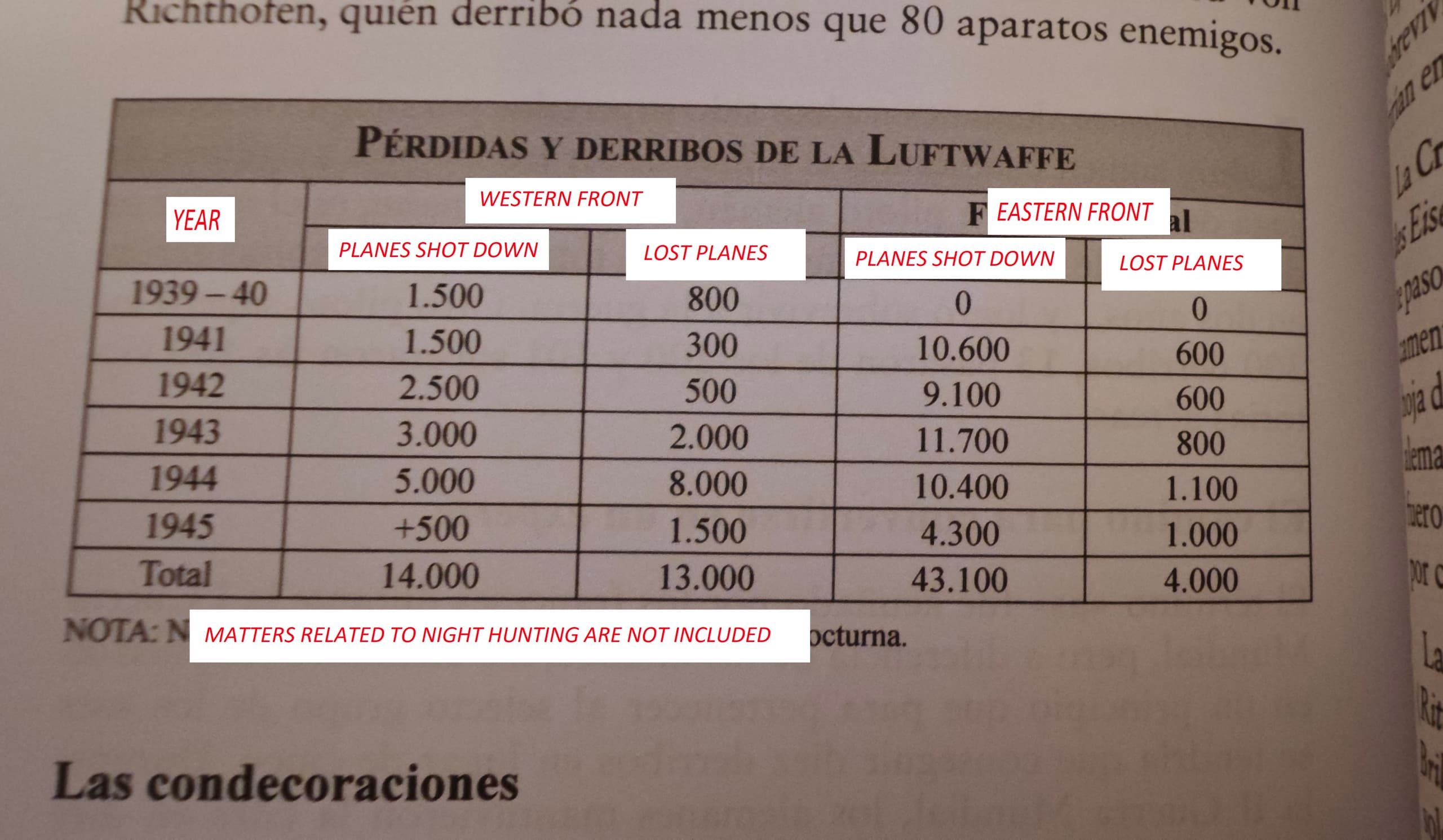
In the last book I was reading, this list of Luftwaffe losses and shootdowns appears; it shows how in the early years of the Western Front the Germans had a certain advantage in air combat.
2 Likes
Guess Yaks and La’s weren’t as good irl. And German cannon shells didn’t phase through russian planes without doing damage.
3 Likes
This is a highly complex topic - what i can tell you (based on reading way too many books) is that your overview shows a way too positive picture. Mainly about LW losses as combat related plane losses were often estimations whilst the way more decisive pilot losses are hard to quantify due to way too many variables.
An example: Your source states that the LW would have lost 13,000 (Western front) and 4,000 (Eastern front) fighters in combat. If you do a common sense “smell test” and compare these numbers with day fighters produced (>50,000) you might get the point.
As the content is imho off-topic - my answer behind a spoiler:
- Aerial kill claims on both sides were often exaggerated - even when gun cams were used - granted / approved kill claims were often counting E/A as destroyed despite their “victims” made it back to an airfield.
- There is from my pov (i never read one) not a single publication available which covers air-to-air (A2A) kill claims correctly as counting methods varied (damaged, crash landed, beyond repair or not) and involved types (day fighters included also twin engine fighters) were not easy to distinguish.
- If you try to verify combat results of specific engagements in specific areas on a specific date you see the dilemma. In a battle vs the USAAF you need to check at least 3 sources: 1) Official US kill claim summary; 2) Non-official LW kill claim lists; 3) Actual loss numbers on involved LW units based on their daily statistics. All 3 are available online. Have fun.
- If you then know that for example the US 8th AF granted the desired “ace” status (see Osprey “Down to Earth: Strafing Aces…”) for strafing parked aircraft you might agree that kills and losses are just highly subjective data - depending which data you want to use.
- From a technical pov the LW loss numbers on the Western front for 1944 + 1945 seem rather too low (8,000 + 1,500) as at this point of time (= latest mid 1944) the pure A2A kill ratio was highly dependent on individual circumstances - like local number advantage / disadvantage. That means when the Germans were able to find a gap in the escort fighter screen they had no issues to score bomber kills - but when they ran into a stronger escort fighter group in a tactical disadvantage they suffered.
4 Likes
I know the table is simple and that many nuances are missing, but it suggests that the air war on the different fronts was completely different.
1 Like
Well done - I think you win an award… or something.
Cracks Knuckles
“Both (including the Hurricane) had despite this power boost a negative K/D ratio in A2A combat vs 109s - both in the BoB and later above France (1941-43).” Objectively false. If 109s were sweeping the skies of RAF Fighters in the way you imply - then one wonders why those pesky RAF fighters kept on appearing.
“You will find even RAF tests confirming that the Hawk was the better CQC fighter compared with Spits and Hurricanes.” Objectively false. You can find a test that says that aircraft A is better than aircraft B for almost any metric … in a vacuum. Most RAF reports of the time viewed the Hawk as second-rate and inferior to even the Hurricane. It was acquired because it was available - not because it was optimal. The phrase ‘CQC’ doesn’t even APPEAR in RAF Reports of WW2 - so how can the Hawk be good using it as a metric?
" 1. This is (in the best case) the mainstream view pushed by historians like Overy & co - the Spitfire is like the P-51 absolutely overrated regarding their impact and battle results - British historians still to keep this myth alive - this story which is similar to the Lancaster myth." Ah, I think we see the basis for your takes now. Of course there is surely no glossing over or mythmaking about the 109 is there? Not at all… No, it is just those pesky mainstream historians… annoying that they, official histories and reporting of the time doesn’t align with your worldview!
" 1. The difference to LW fighters is that RAF loss per sortie rates dropped significantly after D-Day due to numerical superiority of the 2TAF and not due to the performance of the Spitfires - whilst the Nazis succumbed due to their systemic disadvantages." Objectively false Even Luftwaffe records of the time state that the quality of aircrews, the quality of aircraft they were facing and often the fact that they were losing almost as many crews and aircraft to accidents as action were all factors. I think you might find that a 109 pilot in 1944 would much rather that Spitfire he was dealing with was an earlier model…rather than the very capable and hard hitting cannon armed later-models that he likely was facing.**
" 1. In addition: 1939 - 1943 the Spitfires produced inferior battle results compared to German hardware - Caldwell proved this decades ago, all you have to do is to check RAF fighter losses 1941-1943 in the ETO fighting JG 26 and JG 2." Needs Qualification - cherry picking stats from a specific area. Losses could also include accidents that had the aircraft repaired in short order and back in the line.
" 1. The Spitfires had the same issues as any other “old airframe” in ww2 - in order to increase speed they needed heavier engines and larger radiators - so the drag to cool these more powerful engines (with even higher octane fuels) consumed a lot of the power increase whilst producing speed increases lower than initially expected." Utter codswallop. Objectively false. Oh boy. I don’t even know where to begin?
Spitfire was a younger airframe relative to 109 by several years. Arguably - from about 1944 the ‘Spitfire’ with a Griffon is almost a totally different airframe and almost given a different type and name. By the time you got the 109K - you had an airframe that was about as far gone down the road as possible. In fact in many ways it was worse (wooden sections anyone?) and Pierre Clostermann remarked that they were good in a straight line but pretty poor in every other dynamic.
The Spitfire on the other hand? Well, marks of those were being upgraded and used around the world long after WW2. A simple comparison.
The Mk1 Spitfire to the Mk24 is a MASSIVE jump in almost every metric. Many would say that the 109 gave years of development potential. The Spitfire gave almost two decades of upgrades before the jet age meant it had to stand aside.
I would suggest you broaden your reading material.
Sources for the Above - I work in the field. I take particular pleasure in mythbusting and tackling revisionists…
1 Like