- Yes
- No
Hello everyone, welcome. In this suggestion we’ll be having a look at a rather curious French tank of the 1930s: the Batignolles-Châtillon DP2

The DP2’s story begins in the early 1930s, the French defense ministry had taken an interest in amphibious vehicles after earlier designs had popped up in Britain and Czechoslovakia. The interest stuck and the decision was made to start developing an amphibious vehicle of their own. Batignolles-Châtillon was contacted to create the new vehicle and they came out with the first prototype in 1935. This first prototype still featured an mockup turret, but the rest of the vehicle was functional. As was typical for a French tank of the time, it featured a crew of 2, with a driver and a commander/loader/gunner in a one-man turret. This first iteration was powered by a respectable 228 hp Hispano Suiza type 81 engine. This was coupled with a 6 gear gearbox (5 forward, 1 reverse) to give the vehicle a very respectable mobility on land. The vehicle weighed in at 11.9 tons combat weight, which gave it a power to weight ratio of 19.2 hp/ton. This allowed the vehicle to reach a top speed of 40.5 km/h on land and 6.5 km/h in water. For water propulsion, the vehicle was also outfitted with some sort of turbine to provide steering and propulsion.
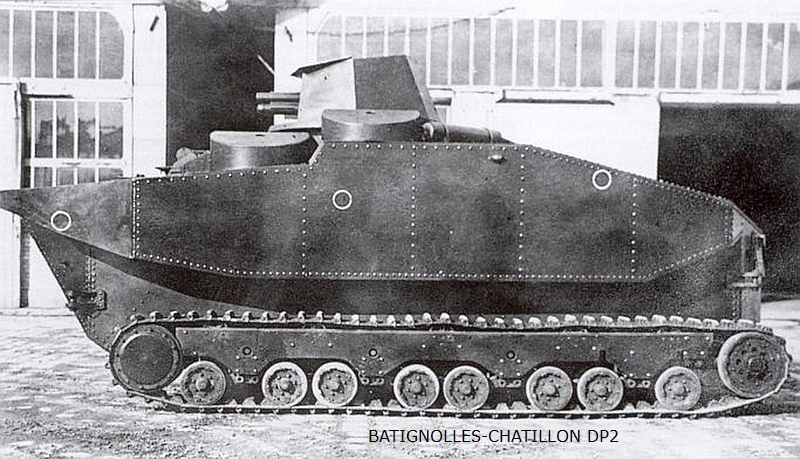
The first prototype.
With a functional prototype finished, it was time for the first set of tests, and these immediately included trials of its amphibious capabilities. The vehicle was taken down to the Seine, where it commenced the trials. At first these went well, the vehicle entered the water well, proved that it could move around without issues, however, after that, it went wrong. The final test was (obviously) leaving the water. It was here that the tank ran into its design limits. Upon making contact with the river bank, the rear of the vehicle dropped as the front rose up. Water entered the engine compartment, eventually leading to the sinking of the whole tank. This was obviously considered a failure, and thus back to the drawing board for Batignolles-Châtillon.
A bunch of modifications were made to the vehicle in response, changes to the air intakes, valves that could close, reworking of the shape itself for better floatation, and finally, a functional turret. The turret in question appears to be some early version of the APX-5 turret which would later be used on the AMD 35. This is a 2 man turret with the 25mm SA35 cannon.
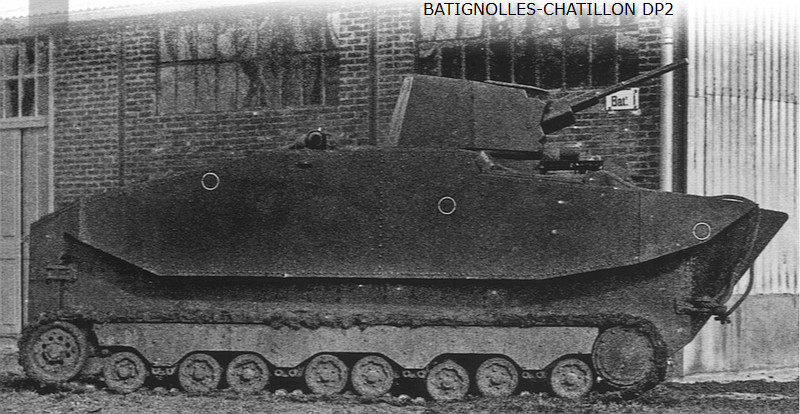
The final version of the DP2
With this new set of modifications, it was time for a new set of trials. The first part of the trials focused on mobility on land. Out of the 550km planned (500 on road, 50 on “various terrain”), only 115 were actually finished. This set of trials lead to some minor improvements as well, among which a new improved set of tracks.
After this it was once again time for the vehicle to go into the water to prove its worth.
Although these trials were certainly better than the initial ones, they were still not perfect. The vehicle didn’t sink, but it didn’t stay entirely dry either. Confidence in the design appears to have been lost after this, as the records quite quickly end there. Batignolles-Châtillon appears to have started on an entirely new design afterwards, instead of further improving the DP2, but that never got finished.
The further fate of the DP2 remains unknown.
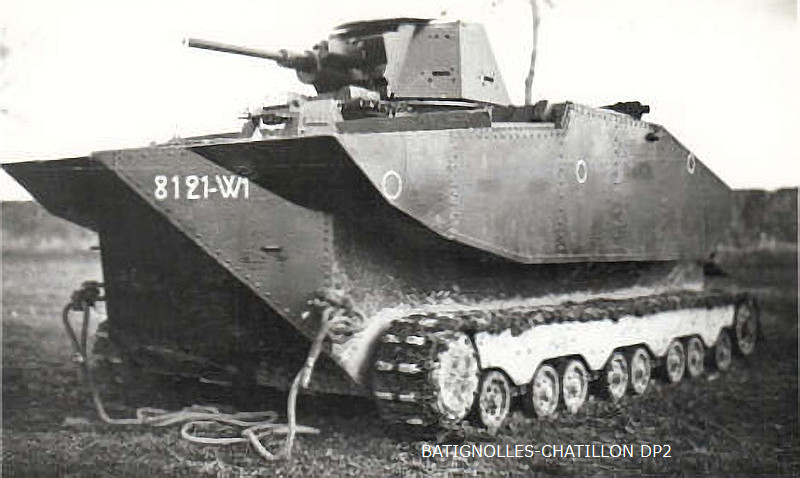
The vehicle’s basic design very much revolved around being amphibious, to such a point that it was a detriment for its performance on land. The design of the tracks for example is particularly small and flat for such a large vehicle. And a large vehicle it was. The DP2 measured in at 5.75m long, 2.5m wide and 2.60m tall. With the new turret and other improvements, the weight of the vehicle had also been increased to 12.2 tons. No further engine upgrades means that it ended with a power-to-weight ratio of 18.7 hp/ton. The final set of trials confirmed the top speed of 40.5 km/h, as well as the reverse speed of 4.5 km/h.
Armour on the vehicle was paperthin, and only really offered protection against the most basic of arms. Another consequence of the design being entirely based on being amphibious. The upper part of the tank was 15mm thick, the part behind the running gear 13mm, the roof 8 and the bottom 6.
With the turret, the tank was now armed with the 25mm SA35 cannon, which we already know in-game from the AMD 35 and AMR 35 ZT3. It also upped the crew count to 3, something that always appears to have been the plan, as documents describe the original trial crew as 2, but the combat weight always counted on a crew of 3. The turret also came with a 7.5 mm MAC machine gun as coaxial armament.
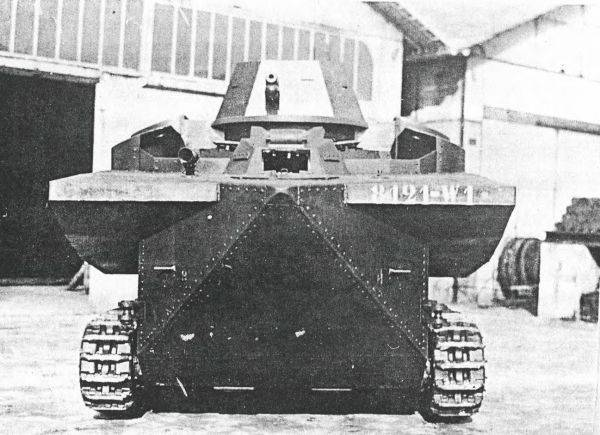
Front view of the original prototype
General Characteristics:
- Crew: 3
- Height: 2.60m
- Length: 5.75m
- Width: 2.50m
- Weight: 12.2 tons
- Engine: Hispano-Suiza type 81 engine, providing 228hp
- Power-to-weight ratio: 18.7 hp/ton
- Maximum Speed on land: 40.5 km/h forward, 4.5 km/h reverse
- Maximum speed in water: 6.5 km/h
- Armour: 6-15mm all-round
Armament:
- 1x 25mm SA35 cannon
- 1x 7.5mm MAC coaxial machine gun
Place in-game:
The DP2 a very curious and unusual French tank of its time period. It’s large, lightly armoured and relatively mobile. It also features a crew of 3, giving it somewhat better survivability than most reserve tier tanks we see in the French tree, despite having basically no armour. The DP2 also comes with respectable firepower in the form of the 25mm SA35 cannon. This is a weapon we already have in-game, and it is one of the better guns at France’s lowest br bracket.
I think the DP2 would be a very interesting addition to the French tree because it offers variety in playstyle through both its mobility and amphibious capabilities, that can otherwise not exist in this bracket of the tree.
It would potentially also offer new players a more forgiving platform to enter into the French tree with, than already existing vehicles.
I have considered an event status for the vehicle, but I feel it just offers too much that the French tree lacks at BR 1.0 - 1.3 that it should really be a researchable vehicle, despite its status as a one-off prototype.
Playstyle wise, it would probably be a vehicle that relies heavily on its mobility to get around, using the good penetration and fire rate of the cannon to pick apart enemies from longer distances. The design of the tracks means that the vehicle will probably have some issues crossing trenches or highly irregular terrain, but it should do fine on more conventional surfaces, additionally, the amphibious capability could allow you to reach unexpected positions on the map. Hiding yourself will not be easy, your main protection will be the large amount of empty space in the vehicle, and the redundancy of having a single crew member which you can lose.
Sources
1935 BATIGNOLLES-CHATILLON DP2
Batignolles-Châtillon DP2 - Tank Encyclopedia
Original documents from the archives at Vincennes, France
Amphibious armoured car DP2 - Google Drive