Just as a point
What is the L/E sweep back and aspect ratio of the Harrier 1 wing
Just as a point
What is the L/E sweep back and aspect ratio of the Harrier 1 wing
It doesn’t matter.
So you’re saying aspect ratio doesn’t matter when figuring out how much induced drag a wing is making??
I’m not even gooder at math and I know they are related
Why would that matter when those values are already provided in the CL/CD ratio?
Even still
Tell me what happens to the wing when thrust is vectored
What was the point you were trying to prove?
What happens when the thrust is vectored depends on a variety of factors. None of which the sources you have provided show anything one way or the other. For instance it will be heavily dependent on the speed of the plane at time of vectoring, the angle of the vector, etc. In all likelihood the effect of vectored thrust is less detrimental at high speeds and becomes severely detrimental as speed increases and the forward momentum of the plane decreases. This is probably hinted at in your own documentation.
60 degree nozzle angle down will have less of an effect on bleed rates at high speeds but the transition from high to medium speed creates situation where bleed rate can quickly runaway from the pilot; hence suggestion in tactics manual to return to 15-20 degrees once turn rate speed is reached.
Right
True or false
Does the change in velocity over the entire wing caused by VIFF decrease its local AOA in relationship to the fuselage
Does it matter?
You talk a lot about the lifting properties being altered by VIFF and nothing about the drag properties. The way that it appears in-game is that the developers have selected 18 AoA to approximate VIFF effects. Depending on the window of the flight envelope that you pick one could make argument for high amounts of overperformance or underperformance.
Using CL/CD numbers for 18 degrees will largely approximate the results for VIFF found in your documents.
Wrong stop drying to say unrelated things to wiggle your way out of this
1: you DO NOT know the wings new perceived AOA
2: you DO NOT know its new lift drag polars
3: you DO NOT know the lift lost caused by VIFF for this exact situation
Hell I don’t even think you know it’s reference area
So tell me how in the hell do you think you can find a bleed rate
All you have done is use a bunch of math to make yourself appear credible
Yet all of the values you used would be massively incorrect with your final result being extremely incorrect
3 days later this is still going on
You also do not even know these values. You also did not know how triangles worked until yesterday.
You are once again fundamentally misunderstanding the math and also just how flawed your process has been. Even if we run the disparate data you have aggregated through the same equation and operate under your own assumptions then we will have a plane that phenomenally overperforms what even the rosiest interpretation of your documents suggests.
Indexing the plane to 14 degrees AoA for best ITR, making the thrust reflect uninstalled values, and then using CL/CD diagrams from your source would result in a plane that is fundamentally broken. Do you think the Harrier should be able to maintain 10G steady state turn without speed loss while at 85% fuel weight and at 400kts?
No the difference is I’ve never even attempted to apply conventional aerodynamic principles to an aircraft no longer abiding by them nor have I tried to use random math to come up with performance figures.
I don’t have to be gooder at math to know that you need the correct inputs to get the right out put
THAT MAKES YOUR CALCULATIONS INVALID
As a Shar pilot once said “the harrier doesn’t defy the laws of physics, it beats them into submission”
I am talking about running the calculations for non-vectored flight. Or does the Harrier hover above aerodynamics when the thrust isn’t vectored?
You didn’t calculate for wing Bourne flight
So don’t change it now
You calculated to 7G at 400 knots being the VIFF value
I have done both. It is not hard to adjust the calculation to account for 100% thrust directed aft.
What do you think is more plausible?

Using 18 AoA value from CL/CD diagram provides close approximation of STR. Using 14 AoA value would mean that plane is massively gaining speed and can sustain far higher than chart indicates.
In reality my estimate can be revised down as well due to the following;
Lmao I can correct your math
Why don’t you use net thrust at .6 Mach?
I have coefficient of lift at .6 Mach for an aircraft with pylons and recce pod
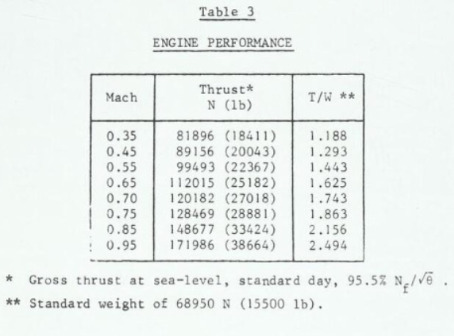
That says gross thrust brotato
Ie intake momentum drag not accounted for
This is why I said I wanted your values
According to you and gaijin the harrier would need its entire GROSS thrust to sustain the correct G at 400 knot
Ask for the correct values and I’ll give them too you