So no we are once again moving the goal posts from it’s ITR is 19 degrees per second and 60 degrees nozzles down to “well actually now it sustains 19 degrees per second.” This is an actually delusional take.
I said looking at the chart, were it pulls 5.3 odd G at 400 knots with the wing alone. Stop confusing things
I found something revolutionary for the VIFF reports.
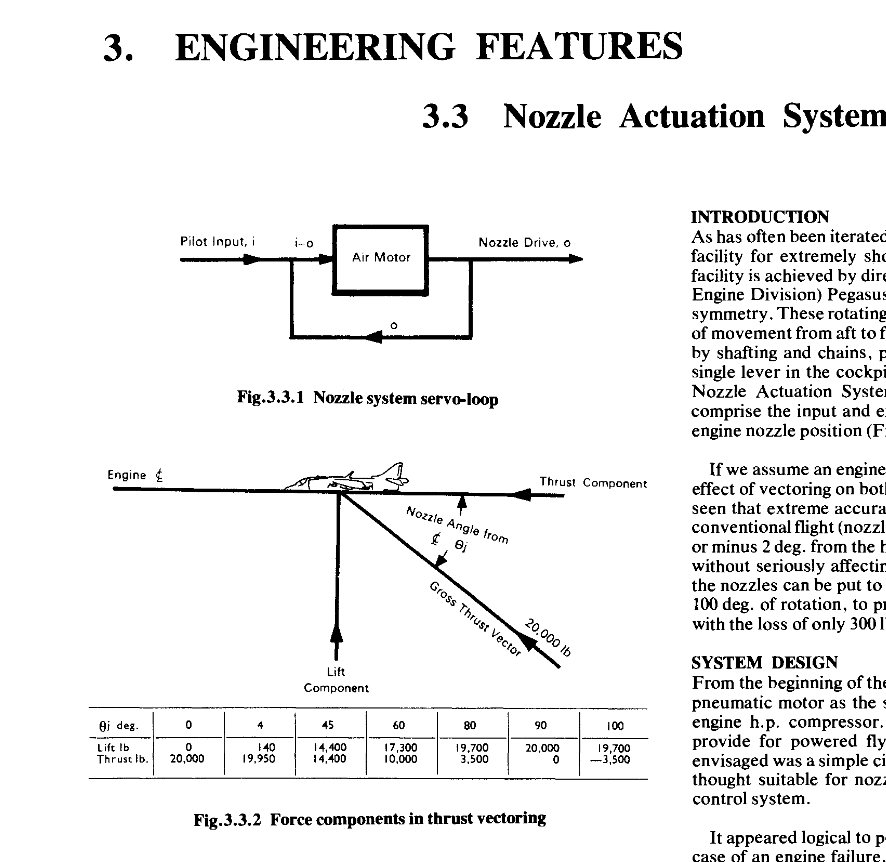
The Gr.1 Mk101 when at the breaking stop position create -3,500 lbs in thrust (reverse thrust) when stationary.
2 Likes
Nice
Which chart? You keep posting different ones whenever you want to try to change your argument.
The only chart I’ve used to compare turn rates with the F-4 broski
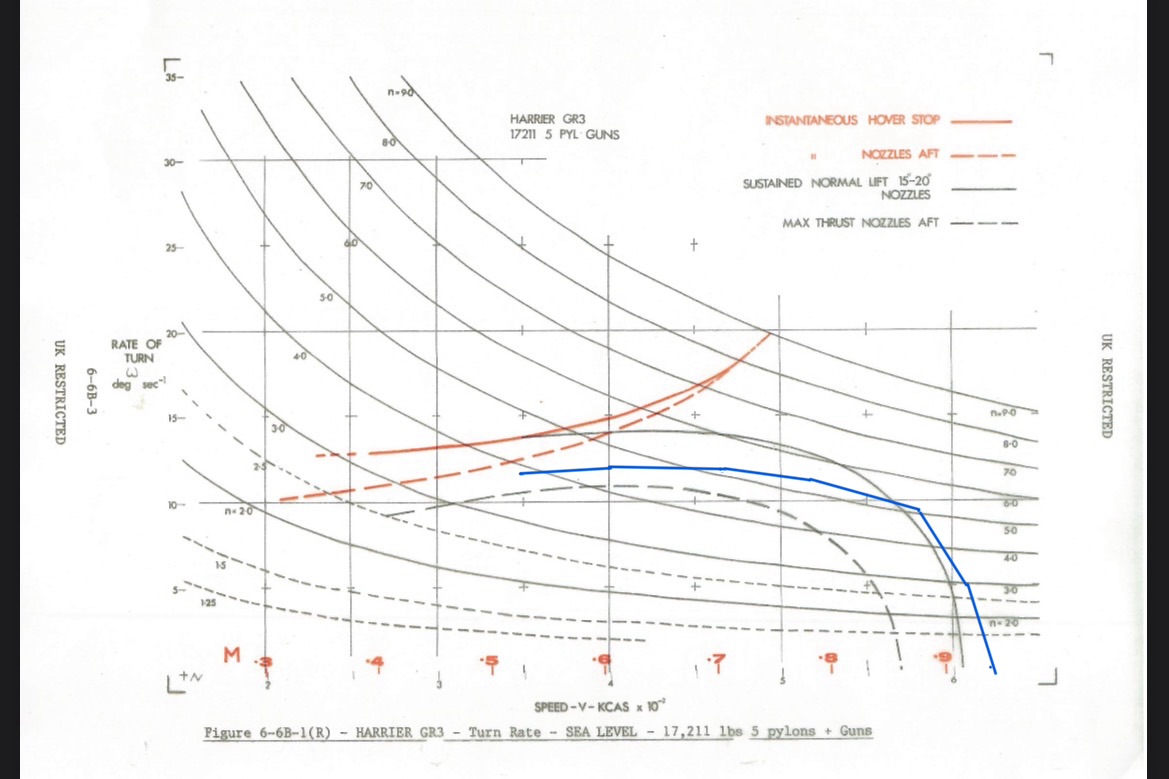
If you follow this chart at face value, pulling to your best instantaneous turn rate at 400 knots with the wing lift only will result in 0 loss in airspeed.
If you think about that it doesn’t make sense, what does make sense is that this chart provides you with buffet onset coefficient of lift instantaneous G.
Based on Gaijins though process (and likely your own) the Harrier can pull to 18-20 degrees AOA at 400 knots and lose 0 airspeed.
Since gaijin believes that the NATOPS V-N diagram is gospel its only 3 lbs different in weight and we both know that stores has essentially no effect on lift (instantaneous G) for a given weight.

If we continue to follow that chart it should be impossible for the harrier to pull 2 G at 200 knots as in the NATOPS chart it cant even get to 2G at 200 knots using 20-21 degrees AOA.
at 475 knots the harrier should only be pulling 7.25 vs 8G
Just food for thought if its instantaneous G capabilities are to be taken at face value from gaijins assessment and your own, the harrier can pull about 20 degrees AOA at 400 knots achieve 5.3G for 0 loss in airspeed.
Or what my assessment is based on 5 other primary sources is that the V-N diagram and the ITR line on this chart are for buffet onset. With the V-N diagram being extrapolated using an unknown AOA figure.
In other docs - 6.2G on a 16,000 lbs harrier can be achieved with just 14 degrees ADD. At the same time the aircraft can comfortably pull to 18-20 degrees AOA at the same Mach value. Potentially providing 7G at 400 knots. (Although this is for a 1000 lbs lighter aircraft 6.6-7G would be my estimate for a 17,200 lbs aircraft at 400 knots)
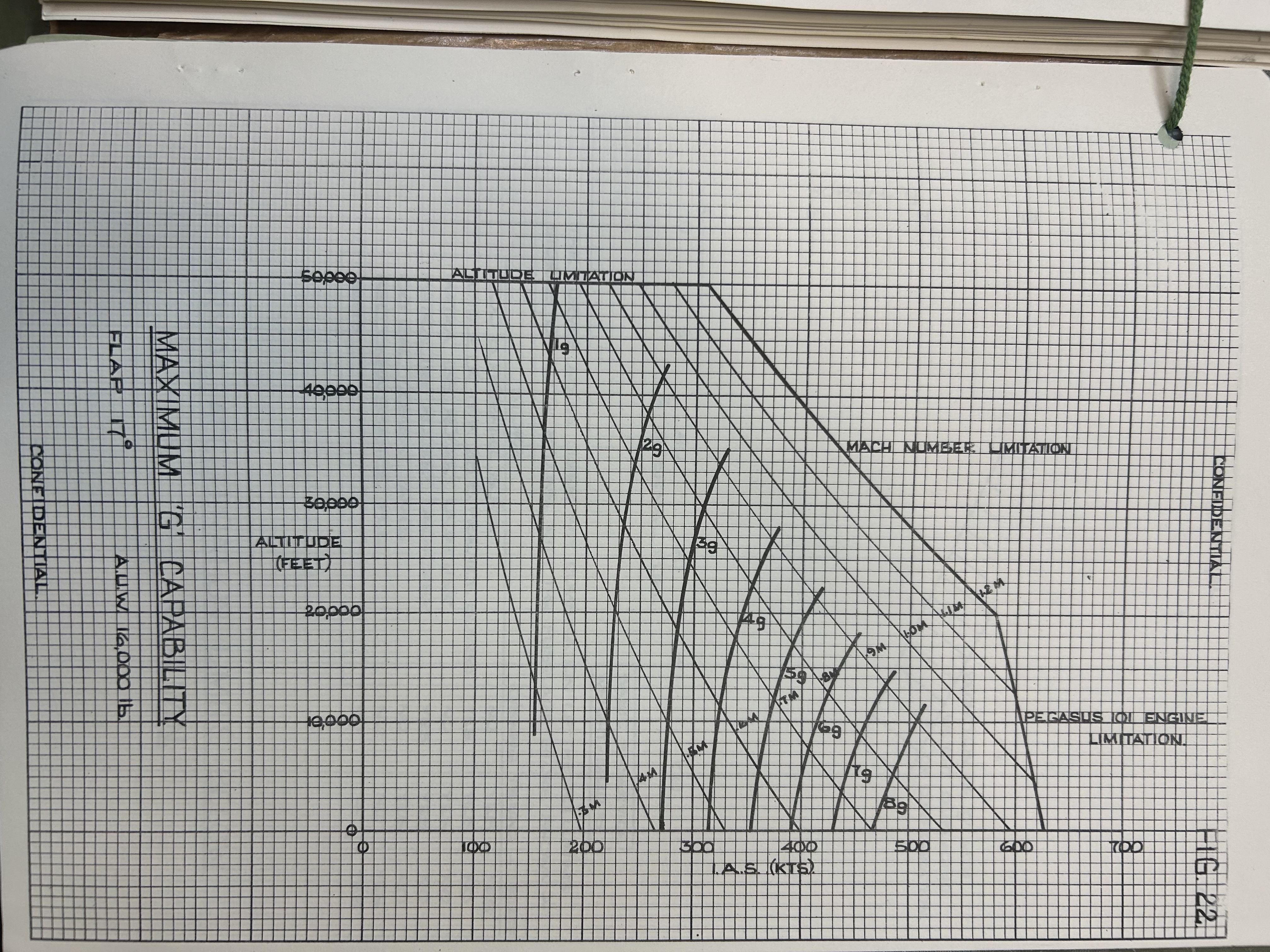
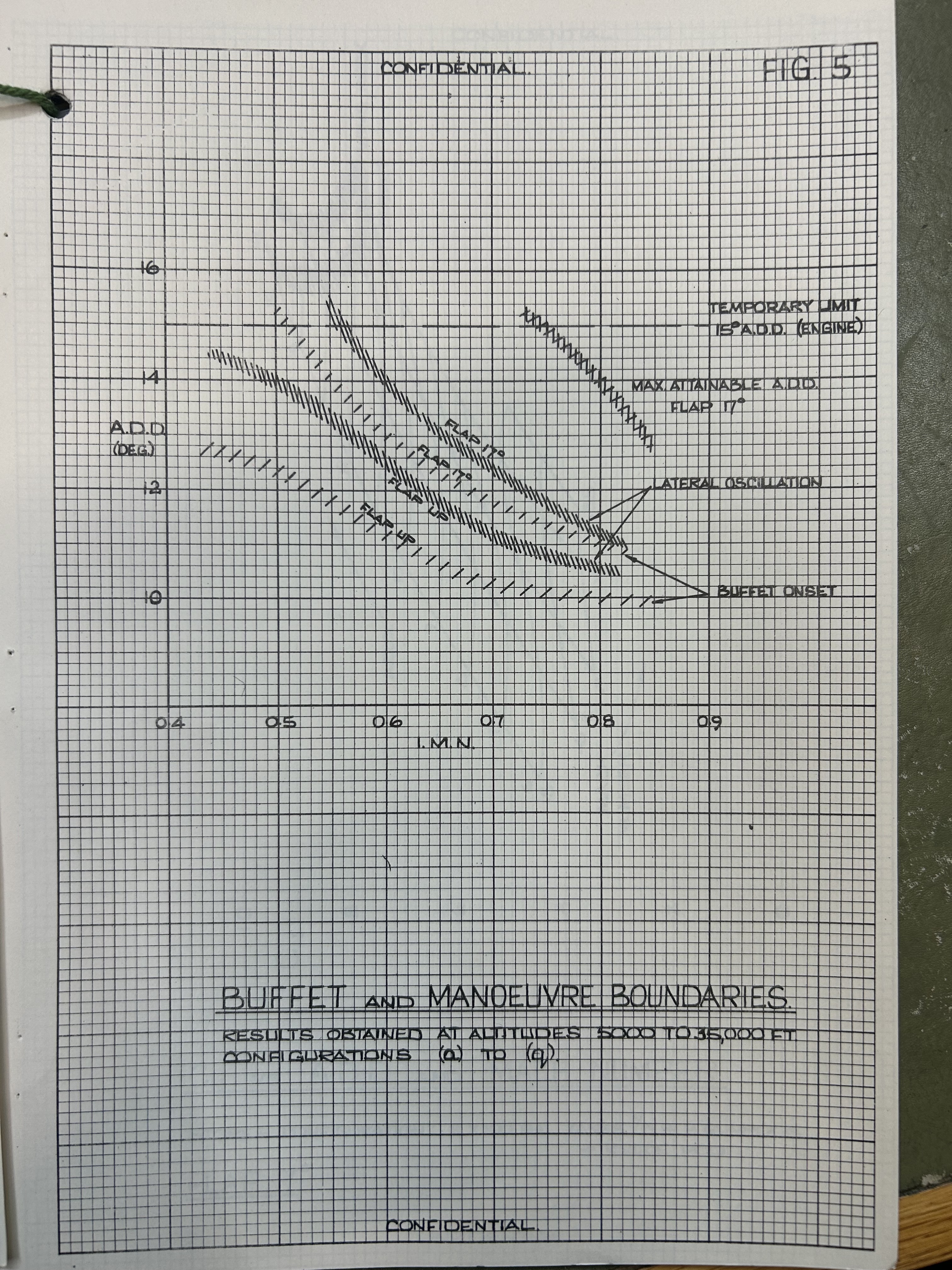
Red pill / blue pill thing here
Choose gaijins side and the harrier can pull 20 degrees AOA without loss in airspeed / meaning it would need the SEP of a rocket ship to maintain that thrust/drag
Or choose my side the harrier can pull 12 degrees AOA without loss in airspeed / however this means its also underperforming in lift and instantaneous G.
1 Like
And before it’s even mentioned as I know you’ll say it “WhY wOulD ThE brItIsh GeT thEiR OwN SoUrCes WrOnG”
They didn’t, as stated before they only tested to buffet onset to keep the testing simple and much more accurate.
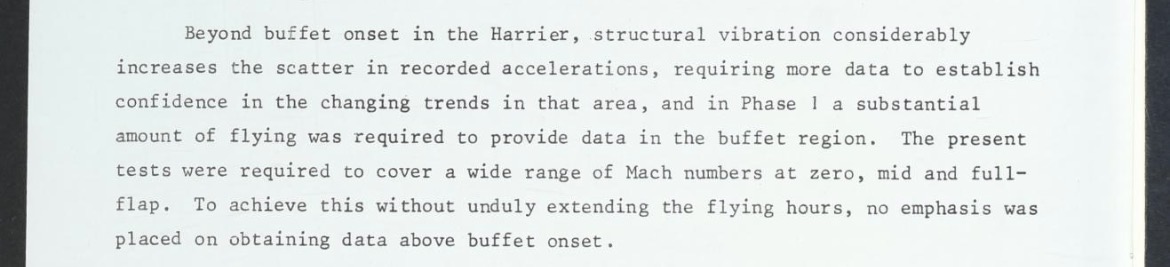
Them calling this Phase I testing implies that there would be a Phase II. Your assumption is that they never tested beyond Phase I and just wrote every subsequent manual based on Phase I testing.
By the same estimation we can just say the F-104 was never tested beyond buffet limit and is actually much better IRL and just vomit post snippets of incomplete and unrelated documents to substantiate the argument.
1 Like
The data I have is phase 2 VIFF trials. I don’t know where phase 1 is or how to get it.
And the buffer onset and G capability came from the RtoS manual.
1 Like
Sea Harrier is an F-104 victim
2 Likes
Lmao sure buddy
It’s unfortunate that it was never equipped with AMRAAM. Would have been much better premium then whatever harrier variants there are.
1 Like
4 AMRAAMs plus 2 Aim-9M on supersonic dart sounds way better than a shitty subsonic platform tbh.
Btw you mentioned that EFT documents says Gripen has poor sustain rate, did they write based on bad faith or is it accurate?
My F-15j with AAM-3s sat at 12.7… i do feel bad using it if not for the fact all i see in it are the god damn su 30 players dragging me up to 13.3… Let me have some god damn peace man.
1 Like
The 13.3 flankers are the worst thing since that dual auto cannon Russian thing
The EFT document has a comparison of STR , ITR, and SEP of a few different planes. Amongst those are Gripen and Rafale but it is unclear in the document what information the predictions are based on; i.e is a clean sheet analysis by UK aero engineers or if figures are based on information provided by the manufacturer etc.
The document shows Gripen with STR of approximately 65% of ESR-D requirement which is 20 degrees per second st sea level with full fuel and 2 IR missiles.
There is AIAA article with Gripen STR chart as well that only specified that it’s at low altitude and makes a comparison to Viggen. One can interpolate values by cross referencing the Viggen line in that chart. When checked against the R,KM or sea level chart the Gripen STR line is basically 1 - 3 degrees over it. Moreso at higher speeds / near transonic which is something that is not unique to the Gripen.
The UK document is plausible if you consider the AIAA chart to be at 50% fuel and clean vs Gripen w/ full fuel. Typically WarThunder aircraft do not have the same margin of performance decline for increased weight as their real life counterparts.
1 Like
VIFF Explanation / added capabilities (To the bets of my abilities)
Seeing as VIFF is an extremely complicated topic, and since I’ve not been able to “convince” a generally accepted “additional capability provided by the use of CTVC (Combat Thrust vector control)” I’ll explain my rationalizations in full. The idea of this write up is for the “community” to have a better understanding of how CTVC works and the performance actually achieved via its use. I will include the source material and where to view it for yourself if you are so interested.
Conventional aerodynamic thinking and principles can often times not be applied to an aircraft such as the Harrier. For this reason its understandable that most people would be skeptical of its claimed performance benefits, even despite my primary source material.
Explaining additional G capability:
Additional G obtained by the use of CTVC is caused by the combination of several key aspects.
1- The action of imparting some of the GROSS thrust of the engine naturally results in the addition of jet lift. Net thrust can no longer be used in calculations regarding the use of CTVC as intake drag only operates inline with the intakes face

A good % of the total gross thrust is actually lost due to jet interference effects at higher nozzle angles. However the added G even when the nozzles are lowered past the optimum angle of 60 degrees is still .5-.75 on the Harrier. When at 60 degrees nozzle angle or less the gross thrust in combination with everything explained below results in a much greater achievable G.
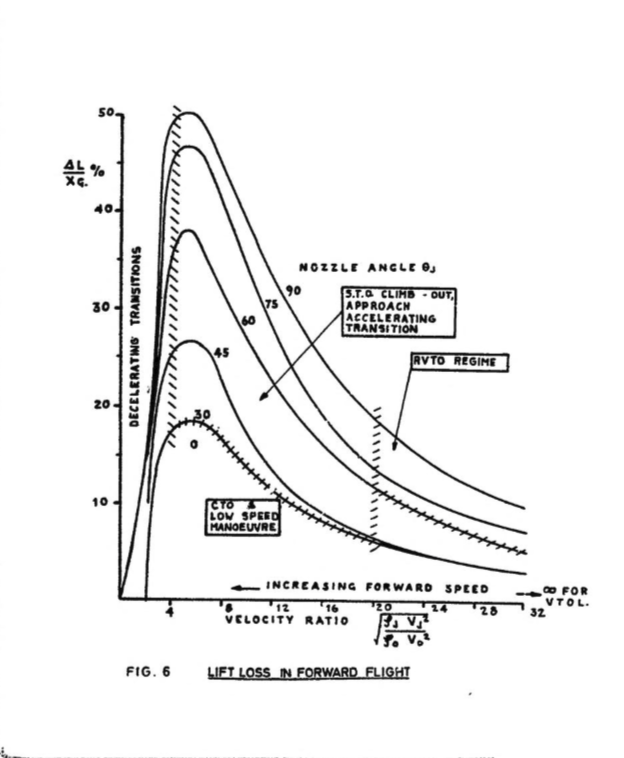
2- The Jet interference effects caused by the change in velocity and relative pressures in the ambient airflow across the entire wing. As the nozzles are rotated, the local airflow around the wind starts to trail downwards resulting in the wing experiencing a local AOA drop. However the Coefficient of lift actually increases. The increase in lift coefficient and the gross thrust imparted downwards allows for more G at any given AOA despite the wing actually producing less lift at the given AOA due to its relative AOA being lowered by the thrust interference effect.
It is extremely difficult to quantify exact incremental G addition at any given speed and AOA as the Coefficient of lift, Gross thrust / gross thrust % loss due to jet interference effects, Local wing AOA vs aircraft datum AOA, and Engine RPM / gross and net power output are always and constantly changing.
However it has been observed, measured, and accepted that an additional 1-1.5G can be achieved when using TVC (optimum nozzle angle of 60 degrees) to aid in a maximum instantaneous turn when the engine is operating in the 95.5% RPM band. With higher engine ratings almost definitely allowing more.
Visualization of the added coefficient of lift resultant from the use of TVC
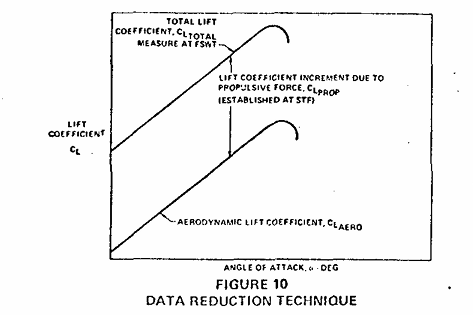
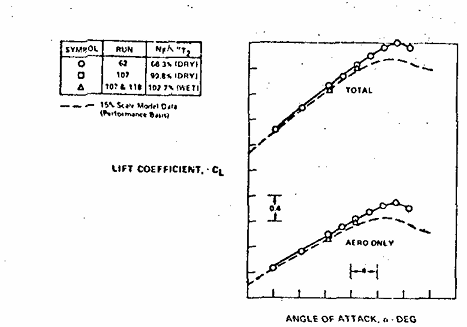
Above 60 degrees of nozzle angle the jet induced airflow will begin to separate from the wing and cause the airflow to stall and swirl resulting in massive amounts of drag being created even when flying straight and level. This also drops the Coefficient of lift resulting in less G achieved.
No more than 60 degrees of nozzle angle should be used when the maximum instantaneous turn capability is desired.
The loss of speed resulting from the correct use of CTVC is not as great as one would expect.
Performing a 90 degree turn at 530 knots will end at 430 knots after 90 degrees using the 60 degrees of nozzle angle.
The use of lower nozzle angles can actually decrease the bleed rate of the Harrier.
High AOA and nose authority enhancements:
Furthermore CTVC, in addition to providing more available G, actually allows the harrier to maneuver at significantly higher angles of attack then the conventional stall angle of attack. The increased velocity around the entire wing increases the effectiveness of the ailerons and flaps allowing for precise roll control and improved stability.
The increase in ambient velocity and therefore pressure around the entire wing results in a boundary layer control (BLC) effect. This forces the airflow to remain attached to the wing well beyond what can be achieved with conventional aerodynamic principles.
For example The F-18A will achieve its maximum lift coefficient at about 32 degrees AOA to achieve this the wing is in very heavy buffet and the LERX is providing vortex lift to maintain the high lift coefficient. Above this angle of attack the curve begins to fall indicating stall.
The Harrier 1 - AV-8A for reference achieves its highest coefficient of lift at about 17 degrees AOA when flying like a conventional jet. However with the nozzles directed downwards the Harriers lift curve will continue to rise until 40 degrees AOA and the wing will have almost no buffet and or wing rock when doing so.

Tactical implications:
As I have stated many many times by now the Nozzles not only allow for a greater Instantaneous G to be achieved but it also provides a noticeable increase in low to medium speed sustained turn rates.
Above about .55 Mach the sustained turn rate decreases with the use of CTVC.
This provides a good visualization of the effects of CTVC on the performance envelope of the harrier.
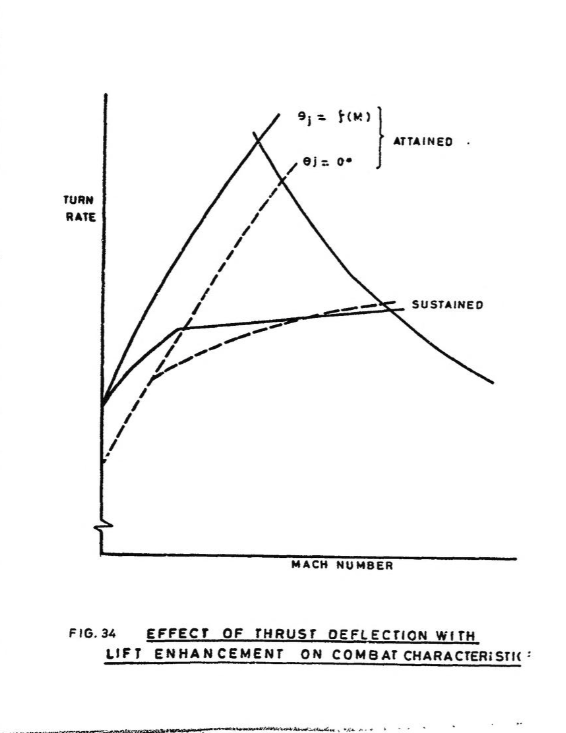
Here you can see a comparison to a conventional fighter with considerably lower wing loading
IE a harrier vs MiG-21
Recall my previous statements about the two:
The use of CTVC allows the harrier to achieve significantly higher low and medium speed ITRs however as the speed rises and the nozzles no longer have the torque to achieve the rotational power needed to achieve the selected nozzle angle the MiG-21 is able to achieve slightly more ITR at its G limit vs the Harrier.
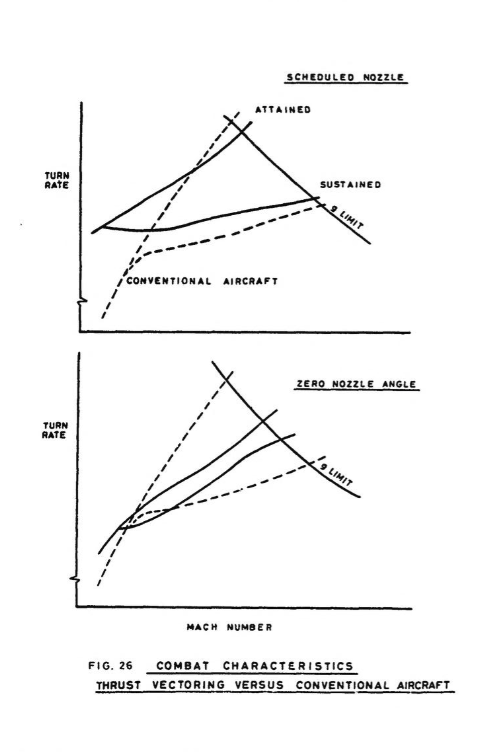
The second important aspect in CTVC is the use of large nozzle angles to generate extreme deceleration.
This is to achieve 2 combat advantages, a massive advantage in a 1 circle capability post high speed merge. Or to generate a large angle off and deceleration to foil a very close in threat aircraft.
No aircraft in the world is able to match the 1 circle performance of the Harrier. However at the same time, if you misuse the 1 deceleration aspect of CTVC you can find yourself too low on energy to effectively fight back. It is best used sparingly.
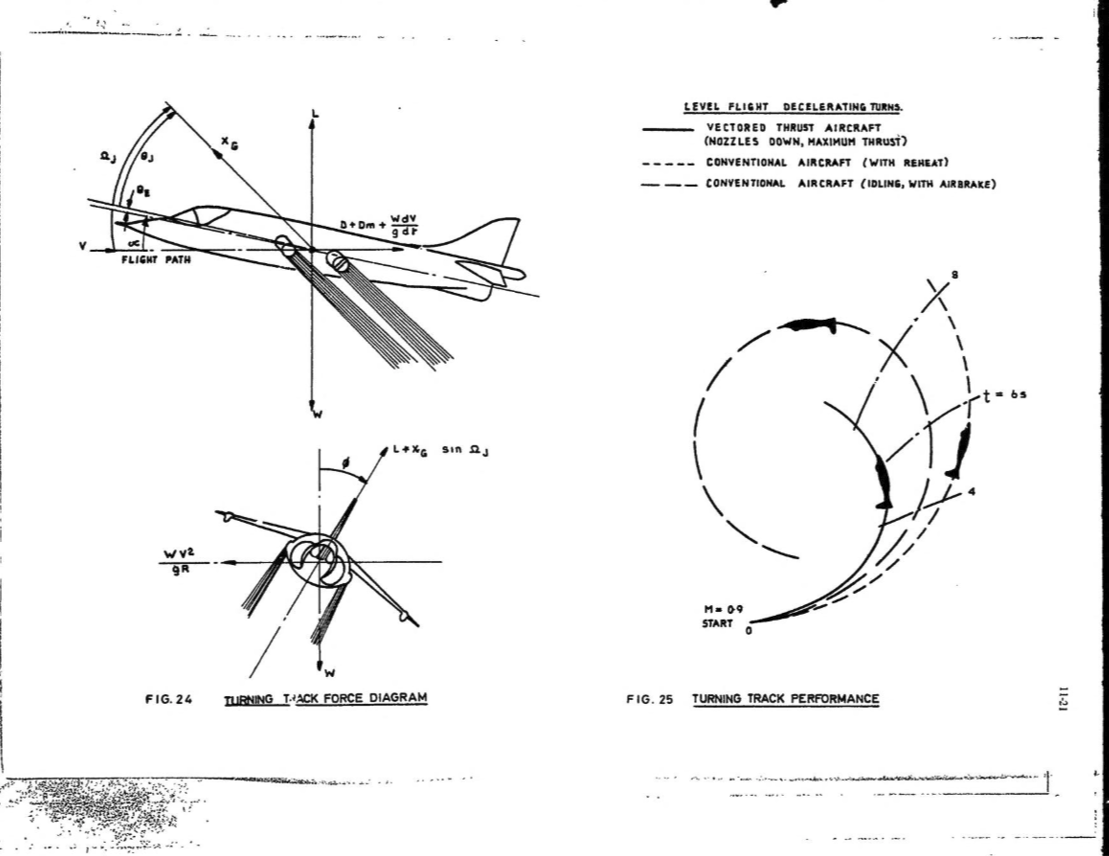
I think this summarizes to the best of my abilities what CTVC does and why I talk about it the way that I do. Contrary to what some may think I absolutely do not pull data and numbers out of thin air, I also do not mis match sources. I just tried to avoid having to explain this in full and just use the figures of added performance to try and compare tactical situations. Unfortunately people cant accept the validity of this data, maybe it seems impossible to them? Nevertheless this is a full explanation of CTVC and rationalization of the performance enhancements that I make claim too.
Sources:
Validation of AV-8B V/STOL Characteristics by Full Scale Static and Wind Tunnel Tests (AIAA)
https://arc.aiaa.org/doi/10.2514/6.1977-597
Aerodynamics of V/STOL aircraft -Performance Assessment- (Page 314)
The British Aerospace Harrier - case study in aircraft design
https://arc.aiaa.org/doi/book/10.2514/4.868634
AV-8A/C NATOPS manual
this is the 1983 addition I do not think it is available online, ask if you require additional information and references.
6 Likes
And how many degrees per second is the Harrier turning for that first 90 degrees of turn? What’s the answer on this? Is it 19?
Maximum performance turn meaning to the limiting G
So 8G at 530 knots by the time you get to 90 degrees of turn you’ve bleed down to 430
16.3 d/s at 530 for 8G as the speed decreases the turn rate will increase at the given G.
At .6 Mach it’s stated to be 19 a seconds so at 430 knots 20 could be likely possible.
That’s a bleed rate around 18 knots per second if it takes 5.5 seconds to complete the turn.