This what what a VIFF lift curve looks like
However it’s an example data plot with an unknown altitude loadout or aircraft weight
But it appears to be the AV-8A
This what what a VIFF lift curve looks like
However it’s an example data plot with an unknown altitude loadout or aircraft weight
But it appears to be the AV-8A
Oh hey look another source and it actually says mostly what you say that it does. I like how you went back and added it to your initial post like it had been there the whole time.
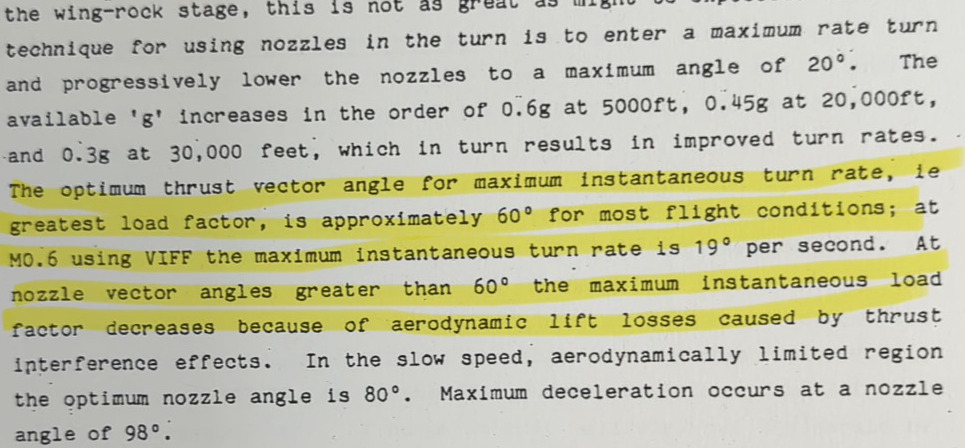
Note the sentence that precedes the section that you have highlighted. We can take the ITR figures cited in your previous document and add 0.6G to them and get updated ITR values to compare with the MiG-21 chart.
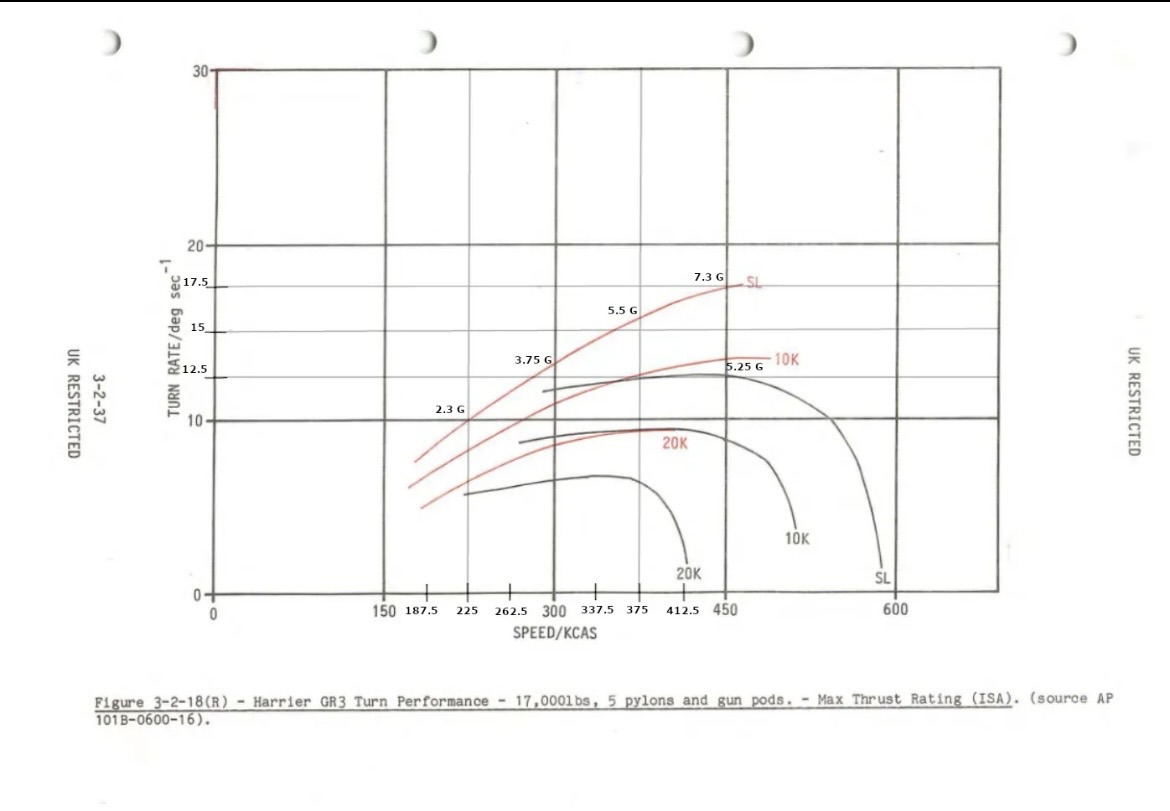
Let’s look at your 2.3G at SL datapoint.
Our interpolated 5,000 feet datapoint is going to give us an STR of around 9 degrees per second for 5,000 feet. This is a load factor of around 2.1G. This low speed comparison is where that 0.6G difference will have the greatest proportional effect as well; the difference at higher speeds is going to be lesser.
So our ITR + VIFF looks like the following: 2.1G + 0.6G…or 2.7G total.
2.7G at 225 KCAS would be around 12 degrees per second ITR.
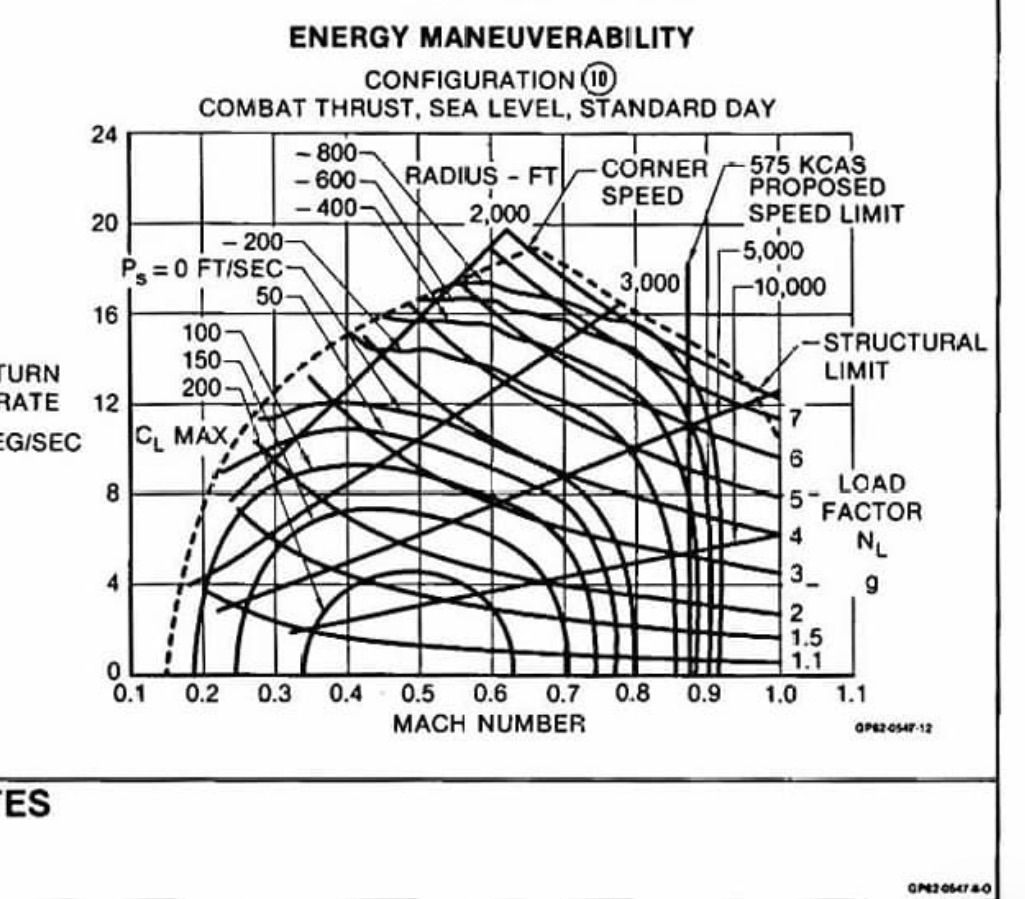
Our MiG-21 EM diagram shows around 14 degrees per second ITR at 225 KCAS.
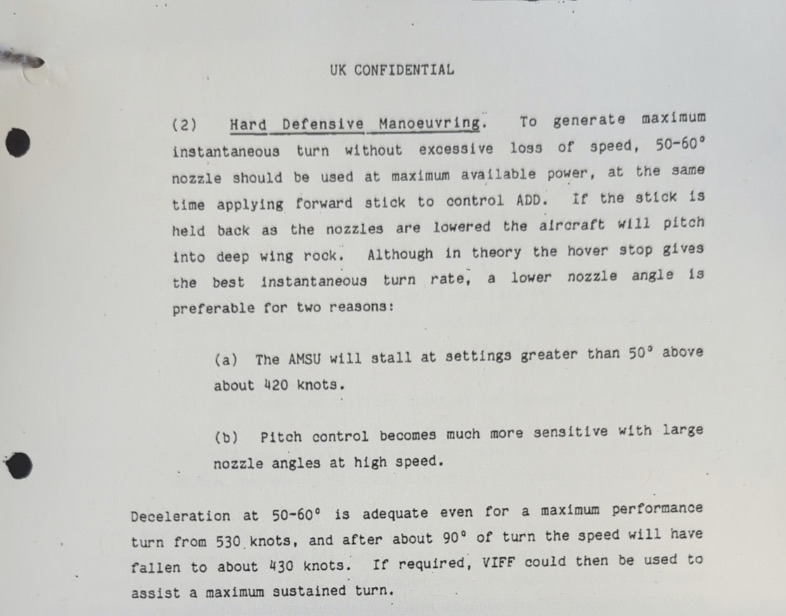
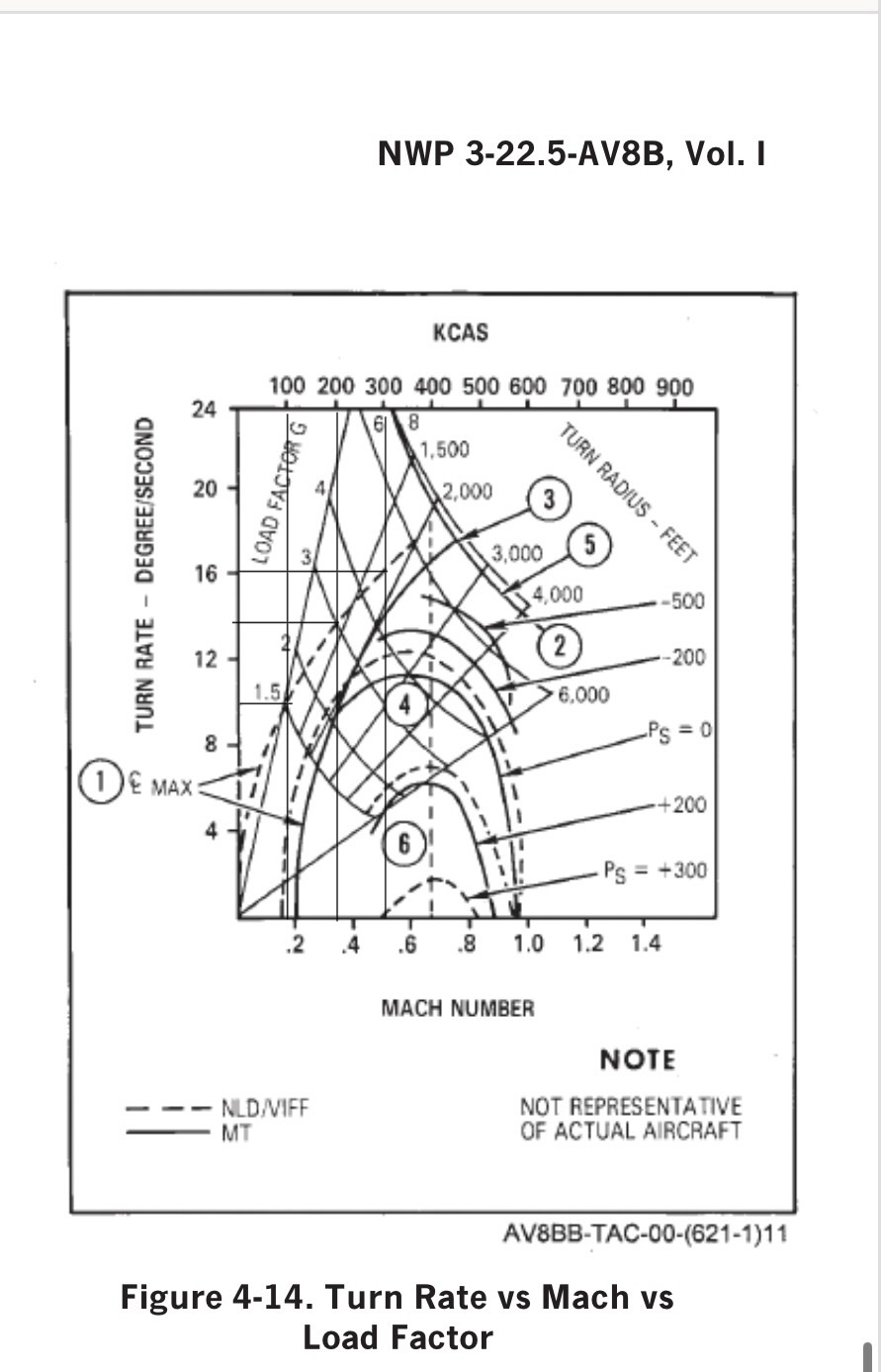
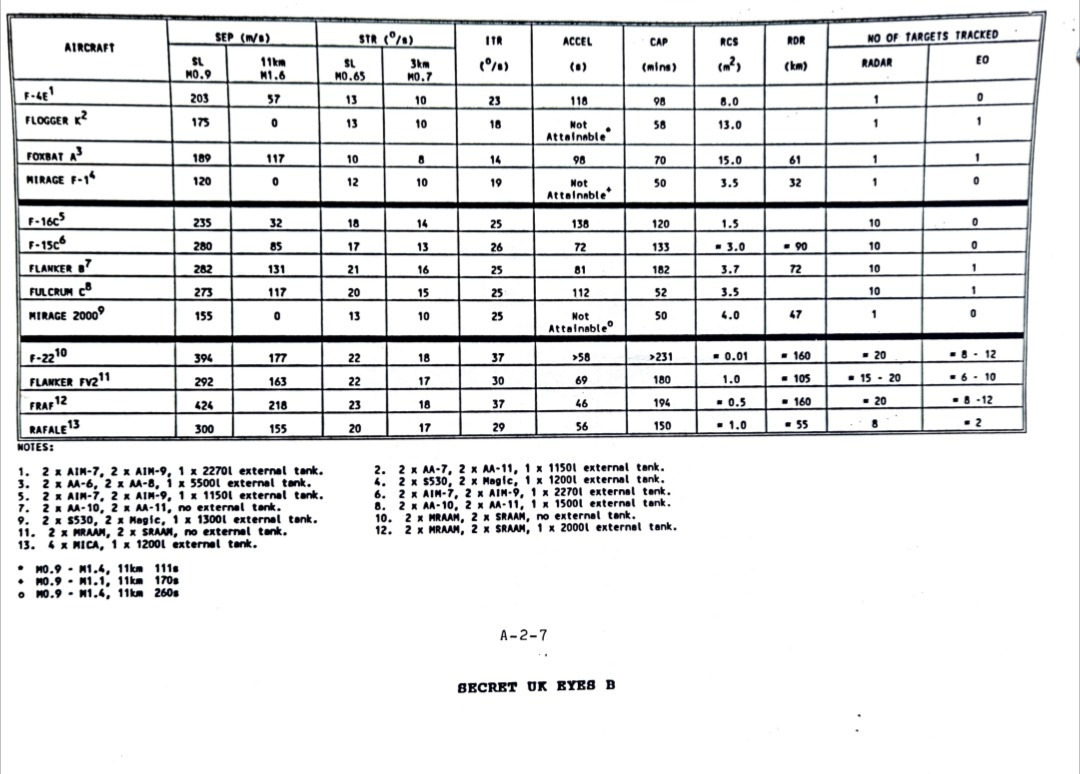
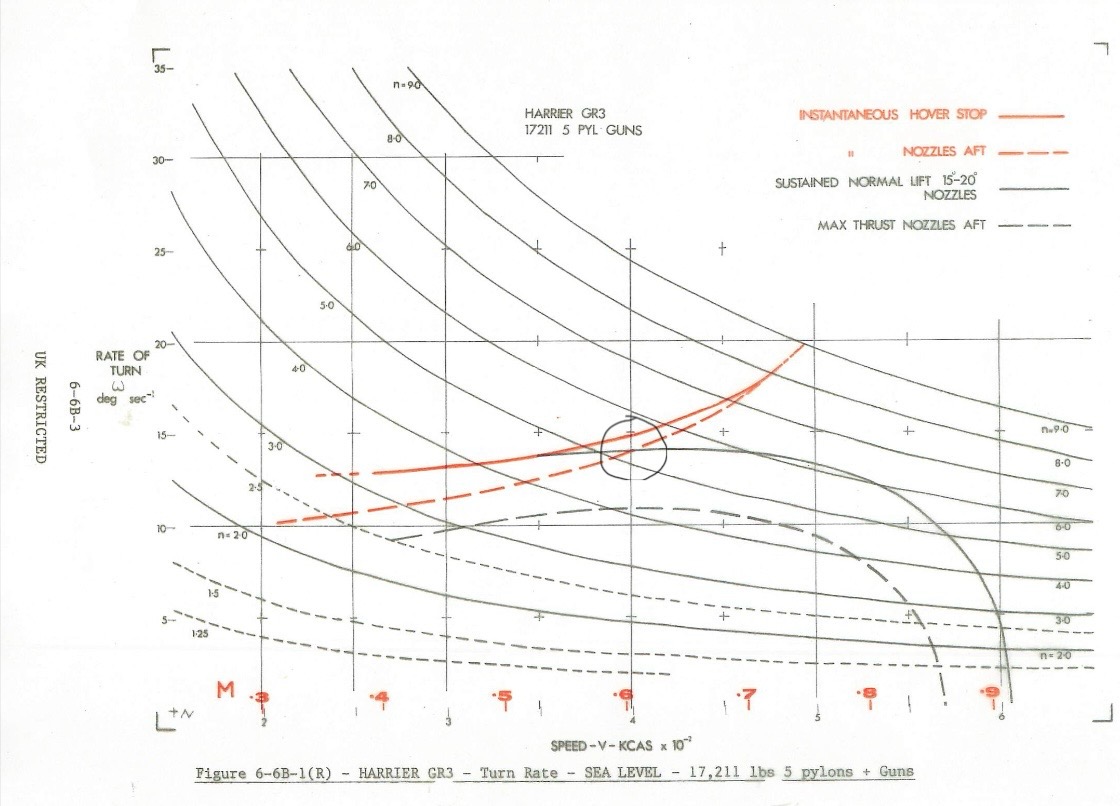
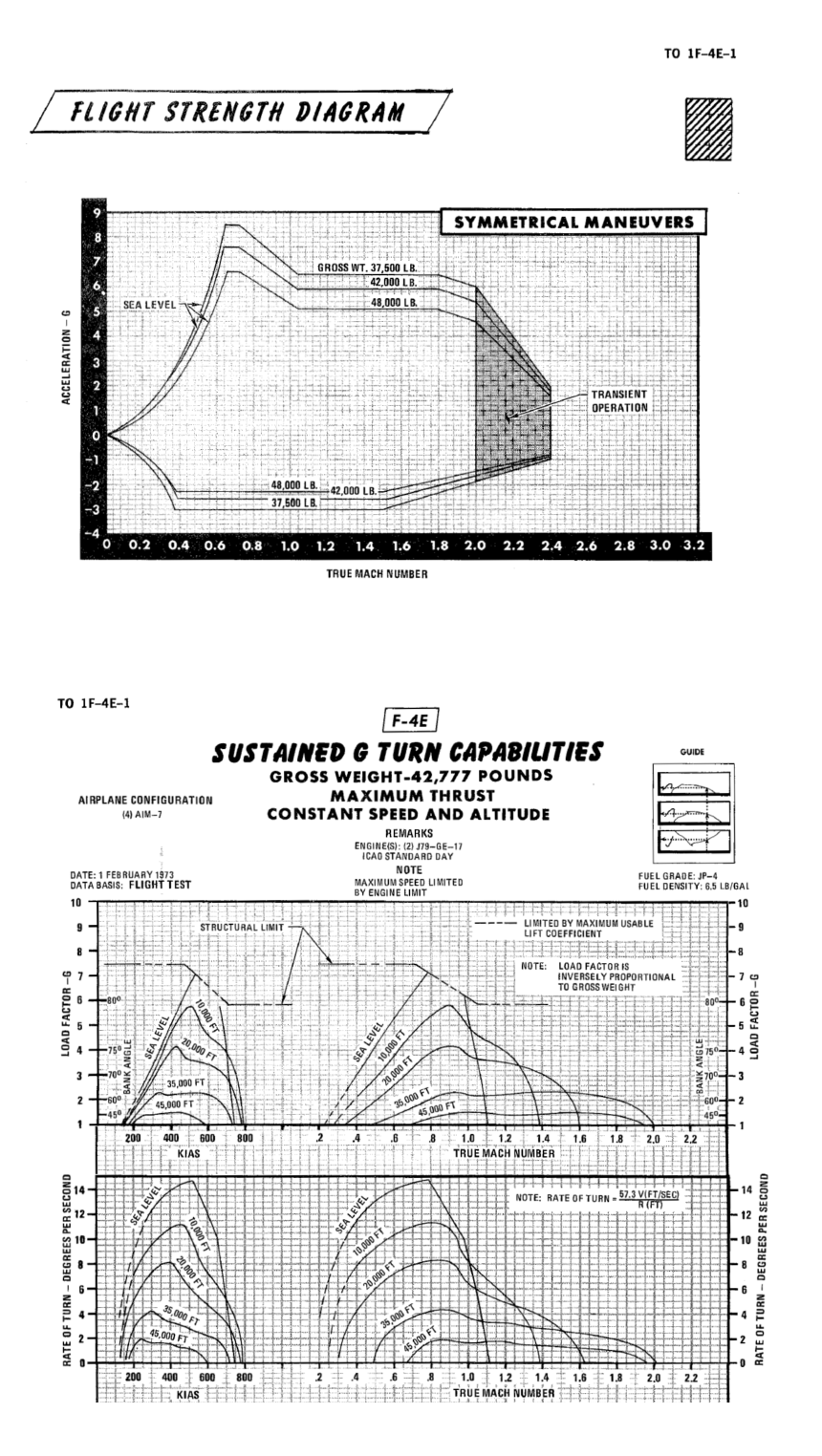
Or we can look at this as well. This 90 degree turn takes nearly 5 seconds to complete and it loses 100 knots of airspeed to do it. If this figure is at sea level then it is truly abysmal. For reference basically the best possible ITR for the Harrier is basically similar to the STR values of other 4th Gen fighters when loaded with missiles and a drop tank. 19 degrees per second ITR at sea level is inferior to an F-4E with a drop tank equipped according to the British.
We can also compare the SAC diagram to the MiG-21 diagram. However once again we are going to discover that it is inferior in terms of ITR, STR, and bleed rates. If we add VIFF to the discussion then bleed rates will go even further through the roof.
It turns out that the sources agree. The plane is a bit shite in terms of maneuverability. Poor sustained turn rate, poor instantaneous turn rate, and horrid energy retention. Look at the -800 line where it get’s around 17 degrees per second. The MiG-21 actually appears to have slightly better energy retention with around 17.5 degrees for the same bleed value while being 5,000 feet higher in altitude.
It’s like you intentionally come up with goofy takes
.6 addition at 5,000 feet is achieved with just 20 degrees of nozzle angle
With 60 degrees it’s about 1.5G in available G
Do remember this is for a harrier with 7 pylons 4 missiles a gun pack using only maximum thrust not normal lift.
Not to mention it’s a 65% lerx model
For example here’s an old standard mk102 engine harrier using normal lift
It will sustain 14 D/S
14 degrees per second sustained turn at sea level is abysmal. That is a whole 1 degree per second faster than an F-4E that is equipped with a drop tank and similar number of missiles. Also note that this chart seems to be around 4000lbs lighter than the reference weight that is used in the EM chart from the AV-8B SAC. Now I am no expert by any means…but if you remove a shit ton of weight from a plane…it will probably cause the planes turn rate to increase.

vs

So yeah it’s a bit shite innit bruv?
You also know this document is hilariously in bad faith.
The F-4E doesn’t turn anything like that with drop tanks
Lmfao you realize they are 2 different aircraft with 2 different wing profiles right
That alone proves you should stop talking here. You don’t even know the basic differences between a harrier 1 and 2.
Besides you don’t like the harrier you don’t play it this doesn’t even affect you.
How is it in bad faith? You think British MOD engineers are incompetent and can’t perform calculations? Or that they were deliberately fudging the numbers of their own aircraft throughout the whole entire process?
The ESR docs are more political and have known bad data in them.
For foreign aircraft sure, not for our aircraft.
There is no indication that any of the performance values in the ESR documentation were made in bad faith. This is what you are alleging and you have absolutely no idea what you are talking about.
So Harrier Gr.3 vs F-4E
ITR Gr.3 400 knots 19 a seconds - sustained 14.3 at 400
ITR F-4E 400 knots 16 a second - sustained 13.9
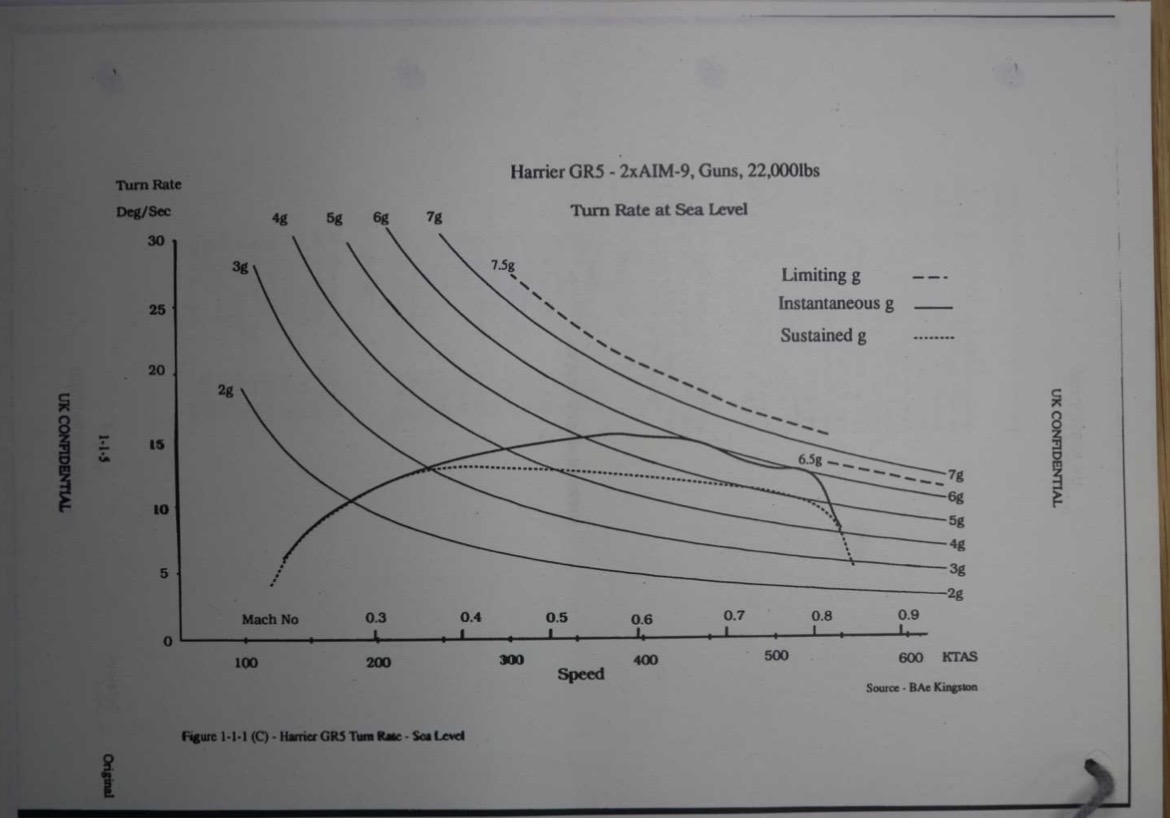
As said they used the Gr.5/7 tacman data for the Gr.5
That uses buffet onset
Unless you feel the Gr.5 can only pull 6G and the ITR decreases with speed and it’s unable to pull to its limiting G then go ahead and make that report as it would be funny.
It doesn’t really matter when all indications are that either version has markedly inferior turn performance. It should also be noted that in-game the AV8B overperforms the SAC chart.
It is amazing that you think the British MOD would not be able to get accurate performance figures for the F-4E Phantom and wasn’t able to channel all their previous experience with the platform to form accurate estimates.
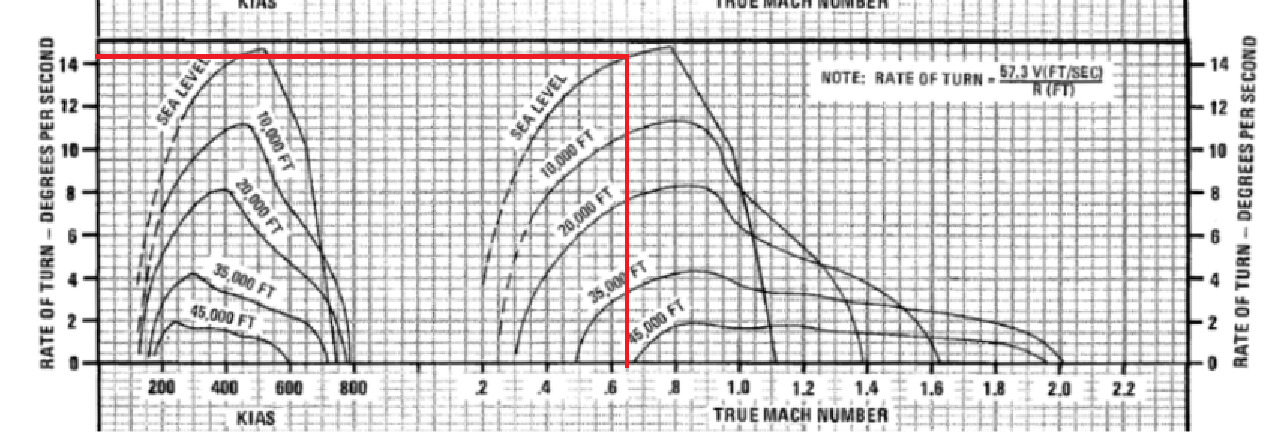
This chart shows 13 degrees per second for F-4E.
And would you look at that…the F-4E w/ approximately 85% internal fuel has a sustained turn rate of above 14 degrees per second at sea level. Slightly better than the MOD figure which specifies a drop tank.
It’s almost like these estimates are reasonably accurate and are made in good faith. The Brits were not deliberately underselling their own stuff to themselves in their own confidential documents.

Now this is peak content.

it kinda is… Through 2 ways
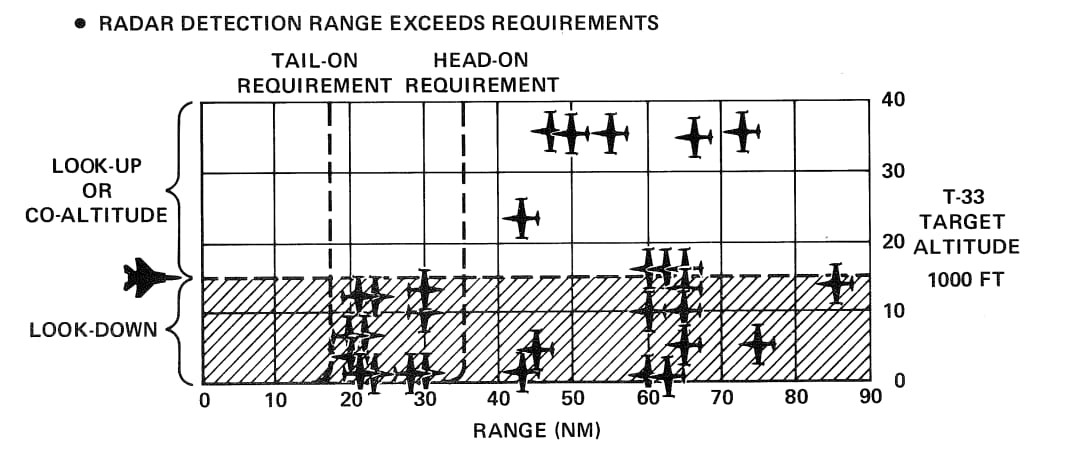
APG-66(MPRF) has a mean(front aspect with closure)( at 85% pd commulative) of 20N.M flying at low altitude, 5kft, against a 1.3m2 target at flying 500 ft. Put those numbers in the chart you posted and voila, you figure out what the “medium sized target, whatever that is in m2 no idea” is
A 1974 APG-63 against a T-33 showed 50% commulative Pd(median) is 62.5NM.
T-33s frontal “front aspect at 8.8GHz(Xband)was theorized at 2 dBms(2.23m^2) and experimentally 0 dBsm(1m^2)”. Lets take 2m^2. In 1978(Pre-PSP) the parametric amplifiers got remplaced for FET amps and it got a 20% increase in HPRF range. Thus 75N.M.
Both are in the ballpark range. It’s big a** radar and these figure are for late 70s early 80s radar.
I mean;
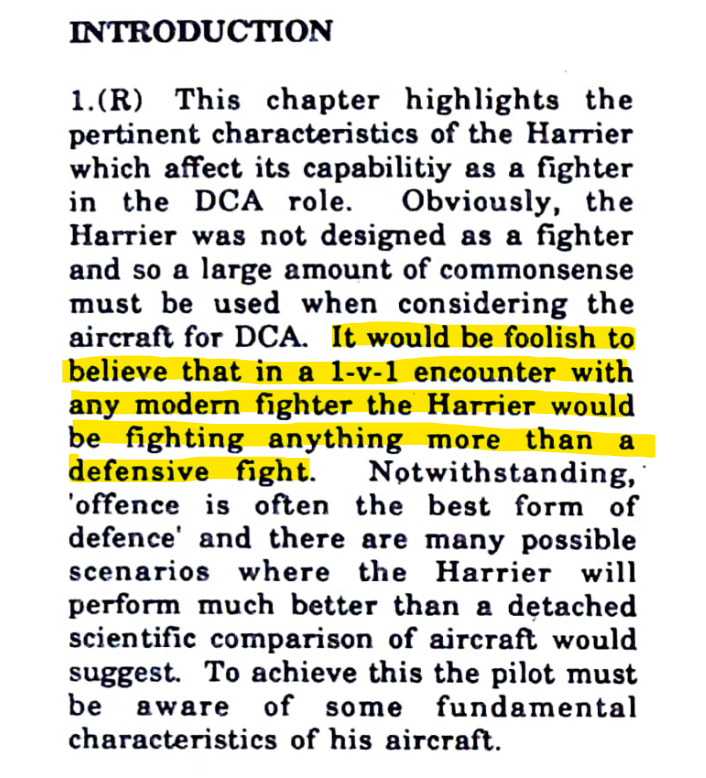
The following statement reads as “in some edge case you may have some advantages” but overall the Harrier was bad for air to air combat against modern threats.
That is then followed up on with this;
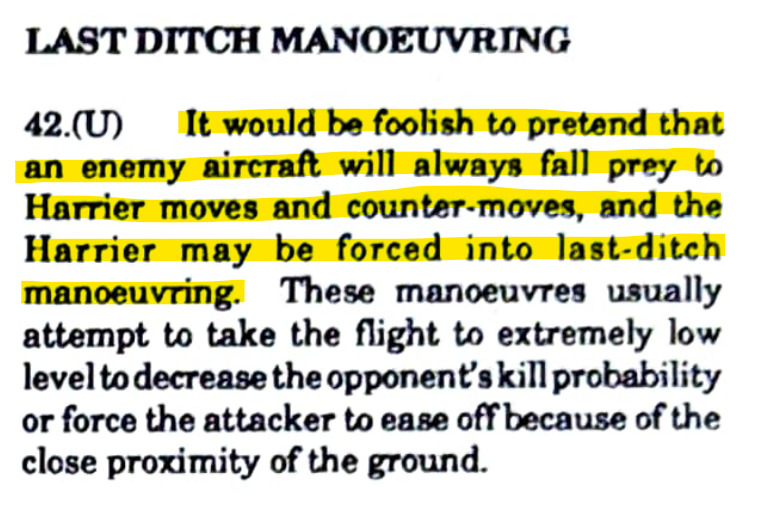
Implication here is those edge cases you might have an advantage are also foolish to rely on.
I mean being called foolish twice from a manual written by Harrier pilots for Harrier pilots from the 1990’s isn’t something I’ve experienced but maybe a little hubris is in order here @MatrixRupture
Well obviously lol but in game you have 0 advantages
I’m really confused at were you even stand on the harrier.
The E-M chart and VIFF documentation exist and in war thunder it can not match the desired values.
It seems you think it can’t match those values irl anyways. You clearly don’t want to see it buffed.
I never said it’s better then a modern fighter I said it lies between something like a F-4E and the F-15A
And it does, all I said was in some cases it has an advantage and your post proved that.
So I’m not so sure why the hubris falls on me.