It is also said that CAPTOR-E could detect the F-35 from 60km before even tested against F-35’s, doesnt mean its true tho.
Not to mention just because it was state of art when it was deployed doesnt mean it stayed that way, technology evolves and render many things obsolete, otherwise current EFT’s would still use the first gen Blue Vixens.
The comparison is F-15s from the late 80s and early 90s
You mean the time when F-15E entered the service with AN/APG-70?
You do realize APG-70 is superior radar overall while blue vixen is specialized in A2A scenarios right? Even then APG-70 had more range with reliable tracking on BVR.
The blue vixen was the first radar ever to be purpose built to support amraam.
The blue vixen in some cases was horizon limited meaning the only reason it couldn’t see you was because the earths curvature was hiding you.
With the size of the F-15 in the picture too; the Shar will detect the Eagle before the Eagle detects it.
2 Likes
It also does very well in air to surface search
1 Like
Yea but considering platform itsel really limited in terms of A2G capabilities it cannot utilize its radar performance hundred percent in A2G missions.
This a another reason why F-15 is superior in terms of overall capability because airframe itself can do basically any job with high load capacity for multiple missions.
That wasn’t even the argument lol
Sea harrier does anti shipping warfare anti air with a limited role in strike
It used to be nuclear strike as well.
1 Like
That wouldn’t matter much since fusalege itself cannot push the AMRAAMs to those distances.
Thats quite interesting claim considering Hughes and Raytheon’s are American based companies that was awarded to develop AIM-120 for Us Air Force and Navy first.
The argument itself which design was the superior overall.
You really think that you can just play for Sea Harriers strength while completely ignoring Eagle’s and win the argument?
Not how it works.
It wasn’t
It started with “if an eagle finds itself in visual with a sea jet it’s not going to be as one sided as most would think”
Then you started talking BVR
And now you’re talking overall capabilities
Because from the start you know that’s one of the area where Sea Harrier excels/par against Eagle in actual combat scenario.
In real life both planes will never get close to each other but try to resolve the combat with BVR engagements which is one of the key factor of Eagle’s design.
Right?
Then I explained to you how the FA.2 is no slouch BVR either
Then you turned too overall capability
So pick one
Blue Vixen was undoubtedly a very good radar, but it is pretty tiny compared to the F-15’s radar (which is over 50% larger in diameter and weight).
And saying it was developed into ECR-90 (and eventually CAPTOR-M) doesn’t really mean anything. ECR-90 had a larger antenna, and about 4x the transmit power, and loads of other upgrades compared to Blue Vixen.
Ferranti proposed upgraded version of Blue Vixen called Super Vixen as a cheaper alternative to ECR-90, which had a larger antenna and more than double the transmit power. One of the reasons Super Vixen never went anywhere for Eurofighter was because it’s range fell well short of ECR-90’s detection range (which in turn is well short of what CAPTOR-M eventually achieved). Super Vixen had significantly worse range than ECR-90 and Blue Vixen had worse range than Super Vixen.
Blue Vixen had a lot of good things going for it, but the detection range was never particularly incredible.
That claim is kind of meaningless without context. For example the radar horizon is about 22 km if you are flying just above Sea Level, in which case an awful lot of radars would be horizon limited.
He is correct on that one. Blue Vixen was indeed the first radar in the world designed from the ground up to guide AMRAAM.
4 Likes
APG-70? or is this purely completely new clean sheet designs
From what I’ve read and former pilots have described to me is it was tuned very sensitive. As in it only needed a small fraction of a return to generate a contact.
To get around the lower power output.
so on top of having a far worse range than the Super Vixen, which had a far worse range than the ECR-90, even at long range (for the Blue Vixen), it had a very weak lock on targets?
It doesn’t rely on powerful locks
It just needs a small return on TWS to build track and then it will guide amraam with a low power output
Thats interesting considering it was designed for Us from the beginning.
Well I guess every day you learn new things.
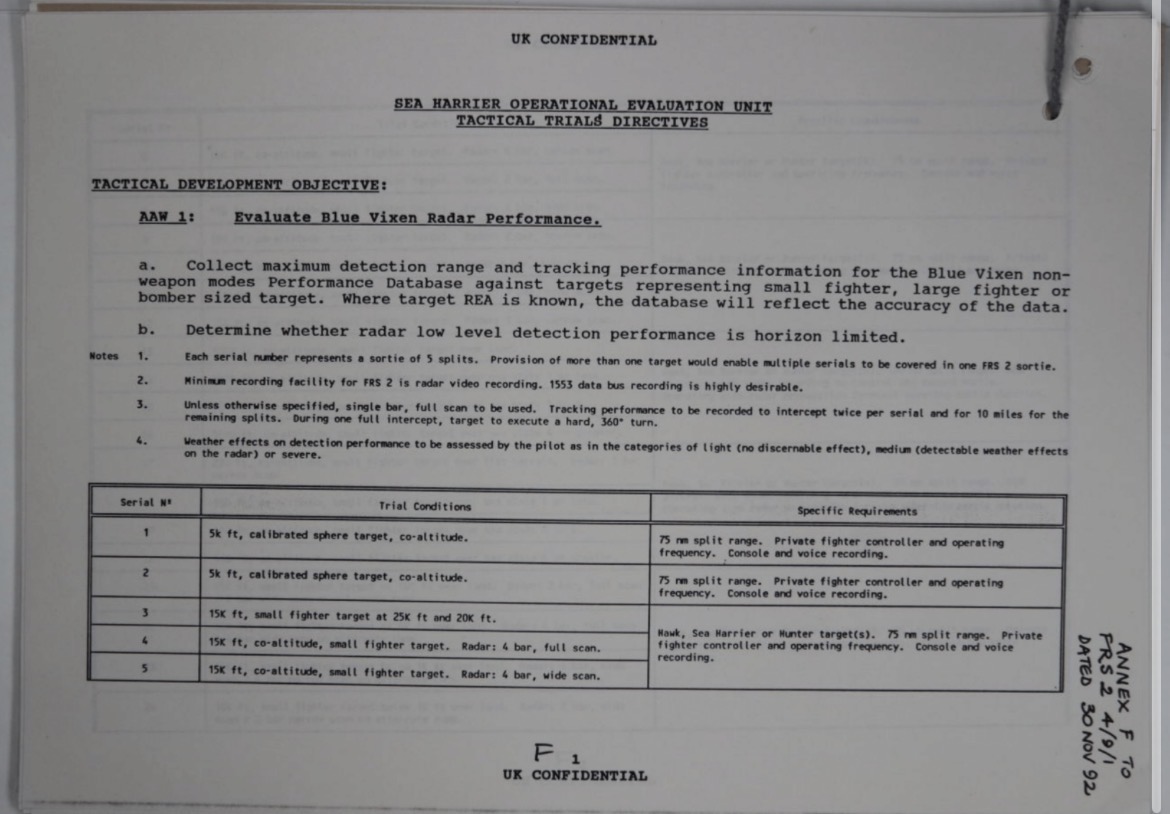
Looking through the Blue Vixen requirements sheet.
It looks like it was required to detect a small fighter at a range of 75 NM (138.9 KM)
At various altitudes and co altitudes.
I’m not sure the specifics of the F-15 radars detection performance but I don’t think a 138.9 km detection of a BAE Hawk is bad.
5 Likes