- Yes
- No
The Ba 349 “Natter” was conceived as a low-cost, mass-producible interceptor during the final years of World War II, a time when the Luftwaffe was in decline and the Reich was losing on all fronts. Upon completing its mission, the aircraft was designed to separate into two sections rather than land; the valuable rocket engine would then glide back to earth for recovery.

A. The “Emergency Fighter Program”
Spoiler
By 1944, the Luftwaffe was on the verge of total collapse. Allied strategic bombing raids were systematically destroying Germany’s war machine, and conventional interceptors could not stem the onslaught. Allied bombers flew at high altitudes and in vast numbers, while German anti-aircraft artillery was becoming increasingly ineffective.
This desperate situation led to the launch of the “Emergency Fighter Program” (Jägernotprogramm) in July 1944. The program sought radical, unconventional solutions based on the concept of “wonder weapons.” The requirements were simple: a low-cost “point-defense” interceptor that could be rapidly built by low-skilled labor, utilized non-strategic materials, and—crucially—did not require the long, vulnerable airfields that were under daily bombardment.
The Bachem Ba 349 Natter (“Viper”) was designed by engineer Erich Bachem as the optimal solution to this challenge. In essence, it was a manned surface-to-air rocket—a “rocket gun”—constructed primarily from plywood and glue.
B. Development and Political Support
Spoiler
Erich Bachem, the former technical director of the Fieseler company, refined a concept for a vertical-takeoff rocket interceptor originally proposed by Wernher von Braun in 1939. The Reich Air Ministry (RLM) initially rejected Bachem’s proposal, dismissing it as “unnecessary and unworkable.”
Refusing to give up, Bachem chose an unconventional political path. He bypassed the Luftwaffe and the RLM by presenting his proposal directly to Reichsführer Heinrich Himmler, the head of the SS. Himmler, eager to expand SS influence over armaments and aviation, was impressed by the simple yet radical design. He immediately signed an order for the construction of 150 Natter aircraft, funded by the SS.
This political maneuver forced the RLM to act. Fearing that the SS might develop an aircraft program beyond their control, the RLM quickly placed its own “official” order for 50 aircraft, assigning the project the formal designation Ba 349. This dual patronage (SS and RLM) created intense political pressure for success, which in turn led to a dangerously compressed development and testing schedule. It was political desperation—not engineering considerations—that drove Bachem (against his own better judgment) to undertake the fateful manned flight in February–March 1945.
C. Operational Doctrine (One-Way Mission)
Spoiler
The entire design of the Natter was predicated on a unique single-use mission profile.
- Launch: The Natter was designed to launch vertically from a guide tower standing 65–80 feet (24 meters) tall. Initial thrust was provided by four jettisonable Schmidding SG 34 solid-fuel boosters.
- Climb: After approximately 10 seconds, the boosters would burn out and be jettisoned. The main liquid-fuel rocket engine—a Walter HWK 109-509—would then accelerate the aircraft toward the bomber formation at a phenomenal rate of climb, likely utilizing an autopilot during the initial ascent phase. * Attack: The “relatively untrained” pilot would then take manual control, aim the interceptor at the bomber, and fire the entire nose-mounted rocket payload in a single devastating salvo.
- Recovery: The “Natter” was not designed to land. It had no landing gear. After firing, the pilot would jettison the nose fairing, triggering a mechanism that broke the aircraft apart. A parachute would deploy from the rear fuselage, recovering the valuable rocket engine for retrieval and reuse. Simultaneously, the pilot would be extracted and descend to safety on his own parachute.
The Ba 349 Natter was a truly “expendable” weapon, as the only component intended to return to base in the conventional manner was the pilot.
III. Technical Specifications and Characteristics
Spoiler
This section addresses the requirement for “Unclassified Specifications and Characteristics.” The data below is summarized from several unclassified sources, primarily regarding the Ba 349B-1 variant. Technical specifications for the Bachem Ba 349B-1 are listed below. Note that discrepancies exist across sources regarding the powerplant and flight duration; the data presented here represents the most frequently cited figures.
| Parameter | Value | Source(s) |
|---|---|---|
| General Characteristics | ||
| Crew | 1 | |
| Length | 6.0 m (19 ft 8 in) | |
| Wingspan | 4.0 m (13 ft 1 in) | |
| Height | 2.25 m (7 ft 5 in) (excluding fins) | |
| Wing Area | 4.7 m² (51 sq ft) | |
| Mass | ||
| Empty weight | 880 kg (1,940 lb) (with fuel expended) | |
| Gross weight | 2,232 kg (4,921 lb) (with boosters) | |
| Gross weight (without boosters) | 1,769 kg (3,900 lb) | |
| Fuel capacity | 650 kg | |
| Powerplant | ||
| Main engine | 1 Walter HWK 109-509C-1 bi-propellant rocket engine | |
| Main engine thrust | 2.9 kN (650 lbf) | |
| Boosters | 4 Schmidding SG 34 solid-fuel rocket boosters | |
| Booster thrust | 4.9 kN (1,100 lbf) thrust each |
Performance
Maximum speed: 1,000 km/h (620 mph, 540 kn) at 5,000 m (16,000 ft)
Cruising speed: 800 km/h (500 mph, 430 kn)
Range: 60 km (37 mi, 32 nmi) after climbing to 3,000 m (9,800 ft)
55 km (34 mi) after climbing to 6,000 m (20,000 ft)
42 km (26 mi) after climbing to 9,000 m (30,000 ft)
40 km (25 mi) after climbing to 10,000 m (33,000 ft)
Endurance Flight duration: 4.36 min at 6,000 m (20,000 ft)
3.15 min at 9,000 m (30,000 ft)
Service ceiling: 12,000 m (39,000 ft)
Rate of climb: 190 m/s (37,000 ft/min)
Time to altitude: 62 seconds to 12 km (7.5 miles)
Armament
- 24 × 73 mm (2.874 in) Henschel Hs 297 Föhn rockets
- or 33 × 55 mm (2.165 in) R4M rockets
- or 2 × 30 mm (1.181 in) MK 108 cannons with 30 rounds (proposed)
Photographs
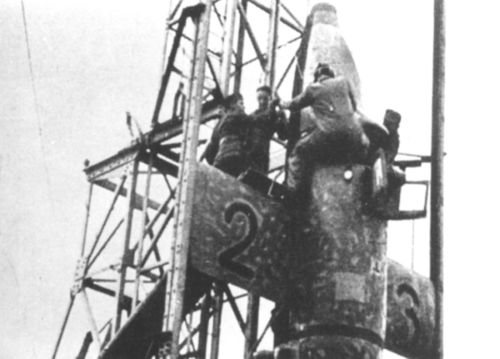

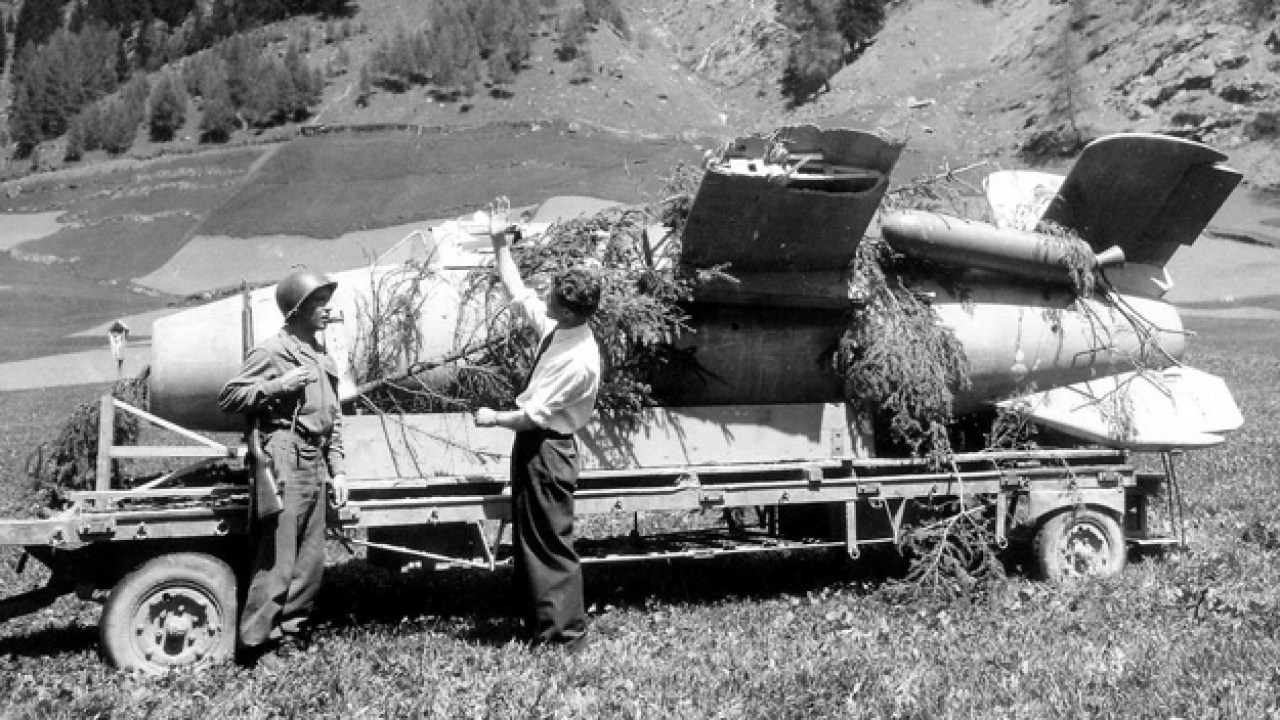
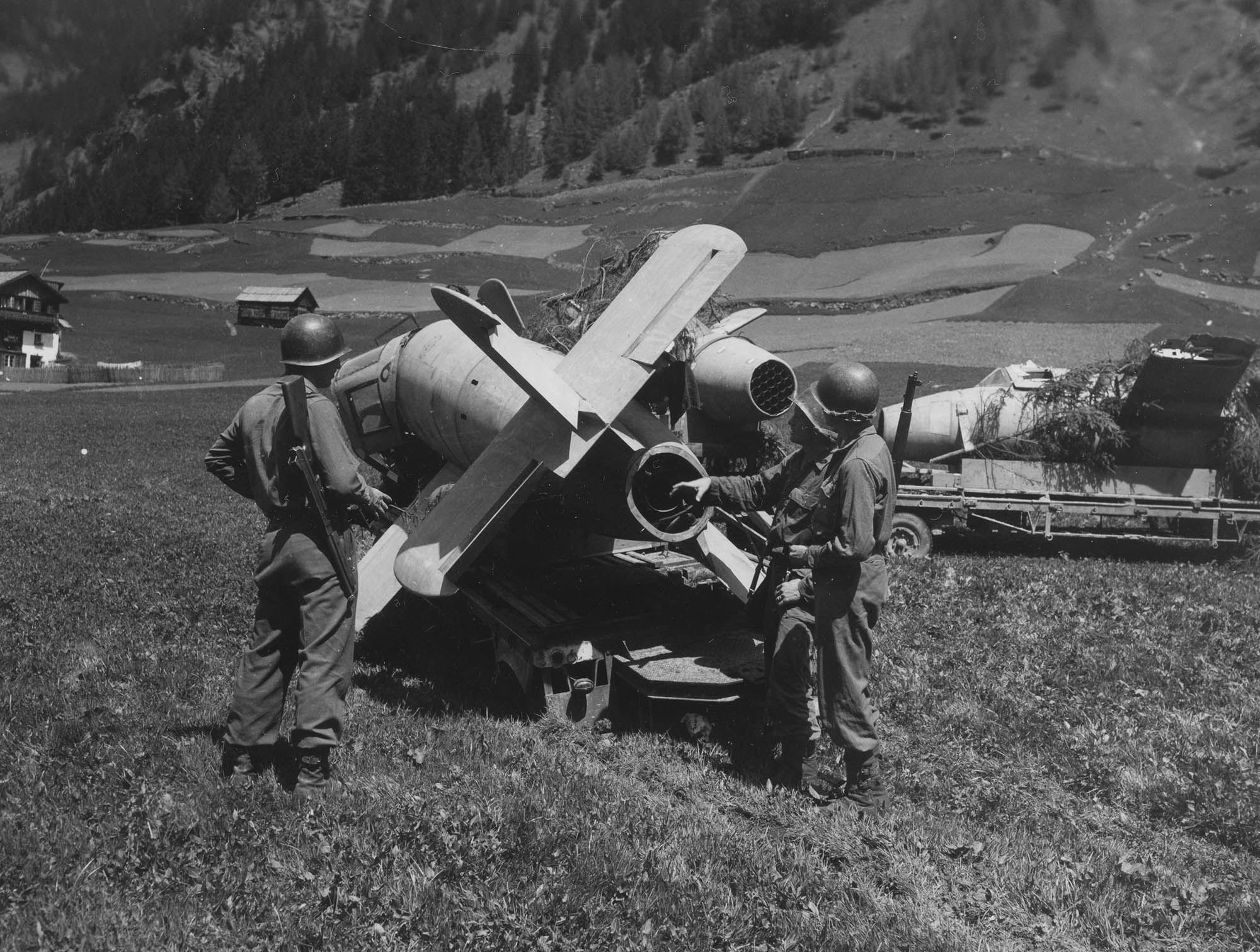
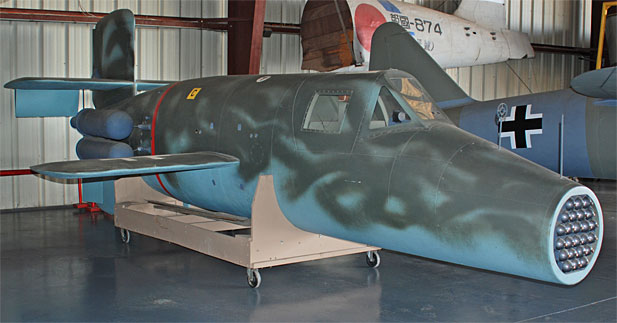
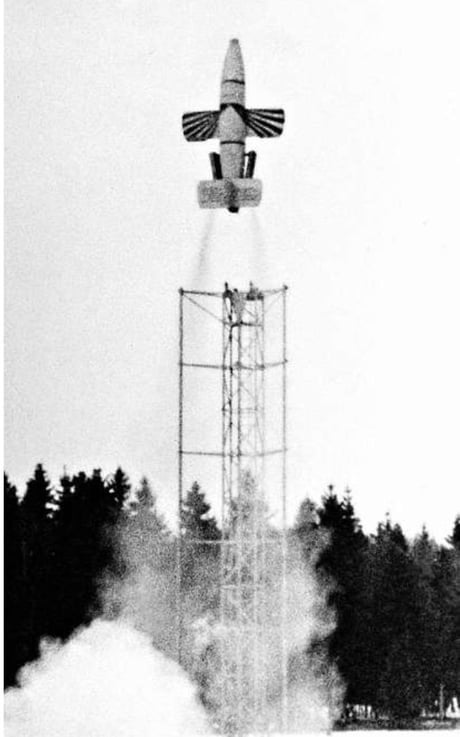
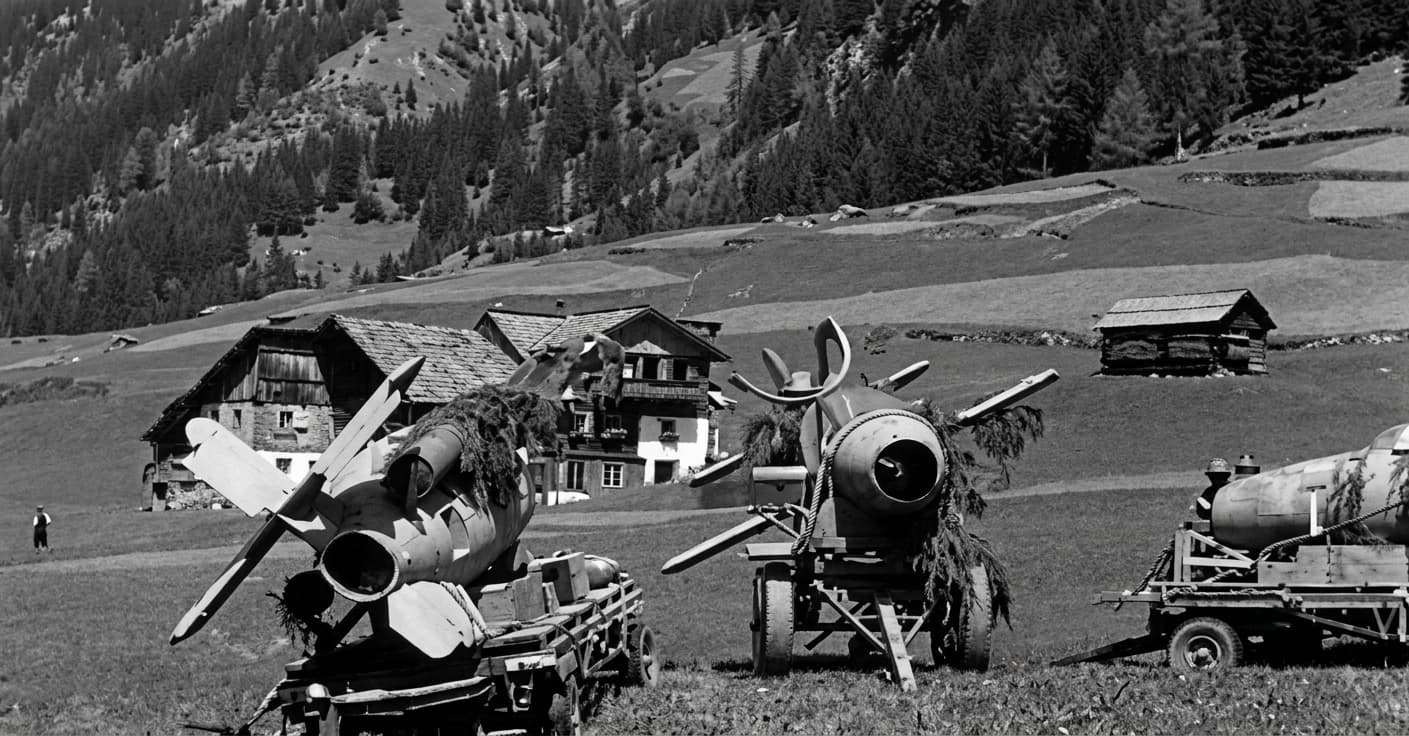
Sources
Spoiler
-
Horst Lommel: Der erste bemannte Raketenstart der Welt – Geheimaktion Natter. 2. Auflage. Motorbuch-Verlag, Stuttgart 1998, ISBN 3-613-01862-4.
-
Roger Ford: Die deutschen Geheimwaffen des Zweiten Weltkriegs. Nebel-Verlag, Eggolsheim 2003, ISBN 3-89555-087-6
-
Wolfgang W.E. Samuel: Watson’s Whizzers. Operation Lusty and the Race for Nazi Aviation Technology. Schiffer Military History, Atglen 2010, ISBN 978-0-7643-3517-4.
-
Brett Gooden: Projekt Natter: Last of the Wonder Weapons (englisch). Classic Publications, Burgess Hill 2006, ISBN 1-903223-62-8.
-
Brett Gooden: Natter: Manned Missile of the Third Reich (Historic step to human spaceflight), Englisch. Brett Gooden, Australia 2019, ISBN 978-0-646-99748-3
-
Bachem Ba 349 B-1 Natter (Viper) | National Air and Space Museum
-
Today in Aviation History: First Flight of the Bachem Ba 349 “Natter” - Vintage Aviation News