ASCOD PROTOTYPE NO.3
INTRODUCTION
HISTORY
Spoiler
As the NM135 infantry fighting vehicles from 1980 started to show it’s age, it was obvious that a replacement was needed, and upgrading the NM135 wouldn’t be adequate to be used against evolving weaponry and vehicles of other nations as it’s tactical mobility, protection and firepower simply weren’t good enough, thus, the Project 5033 Infantry Vehicle Programme began. Several vehicles of foreign nations were considered, both in tactical ways, economic and technical areas, the main priorities were; that the new ifv needed to have a level of mobility that was just as good as the Leopard 1, or preferably better, capacity for at least 8x crewmembers with full equipment in addition to the wagon crew, firepower with the ability to reliable fight all existing armored vehicles and helicopters/low flying aircrafts, and that it had sufficient protection from the era’s threats.
After Norway had sorted out an selection of contenders, those vehicles were prepared for a large Trial in Norway wich were to be held in two rounds, the first in 1991-1992 wich mostly were to train the Norwegian crew and testing at Trandum Camp in Norway, and the vehicles used here were the ASCOD Protoype No.1 (Only nation to trial the vehicle outside the development nations Austria and Spain), the German Schützenpanzer ACV Puma prototype, the British FV501 Warrior, the Swedish CV9040B and the Spanish ASCOD. This first part of the trial lasted a couple months.
The second and more important trial took place in 1993-1994, and the selection of this trial were now the modified CV9030 IFV, M2A2 Bradley and the Ascod Prototype No.1 or 3, and because the crew’s were trained on the vehicles, the proper trials could begin. This time at Hjerkinn shooting range. As Norway’s climate can be quite harsh at times, and with small roads and difficult and steep terrain, often with several meters of snow, the mobility of the vehicles, especially their ability to drive in and trough snow, most of the testing were done in the snowy terrain of Hjerkinn Shooting Range in mid-Norway. They also had to be able to handle the very cold temperatures they would face here. The criteria of the trials were as follow;
-Crossing 80 Meters of swamp
-Firing (Accuracy)
-Firing at -15,+15,+30,+45 degrees celsius
-Driving in Deep Snow round 1
-Driving in Deep snow round 2
-Slalom - This is a skiing style, basically means zigzag
-Circuit, 1.5 m snow, round 1
-Circuit, 1.5 m snow, round 2
-Circuit, 6-7 km long, medium terrain
-Circuit, 4 km long, rough terrain
-Slope, 1 m snow, round 1
-Slope, 1 m snow, round 2
-Slope, 1 m snow, round 3
-0.8 m Step
-15% Slope, ice
-17.5% Slope, ice
-Fording River, 1 m deep, 10m wide
-Fording River, 1.7 m deep, 10m wide
-Cold start, -20 degrees Celsius
-370 km drive
-Track change
The clear winner of this trial, were the Swedish cv90, as it was much lighter, and basically floated on top of the snow, with the German Schützenpanzer ACV Puma prototype in the 2nd place, those had the best performance overall, with the cv90 almost being supreme, as it could both handle cold temperatures really well and being light enough to have very good mobility. For example the cv90 could drive in circles around the M2A2 Bradley, wich were the heaviest of them all and consistently got stuck in the snow as you can see in the video i attached lower in the suggestion!
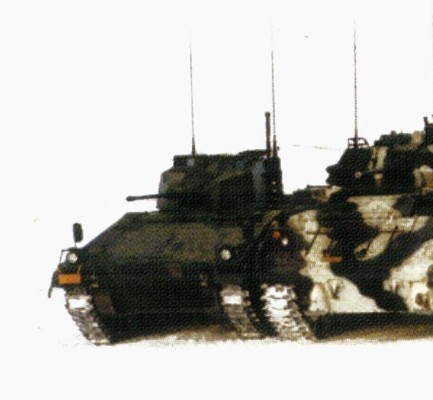
The ASCOD was an Austrian-Spanish Cooperative Development, and prototypes were developed iteratively during the late 1980s and early 1990s, with Prototype No. 1 (PT01) serving as the initial baseline and Prototype No. 3 (PT03) incorporating significant updates based on testing feedback, particularly from Norway’s IFV trials in 1992–1994. PT03 was essentially a rebuilt or heavily modified version of an earlier prototype, reflecting refinements for improved performance, stability, and reliability. Below, I’ll outline the key specifications for PT03 where available, followed by a comparison to PT01. Note that detailed specs for individual prototypes are sparse in open sources, as much of the documentation focuses on production variants (e.g., Spanish Pizarro and Austrian Ulan). The information is derived from military analyses and development histories, emphasizing evolutionary changes.
SOME DETAILS OF THE ASCOD PROTOTYPE NO.3
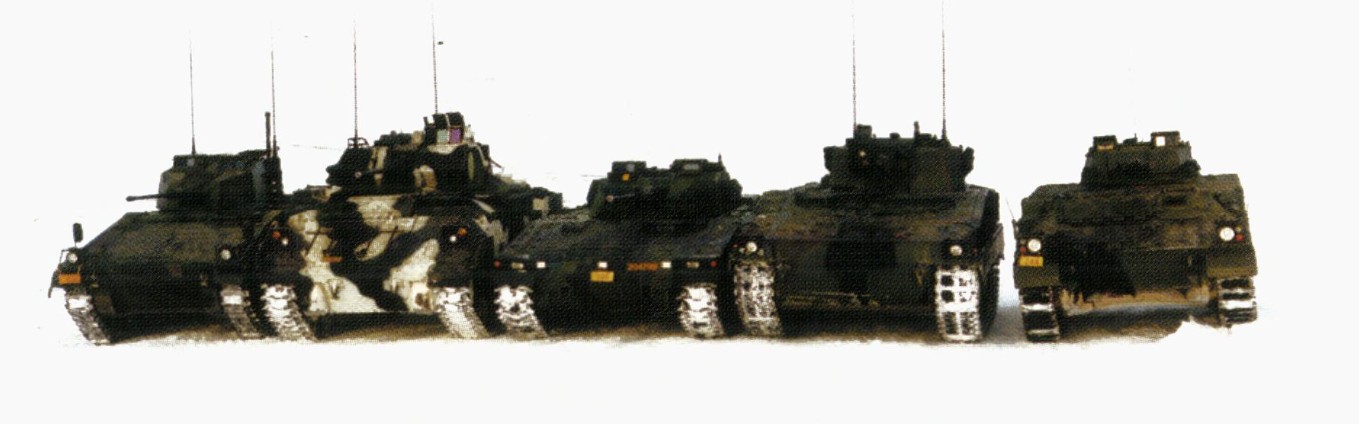
-Image left to right: Ascod PT03, M2A2 Bradley, CV9030 IFV, Puma, Warrior
- was lighter at ~18.8–21 tonnes (optimized for initial mobility but insufficient for added requirements)
- had a shorter hull (~6.2–6.8 m length)
- 6 road wheels per side (12 total), with rotary dampers likely at 1st and 5th/6th stations.
- used a 500 hp diesel engine (lower power-to-weight ratio of ~24–26 hp/t)
- performed adequately in basic tests but struggled in extreme winter conditions (e.g., cold starts at -20°C, long-distance drives)
- Similar base armament for both (30 mm Mauser MK 30-2), but PT01 lacked advanced features like full stabilization, laser rangefinder, thermal sights, and a comprehensive fire control system (FCS).
- had basic rolled steel armor (frontal 14.5 mm protection, all-round 7.62 mm)
- had a standard layout ergonomic wise
- was for proof-of-concept and initial trials.
- increased to 25–29 tonnes to accommodate enhanced protection and chassis extensions, reflecting iterative requirement changes during development.
- was lengthened for stability, with an additional road wheel station per side.
- 7 road wheels per side (14 total), improved suspension for better weight distribution, shock absorption, and cross-country performance. This addressed stability issues in swamps, slopes, and deep snow during Norway trials. More effective torsion bar system and reconfigured trailing arms.
- upgraded to 600 hp or equivalent, improving acceleration and handling heavier loads (e.g., 0–50 km/h in ~14 seconds in similar configs)
- featured refined drivetrain (14 road wheels, 6 support rollers, 2 tensioning wheels, 2 drive wheels) and better overall reliability, directly from trial feedback.
- Similar base armament for both (30 mm Mauser MK 30-2), but PT01 lacked advanced features like full stabilization, laser rangefinder, thermal sights, and a comprehensive fire control system (FCS).
- enhanced this with better base armor thickness, spall liners, and provisions for add-ons like composite panels or ERA, increasing survivability.
- ergonomically wise featured a reconfigured interior for improved crew comfort, accessibility, and maintenance, based on user feedback.
- represented the “final configuration” post-refinements, bridging to production (e.g., Prototype No. 4 as Spanish baseline). This shift helped ASCOD compete better, though Norway ultimately chose the CV90 for its production readiness.
ARMAMENT
Spoiler
-
Main Weaponry: 1x 30 mm Mauser MK 30-2 autocannon
- Feed system: dual feeder
- Firing rates: up to 200–770 rpm depending on mode; ammunition types include HEI-T, APDS, APFSDS-T).
-
Secondary weapon: Coaxial 7.62 mm MG3 machine gun.
-
Smoke grenade launchers: 76 mm (typically 4x3 configuration)
TECHNICAL DATA
Spoiler
Ascod PT03 Specs
-Weight: Approximately 25–29 tonnes (increased from earlier designs due to added armor, lengthened chassis, and other enhancements; exact figure varies by source, but aligned with the final development weight of 29 tonnes before production).
Dimensions:Length: ~6.8–7 m (extended due to additional road wheel station).
-Width: ~3.15 m.
-Height: ~2.65 m (overall, including turret).
-Ground clearance: ~450 mm.
-Engine: Diesel engine, likely 600 hp (447 kW), based on the transition to production specs (e.g., MTU 8V-183-TE22 or similar); some sources indicate alignment with the 530–600 kW range for upgraded variants.
-Power-to-Weight Ratio: Around 20–25 hp/t (improved over early prototypes due to refinements).
-Suspension and Mobility: Torsion bar with trailing arm type.
7 dual rubber-tyred road wheels per side (14 total). Drive sprocket at front, idler at rear, 3 track-return rollers per side. Rotary dampers at the 1st and 6th road wheel stations. Hydraulic track tensioning system.
-Maximum speed: ~70 km/h on roads.
-Enhanced for extreme conditions (e.g., better performance in snow, ice, and rough terrain post-Norway feedback).
-Crew and Capacity: 3 crew (commander, gunner, driver) + 8 passengers.
-Armor and Protection: Rolled steel base with options for add-ons; enhanced compared to PT01, providing frontal protection against 14.5 mm AP rounds at 500 m+ and all-round against 7.62 mm. Included spall liners and potential for composite or ERA upgrades.
-Fire Control and Electronics: Improved over early prototypes; likely included basic stabilization, laser rangefinder, and day/night sights (transitioning toward digital systems like those in Ulan).
-Other Features: Reconfigured interior for better ergonomics; reduced silhouette for lower signature; torsion bar suspension with Piedrafita rotary dampers (AR01/AR02 models).
VIDEO
SOURCES
Spoiler
Kavaleriet i Norge 1200-1994 : utvikling og innsats gjennom 800 år
Link: Nasjonalbiblioteket
Søndenfjeldske dragonregiment 1987-2002
Link: Nasjonalbiblioteket
Den Sorte lue : medlemsblad for kameratforeningen Norske Dragoner hvori opptatt Hedmarks Dragonforening. november 2008 Vol. 5 Nr. 4
Link: Nasjonalbiblioteket
Norsk militært tidsskrift (trykt utg.). 1992 Vol. 162 Nr. 8/9
Link: Nasjonalbiblioteket
Forsvarets forum (Forsvarets rekrutterings- og opplysningstjeneste) : organ for alt personell i Forsvaret. 1993 Vol. 14 Nr. 4
Link: Nasjonalbiblioteket
POLL
- Yes
- No