- Yes, as a tech tree vehicle
- Yes, as a premium vehicle
- Yes, as an event vehicle
- Yes, as a squadron vehicle
- No, I would not like to see the Whitley Mk.V in game.
Given caption: “Armstrong Whitworth Whitley Mark V, Z9266 ‘ZA-K’ of No. 10 Squadron RAF based at Leeming, Yorkshire, in flight. Z9266 was soon to be transferred to No. 77 Squadron RAF, with whom it went missing while on a raid to Dusseldorf on 28 December 1941.” (source)

TL;DR
- Medium/heavy bomber of the interwar period
- Stressed metal skin for durability
- Odd flight behavior limits its top speed, but it still moves decently quick
- Large payload for its size
- Good field of fire for the rear turret, but coverage of front/sides lacking
Why it should be in the game: At a potential BR of 3.3-3.7, the Whitley Mk.V would make an excellent segue from the medium Wellington to the heavy Halifax. Its historical significance as an early component of the RAF’s night bomber wing cannot be overstated and is another reason it should be represented. As a night bomber it would struggle in War Thunder’s daylight setting, but not exceptionally more than any other bomber. Finally, it just looks funny and I think that’s neat.
History
Given caption: “The second prototype Armstrong Whitworth Whitley bomber.” (source)

The A.W.38 Whitley began life as a cargo aircraft, the A.W.23. While this design was passed over, Armstrong Whitworth engineers kept the experience in mind when designing a bomber to meet specification B.3/34. The Whitley was designed by John Lloyd, the chief engineer at Armstrong Whitworth Aircraft. Originally it was designed with the A.S. Tiger radial engine in mind, which was acceptable but weaker than the Bristol Pegasus which powered its contemporaries, the Wellington and Hampden. This was because the plane was designed for night bombing missions and speed was not viewed as an extreme priority. Of course, the stressed metal skin and monoplane design of the Whitley promised better speed than its biplane predecessors, and it carried a good size bomb load of 3,365 pounds (why this exact number, I have no idea.) These bombs could be stowed within a fuselage bomb bay or fourteen wing cells, seven of which were built into each. Its defensive armament of one nose mounted .303 Browning machine gun and one tail mounted gun was unimpressive, but considered adequate for night bomber duty. The strangest feature of the Whitley was its wing incidence. The design originally omitted wing flaps, and to make up for this the wing had an 8.5 degree angle of incidence for better low speed handling. Despite flaps later being incorporated, this design feature never went away, and led to the aircraft’s nose pointing downwards in level flight. Performance took a hit from this, but apparently it was not enough of a problem to ever change the incidence of the wing.
Given caption: “A Whitley crew preparing for a night sortie in November 1941. The ground crew wait patiently as last-minute adjustments are made to the pilot’s flying clothing at dispersal. Note the parachutes and map bags on the ground, and the thermos flask- an essential item of personal kit for a seven-hour flight a draughty Whitley.” (source)

The Whitley would undergo various revisions leading up to the outbreak of World War II. This included an extremely British extension of the bombardier’s window for better visibility. An attempt to improve the defensive armament with the Whitley Mk.III’s retractable ventral turret ended in failure, though the aircraft introduced the ability to carry larger bombs. The real saving grace for the Whitley came from the Mk.IV, which introduced a powered turret fitting four .303 Browning machine guns in the tail much like the one which would later be used on larger bombers like the Halifax. Compared to other bombers in 1938, this was actually the most powerful tail-mounted armament to date and did see some results. The Mk.IV also switched out the uprated Tiger radials for liquid-cooled Merlin inline engines which had less drag and put out more power. However the Mk.IV was very short lived in production since even more design refinements resulted in the penultimate Mk.V. Compared to the Mk.IV, the wing design was amended and the rear fuselage was extended, providing the tail turret with a good field of fire. By the end of its development, the Whitley had more than doubled its bomb load to a maximum of 7,000 pounds.
A Luftwaffe intelligence diagram dated 1943 showing pilots where the fuel tanks of the Whitley Mk.V were located and the firing arcs of its guns. Oddly, the nose is depicted as featuring a twin Browning mount. Considering at least one Whitley had crashed in Nazi occupied Holland, it’s a strange mistake to make.
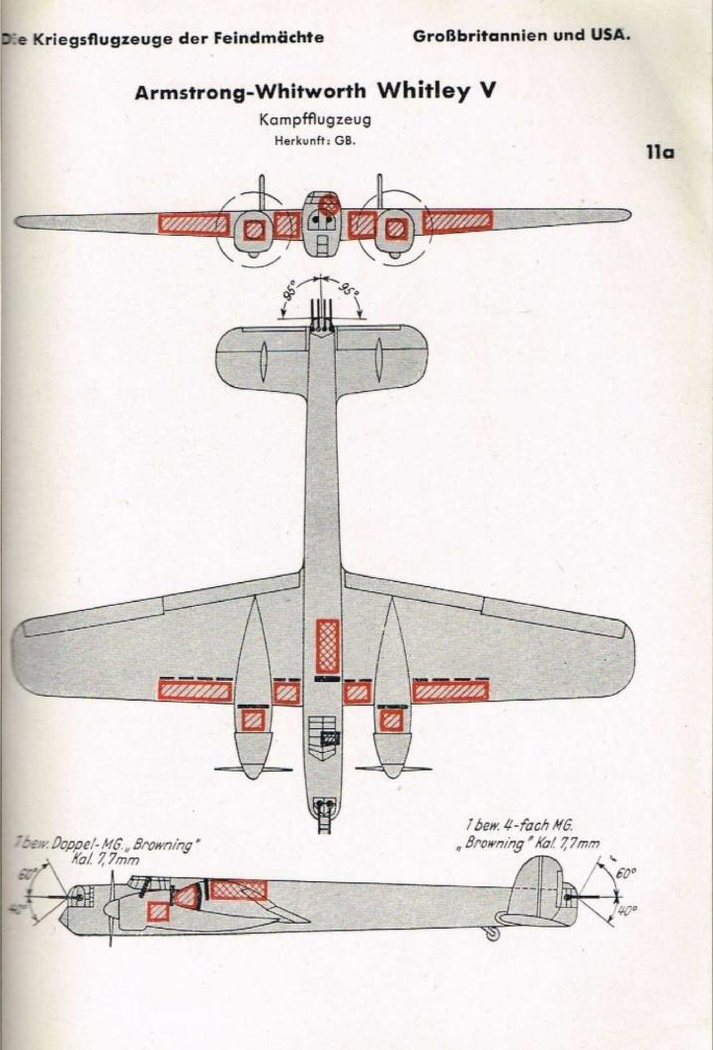
When conflict erupted, most Whitleys on the front lines were Mk.IIIs before Mk.V production could ramp up. The Mk.V would have 1,476 units produced, which participated in many key operations and firsts for Bomber Command. It was not only the first British bomber to strike at the German mainland, but Italy as well, having flown over the Alps in a long-distance mission. The aircraft found itself well-suited to other missions such as dropping leaflets and paratroopers, which was another first achieved in 1941. The Whitley’s bombing duties mainly occurred at night initially, as its design specification called for, making loss rates lower than the Wellington. Meanwhile its durability was evident as plane after plane limped home with damaged skins. Naturally, the design which was on the verge of being obsolescent at the outbreak of the war did not have too much longer to shine, with larger and heavier bombers handily outdoing it in its niche. As such it was retired in Spring of 1942, but still used for its other duties well into 1943. Overall, the Whitley Mk.V was a surprisingly capable yet often overlooked tool in the RAF’s arsenal.
Specifications
Whitley Mk.V
Dimensions:
- Length: 72 ft 6 in (22.10 m)
- Span: 84 ft 0 in (25.60 m)
- Height: 15 ft 0 in (4.57 m)
Weight:
- 19,350 lb (8,777 kg) empty
- 28,200 lb (12,791 kg) loaded
- 33,500 lb (15,195 kg) maximum
Propulsion: 2 x Rolls-Royce Merlin X
- 1,075 hp each; 2,150 hp total (takeoff)
Maximum speed:
- 230 mph (370 km/h) @ 16,400 ft (5,000 m)
Armament:
- Guns:
- 1 x 1 .303 caliber Browning machine gun in a powered nose turret
- 1 x 4 .303 caliber Browning machine gun in a powered tail turret
- Bombs:
- Up to 7,000 lb total
Crew: 5 (pilot, copilot/navigator, bombardier, radio operator, tail gunner)
Additional equipment:
- Bomb sight
Sources
- Famous Bombers of the Second World War: Volume 2 by William Green (1960)
- The Armstrong-Whitworth Whitley by Philip J. R. Moyes (1967)
- Die Kriegsflugzeuge der Feindmächte, Teil I: Großbritannien und USA (November 1943)
- https://www.armstrongsiddeleyheritagetrust.com/a-w-38-whitley