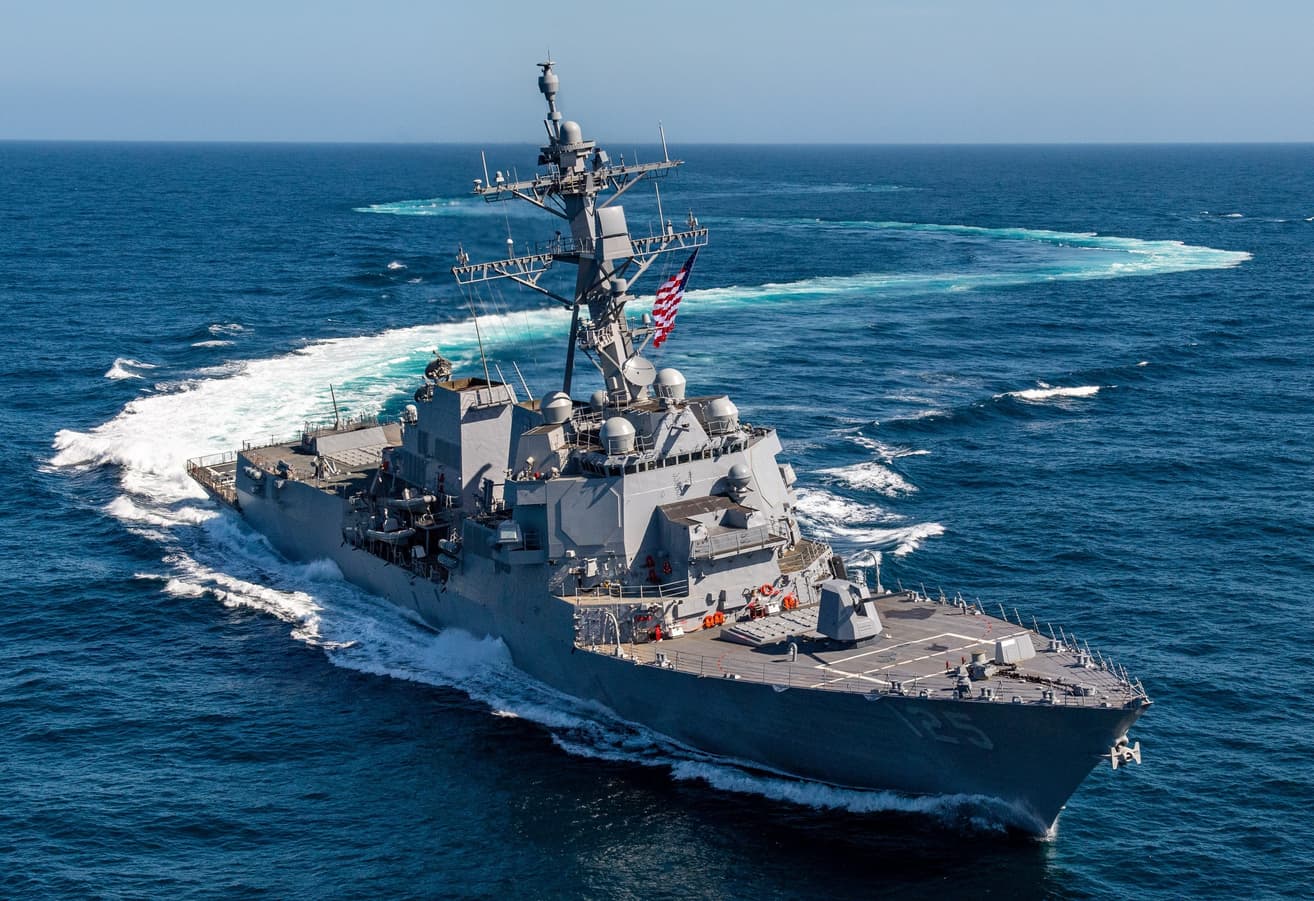
Description
Background
An artist’s concept of the USS Arleigh Burke (DDG-51) class guided missile destroyer, July 16, 1984.
Arleigh Burke-class destroyers were designed and introduced in the early 1980s to replace the aging Charles F. Adams- and Farragut-class destroyers, along with the Leahy- and Belknap-class cruisers. The Navy intended the Arleigh Burke class to serve as lower-end, Aegis-equipped multirole destroyers, while the Aegis-equipped Ticonderoga-class cruisers, firstly introduced in the early 1980s, filled the high-end multirole role.
Diagram of the Aegis Combat System for Aegis vessels with Mk 41 VLS.
Ships of this class were designed with a new hull, approximately 50 feet (15 meters) shorter than that of the Ticonderoga-class cruiser. The design incorporated much of the propulsion and machinery plant from the Spruance-class (DD-963) destroyers, as the Ticonderoga class had done. The Aegis Combat System was the cornerstone of the design, consisting of the AN/SPY-1 radar arrays, the Mk 99 Fire Control System, the Weapon Control System, and the Command and Decision System, all working together to detect, track, and engage multiple targets simultaneously. In the 1980s, this was considered the most advanced combat system in the US Navy. These ships were capable of performing air warfare, undersea warfare, naval surface fire support, and surface warfare missions, providing highly flexible operational capability.
Flight I USS Arleigh Burke (DDG-51) conducts underway operations in support of Operation Iraqi Freedom, March 29, 2003
In addition, the ships featured an all-steel superstructure to improve survivability. At approximately 8,300 tons displacement, the ships were initially equipped with two VLS units, one 5-inch (127 mm)/54 Mk 45 gun, two CIWS mounts, and two Harpoon launchers. With the first ship, USS Arleigh Burke (DDG-51), laid down in December 1988 and commissioned in September 1991, 70+ additional ships were built in successive batches, defined as “Flights.” DDGs 51–71 represent the as-built design and are Flight I; DDGs 72–78 are Flight II ships; and DDGs 79–124 and DDG-127 are Flight IIA ships. The Flight III begins with DDGs 125–126 and continues with DDG-128 onward.
Flight II USS Mahan (DDG-72) in the Atlantic Ocean during Exercise Mediterranean Shark, July 22, 2006.
Flight I destroyers did not include helicopter hangars due to cost and design constraints, though they retained flight decks for landing, refueling, and rearming helicopters. Flight II ships, introduced in fiscal year 1992, retained this configuration while incorporating improved sensors and communications.
Flight III was originally intended to succeed Flight I and II ships in fiscal year 1994; however, the end of the Cold War led to budget cuts that impacted the program, resulting in its cancellation in December 1990. Instead, Flight IIA was introduced shortly afterward in the early 1990s. The Navy found the design adaptable for upgrades, so Flight IIA ships incorporated two helicopter hangars, an increased length of 509.5 feet (155.3 meters), a longer 5-inch/62-caliber Mk 45 Mod 4 gun, elevated rear SPY-1D arrays to reduce blind spots, redesigned propellers, and upgraded sensors. However, Flight IIA ships lost the two quadruple Harpoon launchers, the AN/SQR-19 TACTAS, and one forward Phalanx CIWS (beginning with DDG-85).
An HH-60H and an SH-60F Seahawk helicopter flanking Flight IIA USS Oscar Austin (DDG-79) while underway in the Persian Gulf, October 26, 2005.
The Navy began modernization efforts for existing Flight I and II vessels between 1996 and 2000. The goal was to provide mid-life upgrades to ensure the destroyers remained effective over service lives of at least 35 years, while reducing manpower requirements and overall costs and improving combat capability. New technologies were first tested on DDG-111 and DDG-112 before being applied to earlier ships. The modernization program was conducted in two phases: the first focused on hull, mechanical, and electrical (HM&E) systems, while the second focused on upgrades to the Aegis Combat System. By 2017, these modernization technologies had been introduced across in-production ships.
It was originally planned to conclude the class with USS Michael Murphy (DDG-122) and transition to the Zumwalt-class destroyer. However, in 2008, due to concerns about lacking capabilities against ballistic missiles, anti-ship missiles, and submarines, the Navy resumed Arleigh Burke-class production with DDGs 113 through 115 as Flight IIA Restart ships, incorporating modernization features. DDG-116 through DDG-124 and DDG-127 were ordered as Flight IIA Technology Insertion ships, integrating elements intended for Flight III.
Flight III USS Ted Stevens (DDG-128) during her acceptance trials, December 29, 2025.
In fiscal year 2013, the Navy revived the Flight III program with a refined design. Plans called for the procurement of 24 Flight III ships from FY2016 to FY2031. The primary upgrade was the AN/SPY-6(V)1 Air and Missile Defense Radar (AMDR), which provides significantly greater capability than the SPY-1D system and enables simultaneous air and ballistic missile defense operations. The first Flight III ship, Jack H. Lucas (DDG-125), was laid down in November 2019 and completed in June 2021. Flight III achieved initial operational capability in 2024, and construction continues, with 4 of the planned 24 ships completed to date.
In 2017, the Navy initiated another modernization effort for Flight IIA ships, combining both upgrade phases into a single process. This included the introduction of the Surface Electronic Warfare Improvement Program (SEWIP) Block 2 and enhancements to overall combat capability, increasing commonality between newly built and modernized ships.
All existing Arleigh Burke-class destroyers remain in active service to this day, and some ships have seen action in the Middle East since 1996.
Propulsion
The LM2500 engine is typically installed within a metal enclosure to isolate sound and thermal from personnel and adjacent machinery spaces.
As designed, the Arleigh Burke-class destroyer was powered by four gas-turbine General Electric LM2500 engines, originally each rated at 21,500 shp. With the introduction of this class, these engines were uprated to 26,500 shp and provided the ship with a total of 106,000 shp and a top speed exceeding 30 knots. The LM2500 propulsion system was so reliable and successful that it was also used on the earlier Spruance-class destroyers and Ticonderoga-class cruisers and has remained in service on most subsequent US warships through later iterations of the LM2500 family.
Aegis Combat System & Sensors
User-made Infographics of Flight IIA USS Jason Dunham (DDG-109).
Until the introduction of Flight III ships, each Arleigh Burke-class guided-missile destroyer had four AN/SPY-1D PESA 3D radar systems installed in light grey octagonal panels on the sides of a single deckhouse, providing 360-degree coverage. The SPY-1D was a development of the Ticonderoga-class cruisers’ SPY-1B, designed specifically for operations on Arleigh Burke-class destroyers. Flight IIA ships included elevated rear SPY-1D arrays on a revised deckhouse to eliminate blind spots. This also applies to Flight III ships, except that they replace the SPY-1D with the more capable AN/SPY-6(V)1 AESA 3D radar, known as the Air and Missile Defense Radar (AMDR). This system improves detection of smaller targets at greater distances and enables simultaneous defense against ballistic missiles, cruise missiles, air and surface threats, while also supporting electronic warfare functions. In addition, the AN/SPY-6(V)4 was developed and made available for retrofit on Flight IIA ships; its capabilities are similar to the SPY-6(V)1, though it uses fewer Radar Modular Assemblies (24 RMA vs. 37 RMA).
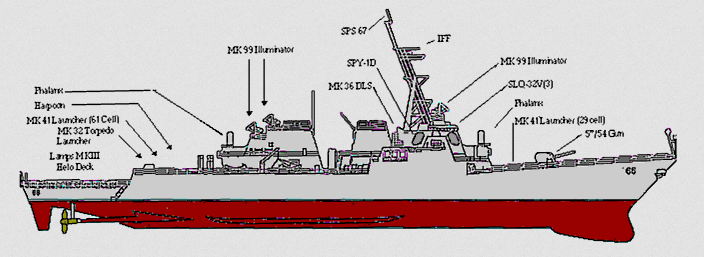
Diagram of the Original Flight I/II destroyer.
The AN/SPS-67(V) is a search and surveillance radar designed primarily for use on surface vessels. The AN/SPS-67(V)3 was installed beginning in the 1990s on DDG 51–102 and was designed to operate with the Aegis system. It included digital automatic target detection (ATD), track-while-scan (TWS), and moving target indicator (DMTI) capabilities. It was later replaced by the AN/SPS-67(V)5, beginning in the fourth quarter of fiscal year 2007, on Flight II and IIA ships (DDG-72–102 as backfit and DDG-103–118 as production units) to address limitations in the earlier signal processor. The (V)5 variant provided improved detection and tracking performance, support for gun engagements, and better operation in littoral environments. The SPS-67(V)5 is being replaced by the AN/SPQ-9B multi-purpose surface search radar on DDG-119 onward.
The AN/SPS-73(V)12 was another surface search and navigation radar installed on DDG-51 through DDG-86. It acted as a short-range surface search and navigation radar, providing range and bearing data with signal processing and automatic target detection. Beginning with DDG-87, it was replaced by the BridgeMaster E surface search and navigation radar.
To engage air or surface targets with missiles, three AN/SPG-62 fire-control radars are used for terminal illumination in conjunction with the Aegis system. One antenna is mounted on the main deckhouse, while the other two are installed on the aft superstructure.
For ASW, an AN/SQS-53C sonar was mounted in the bow below the waterline, with both active and passive operating modes. It served as a key sensor for ASW weapons guidance. The ship could also employ the AN/SQR-19 tactical towed-array sonar, capable of passively detecting hostile submarines at very long range. Beginning with DDG-113, the ships could also use the TB-37U multi-function towed array sonar.
Left: AN/SLQ-32(V)3 EW system aboard the Flight II USS McFaul (DDG-74). Right: AN/SLQ-32(V)6 system aboard the Flight IIA USS Bainbridge (DDG-96).
The AN/SLQ-32 electronic warfare suite was installed, providing improved capability to detect and give early warning of hostile emitters and targeting systems. Flight I and II ships used the SLQ-32(V)3, while Flight IIA ships used the SLQ-32(V)6. As part of the Surface Electronic Warfare Improvement Program, the (V)6 variant was made available as a retrofit, replacing the earlier (V)3 systems. Flight III ships are equipped with the SLQ-32(V)7.
Armament
Left: Flight I USS Benfold (DDG-65) firing its 5″/54 Mk 45 Mod 1 gun during routine training operations off the coast of Southern California, April 16, 1997. Right: Flight IIA USS Mustin (DDG-89) firing its 5"/62 Mk 45 Mod 4 gun during the joint training in the Pacific Ocean, July 9, 2009.
As designed, the destroyers were armed with one 5-inch (127 mm)/54 caliber Mk 45 gun on the forward bow. The Mod 1 introduced improved capability to select and fire six different types of ammunition, with high-explosive rounds being the most common, either in anti-aircraft or high-capacity projectiles. The gun’s rate of fire was 20 rounds per minute in automatic mode. Beginning with DDG-81, the older Mk 45 Mod 1 was replaced with the longer 5-inch/62-caliber Mk 45 Mod 4, which offered increased range and lethality, with engagement distances up to 13 nautical miles (24 km). Both versions are controlled by the Mk 34 Gun Weapon System integrated with Aegis, directing fire in anti-ship, anti-air, and naval gunfire support roles. The Mk 34 system includes the stabilized Mk 46 Optical Sight System, which enhances situational awareness, supports navigation, enables visual target identification, and supplements primary sensors, especially in congested or low-visibility conditions.
Left: Flight I USS Arleigh Burke (DDG-51) firing its forward CIWS during a shooting exercise in the Danish Straits, February 24, 2023. Right: Flight II USS Porter (DDG-78) test-firing its SeaRAM CIWS, March 4, 2016.
Two 20 mm Phalanx CIWS Mk 15 systems were installed for close-range anti-aircraft and anti-missile defense, one on the bow and one aft. These were later upgraded to Blocks IA and IB, improving radar, ammunition capacity, rate of fire, engagement envelope, and computing. Beginning with Flight IIA DDG-85, the ships were fitted with a single CIWS. The CIWS is being replaced by SeaRAM, which combines an 11-cell RIM-116 RAM launcher with the radar and electro-optical systems of the Phalanx Block 1B.
Left: Flight I USS Hopper (DDG-70) firing a Standard Missile 3 from the forward Mk 41 VLS. Right: Flight I USS Curtis Wilbur (DDG-54) firing a Standard Missile 2 from the aft Mk 41 VLS.
The ships are equipped with the Mk 41 VLS as their primary missile armament. Flight I and II ships carry one 29-cell forward and one 61-cell aft launcher, totaling 90 cells. Flight IIA and III ships instead carry a 32-cell forward and 64-cell aft configuration, totaling 96 cells. These systems can employ a wide range of missiles, including RIM-66 Standard, RIM-156 Extended Range Standard, Tomahawk, and RUM-139 VL-ASROC.
Left: Flight I USS Fitzgerald (DDG-62) firing a Harpoon missile during a live-fire exercise, near Guam, August 12, 2015. Right: Flight I USS Fitzgerald (DDG-62) firing a new Naval Strike Missile during exercise near the Hawaiian Islands, July 18, 2024.
The Harpoon system was installed on Flight I and II ships, with eight anti-ship missiles in canister launchers mounted at the rear. This system was removed on Flight IIA ships due to the addition of helicopter hangars, with increased VLS capacity compensating for the loss of Harpoon missiles. The Kongsberg Naval Strike Missile is replacing the original Harpoon system of Flight I and II ships.
USS Arleigh Burke (DDG-51) firing one of her Mk 38 25mm guns during a live-fire exercise in the Arabian Sea, July 18, 2014.
Four single 12.7 mm Browning heavy machine guns and two 25 mm Mk 38 Bushmaster guns were added as part of later modernization efforts for close-range defense. The Mk 38 guns, in Mod 2 and Mod 3 configurations, introduced remote operation and improved imaging and fire-control systems.
Flight IIA USS Mustin (DDG-89) launching a Mk 46 torpedo, April 12, 2007.
Two triple Mk 32 torpedo tube launchers were installed amidships on either side, used to fire Mk 46, Mk 50, and Mk 54 torpedoes against hostile submarines at close range. On later ships, these were relocated to the aft missile deck to accommodate structural changes.
An MH-60R Sea Hawk helicopter landing on the flight deck of Flight IIA USS Bulkeley (DDG-84), May 18, 2016.
Flight IIA and III ships were equipped with the Light Airborne Multi-Purpose System (LAMPS) Block III, including two SH-60B Seahawk ASW helicopters housed in an enclosed hangar. These helicopters are capable of deploying torpedoes and passive/active sonobuoys to detect and relay information on submerged targets. In the mid-2000s, MH-60R Seahawks replaced the SH-60B with improved avionics and weapons. Although Flight I and II ships lacked hangars, they retained flight decks and LAMPS equipment to support helicopter operations from other ships.
Protection and Countermeasures
Arleigh Burke-class vessels were fitted with Kevlar armor in critical areas such as magazines, command spaces, missile storage, and radar rooms to protect against fragmentation and small-arms fire. This spall liner, applied over steel bulkheads, reduced secondary fragmentation from nearby impacts. While not designed to withstand large-caliber hits, it improved overall crew survivability. Approximately 130 tons of Kevlar protection were installed. The ships also featured all-steel construction, with only the mast made of aluminum.
Left: Mk 36 SRBOC firing a chaff decoy from Flight I USS Stout (DDG-55), April 7, 2016. Right: Mk 53 launching system firing a Nulka decoy from Flight IIA USS Dewey (DDG-105), July 11, 2018.
For countermeasures, the ships were equipped with Mk 36 chaff decoy launchers, used to defend against anti-ship missiles by generating false targets and disrupting enemy guidance systems. Arleigh Burke-class destroyers typically carried between four and eight launchers, each with six 130 mm tubes arranged in two rows at 45 and 60 degrees to disperse decoys at 75 m/s. Through modernization, the Mk 53 Decoy Launching System was added, incorporating up to six Nulka launchers used alongside the Mk 36 system. The Nulka decoy emits a large radar signature while flying a programmed trajectory to lure incoming missiles away, with a flight duration of approximately 10 minutes.
Left: Flight I USS Ramage (DDG-61) launching Naval Decoy IDS300, June 18, 2014. Right: USS Ramage (DDG-61) recovering an inflated decoy, June 12, 2014.
In addition, the ships were retrofitted with the Mk 59 decoy launching system, which includes four launchers capable of deploying the Inflatable Decoy System (IDS300). Once deployed at sea, the decoy inflates into a radar-reflective structure designed to attract incoming anti-ship missiles away from the ship. These decoys can remain afloat for several hours under calm conditions.
AN/SQL-25 Torpedo Protection Concept.
The Torpedo Countermeasures Transmitting Set AN/SLQ-25, known as Nixie, was a towed decoy system used to confuse and divert acoustic- and wake-homing torpedoes by emitting simulated ship noise, drawing threats away from the vessel.