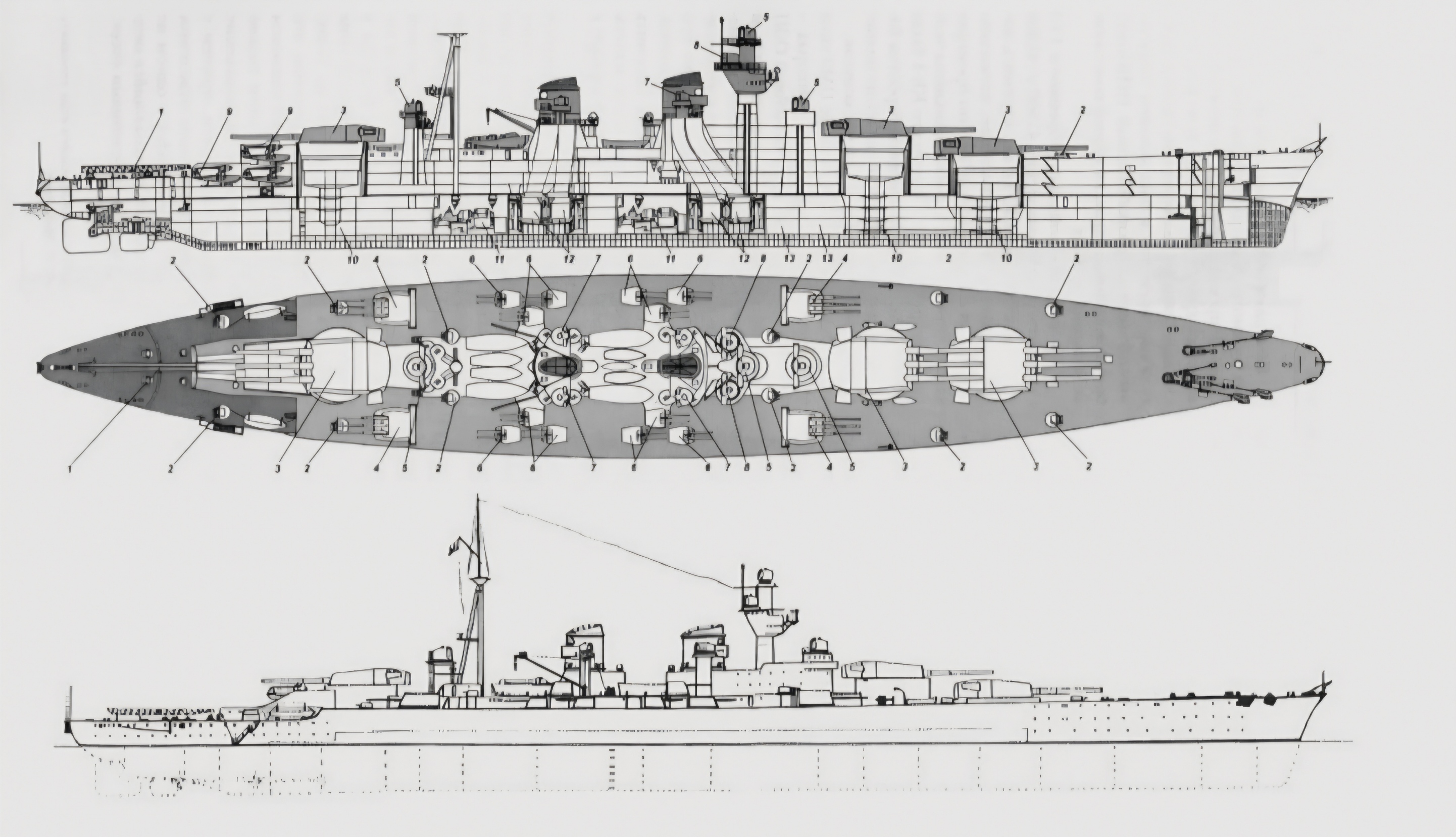
1. Historical Context & The 406 mm Main Armament Question
Often brought up in discussions regarding high-tier additions for the Regia Marina tech tree, “Project UP.41” (“Ufficio Piani” – 41,000-ton design study, associated with General Umberto Pugliese’s technical oversight) represents the technical intersection between Italian naval engineering of the 1930s and Soviet oceanic fleet ambitions.
Contrary to popular misconception, UP.41 did not originate as a direct replacement for the “Littorio”-class within the Regia Marina. Instead, it was an export design developed by the Ansaldo shipyards in Genoa in 1936 at the request of the Soviet Navy (VMF), which was seeking foreign technical assistance for its heavy battleship program (later realized domestically as Project 23 / “Sovetsky Soyuz”-class).
“Note on Original Archival Designation (“Nave di Battaglia da 42.000 T.St.”)”: In Ansaldo’s official technical title blocks and contemporary Italian naval records, the design is formally titled “Nave da Battaglia da 42.000 T.St.” (Battleship of 42,000 Standard Tons). In 1930s Italian naval terminology, “Nave da Battaglia” was the standard archival phrasing for a battleship, while T.St. (Tonnellate Standard) denotes “Standard Displacement” under Washington/London Naval Treaty rules (complete ship ready for sea, fully manned and armed, but excluding fuel and reserve feed water).
“Addressing the 406/50 mm Main Guns (Historical Status & In-Game Ballistics)”
Because Italy never built or bench-tested a 406/50 mm naval gun—halting its domestic heavy naval artillery development at the 381/50 mm Ansaldo/OTO—no real-world firing tables or experimental penetration trials exist for an Italian-manufactured 406 mm barrel. While Ansaldo’s preliminary 1936 calculations projected a high-velocity 406/50 mm gun (~830–850 m/s) housed in “Littorio”-style triple turrets, assigning speculative armor-penetration figures to an unbuilt Italian gun would lack primary empirical backing.
However, because UP.41 was engineered specifically to meet Soviet Navy caliber and ammunition requirements, both historical reconstruction and potential in-game implementation can rely directly on the real, bench-tested Soviet “406/50 mm B-37” gun (MK-1 triple turret)—the exact weapon system developed for Project 23 (“Sovetsky Soyuz”) and already established in War Thunder’s ballistic framework:
“Real-World Testing Status”: Prototype barrels of the 406/50 mm B-37 were physically manufactured at Bolshevik Plant No. 232 and extensively fired at the Rzhevka Proving Ground near Leningrad between 1937 and 1940.
“Verified Ammunition & Ballistic Data (406/50 mm B-37)”:
-Armor-Piercing (AP) Shell: 1,108 kg total weight | 830 m/s muzzle velocity (full charge) | ~24.8 kg TNT burster charge (~2.24% charge-to-weight ratio).
-High-Explosive (HE) Shell:** 1,108 kg total weight | 830 m/s muzzle velocity | ~88.0 kg TNT explosive filler (~7.94% ratio).
-Loading & Rate of Fire: Fixed-angle loading at +6° elevation via caged trunk hoists and hydraulic chain rammers, achieving 2.0 to 2.6 rounds/min (1 round every 23–30 seconds).
-Verified Armor Penetration (Vertical Cemented Armor, 0° obliquity):
* 1,000 m: ~685 mm
* 5,000 m: ~580 mm
* 10,000 m: ~470 mm
* 15,000 m: ~360 mm (Note: Penetration figures reflect verified ballistic calculations from Rzhevka firing tables and standard De Marre / USN empirical formulas as documented by John Campbell and Stephen McLaughlin.)
Using the established 406/50 mm B-37 ballistic dataset alongside “Littorio”/“Roma” architectural assets allows UP.41 to be implemented without fabricating unverified weapon stats, while accurately reflecting the historical Ansaldo–VMF technical exchange.
2. Design Specifications & The Tonnage / Protection-to-Weight Debate
When evaluating UP.41 from a naval engineering standpoint, it is essential to distinguish both between “measurement standards” (Standard vs. Full Load displacement) and between “chronological stages” of the design and its subsequent technical audits:
“Chronological Evolution & Tonnage Distinctions (1936–1939)”
“Initial Design Study Target (UP.41 – Early 1936)”: The designation “UP.41” originated from the initial ~41,000-ton design baseline (41,337 long tons / ~42,000 metric tons) defined when Ansaldo began sizing a 406 mm capital ship for the Soviet inquiry.
“Formal Ansaldo Export Proposal (42.000 T.St. – July 1936)”: When Ansaldo submitted its formal preliminary plans in July 1936, the contractual “Standard Displacement” was fixed at “42,000 long tons” (~42,674 metric tons), with a projected “Full Load Displacement” of approximately “46,200 metric tons”(including fuel oil and reserve feed water).
“Soviet TsKB-4 Engineering Audit (Late 1936 – 1937)”: During their technical review of the July 1936 blueprints, Soviet engineers at TsKB-4 recalculated hull weights and protective margins, estimating that the as-drawn ship would realistically reach “~45,000–46,000 tons standard” and “~48,500–52,000+ tons at full load” once adequate horizontal deck armor and anti-torpedo protection were incorporated.
“Later Archival & Comparative References (1938–1939)”: Subsequent references in Italian and foreign naval literature between 1938 and 1939 reflect ministerial export correspondence and comparative evaluations against the “Littorio-class” (Roma and Impero laid down in 1938), rather than a new physical hull design. All dimensional and hydrostatic figures remain anchored to the July 1936 “42.000 T.St.”
-Standard Displacement: Ansaldo Proposal (July 1936): 42,000 long tons (~42,674 metric t) | TsKB-4 / Engineering Audit (1936–1937): ~45,000 – 46,000 t (realistic equivalent) | Littorio-class Reference: 40,724 – 41,377 t
-Full Load Displacement: Ansaldo Proposal (July 1936): ~46,200 metric t | TsKB-4 / Engineering Audit (1936–1937): ~48,500 – 52,000+ t | Littorio-class Reference: 45,236 – 45,963 t
-Length Overall: Ansaldo Proposal (July 1936): 252.0 m | TsKB-4 / Engineering Audit (1936–1937): 252.0 m | Littorio-class Reference: 237.76 m (Littorio) / 240.68 m (Roma)
-Beam (Max Width): Ansaldo Proposal (July 1936): 35.5 m | TsKB-4 / Engineering Audit (1936–1937): 35.5 m | Littorio-class Reference: 32.82 m
Draft: Ansaldo Proposal (July 1936): 9.4 m | TsKB-4 / Engineering Audit (1936–1937): ~9.8 – 10.1 m (at realistic full load) | Littorio-class Reference: 9.6 m
-Propulsion Plant: Ansaldo Proposal (July 1936): 8 Yarrow-type boilers, 4 geared turbine sets | TsKB-4 / Engineering Audit (1936–1937): Same architecture (Littorio lineage) | Littorio-class Reference: 8 Yarrow boilers, 4 Belluzzo/Parsons sets
-Design Output: Ansaldo Proposal (July 1936): 180,000 shp (4 shafts) | TsKB-4 / Engineering Audit (1936–1937): 180,000 shp | Littorio-class Reference: 130,000 – 140,000 shp
-Max Speed: Ansaldo Proposal (July 1936): 32.0 knots (59.3 km/h) | TsKB-4 / Engineering Audit (1936–1937): ~30.5 – 31.5 knots (at realistic full load) | Littorio-class Reference: 30.0 knots
-Range: Ansaldo Proposal (July 1936): ~10,800 nmi at 10 knots | TsKB-4 / Engineering Audit (1936–1937): ~9,500 – 10,000 nmi (estimated) | Littorio-class Reference: 4,700 nmi at 14 knots
-Main Armament: Ansaldo Proposal (July 1936): 9 x 406/50 mm (3 triple turrets) | TsKB-4 / Engineering Audit (1936–1937): 9 x 406/50 mm (B-37 / MK-1 reference) | Littorio-class Reference: 9 x 381/50 mm (3 triple turrets)
-Secondary Armament: Ansaldo Proposal (July 1936): 12 x 180/60 mm (4 triple turrets) | TsKB-4 / Engineering Audit (1936–1937): 12 x 180/60 mm (B-1-P / MK-3-180 reference) | Littorio-class Reference: 12 x 152/55 mm (4 triple turrets)
-Anti-Aircraft Battery: Ansaldo Proposal (July 1936): 24 x 100/47 mm (12 twin) / 48 x 45 mm (16 triple) / 24 x 13.2 mm | TsKB-4 / Engineering Audit (1936–1937): Soviet-requested ammunition standardization | Littorio-class Reference: 12 x 90/50 mm (single) / 20 x 37/54 mm / 16–32 x 20/65 mm
-Main Belt Armor: Ansaldo Proposal (July 1936): 370 mm (inclined inward at 6 deg) | TsKB-4 / Engineering Audit (1936–1937): 370 mm single-plate (vs. Italian spaced system) | Littorio-class Reference: 70 mm decapping + 280 mm main (inclined)
-Main Turret Armor: Ansaldo Proposal (July 1936): Face: 400 mm / Sides: 150 mm / Roof: 200 mm | TsKB-4 / Engineering Audit (1936–1937): Face: 400 mm / Sides: 150 mm / Roof: 200 mm | Littorio-class Reference: Face: 350 mm / Sides: 200 mm / Roof: 200 mm
-Horizontal Deck Armor:[/u] Ansaldo Proposal (July 1936): 150 mm (main armored deck) | TsKB-4 / Engineering Audit (1936–1937): Flagged as underweight against plunging fire | Littorio-class Reference: 100 – 162 mm (across multiple decks)
-Conning Tower: Ansaldo Proposal (July 1936): 370 mm | TsKB-4 / Engineering Audit (1936–1937): 370 mm | Littorio-class Reference: 260 mm
“Analysis of the Protection-to-Weight Ratio”
A frequent point of scrutiny regarding UP.41 is how Ansaldo packed nine 406 mm guns, a 370 mm belt, 180,000 shp machinery, and a 10,800 nmi range within a 42,000-ton standard displacement:
- Contractual Optimism & Hull Weight Saving: Much like the Littorio-class (nominally 35,000 tons under treaty rules, actually ~41,000 tons standard), Ansaldo’s 42,000-ton figure was a strict contractual target achieved through an elongated, slender hull and a relatively shallow draft (9.4 m).
- The Horizontal & Underwater Trade-off: To keep the vertical belt at 370 mm and turret faces at 400 mm within the target displacement, horizontal protection was kept lighter (a 150 mm main armored deck). Furthermore, because the Regia Marina prohibited exporting the patented Pugliese underwater torpedo defense system, Ansaldo replaced it with a lighter, conventional multi-bulkhead system.
- Soviet Weight Recalculation: When Soviet naval engineers at TsKB-4 audited the design, they concluded that upgrading the horizontal deck armor and underwater bulkheads to withstand modern plunging fire and heavy warheads would push the ship’s full-load displacement past 50,000 tons—a realization that directly shaped the 59,150-ton standard displacement of the domestic Sovetsky Soyuz design.
3. Hull Hydrodynamics & Real-World Tested Subsystems
While no physical hull blocks, propellers, rudders, or bulbous bows were ever cast for UP.41 (the project remained strictly at the blueprint stage), it was not a speculative “napkin sketch.” Nearly all of its core mechanical, hydrodynamic, and secondary weapon subsystems were direct extrapolations of components already built, bench-tested, or deployed by Ansaldo, OTO, and Soviet arsenals between 1934 and 1940:
- Hull Form, Propellers & Rudders (Hydrodynamic Lineage):
- No Bulbous Bow: Unlike the Littorio-class—whose bulbous bow later required modification during 1939–1940 sea trials to curb hull vibrations—the July 1936 Ansaldo plans for UP.41 show a fine, raked clipper bow without a bulb. Its lines were extrapolated from the towing-tank data gathered at the Vasca Navale di Roma (Rome Naval Tank) during the 1934–1935 Littorio trials, scaled up to 252.0 m to minimize wave resistance at 32 knots.
- Propellers & Steering Gear: The propulsion layout specified four 3-bladed bronze propellers (scaled from the 4.80 m diameter screws built by Ansaldo for the Littorio class) paired with a tandem semi-balanced rudder arrangement (one large centerline main rudder backed by a smaller auxiliary rudder forward of it), a proven Italian layout for high-speed turning stability.
- Propulsion Plant (Tested Boiler & Turbine Architecture):
- The 180,000 shp machinery plant scaled up the exact Yarrow water-tube boiler and Belluzzo/Parsons geared turbine architecture built and bench-tested at Ansaldo’s Sampierdarena works for the Littorio class (which exceeded 140,000 shp on trials) and supplied by Ansaldo for the Soviet Kirov-class cruisers (achieving 113,500–126,000 shp on trials).
- Armor Metallurgy:
- The 370 mm belt and 400 mm turret faces relied on Terni Cemented (TC) armor produced by Acciaierie di Terni, whose metallurgical process was already mass-produced and ballistically tested against 381 mm shells at the Muggiano proving ground.
- Secondary & Anti-Aircraft Batteries (All Service-Tested Systems):
- 180/60 mm Secondary (B-1-P / MK-3-180): Mass-produced and service-tested on Kirov-class cruisers (97.5 kg AP/SAP shell, 920 m/s muzzle velocity, +6° to +8° fixed loading, 5.0–6.0 rounds/min).
- 100/47 mm Heavy AA (OTO Mod. 1924/1927/1928): Mass-produced and combat-tested across Regia Marina capital ships and Soviet Black Sea cruisers (13.8 kg fixed shell, 850 m/s muzzle velocity, 8–10 rounds/min per barrel).
- 45/46 mm Light AA (21-K / 41-K Series): Mass-produced Soviet naval light AA mount (1.43 kg HE-T shell, 760 m/s muzzle velocity, 25–30 rounds/min per barrel).
4. Official Feasibility Studies: Why It Was Never Built
Two independent official evaluations halted Project UP.41 between 1936 and 1938:
- -Soviet Navy Evaluation (TsKB-4 & Admiral Orlov Commission, 1936):
- Positive findings: Soviet engineers praised the hull’s hydrodynamic efficiency (capable of 32 knots), the superfiring aft turret arrangement, and the compact propulsion layout.
- Rejection factors: The absence of the Pugliese torpedo defense system, insufficient horizontal deck protection against long-range plunging fire, and the outbreak of the Spanish Civil War in July 1936 (which placed Italy and the USSR on opposing sides) caused Moscow to freeze the contract and pursue Project 23 independently.
- -Regia Marina Internal Feasibility Studies (MARICOMINAV & Admiral Cavagnari, 1935–1938):
Drydock constraints: At 252.0 m long and 35.5 m wide, UP.41 exceeded the capacity of existing Italian drydocks at Taranto and La Spezia without costly, multi-year structural expansions.
Artillery lead times & doctrine: Developing a new 406 mm gun and turret mechanism domestically would have delayed commissioning by 2–3 years. Admiral Domenico Cavagnari concluded that the existing 381/50 mm Ansaldo/OTO (with its 850 m/s muzzle velocity) was already capable of defeating any rival battleship in the Mediterranean, choosing instead to order two additional Littorio-class battleships (Roma and Impero).
5. In-Game Implementation Feasibility & Proposed Configuration (War Thunder Context)
From a game-development perspective, Project UP.41 offers a pragmatic advantage over purely speculative “paper” proposals:
-Streamlined Development via Existing Assets: With Littorio and Roma already modeled in-game—and with the 406/50 mm B-37 ballistics, shell weights, TNT fillers, and penetration mechanics already established via Sovetsky Soyuz—the workload for Gaijin would be significantly more streamlined than creating an entirely new battleship class from scratch. While a dedicated lengthened hull, updated barbette geometry, and damage model would still be required, existing Italian architectural assets and established weapon systems could be leveraged directly.
-High-Tier Tech Tree Balance: Should Gaijin expand the allowance for complete, engineering-documented blueprints to prevent minor naval trees from hitting a hard ceiling against 406/460 mm battleships, UP.41 stands as the only historically documented, fully drafted design capable of anchoring the top of the Italian bluewater tree (either in its 1936 Ansaldo export configuration or with standardized Regia Marina 152/55 mm and 90/50 mm secondary/AA batteries).
“Proposed In-Game Configuration & Protection Balance”
If implemented in War Thunder as a top-tier battleship for the Regia Marina, Project UP.41 is best represented by its July 1936 Ansaldo export configuration rather than an inflated “what-if” rebuild with reinforced deck armor and the Pugliese system:
-Main & Secondary Armament Mix (406 mm + 180 mm): Pairing the 9 × 406/50 mm B-37 main guns (in triple turrets) with 12 × 180/60 mm B-1-P / MK-3-180 secondary guns gives the ship a distinct identity in the Italian tree—heavy main-battery hitting power paired with high-caliber secondary turrets capable of punishing cruisers and smaller vessels at close-to-medium range, balanced by a deliberate reload pace (~2.0–2.6 rpm on the main guns).
-Why Keep the 1936 Protection Profile (Lighter Deck & Conventional Underwater Defense) Over a “Reinforced / Pugliese” Version:
-Historical Fidelity: UP.41’s design trade-offs—a 370 mm main belt (6° inward inclination), 400 mm turret faces, a ~150 mm main armored deck, and a conventional multi-bulkhead underwater subdivision—are inherent to fitting 406 mm guns and 180,000 shp machinery into a ~42,000-ton standard displacement study.
-Avoiding Speculative Buffs: Adding a heavier horizontal deck or the Pugliese torpedo defense system (which was withheld from export and drove weight estimates well past 50,000 tons in Soviet evaluations) would move the ship away from the documented 1936 design toward a fictionalized variant.
“Gameplay & Survivability Balance”: A 370 mm belt and 400 mm turret fronts provide credible protection against direct/flat-trajectory hits and turret duels, while the lighter deck armor and non-Pugliese underwater protection keep incoming plunging fire and torpedo hits meaningful—promoting tactical positioning rather than unhistorical invulnerability.
6. Sources & Attribution Notes
To maintain strict historical transparency for forum and developer review, the data above is compiled from standard naval historiography, separating archival design specs from empirical ballistic references:
- Erminio Bagnasco & Augusto De Toro – The Littorio Class: Italy’s Last and Largest Battleships 1937–1948 (Seaforth Publishing, 2011).
- Scope: Covers the 1936 Ansaldo 42,000-ton export proposal (UP.41), MARICOMINAV’s internal feasibility studies, Italian drydock constraints, and the technical/hydrodynamic lineage of the Littorio hull, propulsion, and Terni armor.
- Stephen McLaughlin – Russian & Soviet Battleships (Naval Institute Press, 2003).
- Scope: Documents the Soviet Navy’s 1936 solicitation to Ansaldo, the TsKB-4 technical audit of the UP.41 blueprints, the weight/protection recalculations, and the lineage connecting UP.41 to Project 23 (Sovetsky Soyuz) and the 406/50 mm B-37 gun.
- John Campbell – Naval Weapons of World War Two (Naval Institute Press, 1985).
- Scope: Primary empirical reference for the physical dimensions, shell weights (1,108 kg), TNT filler percentages, muzzle velocities (830 m/s), loading angles (+6°), practical rates of fire, and armor penetration benchmarks of the 406/50 mm B-37, 180/60 mm B-1-P, 100/47 mm OTO, and 45/46 mm 21-K naval guns.