- Yes
- No

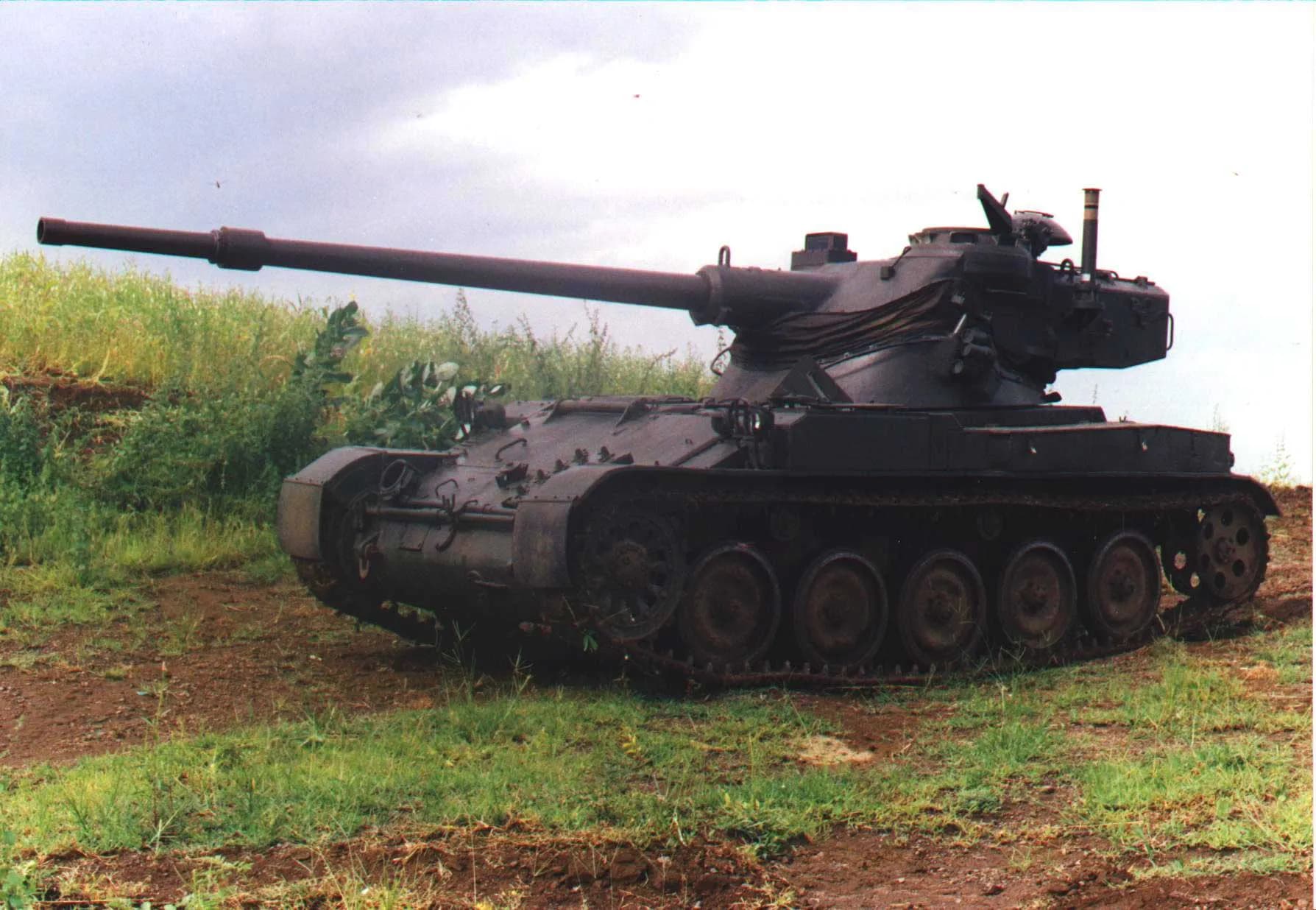
(Before jumping into the description, I want to clarify the tank’s name. “Meshupar” [Hebrew: “משופר”], meaning “Improved”, is the term used in Hebrew source to describe Nimda and Elbit’s joint AMX-13 modification. Other names are also used for this tank, such as “Meshupats” or “Me’shufetzar” [Hebrew: “משופץ”/“משופצר”], meaning “Renovated” or “Upgraded,” while Nimda’s English brochures vaguely refer to the vehicle as the “AMX-13 Modernization Program” without a specific designation.)
- BASIC DESCRIPTION -
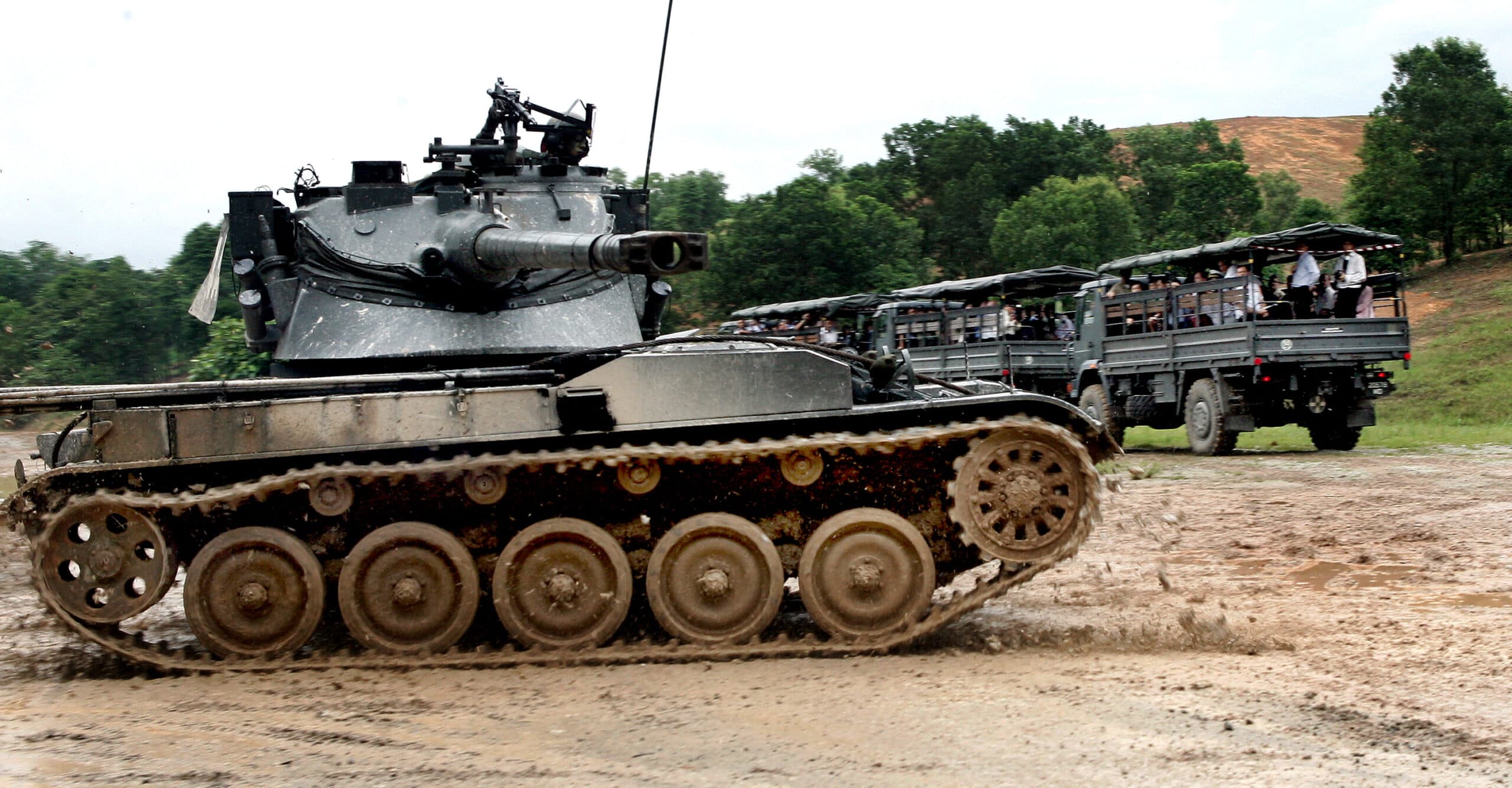
AMX-13 Meshupar (90 mm) - Is a complete AMX-13 modernization, made in private venture by the Israeli Nimda and Elbit firms targeted at export market in the Latin America and Far East. The core of this upgrade is a complete re-motorization of the AMX-13, featuring a new Detroit Diesel 6V53T engine paired with Nimda’s N-303 automatic transmission (or optionally different types of transmissions), alongside a modified engine compartment with updated exhaust and cooling systems. There were several variations made of this vehicle, mainly with different types of armament. This specific version is armed with the Belgian 90mm Cockerill Mk3A8 cannon, as well as it has Elbit’s (El-Op) “Lan-Sadot” Fire Control System (FCS), incorporating a laser rangefinder, electronic ballistic computer, and night-vision sight. Additionally, it may also feature an Elbit’s gun stabilization system, as such systems were at the time in development for various light tanks including the AMX-13s, though this remains unconfirmed.
Spoiler
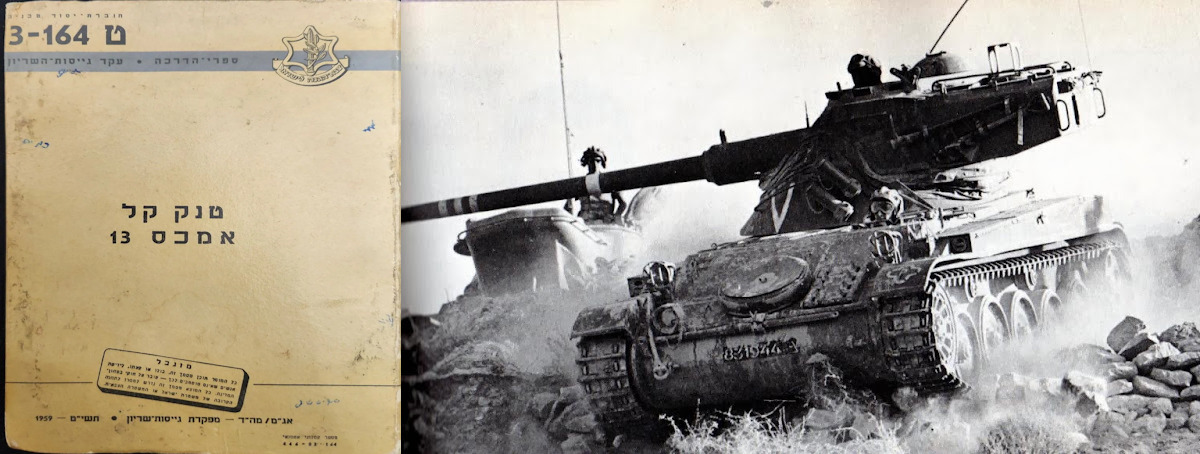
Origins of the AMX-13 in IsraelㅤThe history of the AMX-13, or the “Emeks 13” as the IDF called it, began in 1954 when Israel ordered five tanks for evaluation. Following their arrival in February 1955, initial trials in Israel revealed serious mechanical malfunctions stemming from the tank’s unsuitability for the local climate. Nevertheless, the project was backed by Chief of Staff Moshe Dayan, who prioritized mobility and innovation over armor thickness. Therefore, a decision was made to purchase the tanks in limited quantities while reaching an agreement with France to upgrade various systems to better suit the IDF’s needs. During 1955, Israel received 25 tanks, with another batch of 30 ordered and delivered in 1956.
ㅤHowever, maintenance difficulties led to a deterioration in their mechanical condition, and by May 1956, only 24 of the 60 tanks remained operational. That year, following the Czechoslovak-Egyptian arms deal and the Egyptian nationalization of the Suez Canal, Britain secretly formed a coalition with France and Israel. During this period, another 120 AMX-13s, withdrawn directly from French Army units and depots, were delivered to Israel as urgent military aid. By the start of the 1956 Suez Crisis (Sinai War), Israel had 180 AMX-13 tanks, of which 65 participated in combat operations. In 1962, Israel purchased four additional AMX-13s. By the 1967 Six-Day War, 184 tanks were in service, fighting on all fronts. While exact data on Israeli losses for this tank type is scarce, they were apparently so heavy that the AMX-13 was withdrawn from active service immediately after the war, bringing its brief 12-year career in the IDF to an end.
Left: Official IDF designation, Tank Kal Emeks 13 (Light Tank AMX 13)
Right: AMX-13, in 1962, from National CollectionSingaporeㅤFollowing their decommissioning from the IDF, the Israeli AMX-13s found a second life in Southeast Asia. When the newly formed state of Singapore needed to build its armed forces from scratch following the British military withdrawal, it secretly turned to Israel. The IDF played a foundational role in forming the Singapore Armed Forces (SAF), but due to regional political sensitivities, this deep relationship was kept strictly classified. IDF advisors in Singapore were even covertly referred to as “Mexicans” to disguise their origins.
ㅤAs part of this covert partnership, Singapore moved to establish its armored forces in 1968. That December, 36 Singaporean officers traveled to Israel for a rigorous four-month training course on the retired AMX-13s, enduring harsh winter desert conditions and famously strict IDF instructors. Between July and September 1969, Israel secretly delivered 72 of these tanks. The acquisition remained highly classified until August 9, 1969, when 18 AMX-13s were unveiled during Singapore’s National Day Parade. This dramatic debut served as a major strategic surprise to neighboring Malaysia, which possessed no tanks at the time, officially marking the birth of Singapore’s armored forces.
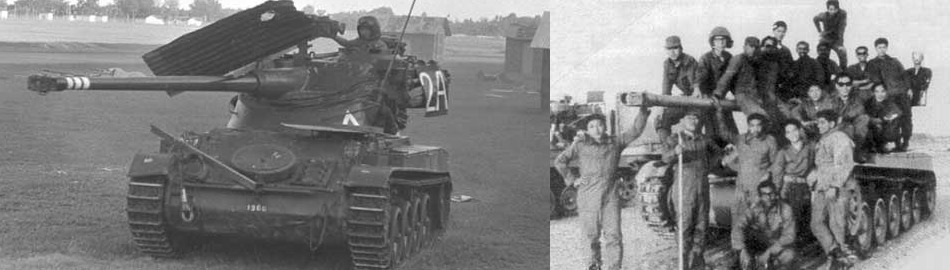
Left: Singaporean AMX-13, 1974, note the resemblance to the marking scheme used in Israel
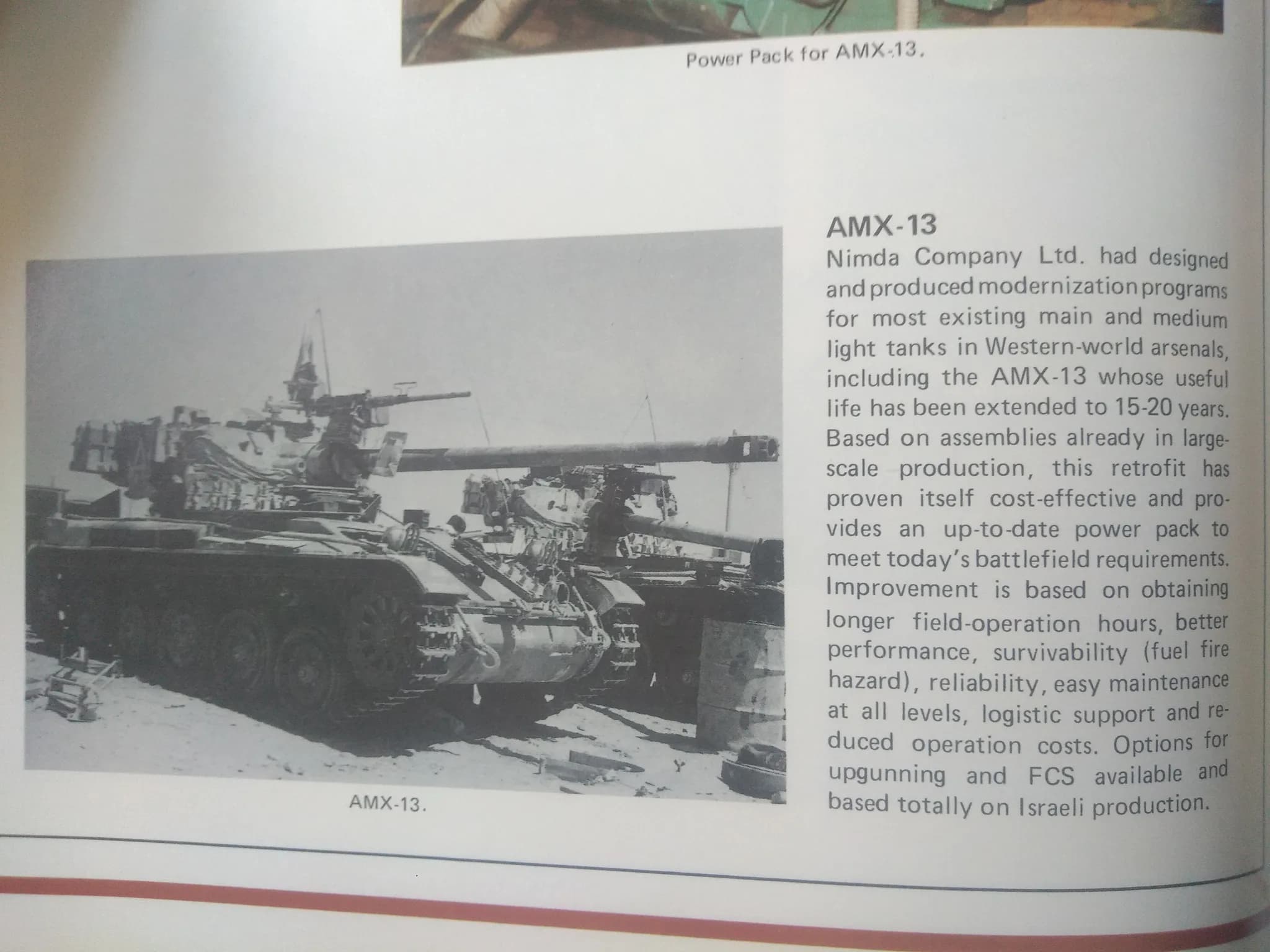
Right: Singaporean tankers during their training course in IsraelAMX-13 Modernization ProgramㅤThe history of the Israeli modernization program for the AMX-13 is sparse, with very little historical documentation or media coverage. Developed around the 1980s, the project was led jointly by two companies: Nimda, which specialized in powerpack production, and Elbit, which specialized in electronic subsystems. The upgraded tank was referred to in Hebrew as the AMX-13 “Meshupar” (meaning “Improved”), though it was also called “Meshupats” or “Me’shufetzar” (meaning “Renovated” or “Upgraded”). The program served as an export-oriented life-extension package for markets in Latin America and the Far East that still heavily relied on the AMX-13 platform.
ㅤThe upgrade included replacing the old gasoline engine with a new powerpack featuring a Detroit Diesel 6V53T engine paired with Nimda’s N-303 automatic transmission (with optional alternative transmissions available), requiring a complete redesign of the engine compartment to accommodate new cooling and exhaust systems. On Elbit’s side, they integrated the “Lan-Sadot” (also known as “Lancelot”) Fire Control System (FCS), equipping the gunner with a new day/night sight and an integrated laser rangefinder. Additionally, the modernization program offered optional rearmament choices, including 60 mm HVMS, 90 mm, or 105 mm cannons. According to the manufacturers’ claims, the package extended the tank’s operational lifespan by 15-20 years while increasing hit probability by 150% against moving targets and 300% against stationary targets.
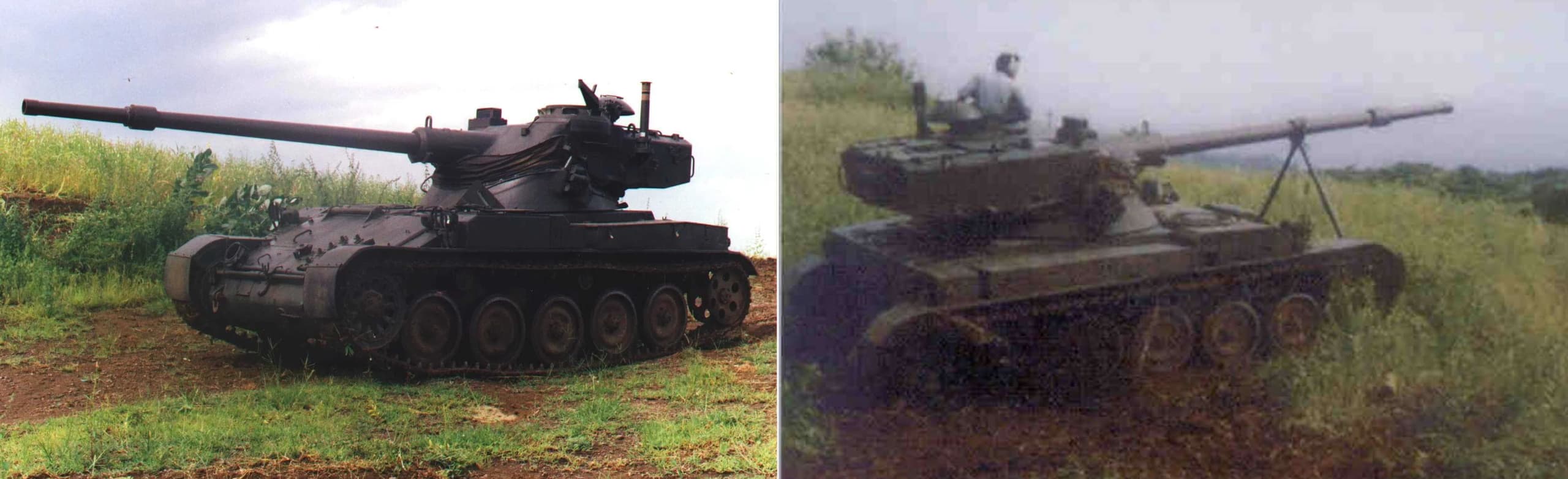
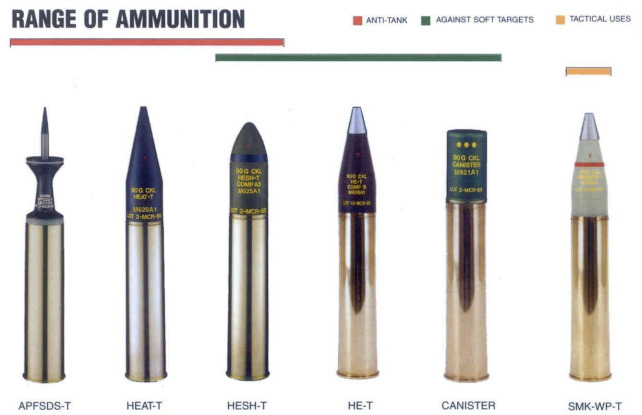
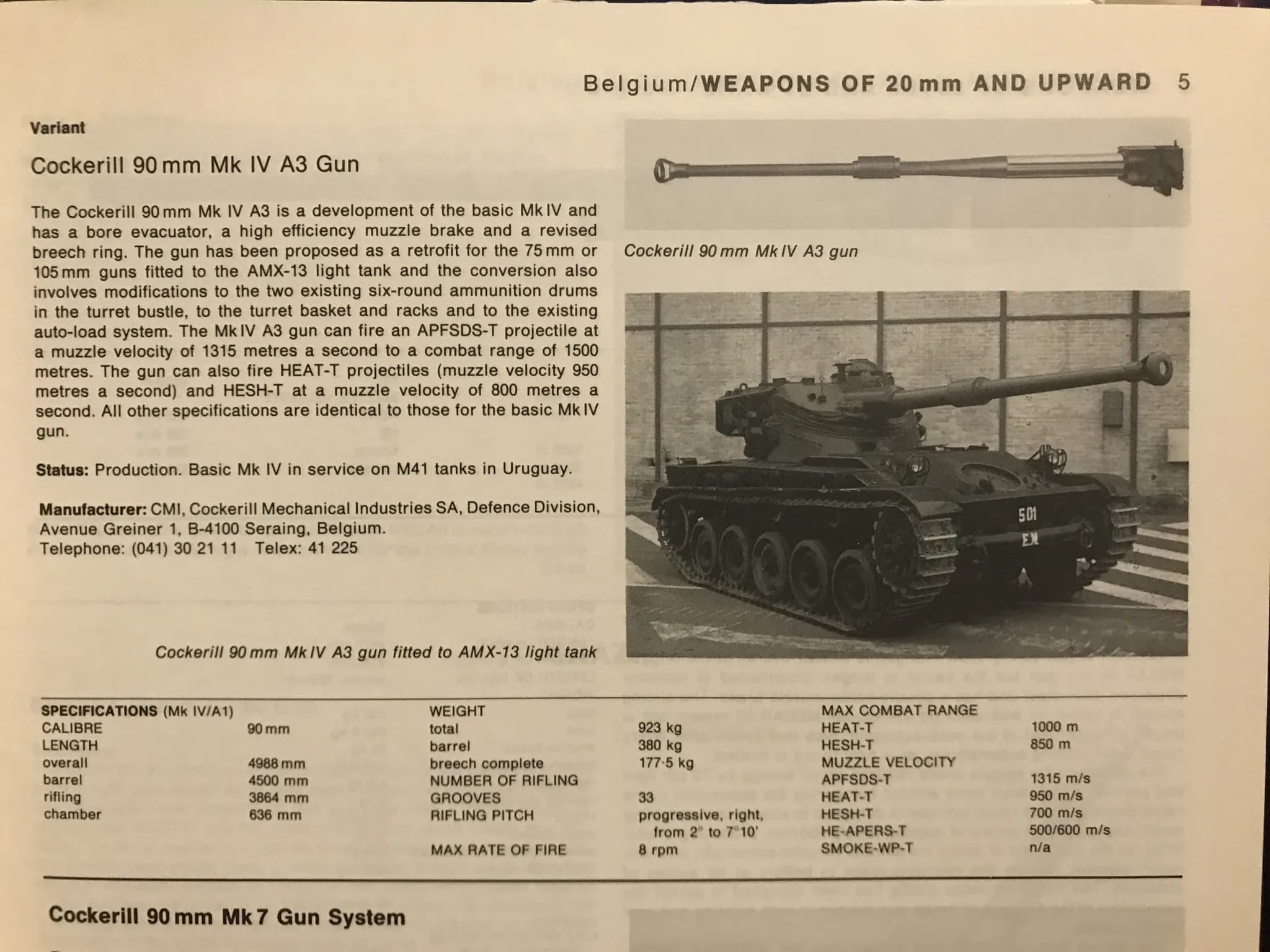
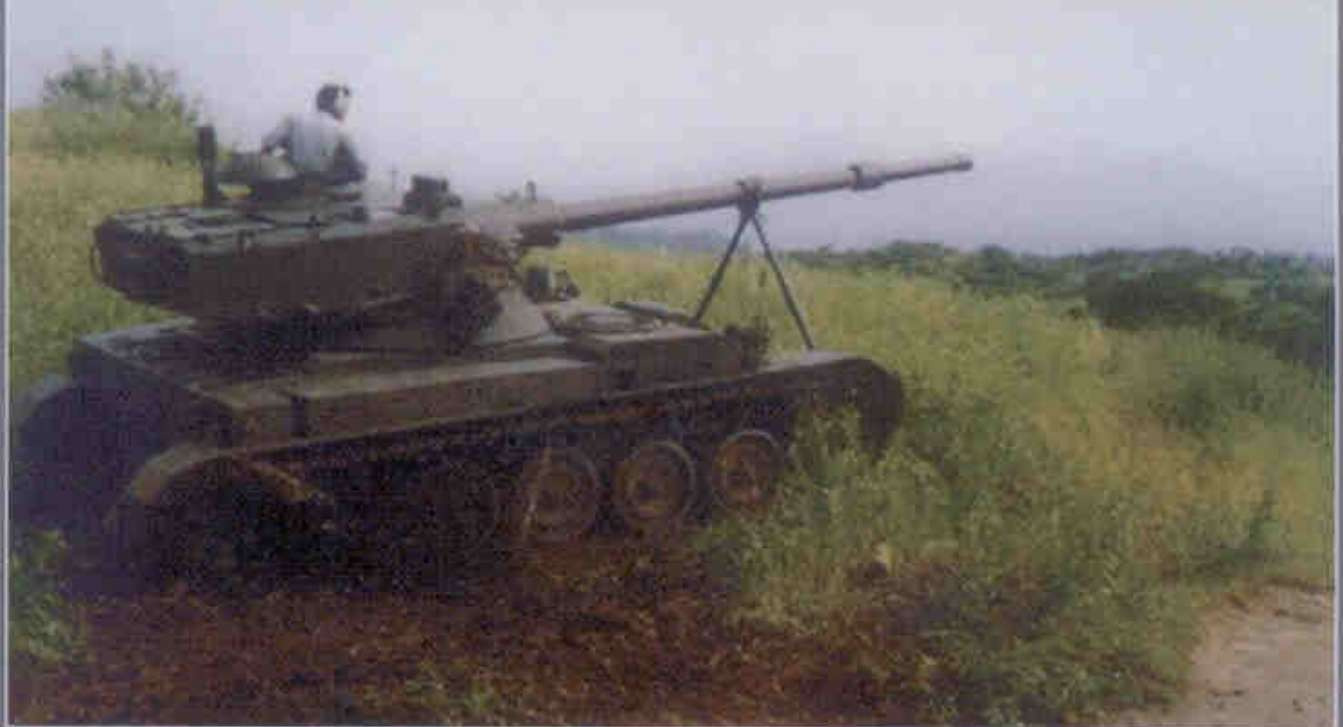
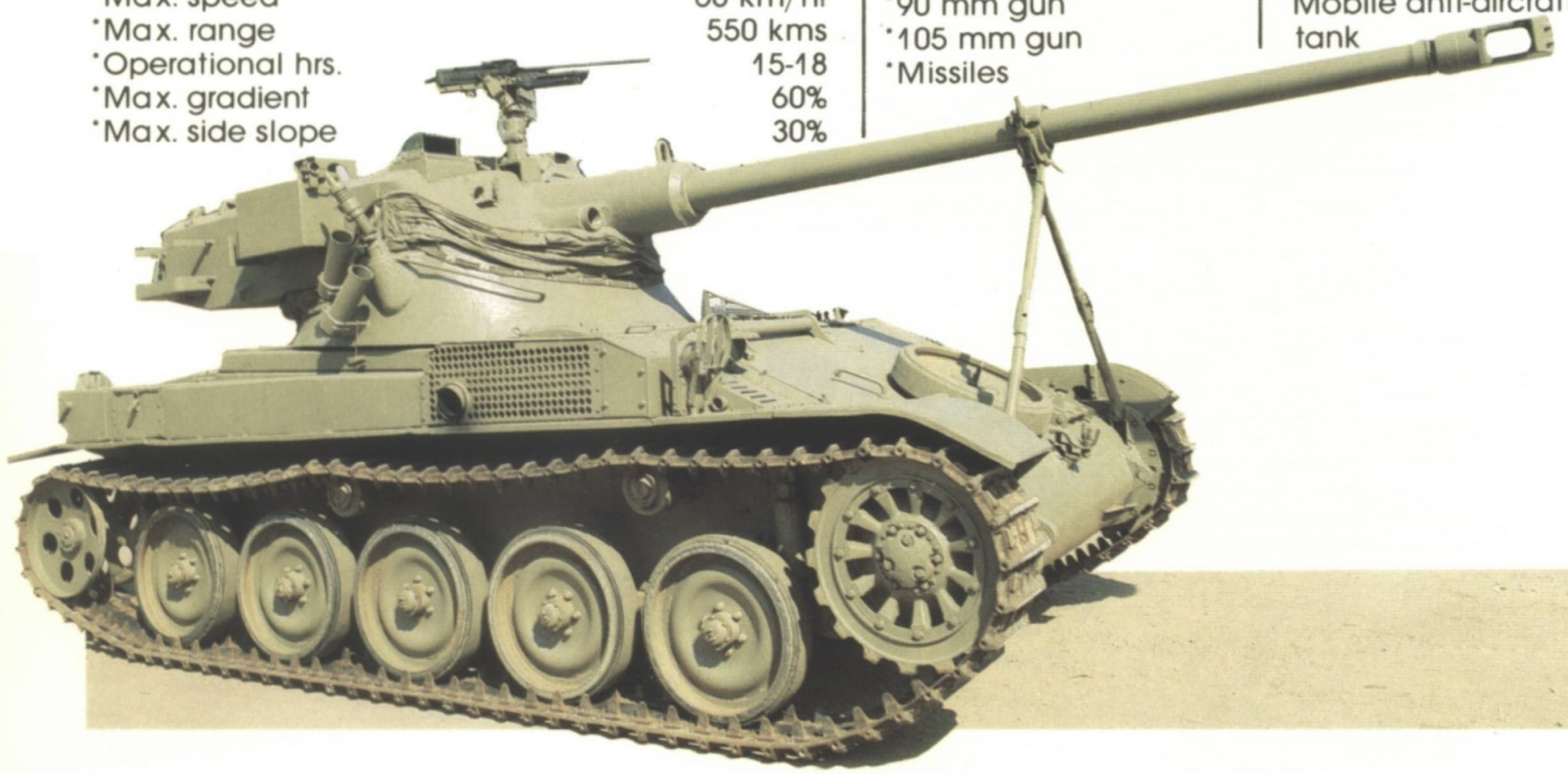
ㅤSeveral prototypes were built, mainly featuring different types of main cannons, and at least two are known to exist with photographic evidence. One retains the original 75 mm SA50, while the second was built with a Belgian 90 mm Cockerill Mk3-A8 cannon (often mistaken for a 60 mm HVMS). Designed to replace the 75 mm or 105 mm cannons on the AMX-13, this gun required modifications to the existing six-round drums, ammunition racks, and autoloader system. The new cannon can fire APFSDS, HEAT, HESH, and smoke rounds, with Cockerill claiming the autoloader is capable of an 8 RPM rate of fire (a 7.5-second reload). Interestingly, the 90 mm prototype might also have featured electronic drive stabilization, as such systems were under development by Elbit at the time for various tanks, including the AMX-13, though this remains unconfirmed.
The only two known pictures of 90mm armed prototype, date and location unknownWhere Were These Modified AMX-13s Used?ㅤAs mentioned earlier, there is little to no media coverage on this joint Nimda-Elbit project. However, an Israeli magazine, likely citing manufacturer information, stated that these modified AMX-13s were already in service abroad in “Latin America and the Far East” without naming specific countries. That reference to the “Far East” almost certainly points to Singapore. In 1988, Singapore set out to upgrade its aging fleet of AMX-13s to further extend their operational lifespan. Although the modification program was officially presented as a local effort led by ST Kinetics with no public mention of foreign involvement, the technical overlap tells a very different story.
ㅤThe upgraded tank was designated the AMX-13SM1 (Singapore Modernized 1), and its suite of improvements is virtually identical to the Israeli package. It features a Detroit Diesel 6V53T engine paired with a ZF 5WG-180 automatic transmission, alongside a new FCS featuring a gunner sight equipped with night vision and an integrated laser rangefinder. However, the Singaporeans opted to retain the original 75 mm SA50 cannon, while also integrating a few of their own additions, such as a new “Dunlostrut” hydropneumatic suspension system and extra storage on a turret bustle rack. Aside from these specific modifications, the core components of the upgrade mirror the Israeli design, even from the exterior, the redesigned engine compartment and gunner sight are dead giveaways of Nimda and Elbit’s influence. Given the covert nature of defense relations between Israel and Singapore, and considering Singapore had no prior experience with such modernizations before the SM1 project, it was only natural for them to seek Israeli assistance. Overall, while officially unconfirmed, it is highly probable that Nimda and Elbit worked closely with ST Kinetics, transferring technology and modernization components to establish licensed local manufacturing.
AMX-13SM1, note the similarities to the Israeli prototypeㅤUltimately, most of Singapore’s fleet of 350 AMX-13s received this modernization, serving as the backbone of its armored forces until being fully phased out in 2008 and replaced by the Leopard 2SG. This program even led to a regional export venture. In the 1990s, Singapore helped modernize a portion of Indonesia’s AMX-13 fleet to the “SM1” standard. It should be noted that this specific upgrade only included the automotive components produced in Singapore, without the Elbit FCS. Despite this, those Indonesian vehicles continue to serve today.

ㅤ
TL;DR: Key differences of this AMX-13 modernization over the unmodified one we have in game (for Israel):
- 90mm Cockerill Mk3-A8 cannon capable of firing APFSDS, HEAT, HESH, and smoke rounds.
- Autoloader for the main gun with 8 rpm rate of fire (7.5 second reload)
- Detroit Diesel 6V53T engine paired with Nimda’s N-303 automatic transmission, mobility stays the same, max speed 60 km/h
- Elbit’s “Lan-Sadot” FCS featuring a gunner sight equipped with night vision and an integrated laser rangefinder, as well as ballistic computer.
- Unconfirmed, but might also feature experimental stabilization system from Elbit.
Spoiler
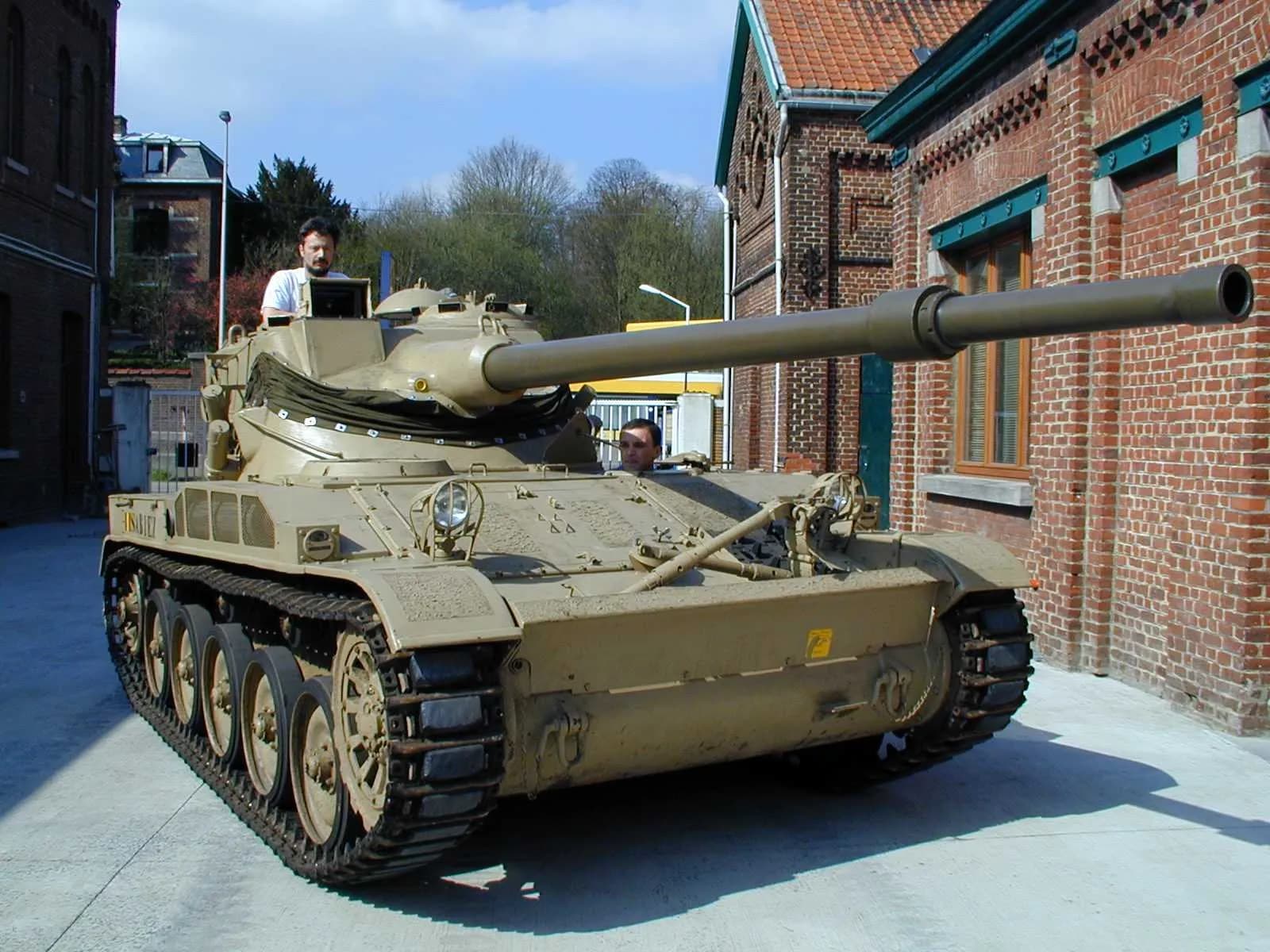
ArmamentㅤThe primary armament of this tank is a Belgian 90 mm Cockerill Mk3-A8 cannon, secondary armament consists of a single coaxial machine gun. While the exact model is unconfirmed, Israel had standardized the use of the 7.62 mm FN MAG 60-40 at the time. Furthermore, the AMX-13SM1 (which is based on this upgrade) also utilizes it as a coaxial machine gun. The 90 mm cannon fits in place of the original 75 mm without requiring major structural changes to the turret, it only required modifications to the existing six-round drums, ammunition racks, and autoloader system to accommodate the new caliber.
Belgian AMX-13 with 90mm Mk3-A8 cannon (unrelated to Israeli project, but uses the same cannon)Ammo Capacity & Reload RateㅤWhile exact ammunition capacity figures are unavailable, the Cockerill modification likely mirrors that of the French AMX-13/90. The first-stage autoloader is left unchanged with a 12-round capacity (housed in two 6-round drums), and the total main gun ammunition count is likely 34 rounds. As for the 7.62 mm coaxial, standard AMX-13s usually carry 3,600 rounds for the coaxial, which is likely the case here as well. The reload rate is slightly slower than that of a French 90 mm. According to Cockerill, it is capable of an 8 RPM rate of fire (meaning a 7.5-second reload).
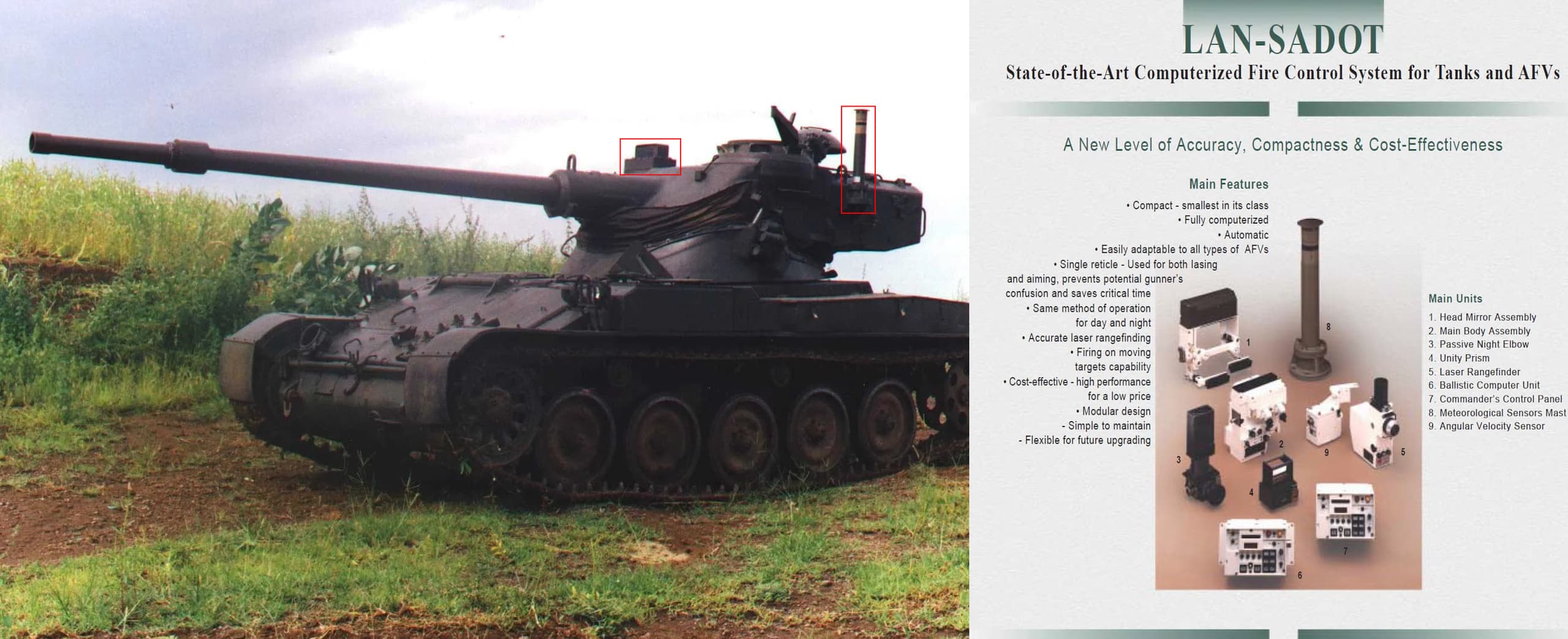
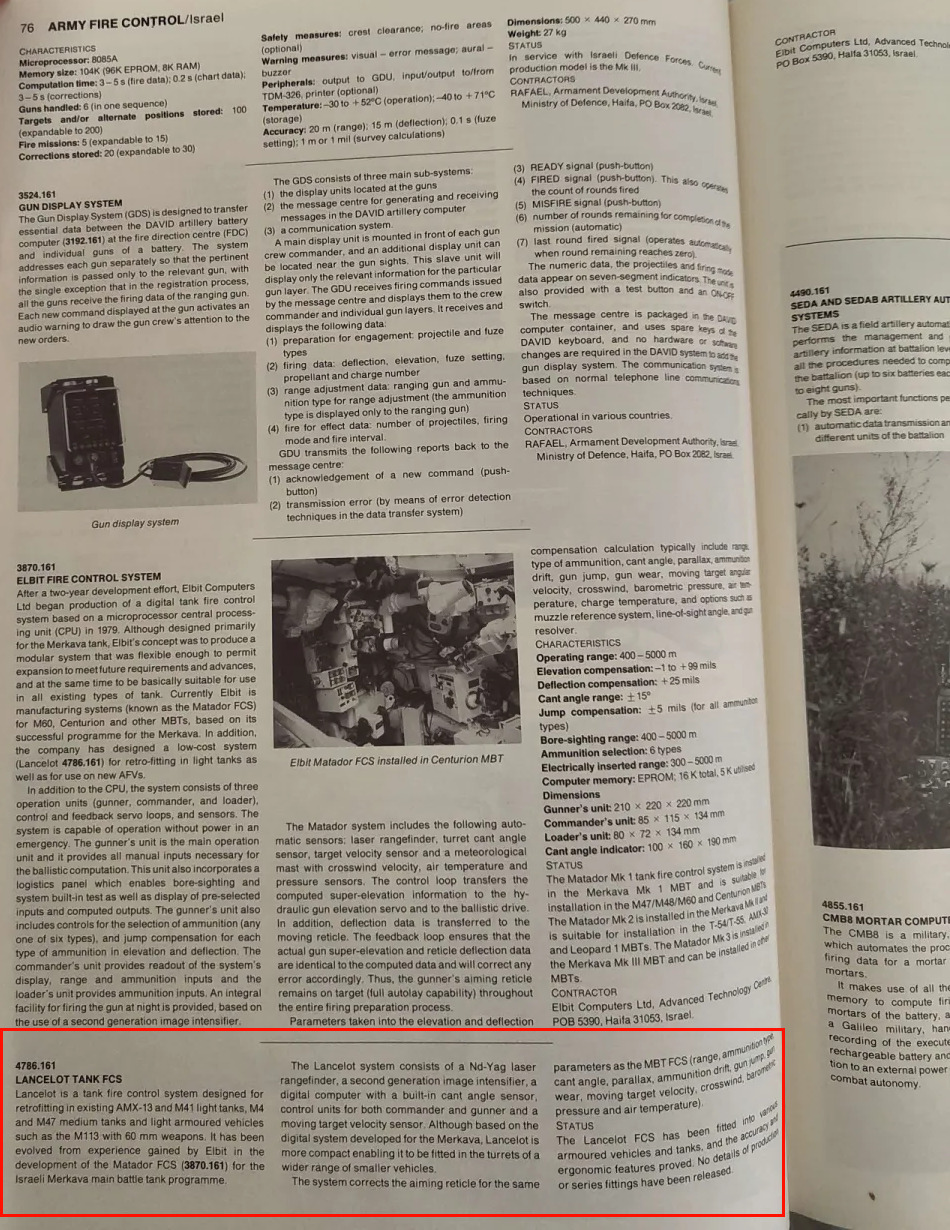
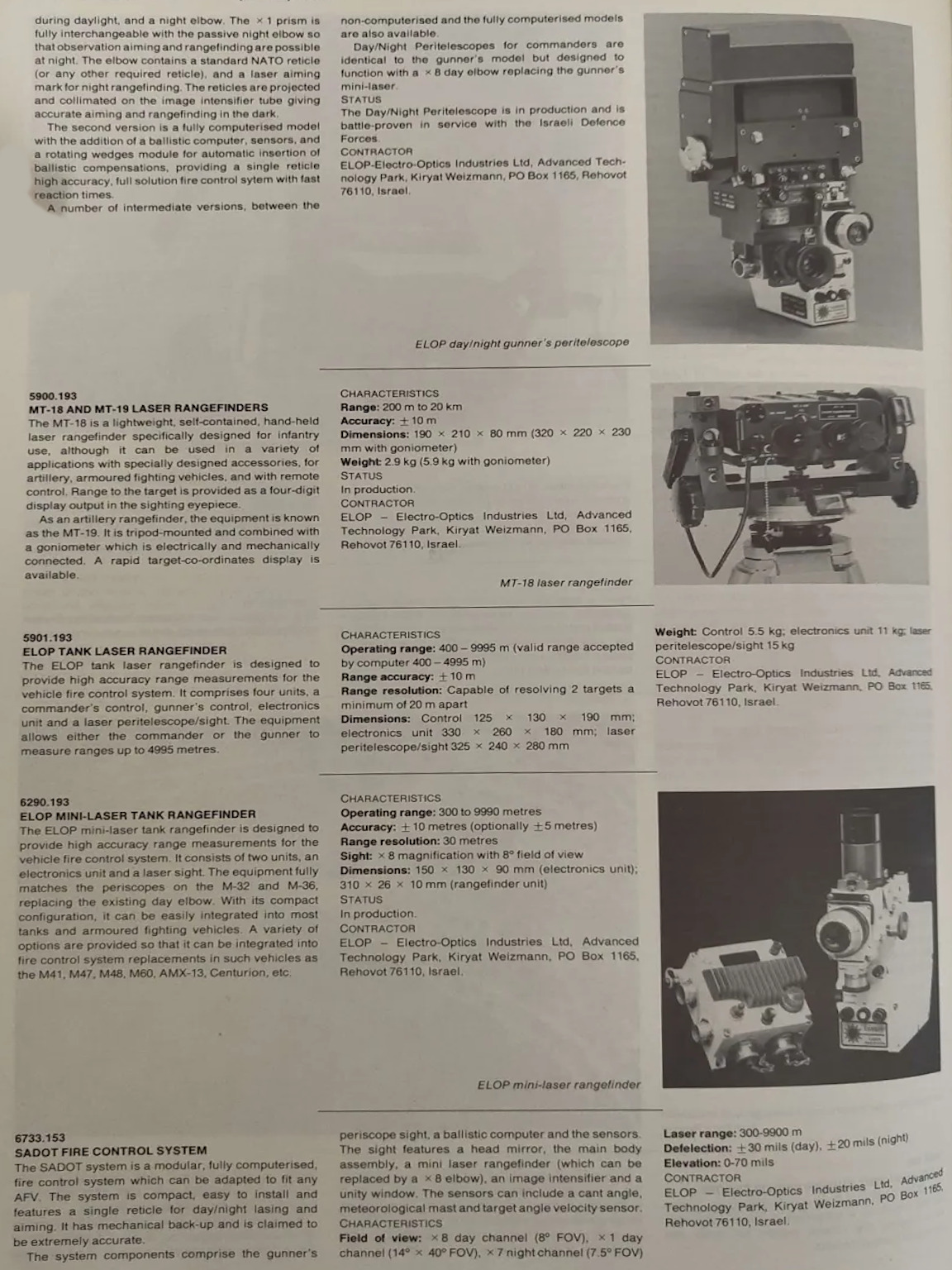
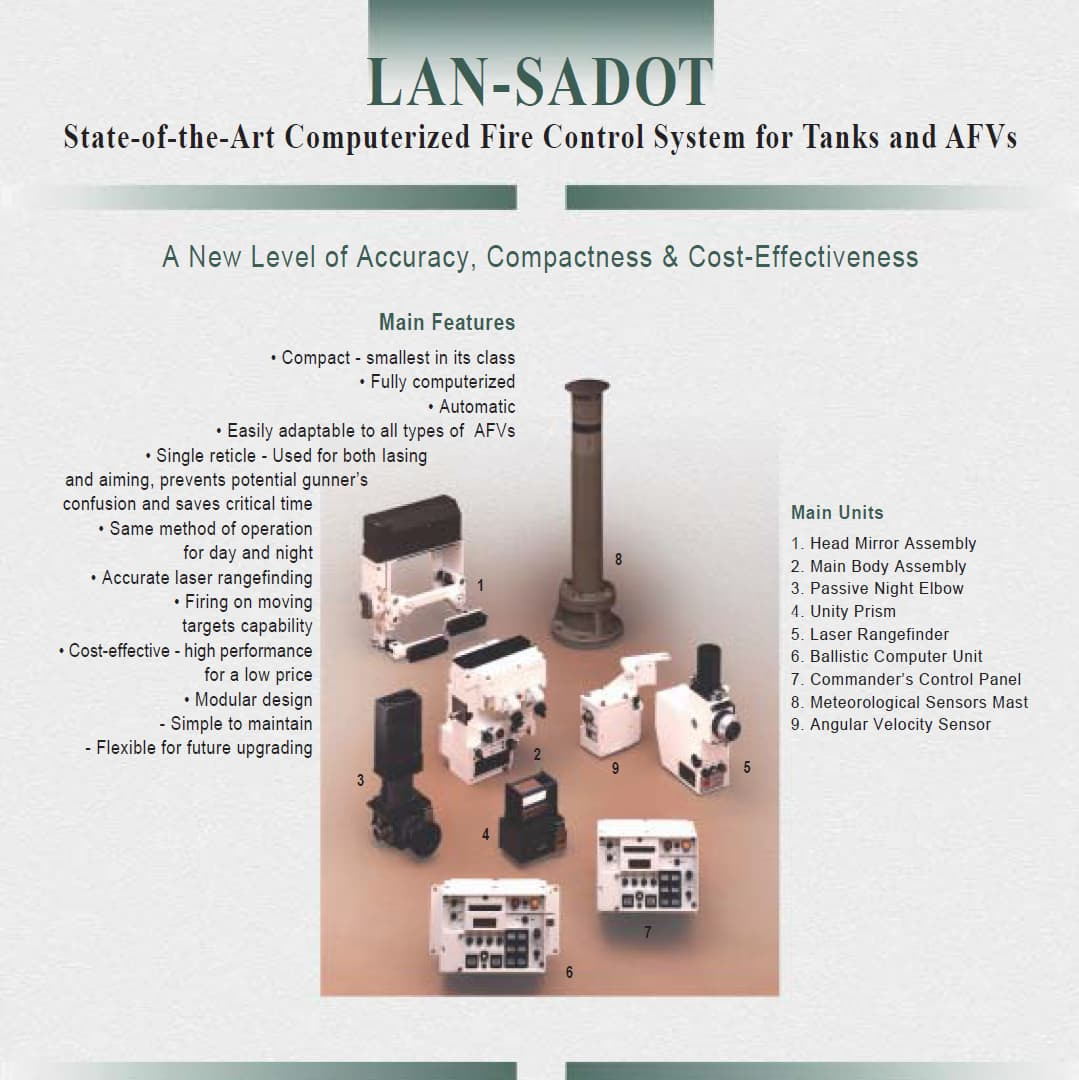
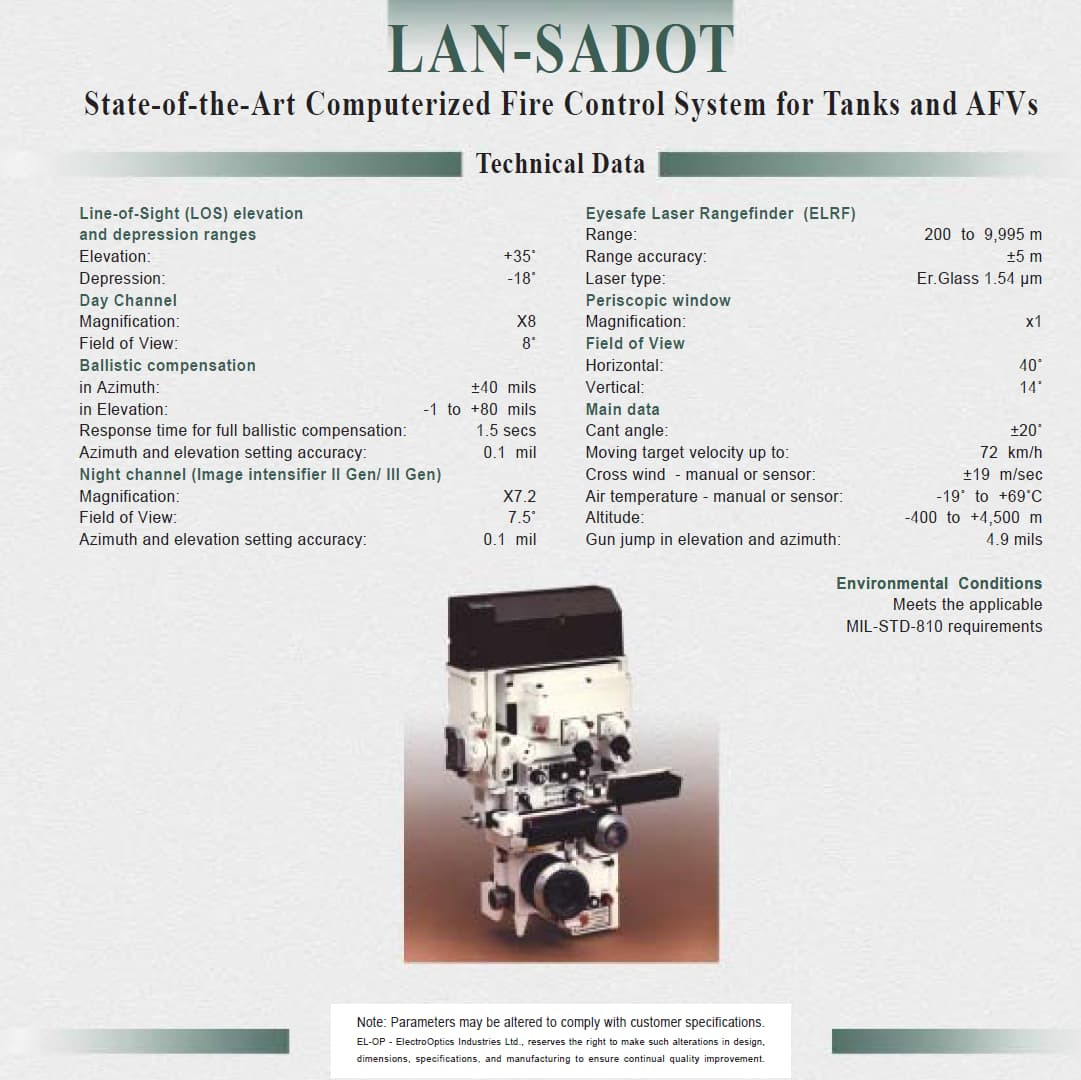
Fire Control SystemㅤThe tank integrates Elbit’s “Lan-Sadot” Fire Control System (FCS). Designed for light vehicles with limited space, this compact FCS incorporates an electronic ballistic computer and sight for the gunner, with integrated eyesafe laser-rangefinder, day channel with an 8° field of view with 8× magnification and 2nd-gen image intensifier (night-vision channel) offering a 7.5° field of view with 7.2× magnification.
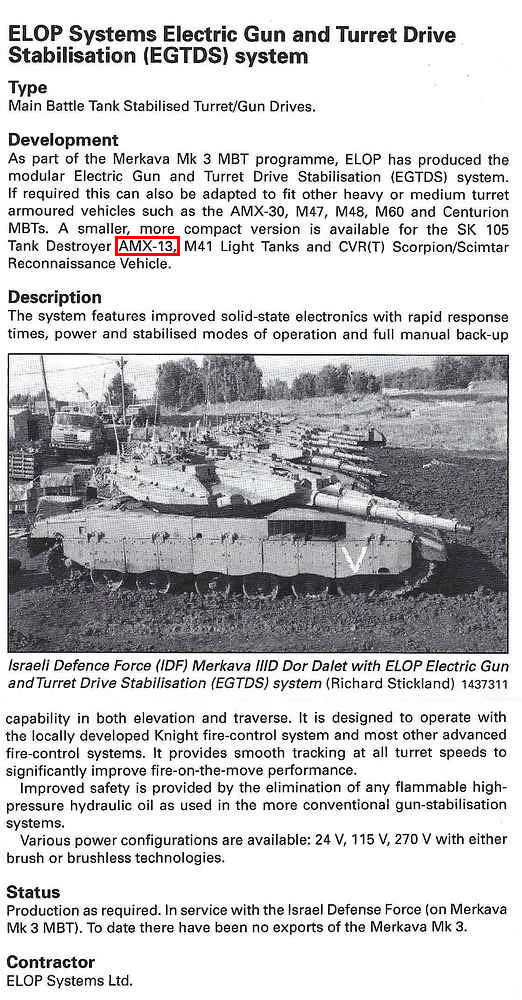
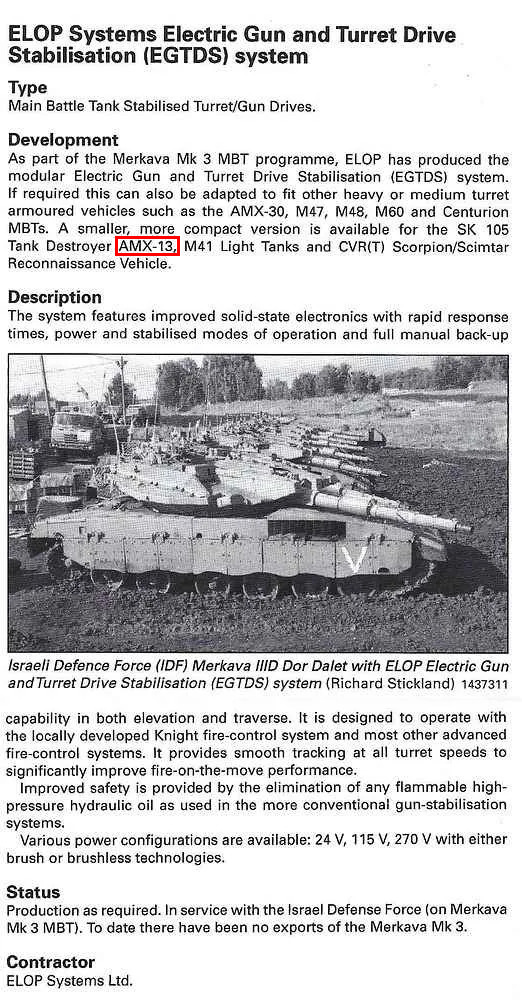
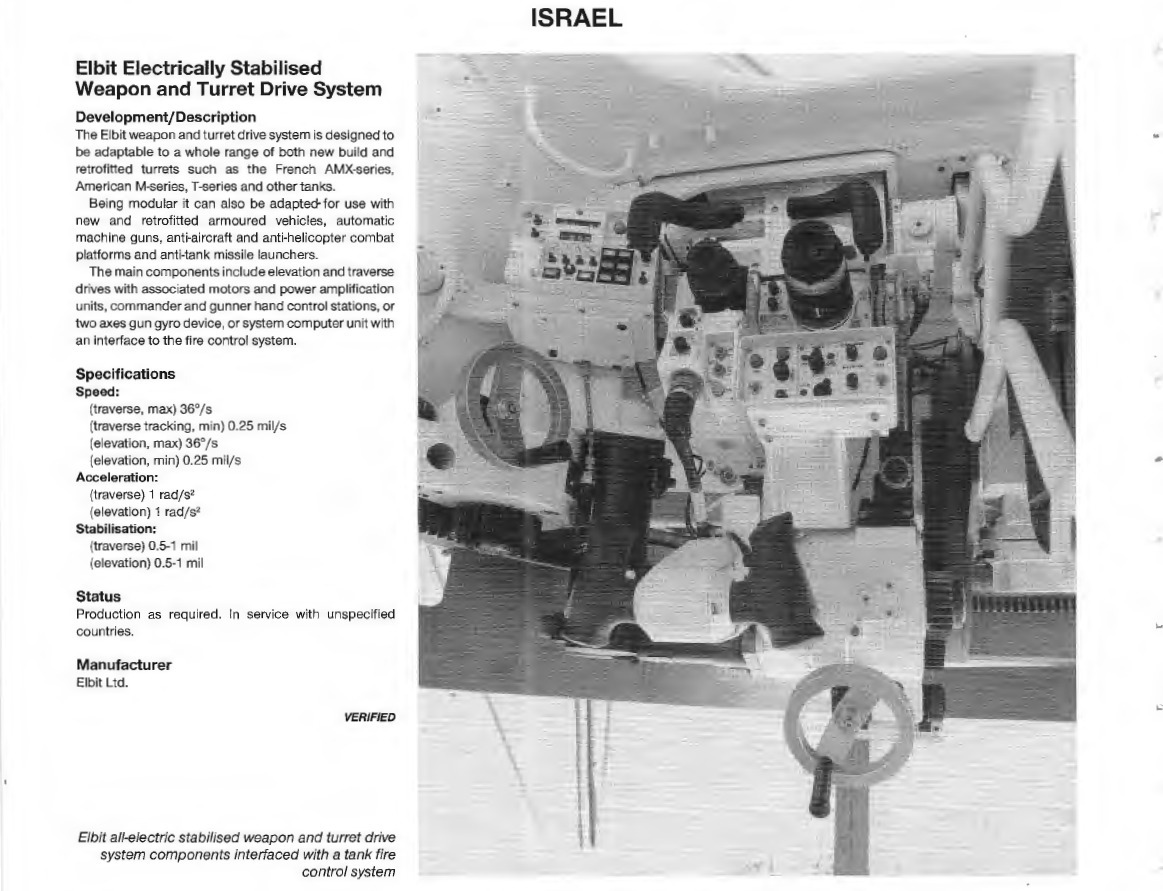
Stabilization System (Unconfirmed)ㅤLastly, one detail caught my eye when examining the photographic material: there is an unidentified mechanism installed in the usual location of the radio antennas. During my research, I discovered that Elbit (El-Op) developed an electric gun and turret drive stabilization (EGTDS) system. Among other tanks, they developed a compact version specifically designed for installation on light tanks among which AMX-13. I could not find definitive verification that this was implemented in practice, as there is no mention of gun stabilization in the promotional materials. Thus, it remains an unconfirmed possibility pending solid proof.
Unknown turret mechanism
Jane’s article regarding the stabilization systemThe types of ammunition that it can fire
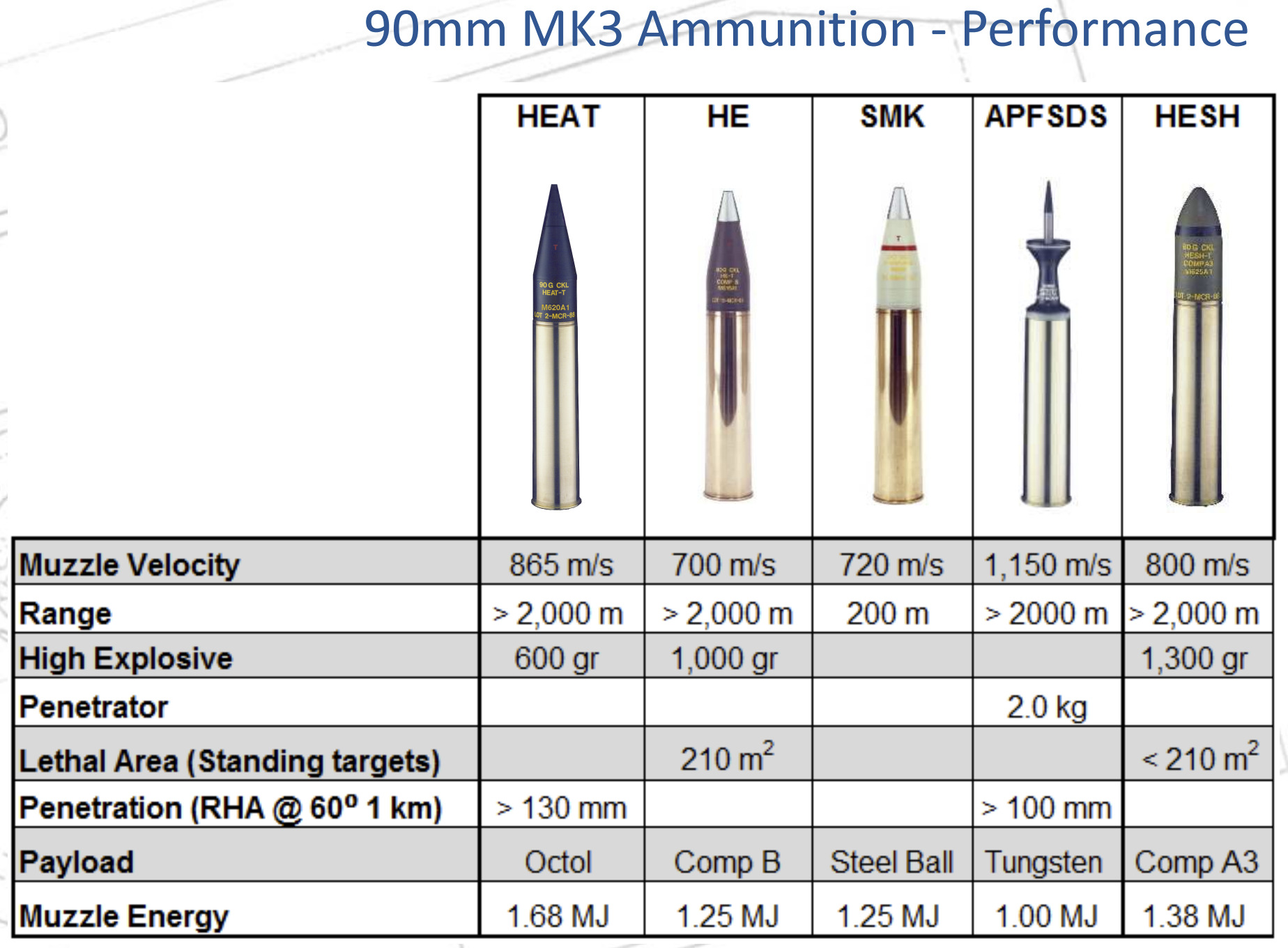
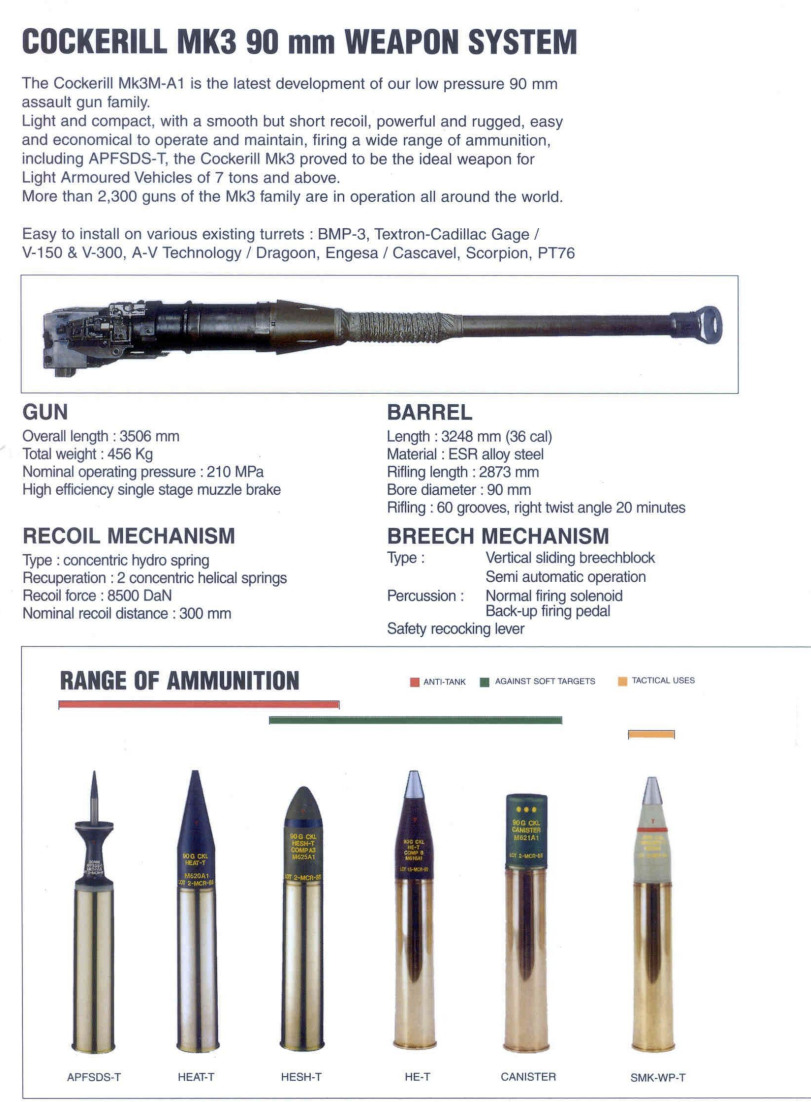
Cockerill 90mm (Mk3-A8)
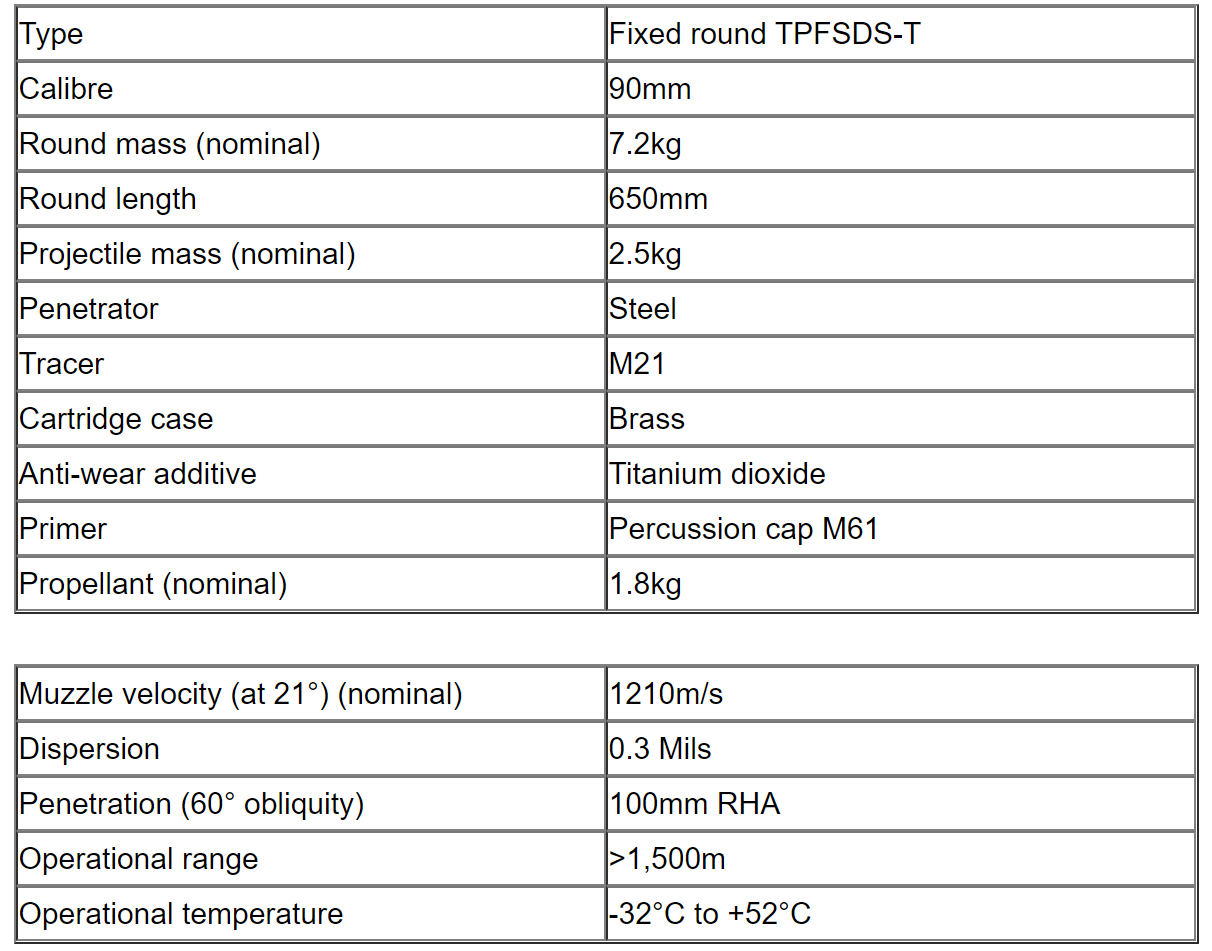
M652A1 APFSDS-T
- Penetration (RHA @ 60° 1 km): > 100 mm
- Caliber: 90 mm
- Projectile Mass: 2.5 kg
- Muzzle Velocity: 1210 m/s
- Payload Type: Tungsten
M620A1 HEAT-T
- Penetration (RHA @ 60° 1 km): > 130 mm
- Caliber: 90 mm
- Projectile Mass: 4.1 kg
- Muzzle Velocity: 890 m/s
- Fuze Delay: 0.05 m
- Fuze Sensitivity: 0.1 mm
- Explosive Type: Octol
- Explosive Mass: 560 g
- TNT equivalent: 890 g
M625A1 HESH-T
- Caliber: 90 mm
- Projectile Mass: 4.5 kg
- Muzzle Velocity: 800 m/s
- Fuze Delay: 0.1 m
- Fuze Sensitivity: 4 mm
- Explosive Type: Comp. A3
- Explosive Mass: 1.2 kg
- TNT equivalent: 1.7 kg
M618A1 SMK-WP-T (Smoke)
- Caliber: 90 mm
- Projectile Mass: 5.3 kg
- Muzzle Velocity: 714 m/s
- Fuze Delay: 0.4 m
- Fuze Sensitivity: 0.5 mm
- Explosive Type: Smoke composition
- Explosive Mass: 50 g
Additional technical info for each round
M652A1 APFSDS-T specifications

Spoiler
ㅤThe level of protection remains identical to that of the standard AMX-13. Although structural changes were made to the engine compartment, they likely do not affect overall armor protection.
- Hull
- Hull Front: 15 mm (55°)
- Hull Side: 20 mm
- Hull Rear: 15 mm
- Hull Top: 10 mm
- Turret
- Turret Front: 25 mm (45°)
- Turret Sides: 25 mm
- Turret Top: 10 mm
- Other
- Smoke Grenades: 4x (2x per side)
Spoiler
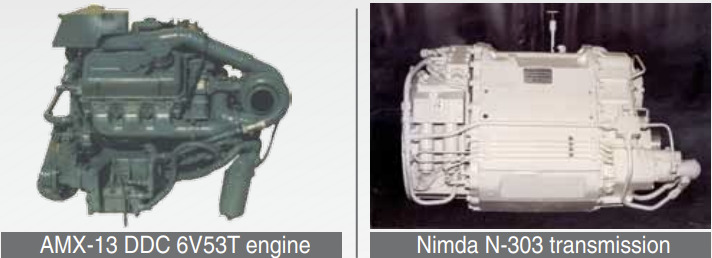
ㅤThe tank is powered by a new powerpack assembled by Nimda, consisting of a Detroit Diesel 6V53T engine paired with Nimda’s N-303 automatic transmission. While the new engine does not significantly increase top road speed, it focuses primarily on technical and operational modernization. Replacing the original gasoline engine extends the AMX-13’s operational lifespan by 15-20 years. Key advantages of this powerpack upgrade include improved fuel efficiency, higher reliability, extended operational field hours, simplified maintenance, better logistics, reduced operational costs, enhanced crew comfort from the automatic transmission, and significantly improved survivability by eliminating gasoline fire hazard.
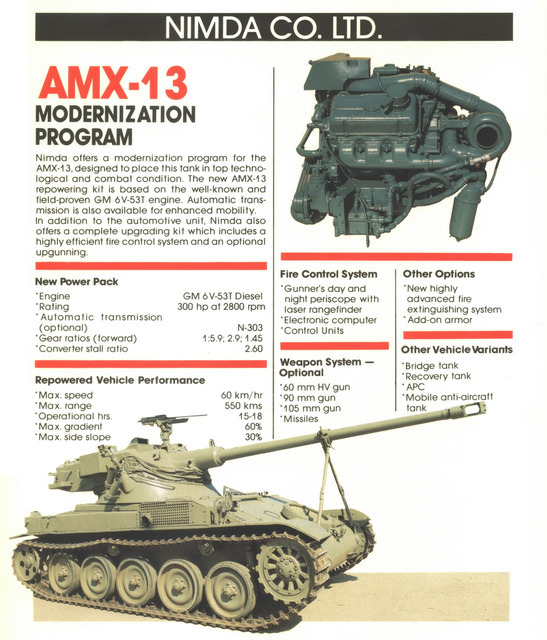
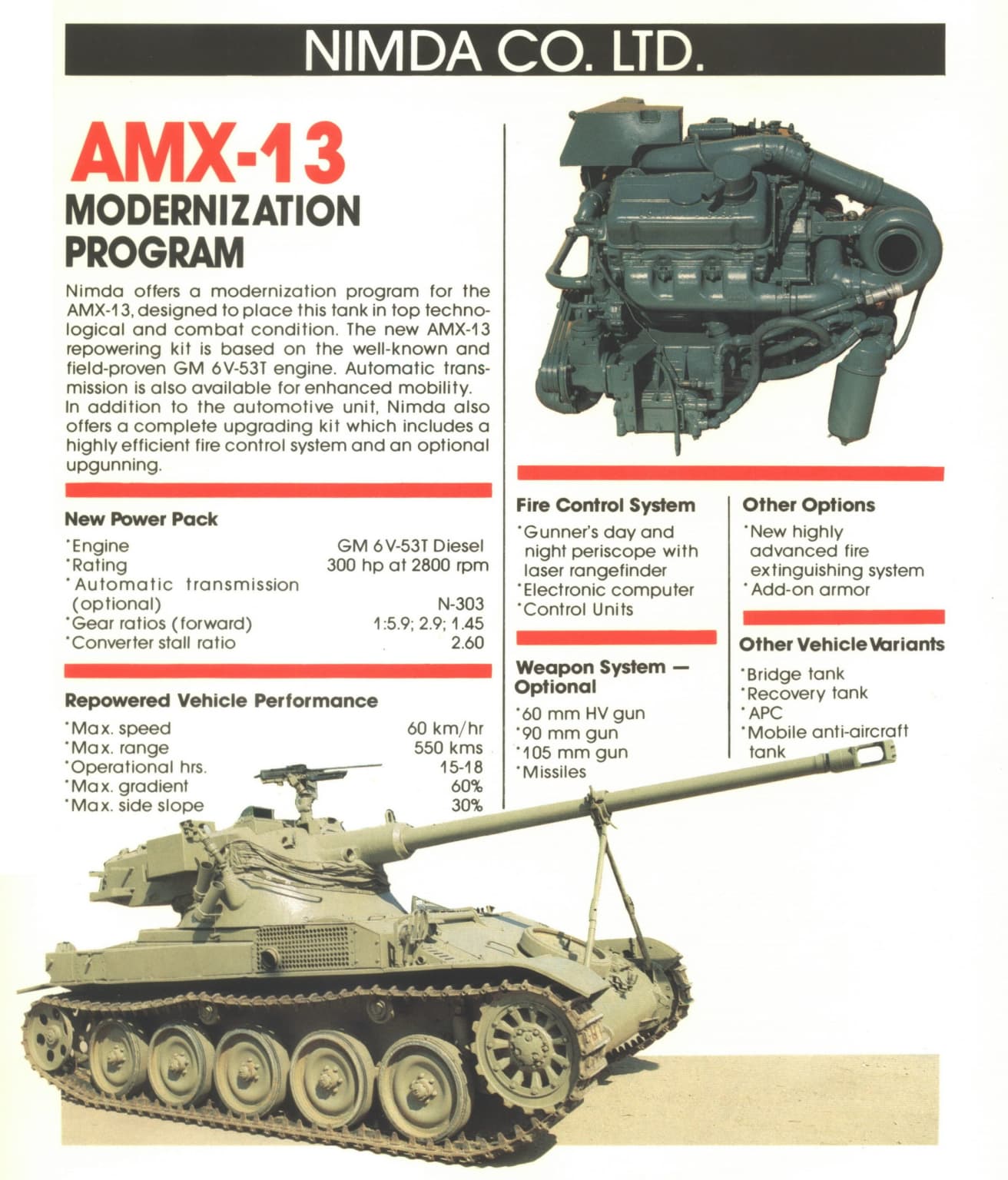
ㅤOn the technical side, most specifications for the modified AMX-13 are specified in Nimda’s brochure. The Detroit Diesel 6V53T produces an output of 300 hp at 2,800 RPM, paired with Nimda’s N-303 automatic transmission featuring 3 forward gears with ratios (1:5.9; 2.9; 1.45), likely along with 1 reverse gear (reverse unspecified). Maximum speed is rated at 60 km/h, maximum range is 550 km, operational endurance is 15-18 hours, maximum gradient capability is 60%, and maximum side slope is 30%.
Nimda’s powerpack specifications
■ - yellow stands for parameters that need further research (based on a single source or estimated)
General Info:
- Name: AMX-13 Meshupar (90 mm) / (אמכס 13 משופר (90 מ"מ
- Origin: Israel
- Manufacturer: Nimda/Elbit
- Year: mid-1980s(?)
- Class: Light Tank
- Crew: 3 (commander, gunner, driver)
Dimensions:
- Length: 4.88 m
- Length w/gun facing forward: 6.58 m
- Height: 2.3 m
- Width: 2.5 m
- Weight: 14.5 t
Armaments:
- Main Armament: 1x 90mm Cockerill Mk3-A8
- Secondary Armament: 1x coaxial 7.62mm FN MAG 60-40
- Ammo Storage
- 90mm: 35 rounds (1 in the chamber, 12 first-stage autoloader and 22 additional)
- 7.62mm: 3,600 rounds
- Ammo Types (90mm)
- M652A1 APFSDS-T
- M620A1 HEAT-T
- M625A1 HESH-T
- M618A1 SMK-WP-T (Smoke)
- Turret horizontal limits: 360°
- Turret vertical limits: +13°/-6°
- Ammo Storage
- Stabilizer: ✗ (Unconfirmed, but it might have it)
- Laser-Rangefinder: ✓
- Optics
- Day Channel:
- Field of View: 8°
- Magnification: 8x
- Night-Vision Channel: Image Intensifier Gen 2
- Field of View: 7.5°
- Magnification: 7.2x
- Day Channel:
- Autoloader: ✓
- Fire Rate: 8 rpm (7.5 sec)
Protection:
- Hull protection (F/S/R): 40 / 20 / 15 mm
- Type: Welded steel.
- Turret protection (F/S/R): 40 / 20 / 20 mm
- Type: Welded steel.
- Smoke charges: 4x (2x on each side)
Engine + Performance:
- Engine: General Motors 6V53T diesel engine
- Transmission: Nimda N-303 automatic transmission
- Gears: 3 forward, 1 reverse(?).
- Horsepower: 300 hp
- Horsepower-to-Weight Ratio: 20.69 hp/t
- Speed
- Max. Forward: 60km/h
- Max. Reverse: 7 km/h
- Suspension Type: Torsion bar
- Range: 550km
Sources:
Spoiler
Nimda’s AMX-13 brochure
Source: AMX-13 Nimda Projects - Nimda Co. Ltd
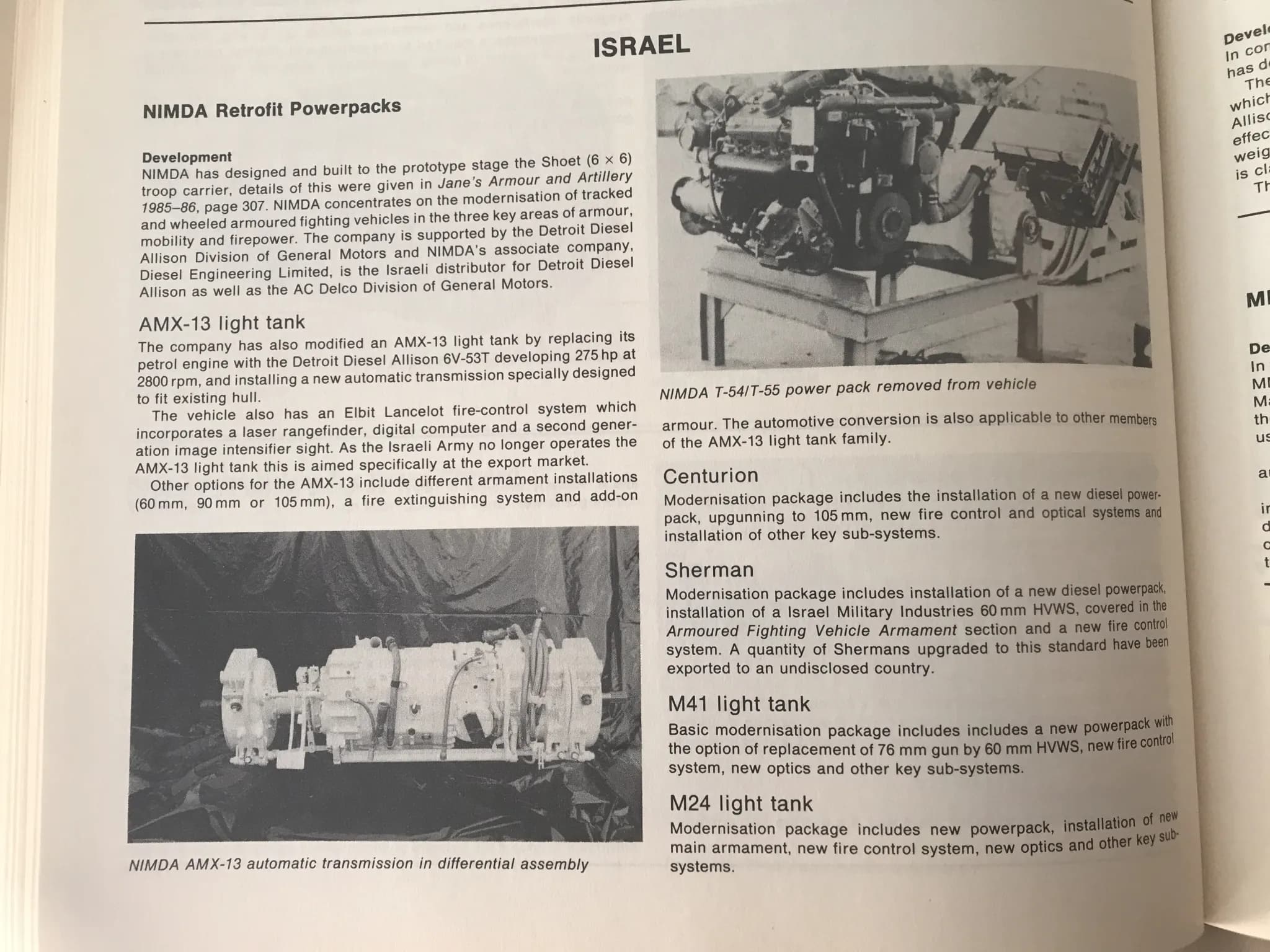
Jane’s
General info about the project, has confirmation of usage of Elbit’s “Lan-Sadot” (Lancelot)
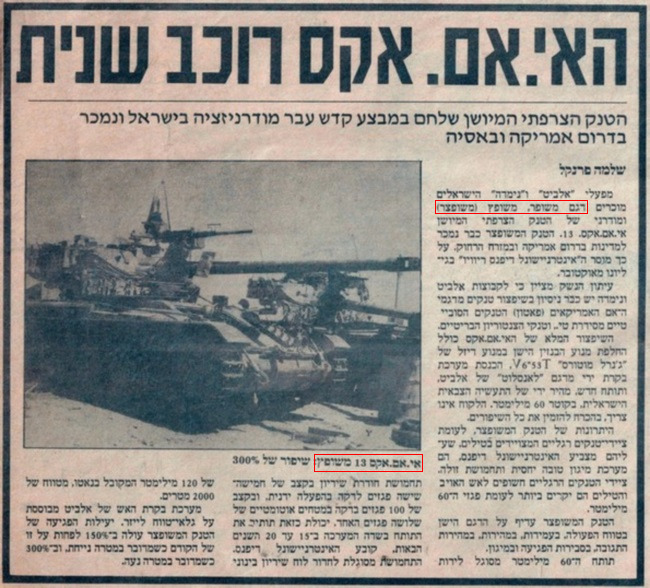
Excerpt from an Israeli newspaper; Author: Shlomo Frankel
General info about the project, citing information from manufacturers, from here comes confirmation of its Hebrew name (Meshupar, Meshupats or Me’shufetzar).
Israel Defense Sales Directory 1985
General info about the project
Jane’s
info and specs for the main cannon
Jane’s weapon systems 1988-89
Lan-Sadot info (Lancelot)
Jane’s weapon systems 1988-89
Lan-Sadot modules (Lancelot)
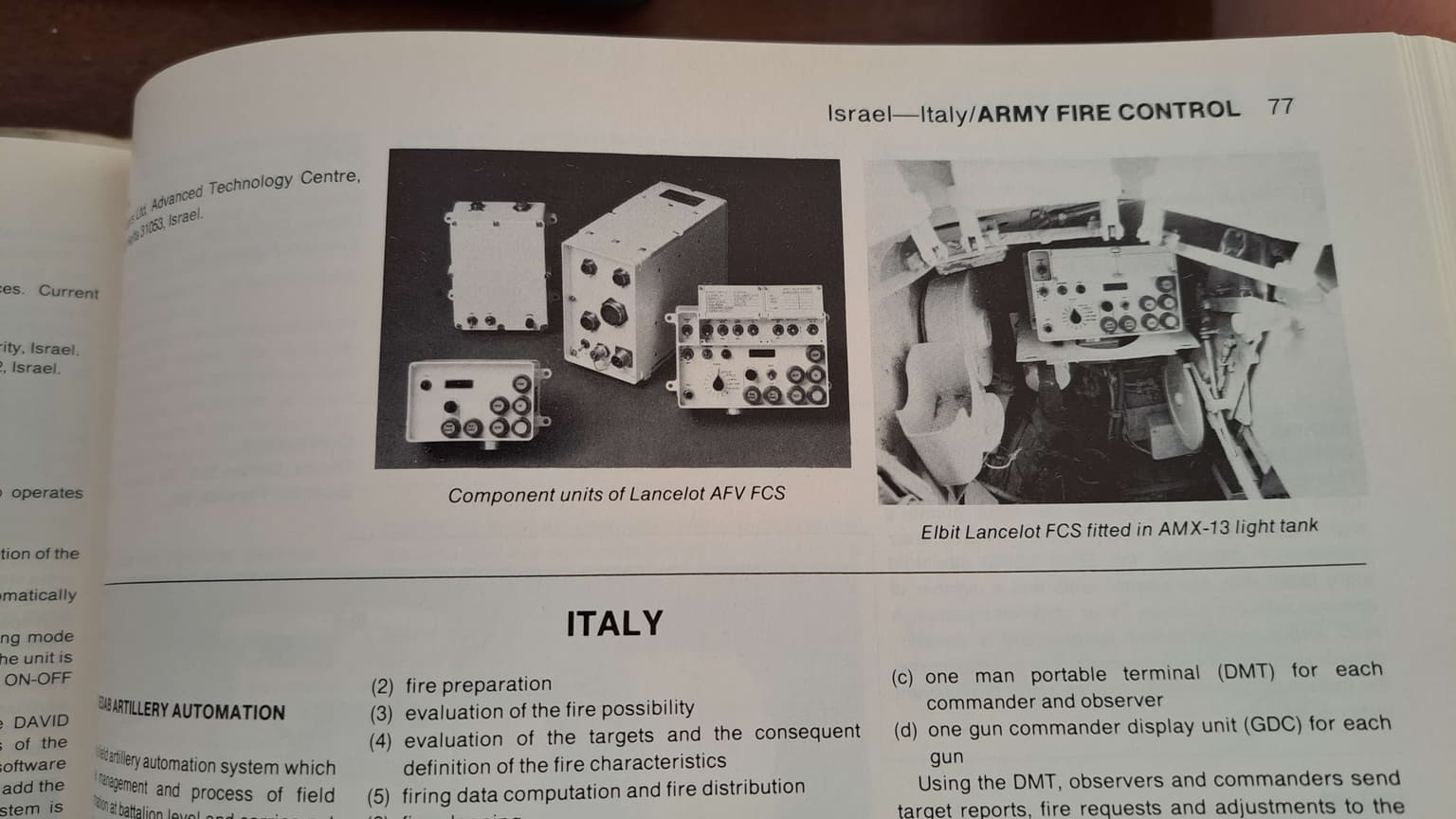
Jane’s weapon systems 1988-89
Lan-Sadot modules (Lancelot)
El-Op’s “Lan-Sadot” Brochure
PDF: https://web.archive.org/web/20040710044234/http://www.elbitsystems.com:80/data/LanSadot.pdf
Jane’s
info about Elbit’s stabilization system that might be used on AMX-13
CMI Defense - Cockerill Mk.3 brochure
General info about the 90mm Cockerill guns and ammunition + specifications
Source: https://web.archive.org/web/20061024193215/http://www.cmigroupe.com/doc/cse90.pdf


Websites
Image material + Gun name (Mk.3-A8) CMI Defence - Upgrading & up-gunning of existing turrets
Nimda catalog https://www.nimda.co.il/wp-content/uploads/2021/05/Nimda_Catalog.pdf
AMX-13 history in the IDF + Singapore Трискайдекафобия ? Нет, не слышали. - Пещера злобного Буквоеда — LiveJournal
History of early relations between Israel and Singapore The first military advisors sent from Israel to S'pore were called 'Mexicans' in order to be discreet - Mothership.SG - News from Singapore, Asia and around the world
General AMX-13 Specifications AMX-13/75 | Weaponsystems.net
Image Gallery:
Spoiler
AMX-13 Meshupar (90 mm)

AMX-13 Meshupar (75 mm)
AMX-13 Meshupar (75 mm) - Early Development

AMX-13 Meshupar (75 mm) - On display at “Yad La-Shiryon” Museum, has Lan-Sadot FCS, but no change to the engine compartment
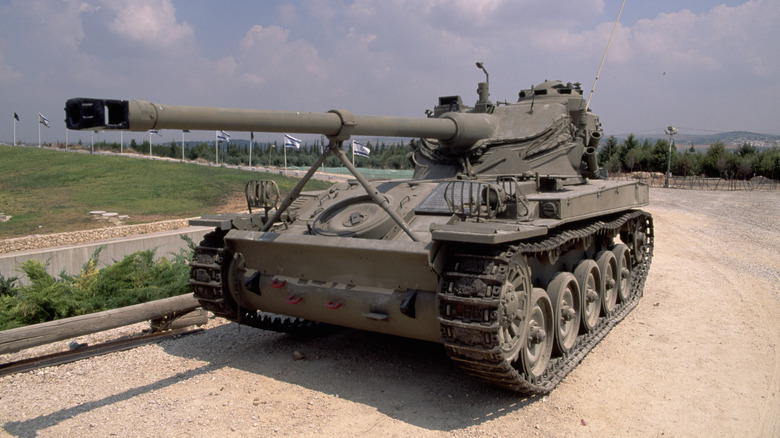
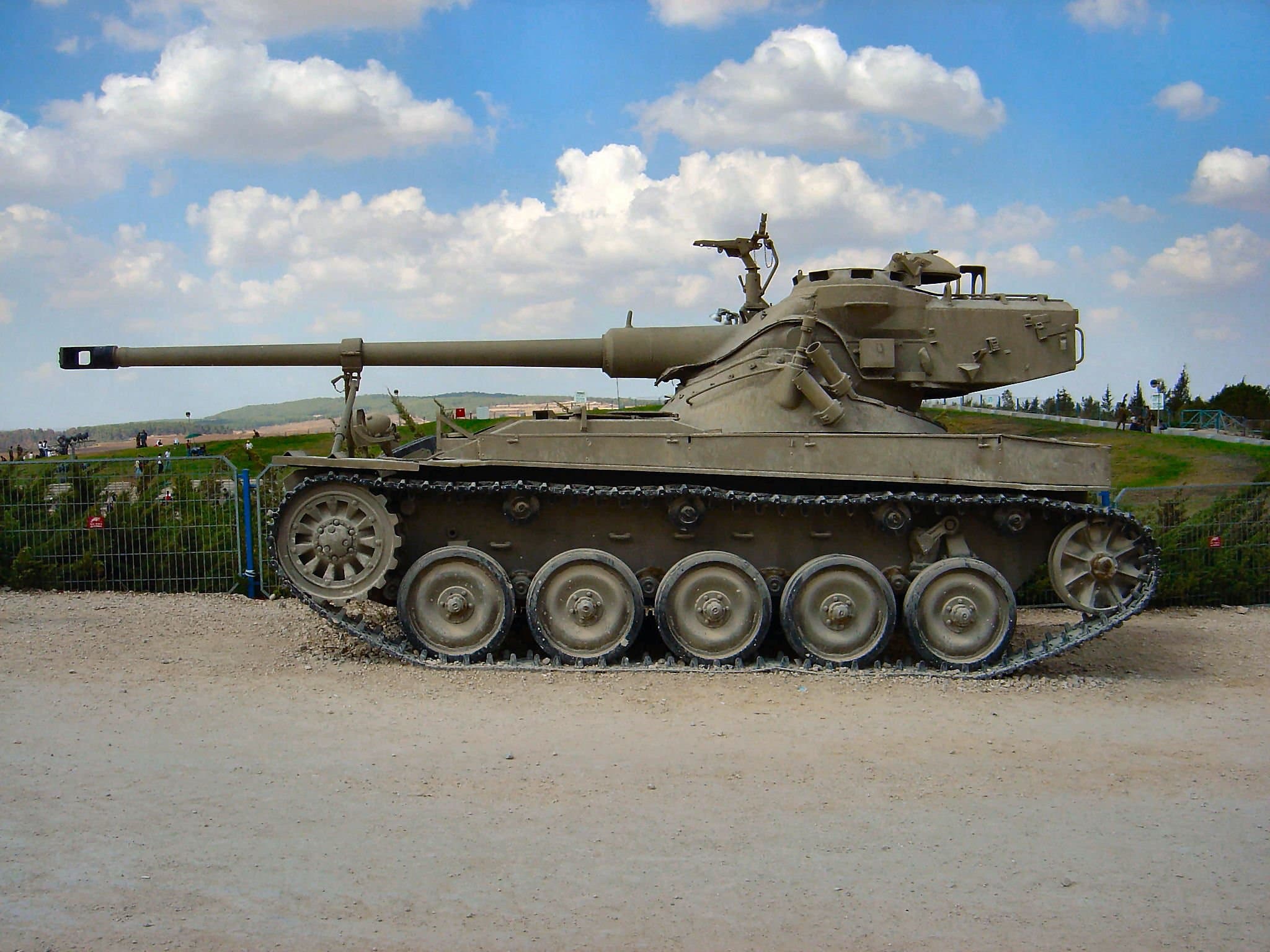
Final Words:
ㅤI am quite surprised nobody has suggested this before, as this vehicle is well-known from early Tech Tree concepts. However, it is understandable given that there is little to no information available on the web. Additionally, many people commonly confuse the main gun with the 60 mm HVMS. Overall, I was able to make this post happen only thanks to the contributions of the great people from the Shiryon Archive Discord server.
ㅤThe “AMX-13 Meshupar” would be a very interesting addition to the game. It features a 90 mm cannon firing a decent APFSDS (100 mm RHA @ 60° at 1 km) paired with a okayish 7.5-second autoloader, alongside an FCS equipped with a laser rangefinder, night vision, and a ballistic computer. Mobility-wise, it would perform similarly to the existing AMX-13 in-game, despite housing a different engine and transmission. Finally, there is the question of gun stabilization, though more historical documentation would be required to fully confirm that capability. Regarding Battle Rating placement, in my opinion, without a stabilizer it would fit nicely around 7.7. With a stabilizer, it would be more effective, however, given that its APFSDS performance is not the best, it should remain around 7.7–8.0 and no higher.
- Researchable
- Premium
- Event
- Squadron
- I don’t know
- I voted no (first poll)
- I don’t know
- 7.0
- 7.3
- 7.7
- 8.0
- 8.3
- 8.7
- Other
- I voted no (first poll)
- I don’t know
- 7.0
- 7.3
- 7.7
- 8.0
- 8.3
- 8.7
- Other
- I voted no (first poll)