- Yes - In the Tech Tree.
- Yes - Event/BP.
- Yes - Premium.
- No - I would not like to see HMAS Albatross in game.
HMAS Albatross operating her cranes to recover one of her aircraft. (n.d)
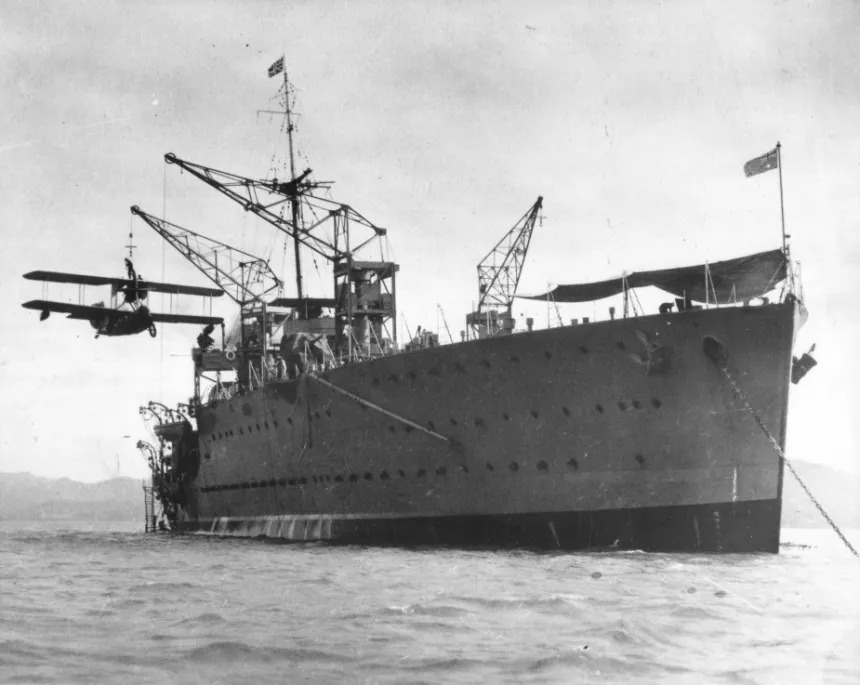
Description:
HMAS Albatross’s story is quite odd when compared to most of the vessels within the Royal Australian Navy’s (RAN) fleet unit. Unlike the typical story of an ex-Royal Navy (RN) vessel loaned to the Australian Government, she was built for the RAN, then traded to the Royal Navy.
She was also a product of Australia’s economy at the time, as the Australian Government had wished for a naval aviation capability in the form of a full sized aircraft carrier, however with the economy drawing down only a Sea Plane tender could be afforded for the fleet. Her design was further influenced by Australia’s economy at the time, as although designed by the British Admiralty, she would be built in an Australian yard to increase the number of jobs to combat unemployment.
This suggestion is for HMAS Albatross in her 1929 refit.
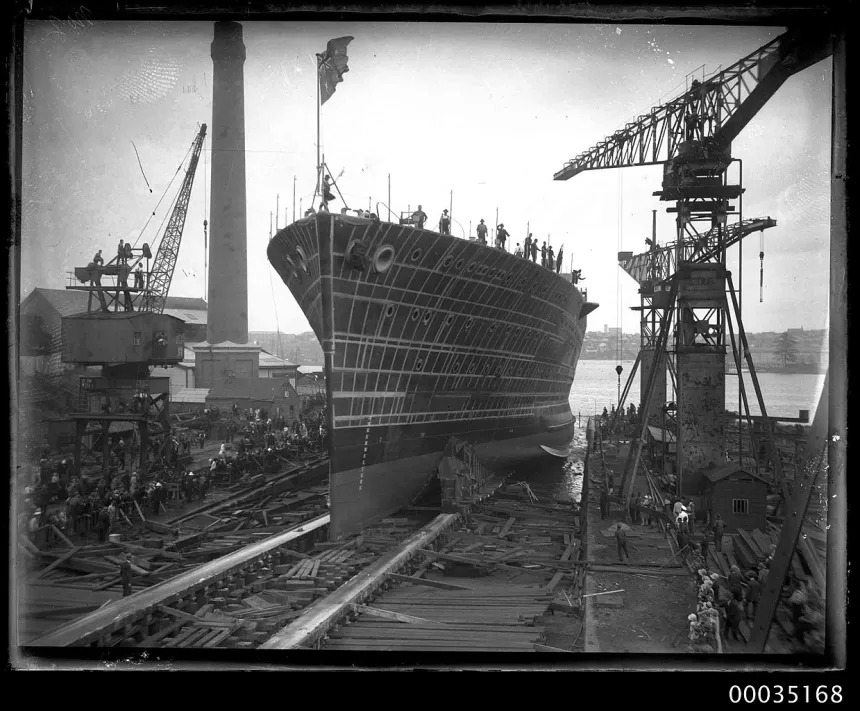
Launch of the HMAS Albatross in 1928 at the Cockatoo Island Dockyard
History:
Royal Australian Navy Service:
Laid down on the 16th of April 1926 by Cockatoo Docks and Engineering Co at the Cockatoo Island Dockyards, Sydney, Australia. She would launch on the 23rd of February, and complete fitting out on the 21st of December 1928. She would work up and finally commission on the 23rd of January 1929, and her armament was altered, giving her two single QF-2pdr Pom Pom guns aft.
Her first action was to search for Sir Charles Kingsford Smith in his Fokker F.VIIb/3m exploration airplane, who had gone missing. When he was found, having made an emergency landing near the Glenelg River, her search was called off. During periods of unrest within the RAN fleet, mostly due to pay cuts and poor treatment, her engines were sabotaged twice, once in November 1931, and another in September 1932. She would however remain active during this time.
She would be refitted for use as a gunnery training ship in December 1931, recommissioning in early 1932, and on the 19th of March the same year she would take part in the opening of the Sydney Harbour Bridge. On the 26th of April 1933 she would be placed in E-class reserve at Sydney. She would continue to operate seaplanes however, but she would not sail.
Although designed with use of the Fairey IIID, which was then in use with the RAAF’s No.101 Flight, she would actually use the Supermarine Seagull Mk.III, as the Fairey type had been retired. The internal hangar for these aircraft would result in her massive freeboard in the forward half of the vessel, but was still too small for the Seagull Mk.III type, which had to manoeuvre around the hangar with the undercarriage retracted on special trolleys. The Seagull Mk.III could also not make use of her steam catapult, which had been designed for the Fairey IIID.
Because of this, the Australian Government would give new specifications to Supermarine for a new aircraft type, the Supermarine Seagull Mk.V, later called Walrus, design of this type would complete in 1933, the Albatross would not see service with this type, as she had already been placed in reserve.
Still in reserve in 1938, and the Australian government struggling to find funding for the purchase of the Modified Leander-class Cruiser, HMS Apollo (soon to be HMAS Hobart), the HMAS Albatross was accepted as partial payment for the new ship. The Australian Government would be credited £266,500 towards the payment of the Apollo.
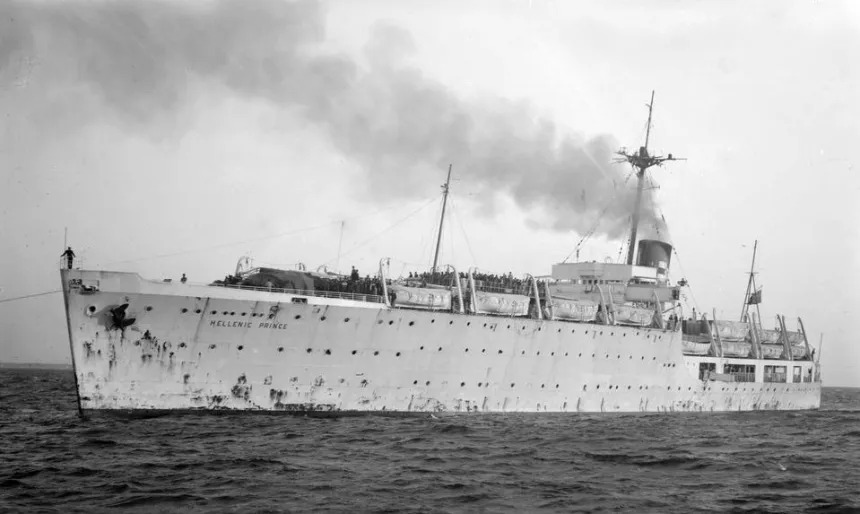
SS Hellenic Prince, the former HMAS Albatross after being converted into a passenger liner, (1951)
Royal Navy and Post-War service:
HMAS Albatross would recommission as the HMS Albatross on the 19th of April 1938 for her voyage from Sydney to Devonport, however as the RN had little use of a seaplane tender, with most capital ships and cruisers carrying their own aircraft, she would be placed in reserve in December 1938. Her catapult was removed and she was used as an accommodation ship.
She would not initially be recommissioned on the declaration of war in September 1939, however with the loss of the aircraft carriers, HMS Courageous and Glorious, the HMS Albatross would be recommissioned for use from Freetown, Sierra Leone, where she would perform ASW, convoy escort, and air-sea rescue missions into the Atlantic. She would transfer to the Indian Ocean in May 1942, as to assist the Eastern Fleet with further trade protection roles, but also supporting the landings at Mayotte, Madagascar. She would return to the UK in September 1942, paying off for refit. During her RN service she would operate the Supermarine Walrus, the aircraft designed for her RAN service.
This refit would only begin in October 1943, and completing in early 1944. This refit transformed her into a LSE, landing ship engineering for the invasion of Normandy. Her initial operations in this area would actually be around the Thames, as part of operations, as to divert German attention away from the invasion zone. She would move to Sword Beach, more specifically to the Mulberry Harbour Gooseberry 5, providing repair facilities, AA, and bombardment support with her 4.7-inch guns.
She would repair over 211 landing craft in her time in Sword Beach, however by July she would move to Juno Beach. On the 11th of August, while sailing off Courseulles-sur-Mer, she was struck by a torpedo, suffering large amounts of damage, suffering 66 killed and many more wounded. She would be towed to Portsmouth by the tug Zwart Zee, with repairs lasting until 1945.
Once repaired she would initially be assigned as a minesweeper depot ship, however she would pay off into the reserve before any lasting service in this role.
Now post war, she would be sold into civilian service for conversion into a luxury liner, however due to a lack of money for this project, she was sold onto the Yannoulatos Group shipping service and renamed Hellenic Prince. She would be chartered by the International Refugee Organization in 1949 for refugee transport from Europe to Australia and New Zealand.
She would have a number of voyagers, often with greater than 1,000 passengers. One famous incident included the hunger strike of the passengers due to very poor conditions aboard, resulting in her captain spraying her passengers with seawater in an attempt to break them up. She would also serve as a troopship in the Mau Mau rebellion.
However her civilian service would not last long. She would be broken up at Hong Kong on the 12th of August 1954.
| General Characteristics: | |||||
|---|---|---|---|---|---|
| Name: HMAS Albatross | |||||
| Country: Australia | |||||
| Type: Seaplane Tender | |||||
| Class name: Albatross | |||||
| Year of commission: 1928 | |||||
| Refit: 1929 | |||||
| ----------------------------------------------------------------------------------------------------------------------------------------- | |||||
| Dimensions: | |||||
| Length: 443ft 7in (135.2m) | |||||
| Beam: 77 3/4ft (23.7m) at sponsons | |||||
| Draught: 16ft 11+1/2in (5.2m) | |||||
| Displacement: 4,800t standard, 6,000t full | |||||
| ----------------------------------------------------------------------------------------------------------------------------------------- | |||||
| Propulsion: | |||||
| Powerplant: 4x oil fired boilers, 2x turbines producing 12,000shp (8,900kW) over two shafts | |||||
| Speed: 20kt | |||||
| Endurance: 4,280nmi @ 22kt | |||||
| ----------------------------------------------------------------------------------------------------------------------------------------- | |||||
| Armament & sensors: | |||||
| Compliment: 450 overall, 404 RAN, 46 RAAF | |||||
| Primary armament: 4x1 QF 4.7-inch Mk.VIII | |||||
| Secondary armament: 2x1 QF 2pdr (Pom-Pom) | |||||
| Tertiary armament: 4x1 .303 Vickers, 10x1 .303 Lewis, 5x2 .303 Lewis | |||||
| Radar: -nil | |||||
| Sonar: -nil | |||||
| ----------------------------------------------------------------------------------------------------------------------------------------- | |||||
| Aircraft Carried and specs: | |||||
| Type: Supermarine Seagull Mk.III | |||||
| Number: 9 | |||||
| Engine: 1x Napier Lion IIB @ 492hp (367kW) | |||||
| Weight (empty): 3,820lb (1,733kg) | |||||
| Max Speed: 98mph @ 3,000ft (158kph @ 914m) | |||||
| Climb Rate: 6.4ft /s (1.9m/s) | |||||
| Armament: 1x1 .303 Lewis, 2x 250lb bombs |
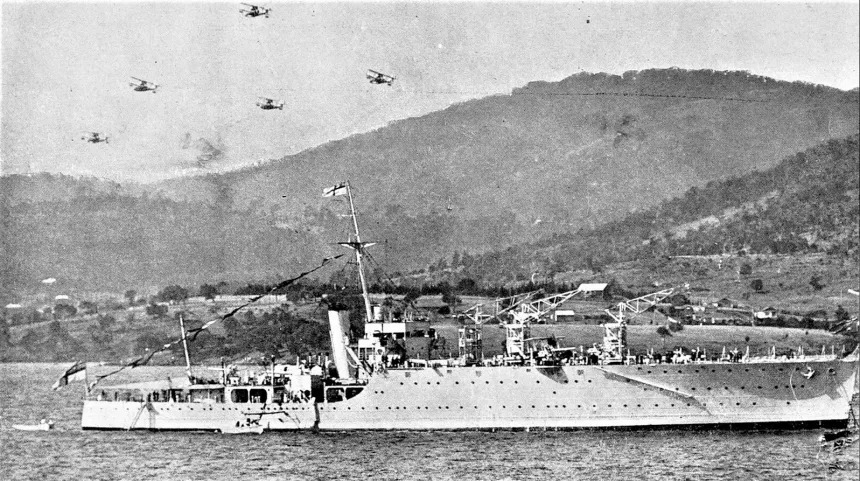
HMAS Albatross and her aircraft operating around Australia, (n.d)
Sources:
Hermon, G. (1957) Royal Australian Navy, 1939-1942 (pp.26, 39, 170-171, 417)
Gillett, R. (1983). Australian and New Zealand Warships 1914-1945 (p.72)
The Sydney Morning Herald, February 21st, 1928. (p.10)
https://seapower.navy.gov.au/history/units/hmas-albatross-i
HMAS Albatross (1928) - Wikipedia
HMS Albatross | laststandonzombieisland
SS Hellenic Prince 1948-1954, ex HMAS Albatross 1928-1946