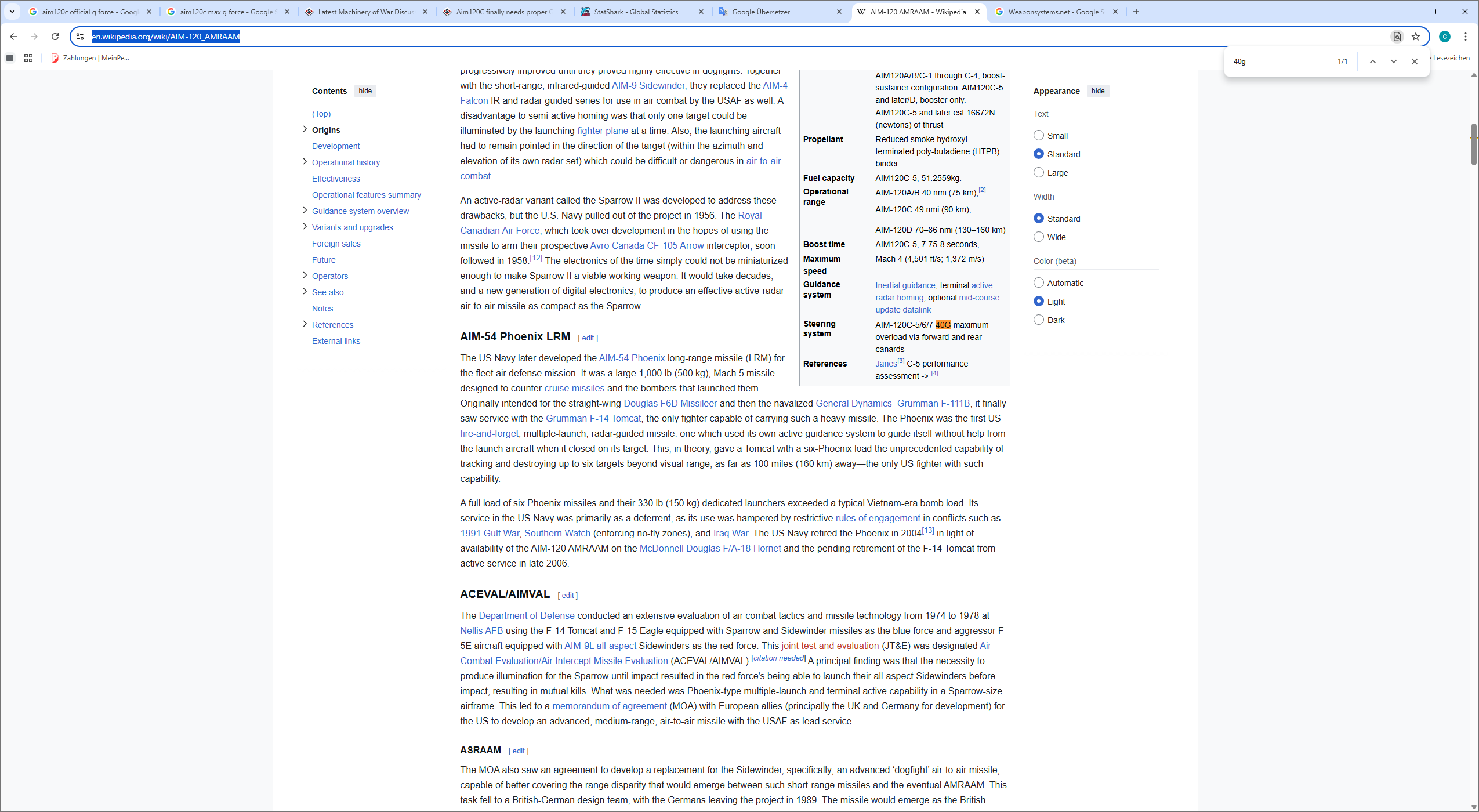
The AIM-120C AMRAAM can achieve a maximum lateral acceleration (G-load) of up to 40 G.
This document says that it can pull 40g at peak.
Here are the key details regarding maneuverability:
Maximum Load: A maximum overload of 40 G is specified specifically for the AIM-120C-5, C-6, and C-7 variants. Older versions, such as the AIM-120A/B, often operate in a range of approximately 28 G to 35 G.
Improved Kinematics: Starting with the C-5 version, maneuverability was enhanced through improved HOBS (High Off-Boresight) capability, enabling tighter turns against targets flying off-bore.
Control: The missile utilizes four movable control surfaces at the rear to achieve these high G-forces during the final stage of interception.
Influencing factors: The actual G-load that the rocket can exert at any given moment depends strongly on its current speed (up to Mach 4) and altitude. At high altitudes, the air is thinner, which reduces aerodynamic maneuverability.
Official military reports often classify specific G-load data as classified, but reliable values can be derived from released documents and technical analyses.
Maximum G-load of the variants
Variant Max. G-load Special Features
AIM-120B ~28 G to 35 G Utilizes larger control surfaces than the C variant, which theoretically allows for high maneuverability at low speeds.
AIM-120C (C-5/6/7) up to 40 G Despite smaller (“clipped”) wings for internal transport (F-22/F-35), the G-load was increased to up to 40 G through improved actuators and software.
Details from official & technical sources
Improved agility of the C series: Starting with the AIM-120C-5 version, an improved control system was introduced that explicitly raised the maximum load to 40 G. This is primarily intended to intercept targets with high maneuverability in the terminal phase.
Influence of airspeed: The full G-load is primarily reached at high speeds (near Mach 4). In simulations and technical analyses (e.g., for DCS World), a value of 35 G is often discussed as a realistic limit for the B variant, while the C variant achieves higher peak values through optimized control.
Aerodynamic differences: The AIM-120B has a larger wingspan (approx. 53 cm) compared to the AIM-120C (approx. 48 cm). The C variant compensates for the loss of wing area with improved aerodynamics and more powerful engines (from the C-5 onward), making it kinetically superior overall.
Official fact sheets from the U.S. Air Force and the Naval Air Systems Command (NAVAIR) confirm its operational capability and high off-boresight capability, but usually list the exact G-limits under “Classified” or refer to its superiority over the AIM-7 Sparrow.

 p21
p21 p30
p30 p5
p5