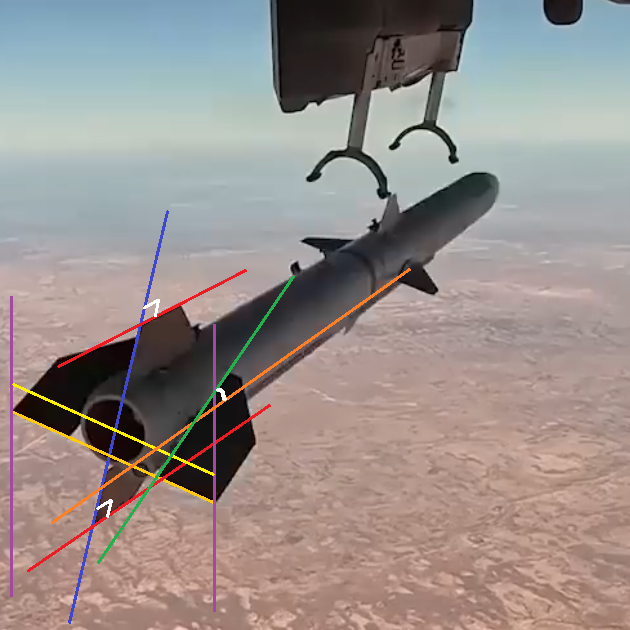
I am in fear that my current thought process is a bit, unscientific. But if we roughly ignore the horizontal image distortion and assume a proportional relation between the distorted angle and a the real angle, we can use the 90 degree edges to guesstimate the fin AoA of that one single frame. So far, it’s like very roughly 35-40 degrees of AoA, but it’s really hard to tell because of how pixelated the frame is.
Even with the rough assumptions, I do believe the fin AoA is definitely higher than the 15 degrees in game.
not really basically anything that isnt russian/chinese has a 20km activation with the exception of the aim54’s and fakours which means its not standardized
this got me thinking a good buff for aim120D is the missile wont go active until tws track is broken or its a hardlock which it will go active as soon as its in range. could be a interesting mechanic
something else i just realized is that this is the exact same situation between the aim54A and C. no difference besides that the C is just worse due to its added weight
If the seeker of AIM-120 wasn’t so hilariously bad the 22km activation distance might not be a detriment, but with the “you don’t need effort to defeat this” easy notch ARH seekers almost everyone has it’ll just give people even longer to defend.
If missiles actually had to be kinematically defeated or avoided by breaking enemy datalink a longer seeker search distance would be amazing. In current meta, I think a longer seeker activation distance is much less desirable.
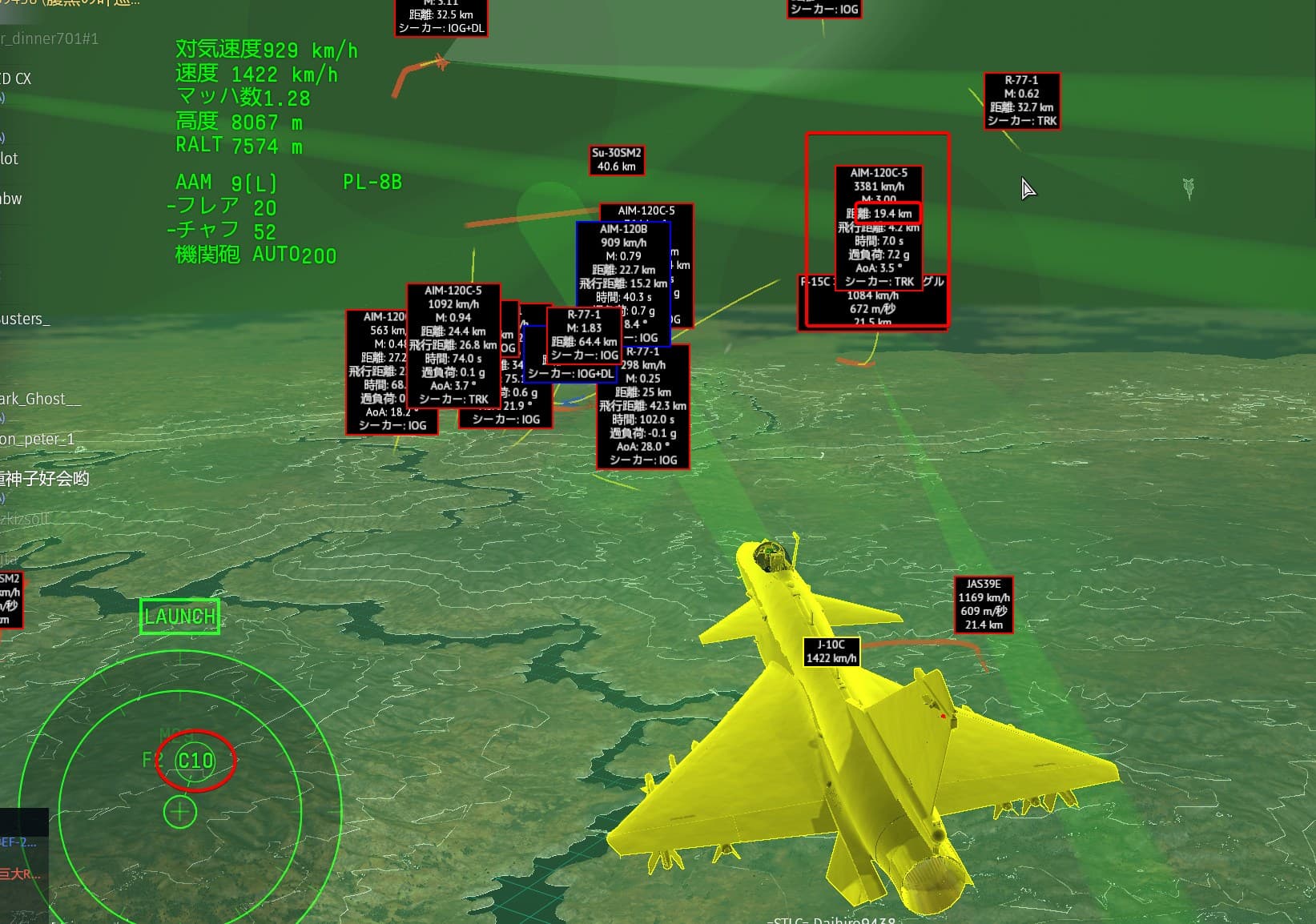
To be more specific, even if the missile enters active terminal guidance on your scope, cutting the data link can cause the AMRAAM to revert to inertial onboard guidance (IOG) depending on the situation. This is because the AMRAAM begins its active guidance at 20km, but it only achieves all-aspect capability against a target with a specific RCS at 16km.