History
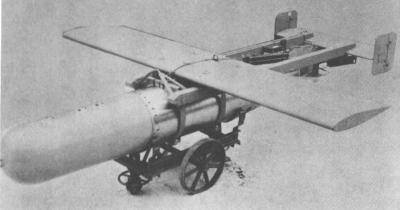
The GT-1 Glide Torpedo was developed by Aeronca as a stand-off anti-shipping weapon for the United States Army Air Forces. It was derived from the earlier GB-1 series of glide bombs developed for use by B-17 bombers. The USAAF sought a means of increasing the effectiveness of aerial torpedo attacks while reducing the vulnerability of aircraft to anti-aircraft fire and enemy fighters. As a result, development of the GT-1 began as early as 1943.
The GT-1 consisted of a standard Mk 13 aerial torpedo fitted with detachable wooden wings and tail surfaces. Guidance was initially provided through preset gyroscopes and an autopilot system, while later versions experimented with radio-control guidance. After release, the weapon would glide along a predetermined course toward the target area. Under ideal conditions, a GT-1 released from approximately 10,000 feet (3,000 m) could achieve a stand-off range of up to 25 miles (40 km).
During the flight operation, a small paravane suspended beneath the weapon by a cable trailed approximately 20 feet (6 m) below the glider. The cable was connected to explosive bolts securing the wings and tail assembly. Upon striking the water, the paravane filled and generated sufficient drag to trigger the detonators, causing the wings, tail surfaces, and supporting structure to separate from the torpedo. The now-unencumbered Mk 13 would then enter the water and continue toward its target. The torpedo’s tail mechanism could be preset to perform evasive patterns, including zig-zagging or circular runs, in an attempt to complicate enemy defenses.
The GT-1 was initially tested using B-17 Flying Fortresses, as evidenced by archival footage showing B-17s carrying GT-1s on under-fuselage racks. Testing later expanded to include the B-25 Mitchell, where the concept continued to demonstrate promising results.
Following successful trials, the USAAF assigned a single operational unit to employ the weapon in combat. This unit was the 47th Bombardment Squadron, 41st Bombardment Group. In November 1944, the squadron was withdrawn from Makin in the Marshall Islands and returned to Hawaii, where its B-25Js were modified to carry the GT-1 on a single centerline rack. The unit subsequently trained for anti-shipping operations before deploying to Okinawa on June 7, 1945.
Led by Major Herb Gartin, the 47th Bombardment Squadron flew its first GT-1 combat mission on either July 27 or July 31, 1945. Fourteen B-25Js carrying GT-1s were originally tasked with attacking shipping in Sasebo Harbor, where Japanese fleet carriers had reportedly been sighted. However, delays in the fighter rendezvous forced the formation to divert to a secondary target at Kagoshima due to fuel concerns. Of the six GT-1s released, three were observed entering the harbor and detonating.
Two days later, thirteen B-25Js attacked Sasebo Harbor itself, where one fleet carrier (CV) and one light carrier (CVL) were reportedly still anchored. Of the eleven GT-1s released that successfully entered the water, three detonations were observed: one near the fleet carrier, one near the light carrier, and one near a small freighter. Due to poor visibility and hazy weather conditions, the effectiveness of the attack could not be conclusively determined. Nevertheless, crews reported observing explosions within the harbor.
The final GT-1 combat mission of the war took place on August 1, 1945, against shipping in Nagasaki Harbor. Heavy smoke from recent attacks by Task Force 38 complicated the observation of results. Five Mk 13 torpedoes were observed running “straight and true” toward three freighters and several additional vessels, while three of these GT-1s successfully entered the harbor. This mission marked the third and final known operational use of the GT-1.
Participating crews reportedly viewed the weapon favorably and appreciated its ability to be launched safely from altitude and at considerable stand-off distance. However, no further combat sorties utilizing the glide torpedo were flown. The 47th Bombardment Squadron returned to conventional bombing and strafing operations from Okinawa until the end of the war on August 14, 1945.
After World War II, development continued into more advanced stand-off torpedo concepts, eventually leading to weapons such as the AUM-N-2 Petrel, designed for aircraft like the P2V Neptune. However, rapid advances in missile technology soon rendered aerial stand-off torpedoes obsolete. As guided missile systems matured, interest in the concept declined, and the entire GT (Glide Torpedo) category was formally abolished in 1947.