- Yes
- No
 Admiral Makarov - The Kriegsmarine’s Soviet Flagship
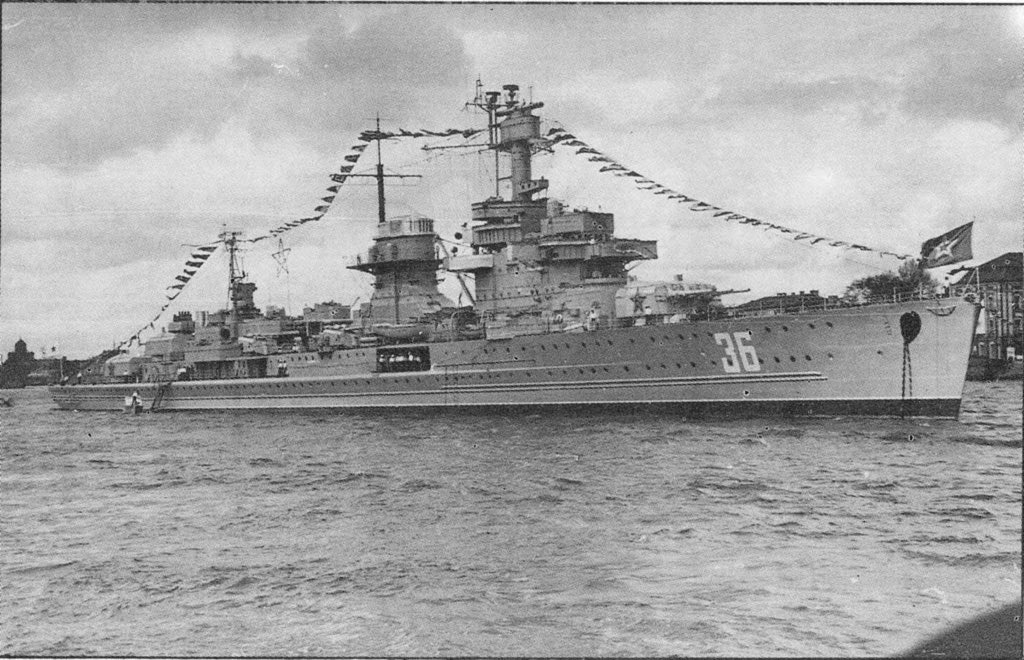
History
When the light cruiser Nürnberg hit the water at Kiel in late 1934, nobody on the slipway expected she would end her days under a Red Banner flag in Leningrad. She was the last light cruiser built by Germany before World War II, a sleek 9,000-ton vessel armed with nine 15 cm guns in triple turrets uniquely offset aft to improve firing arcs and a hybrid engine setup that paired steam turbines for high-speed sprints with diesel engines for efficient long-range cruising.
Her early war was nearly cut short. In December 1939, while returning from a minelaying run off the British coast, the Royal Navy submarine HMS Salmon put a torpedo straight into her bow. The damage required months of extensive structural repairs in Kiel. Once back in service, the Kriegsmarine largely kept her out of high-risk fleet actions due to fuel shortages and structural vulnerabilities. Aside from a brief deployment guarding Norwegian fjords in 1942 and 1943, Nürnberg spent most of the conflict running gunnery drills and cadet training in the Baltic. In January 1945, with the Reich crumbling, she laid her final minefields in the Skagerrak before sailing to Copenhagen, where her crew surrendered alongside the heavy cruiser Prinz Eugen in May 1945.
Her story didn’t end with the fall of Berlin. Divided up among the Allies by the Tripartite Naval Commission, the ship fell to the Soviet Union as war reparations. In January 1946, Soviet sailors under Vice-Admiral Lev Rall boarded the ship in Wilhelmshaven, working alongside her former German crew to navigate her to Liepaja, Latvia. On February 15, 1946, she was officially integrated into the Soviet Navy and renamed Admiral Makarov, honoring the 19th-century naval reformer and polar explorer Stepan Makarov.
The timing of her arrival was critical for Moscow. The Soviet Baltic Fleet’s primary cruiser, Kirov, had been heavily damaged by a magnetic mine in late 1945, leaving a major leadership gap in the region. Assigned to Tallinn, Estonia, Admiral Makarov filled that void instantly, becoming the flagship of the newly created 8th Fleet (Northern Baltic Fleet). During a extensive refit at Kronstadt in the late 1940s, Soviet shipyards stripped away her original German anti-aircraft guns and radar suites, replacing them with standard Soviet 37mm automatic cannons and domestic radar systems.
When the Soviet Navy consolidated its Baltic command back into a single unified fleet in late 1955, Admiral Makarov stepped down from her flagship role. Yearsof hard northern service and constant wear on her high-pressure boiler systems took their toll, leading to her reclassification as a dedicated training ship based out of Kronstadt. Decommissioned in early 1959, she was towed to Leningrad’s Coaling Harbor to be broken up for scrap. Dockyard workers tasked with cutting into her steel noted that despite decades of harsh Baltic duty, her outer hull plating remained remarkably free of severe corrosion a quiet final testament to the ship that had served two opposing navies.

Specifications
General Specifications
- Commissioned: November 2, 1935 (Kriegsmarine) / February 15, 1946 (Soviet Navy)
- Displacement: 7,150 metric tons (standard) / 9,040 metric tons (full load)
- Length: 181.3 m overall / 170.0 m waterline
- Beam: 16.3 m
- Draft: 5.74 m maximum at full load
- Complement: 896 officers and enlisted (German service) / 935 (Soviet service)
Armor Protection
- Waterline Belt: 50mm Krupp cemented steel (sloped 18° inward, tapering to 18 mm at bow and stern)
- Armored Deck: 30mm homogeneous steel with 20-25 mm sloped edges
- Main Turrets: 80mm face, 20 mm roof, 20 mm sides/rear
- Barbettes: 60mm
- Conning Tower: 100mm sides, 50 mm roof
- Internal Bulkheads: 10mm anti-splinter bulkheads
Propulsion & Performance
- Machinery: Hybrid CODAG-style arrangement (Steam Turbines + Diesels)
- Boilers: 6 oil-fired marine water-tube boilers (23 atm operating pressure)
- Turbines: 2 Parsons/M.A.N. geared steam turbines driving 2 outer shafts (66,000 shp)
- Diesels: 4 M.A.N. 7-cylinder double-acting 2-stroke diesels driving 1 central shaft (12,400 bhp)
- Total Output: 78,400 hp
- Top Speed: 32 knots (59 km/h) combined
- Cruising Speed: 10-12 knots on central diesel shaft alone
- Operational Range: 3,900 nautical miles at 10 knots (diesel) / 2,600 nautical miles at 19 knots
Armament
- Main Battery: 9x 150 mm (5.9 in) SK C/25 guns in 3 triple turrets (1 forward, 2 aft superfiring; rear turrets offset 25 cm off-center to widen forward firing arcs)
- Elevation: -10° to +40°
- Rate of Fire: 6-8 rounds per minute
- Muzzle Velocity: 960 m/s
- Max Range: 25,700 meters
- Secondary DP Battery: 8x 88 mm (3.5 in) SK C/32 dual-purpose guns in 4 twin mounts
- Anti-Aircraft Battery (Soviet Project 17 Refit): 16x 37mm V-11 / 70-K automatic AA guns in twin and single mounts (replacing original German 37mm and 20mm mounts)
- Torpedo Armament: 12x 533 mm (21 in) torpedo tubes in 4 triple mounts (removed during late-1940s Soviet refits to reduce topside weight)
- Aviation Gear: Originally 1 Heinkel catapult and 2 Arado Ar 196 floatplanes (catapult and handling equipment removed in 1947)
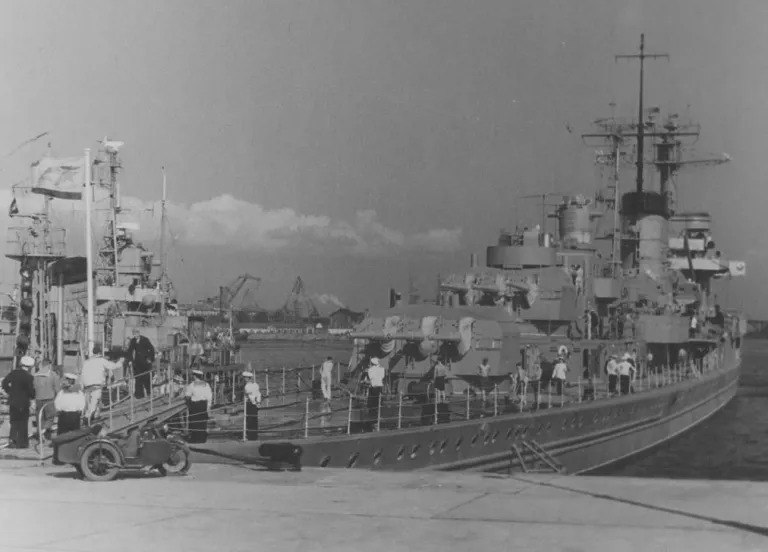
“(Admiral Makarov’s stern during the mid-1950s. Of interest is the quad AA gun above the upper aft turret. It is a Vierling FlaK 38, a quad 20mm Mauser weapon normally used ashore by the Wehrmacht. This had been installed as an emergency anti-aircraft addition in 1942. It is somewhat surprising that the USSR did not replace it with a Soviet 23mm gun to standardize ammunition with other ships.)”
Sensors & Electronics (Soviet Refit)
- Air Search Radar: Soviet “Guis-2”
- Surface Search Radar: Soviet “Rif”
- Fire Control Systems: Soviet “Yakor” and “Zalp” radar-directed fire control suites
- Sonar: Original German S-Gerät hydroacoustic suite retained for sub-surface navigation
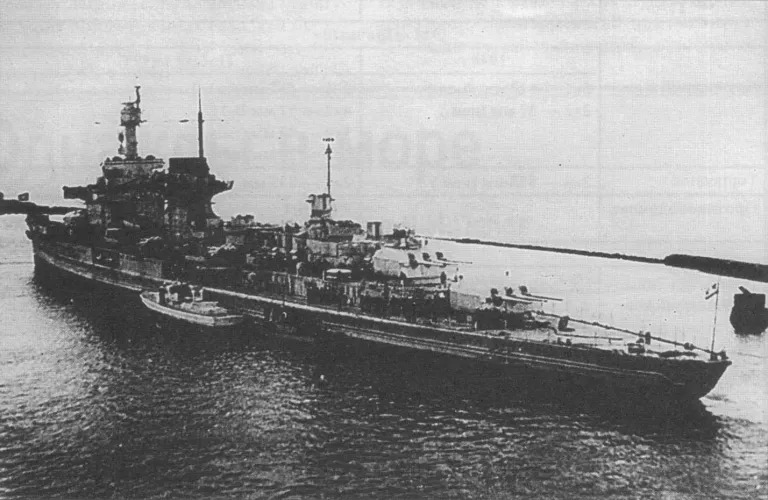
“(Admiral Makarov with all German WWII radars removed. These may have been impossible to support long-term with no spare parts readily available.) (photo via navsource.narod.ru website)”
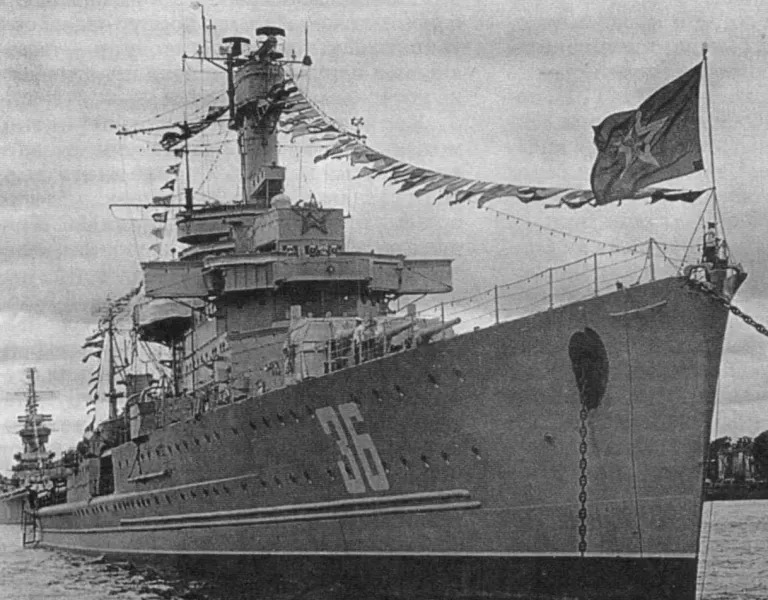
“(Admiral Makarov anchored on the Neva river in Leningrad during the mid-1950s. The new electronics were a “Ball Gun” radar, a small navigational set, and a “Ski Pole” IFF system.)”
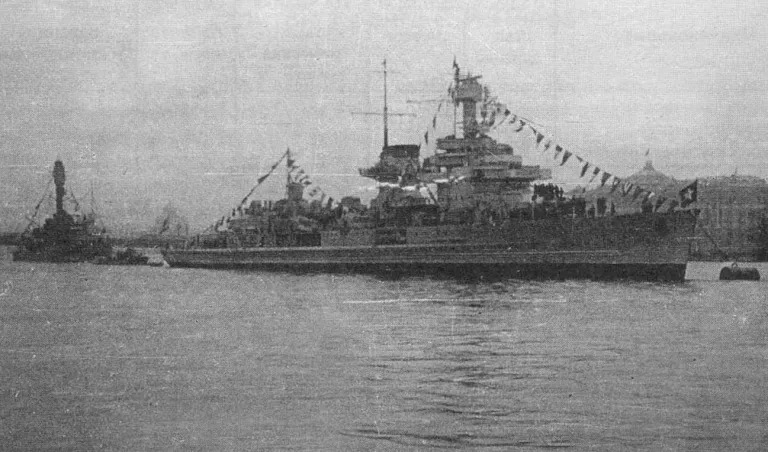
“(Admiral Makarov at anchor during the mid-1950s. The ship astern is Vyborg, formerly the WWII Finnish Väinämöinen, which was ceded by Finland as WWII reparations in 1947.)”