- Yes - In the Tech Tree.
- Yes - Event/BP.
- Yes - Premium.
- Yes - Squadron
- No - I would not like to see HMAS Canberra in game.
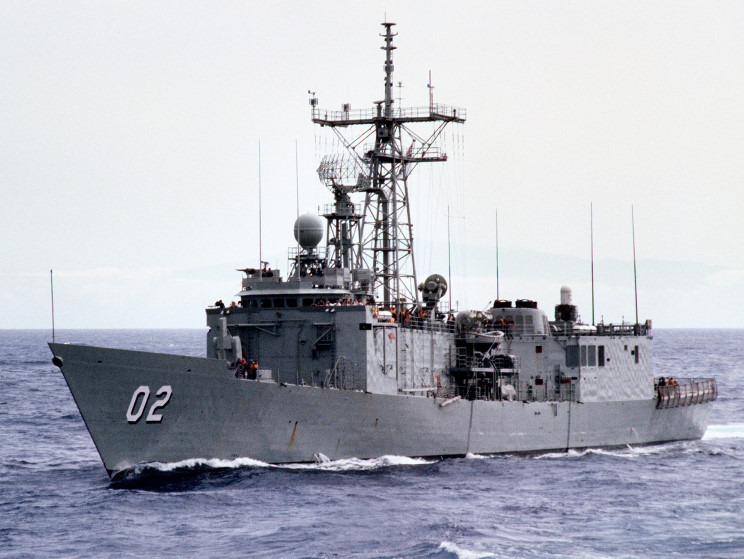
HMAS Canberra at sea off Hawaii during exercise RIMPAC 88, (1988)
Background:
With the Australian Light Destroyer (DDL) program coming into review for cancellation in late 1973, after years of delays and cost expansions, the Royal Australian Navy (RAN) quickly needed a new ‘light’ guided missile destroyer that would replace their ageing Daring-class Destroyers of 1949 vintage. For this competition two foreign designs were highlighted for tender in case the DDL program did indeed fall through. These two designs were the a unique variant of the British Type 42 Destroyer fitted with the SM-1 missile, as well as an unmodified American Oliver Hazard Perry-class frigate.
By the end of the initial comparison the team in charge of this tender found that the Modified Type 42 design was the only design to meet the RAN’s requirements,and listed the Oliver Hazard Perry-class (OHP-class) as “a second rate escort that falls short of the DDL requirements on virtually every aspect”. However, the RAN placed serious doubt that the Type 42 design could be fitted with SM-1 missiles, one of the base requirements for the program. As such the Australian Government placed approval for orders for two OHP-class vessels in April 1974.
With the new Fraser Liberal Government in late 1975, the DDL program was again reviewed, and unanimously voted to be cancelled, as the cost of the 3 DDL ships, which was down from the 10 original planned DDLs, was $130M more expensive than an equivalent number of OHPs, and would take a further three years to construct. With the DDL program now officially canceled, two OHPs were ordered from US yards in February 1976, a third in 1977, a fourth in 1980. The first ship, the future HMAS Adelaide was built to OHP Flight I standards, while the second and third, the future HMAS Canberra and Sydney to Flight II standards, and the fourth and last US built ship, the future HMAS Darwin was built to Flight III standards. Two future Australian built ships would also be built to Flight III standards, but with further upgrades.
This suggestion is for the HMAS Canberra (II) as she commissioned, she is the second of the Adelaide-class to be built, and the first one built to flight II Standards. She is the second of her name, with the first being a Kent-class Heavy Cruiser, commissioned in 1928 and sunk in 1942, the third ship of this name is a Canberra-class LHD commissioned in 2014 and in service with the RAN to this day.
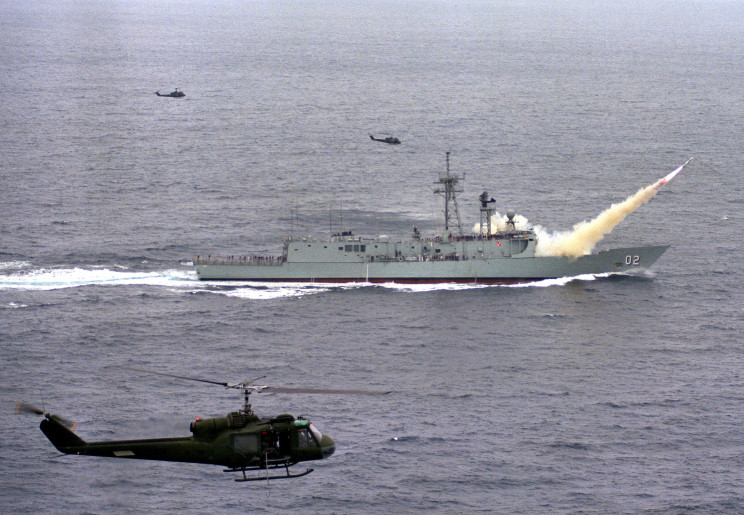
HMAS Canberra firing her first Harpoon Missile during trials, (1981)
History:
Laid down on the 1st of March 1978 by Todd Pacific Shipyards, at Seattle, WA, with the US build number of FFG-18, she would launch on the 1st of December 1978, and finally finish fitting out and would commission on the 21st of March 1981. Upon commissioning into the RAN she would lose her US build number of FFG-18, and would gain the Australian pennant number of FFG-02.
Upon commissioning she would continue in trials at Todd Pacific Shipyards until mid May 1981, when she would sail to Canada, more specifically to Esquimalt, BC, to exercise with vessels of the Royal Canadian Navy (RCN). She would sail down to Long Beach California upon completion of exercises with the RCN, where she would join the USN’s Destroyer Squadron 9 with her sister HMAS Adelaide. During her stay in this Squadron, HMAS Canberra would visit San Francisco, San Diego, and Port Hueneme, and would be visited herself by the Australian Governor General, Sir Zelman Cowen on the 25th of June 1981. By July of the same year she fired a Harpoon Missile for the first time.
As the S-70-B2 Helicopters ordered for use with the RAN had not yet arrived by the time of her commissioning, she would instead operate with two Aerospatiale-as350b-squirrels, which although unarmed, would provide the ships with aerial training, and search and rescue operations.
She would sail for Sydney at the end of operations in the US, she would sail for Sydney, NSW, arriving on the 29th of March 1982 having visited Pearl Harbour, Suva, and Auckland on her way. She was granted Freedom of Entry to the City of Canberra, her namesake, on the 8th of May the same year, as she began exercises and trials in the East Australia Exercise area. During her time here she would visit Honiara, Townsville, Adelaide, and Melbourne, however due to unexplained vibrations she would be placed in the floating dock at Newcastle, then the Sutherland Dock at Cockatoo Island, which found that she had damaged her propellor. Repairs for this took through to early 1983.
With repairs now complete, she would begin her year by firing two SM-1 missiles during further trials as part of Exercise SEA EAGLE 83-1. From here she would start her first Indian Ocean Deployment. During this deployment she would visit Colombo, Mombasa, Port Louis, and Singapore,and would operate as part of the USS America and USS Carl Vinson Carrier task groups. During another visit to Colombo in May 1983 she would strike the wreck of the MV Chief Dragon, which had been incorrectly plotted and buoyed. Repairs were made in Singapore, with the Canberra returning to Australia in June.
Upon her return to Australian waters she would continue in further exercises with the USN and RN through to 1985, including KANGAROO 83, VALIANT USHER 84-2, TRANSITEX 84-1. After this deployment she was to partake in Exercise Sandgrouper off West Australia, but instead returned to Sydney for fitting of the Phalanx CIWS. After this she would land a RNZN Wasp Helicopter that had signalled PAN, but by March she would take part in Exercise FLYING FISH before visiting the South West Pacific then SEA. While in the Malacca Straits she encountered the Soviet carrier Frunze and escorts. She would shadow them for five days using her helicopter.
She would return to Australia by March 1986 where she would continue exercises and port visits. She would visit SEA again in July 1987 and conducted exercises with the USS Midway Carrier Group. During this time she would visit the Solomon Islands, Papua New Guinea, the Philippines, and Hong Kong before moving back to Western Australia by September. By 1988 she would partake in Exercise TASMAN RULER 88, Exercise FLYING FISH 88, RIMPAC 88 TASMANEX 88, as well as escorting the Royal Yacht HMY Britannia during the Queen’s visit in April.
In 1989 she would visit the US for 14 weeks, visiting Newcastle, Honiara, and Pearl Harbour along the way to California. She would then conduct training with the USN, visiting San Francisco, Santa Barbara, and San Diego before returning to Australia via Honiara and Brisbane. Now in 1990 she would visit Wellington to commemorate the 75th anniversary of the ANZAC landings at Gallipoli, then by the 18th of May she would partake in the Royal Malaysian Navies international Royal Fleet Review, taking part in a FPDA exercise enroute.
Although the S-70B-2 helicopter began deliveries in 1988, allowing a great improvement in the Adelaide-classes ASW capability, as the AS350B Squirrel had no ASW gear at all. They would not finish deliveries until 1989, and the Adelaides would continue to use the AS350B Squirrel alongside the Seahawk. HMAS Canberra would only receive these Helicopters after a late 1990 refit, which strengthened the flight deck, and lengthened the hull to Flight III OHP standard (445ft → 453ft).
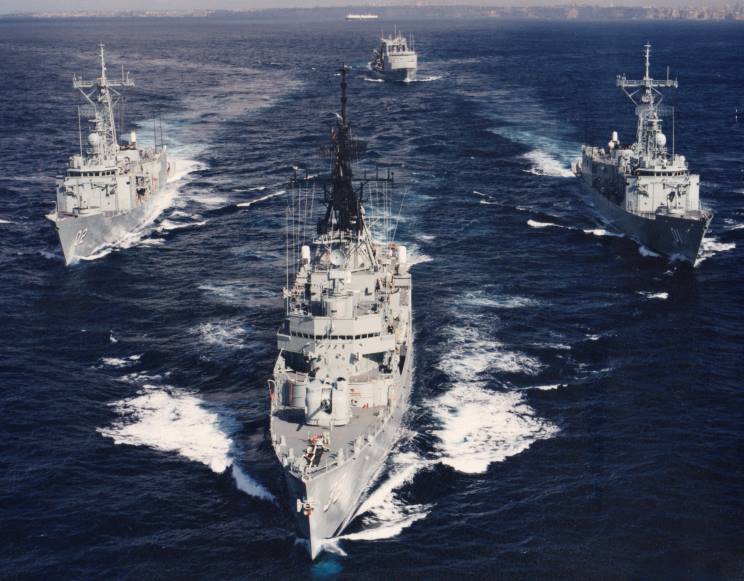
HMAS Canberra (left) sailing with HMAS Hobart (Front), Adelaide (Right) and Success (Back)
Following the Gulf War, HMAS Canberra would be deployed to the Middle East Area of Operation (MEAO) as part of Australia’s contribution to the UN sanctions against Iran. She left RAN fleet base West on the 19th of October 1991. Her role in this area included interception and inspection of vessels suspected to be carrying sanctioned items in collaboration with the USN and Marine Nationale. She would leave this area of operations around late 1992, but would return in January 1993 as tensions further increased.
At this point she would patrol the north of the Red Sea, providing cover for the USS Caron, a job which she was performing when the USN vessel fired a volley of Tomahawks towards Iraq. HMAS Canberra continued interception and boarding operations through to the beginning of March 1993, when it left the MEAO for Australia. She had conducted 256 interrogations, 168 boardings, and 3 diversions while sailing for 204 days.
In January 1994 she would embark her first Female sailors, which necessitated the crewing arrangements be slightly altered, and would then sail to Auckland for the Royal New Zealand Navies (RNZN) Fleet Training period. She would stay here through Waitangi Day (6th of February), before visiting Napier. She would then sail back to Sydney for a 5 month refit.
In early 1995 she would visit Hobart with the HMAS Hobart for that city’s Royal Regatta, during this visit she had the Premier of Tasmania aboard. She would sail back to Sydney, but due to an engine defect her participation in Exercise KAKADU II had to be delayed until it was repaired. Later she would sail to Darwin and join the HMAS Sydney for joint FPDA exercises IADS 95 and Exercise AUSTHAI with the Royal Thai Navy. During her time in this area she would visit Singapore and Indonesia, but had to pull out of further exercises due to defects to her Sonar Dome. Temp repairs were made, but further issues were encountered when she visited Manila and Hong Kong, and she had to return home early.
By 1996 she would move to Fleet Base West from Fleet Base East as part of a Navy Reform program, and would then deploy to SEA, visiting Indonesia, Philippines, Hong Kong, Thailand, and Malaysia, and partaking in Exercise AUSTHAI 96. By 1997 she would take part in FCP 97-1, conducting working up and readiness evaluations to ensure that she was ready for deployment. During this time she would also exercise with the USS Independence Carrier Group in the China Sea, and would visit Japan and Korea before returning home to Fleet Base West. Another engine defect cancelled her partaking in Exercise ADEX 98-2, but would partake in operations to evacuate Australian Citizens from Indonesia following Riots in that country. At the end of this deployment she would again move to Fleet Base East.
From 1999 she would have further FPDA exercises around SEA, and would undertake a five month refit at Garden Island, this refit would last until November, and for the rest of the year she would work up and test her equipment. This continued through to early 2000, when she replaced her Mk.13 Missile Launcher with a new unit. After this refit she would continue further exercises, including, Exercise NORTHERN ENCOUNTER, FCP 00-2, SINGAROO, GOODWILL, and AUSTHAI. By 2001 she would exercise in West Australian waters, and would intercept an illegal fishing vessel, the South Tomi, and would escort them into Fremantle as part of Operation TEEBONE.
During Exercise TANDEM THRUST with the RCN she would have an RCN Sea King Helicopter land on her as they had encountered a faulty Gearbox, later that day the HMAS Canberra would assist the MV Austral Salvor, a civilian ship hired by the RAN to tow a hulk that was to be used in the exercise, but had run out of food. By September she would move to the Solomon Islands as part of the International Peace Monitoring Team. She would be relieved by HMNZS Manawanui by October.
By 2002 she would operate as part of a fisheries protection squadron off McDonald Island as part of Operation SUTTON. Here they would escort the Russian flagged Lena and Volga to Fremantle as they were poaching. After this completion she would depart Australian Waters for the Persian Gulf, as part of Operation Slipper, the RAN’s contribution to the International Coalition Against Terrorism. At the end of this operation on the 27th of February 2003 she had 6 noncompliant boardings, 29 compliant boardings, 232 queries, and 101 diversions. She was in refit through the rest of Q1 2003, and had trials through to June.
She was then Deployed to Christmas Island, as part of Operation REFEX II, which was a border patrol mission. During this operation she would intercept a Suspected Illegal Entry Vessel (SIEV). This operation would take place through to October, but would be interrupted by her participation in Exercise CROCODILE 03. By 2004 she would take part in Australia Day in Sydney, and then took part in Exercise OCEAN PROTECTOR and TASMANEX before returning to Fleet Base West for a refit. She would then again take part in Operation RELEX II, before again returning back to Fleet Base West.
Finally in 2005 her time was coming to an end, she was very worn from her years of constant operations, and the RAN had just created plans for the refit and complete modernisation of the Adelaide-class. However, the HMAS Canberra would not see this refit, as she and the Adelaide, the first two oldest ships of her class would be decommissioned as to offset the cost of modernisation of the latter four vessels.
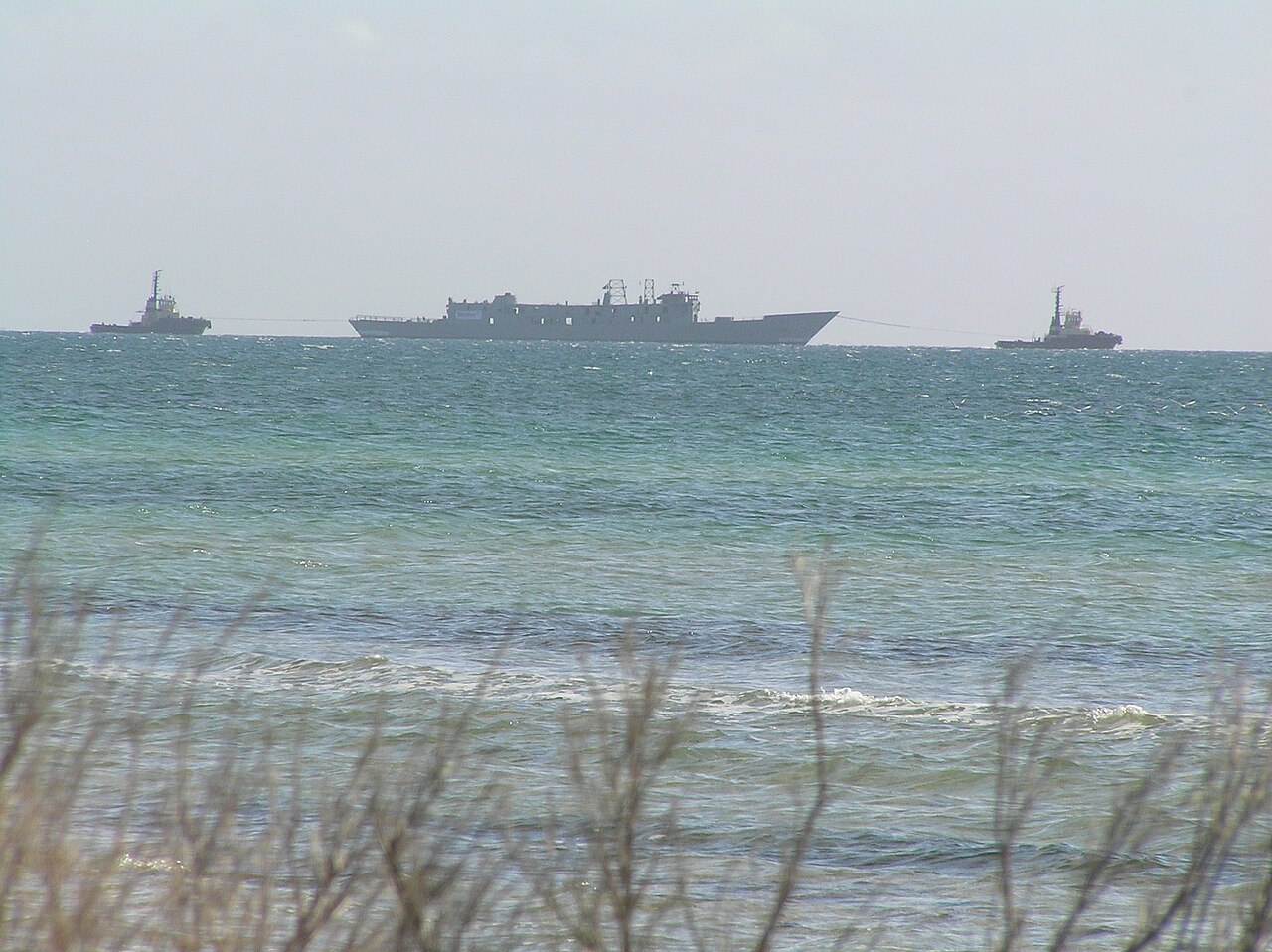
HMAS Canberra would decommission on the 12th of November 2005, and would be stripped for scuttling as a wreck site. She would be sunk by 16 charges placed across her hull, 2nmi off Ocean Grove, Victoria on the 4th of October 2009.
| General Characteristics: | |||||
|---|---|---|---|---|---|
| Name: HMAS Canberra | |||||
| Country: Australia | |||||
| Type: Guided Missile Frigate | |||||
| Class name: Flight II Adelaide | |||||
| Year of commission: 1981 | |||||
| Refit: 1981 | |||||
| ----------------------------------------------------------------------------------------------------------------------------------------- | |||||
| Dimensions: | |||||
| Length: 445ft (136m) | |||||
| Beam: 45ft (13.7m) | |||||
| Draught: 25ft (7.5m) | |||||
| Displacement: 4,100t @ standard displacement | |||||
| ----------------------------------------------------------------------------------------------------------------------------------------- | |||||
| Propulsion: | |||||
| Primary Powerplant: 2x GE LM2500 Gas Turbines, @ 41,000hp (31,000kW) overall, One Screw | |||||
| Secondary Powerplant: 4x Detroit Diesel 16V149TI generators @ 1,010hp (750kW) ea, 2x azimuth thrusters @ 350hp (260kW) ea | |||||
| Speed: 29kt | |||||
| Endurance: 4,500nmi @ 20kt | |||||
| ----------------------------------------------------------------------------------------------------------------------------------------- | |||||
| Armament & sensors: | |||||
| Compliment: 220 with aircrew | |||||
| Primary armament: 1x1 Mark 13 Missile launcher for RGM-84 Harpoon & SM-1MR (RIM-66), magazine capacity for 40 missiles | |||||
| Secondary armament: 1x1 OTO Melara 76mm gun | |||||
| Tertiary armament: 2x3 Mk.32 12.75" torpedo tubes firing Mk.46 ASW torpedo | |||||
| ----------------------------------------------------------------------------------------------------------------------------------------- | |||||
| Systems: | |||||
| Radar: AN/SPS-49A(V)1 Air Search radar, AN/SPS-55 Surface Search and Nav radar, SPG-60 Target Illumination radar | |||||
| Sonar: AN/SQS-56 bow sonar | |||||
| Decoy and ESM: Mark.36 SRBOC Decoy Launcher, AN/SLQ-32 EW system, | |||||
| Other: Mark 92 gun and missile fire control system | |||||
| ----------------------------------------------------------------------------------------------------------------------------------------- | |||||
| Aircraft Specifications: | |||||
| Type: 2x AS350B Squirrel | |||||
| Armament Carried: 1x1 MAG 58 7.62mm MG | |||||
| Engines: 1x Aerospatiale Turbomeca Arriel 1B Turboshaft @ 478kW (641kW) | |||||
| Crew: 2-4 | |||||
| Main Rotor Diametre: 10.7m (35ft 1in) | |||||
| Length: 10.91m (35ft 9.5in) | |||||
| Height: 3.14m (10ft 3.6in) | |||||
| Range: 662m (357nmi) | |||||
| Max Speed (Never exceed speed) : 287kph (178mph) | |||||
| Empty Weight: 1,174kg (2,588lb) |
The hulk of the former HMAS Canberra under tow towards her own scuttling site.
Sources:
Electronic Warfare: The fate of the C-Pearl | ADM May 08 - Australian Defence Magazine
https://www.nepeannavalmuseum.org/post/hmas-canberra-ffg-02
Adelaide class Guided Missile Frigate FFG Royal Australian Navy
https://seapower.navy.gov.au/history/units/hmas-canberra-ii
HMAS Canberra (FFG 02) - Wikipedia
HMAS Canberra FFG-02 Adelaide class Frigate Royal Australian Navy
https://seapower.navy.gov.au/history/units/aerospatiale-as350b-squirrel