- Yes
- No
Introduction
The development of the Centurion began in 1943, as a response to the immediate threat posed by German heavy tanks, such as the Panther and Tiger. British tank doctrine at the time relied on cruiser tanks for mobility and infantry tanks for protection, but neither could effectively match German armour in both firepower and survivability. Interim, improvised solutions, such as the Challenger and Sherman Firefly were adopted, but a purpose-built solution was needed. To address this, the General Staff issued specifications for a new heavy cruiser tank, designated A.41, which combined thick, sloped armor with a 17-pounder gun, and, potentially most importantly, abundant capability for future upgrades. The earliest designs and prototypes, designated P1 - P-15 (later only P1 - P10), incorporated a Polsten 20mm cannon as a secondary armament for engaging lightly armored vehicles and infantry. Vickers-Armstrong was chosen to lead the project, and despite wartime resource constraints, the first prototype was completed in early 1944.
Production of the first ten prototypes was carried out under wartime urgency, with the goal of deploying them to mainland Europe. By February 1945, these vehicles were undergoing final assembly. The Polsten 20mm cannon, initially included for additional firepower, was mounted in the turret but was later deemed unnecessary and removed in subsequent versions. By April 1945, the first six Centurion prototypes were shipped to Belgium for field trials, but with the war in Europe ending in May, they did not see combat. The remaining four were completed shortly thereafter and used primarily for evaluation and refinement of the design.
The main difference between these P-series prototypes and the production standard vehicles is a 2.25 inch (57mm) thick upper front plate, as opposed the 3 inches (76mm) on a production Mk 1 Centurion. This will have a significant gameplay implications, with the hull being easily penetrated by Tigers and Panthers, potentially warranting a drop in BR to something like 5.7.
This suggestion is for the A.41 Centurion prototype ‘P.2’, as modified by Metropolitan Vickers with a full stabiliser for the 17pdr in 1945-46. This was done in as part of the overall development process of stabilising the 17pdr in the Centurion Mk 2 turret. With significantly weaker hull armour but a full stabiliser, this would be the British equivalent to the recently added stabilised T-34-85, and would help to fill out British lineups in the 6.X area.
Specifications

Images
Spoiler
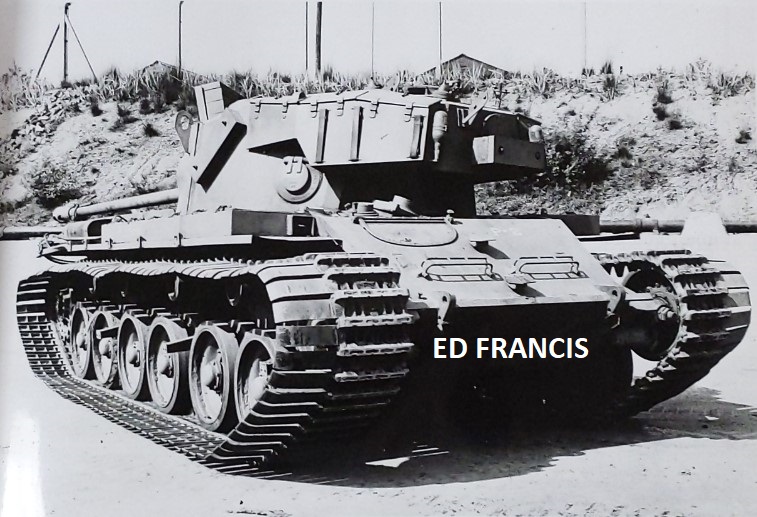
A.41 P.2, as seen fitted with ‘Platypus’ track extenders. P2 can faintly be seen in the upper right of the frontal hull. The track extenders are a separate upgrade, unrelated to the stabiliser, testing a greater track area for mobility over adverse terrain, but it could be added with them in-game as a historical nod and way to visually distinguish the vehicle from other early Centurions.
Sources
Spoiler
The Centurion Tank, Bill Munro, 2005, The Crowood Press
Centurion (A41) Main Battle Tank (MBT)
Operation Sentry - The First Centurion Trials 1945 - Tank Encyclopedia