Seventy-five years ago this month (starting April 9th) an almost unknown battle occurred that while trivial to the greater war was nonetheless a vicious and bloody battle and one of the great ironies in history.
It is known as the Ostrava-Opava Operation (google map).
As the Soviet forces raced across Poland chasing the Germans with the goal of Berlin itself, they initially ignored the former Czech lands (Bohemia, Moravian, parts of Silesia) to the south, the “Sudetenland” controlled by the Nazis. The 1st Panzer Army (possibly with some of 1st Hungarian army) was there and its presence was a worry to the left (southern) flanks of the main Soviet army, so the 1st and 4th Ukrainian Front Armies supported by the Free Czech 1st Czechoslovak Independent Armored Brigade was ordered to defeat if not capture the 1st PzA and the key industrial city of Ostrava (Jan Kremer wrote: The attack was led from Galicia 4th Ukrainian Front Army General Ivan Petrov Yefimovich and 1st Ukrainian Front Marshal Ivan Stepanovich Konev and Romania 2nd Ukrainian Front Marshal Rodion Malinovsky Iakovlevic . The 4th Ukrainian Front, which consisted of the 1st Guards, 18th, 38th and 60 Army and the 8th Air Force. Under the 18th Army was one of the first Czechoslovak Army Corps K. Klapálka and the 38th Army then belonged to the 1st Czechoslovak Independent Armored Brigade under the command of Lieutenant Colonel Janka).
Soviet Intelligence knew the German 1st PzA was located in Ostrava, so a major thrust some 30 km west though the city of Opava going south as far as Olomouc to cut transportation lines while another trust ran from the east, south of Ostrava by the 2nd Ukrainian Front, the goal to encircle and trap the Germany army. The plan was simple and was to start early April, 1945. The 1st UF knew about the existence of the pre-war fortification in their path; however they assumed it was abandoned, which proved to be nasty surprise to the attacking Ukrainian’s.
Background:
In the mid 30’s Hitler’s rise to power also alarmed Czechoslovakian government so the government and military decided to do what the French did (the famous Maginot Line) and build their own lines of fortifications along the German boarder starting as early as 1935. The French, seeing the strategic value of a fortified Czechoslovakia, greatly helped the smaller country advise on designing its fortification (how much they were involved varies with source). Unlike the massive and complex Maginot system of the north east tip of France (Alsace region), the Czechoslovakian military decided on a simpler system of interlocking fortifications, “Block Houses” style found on the southern end of the Maginot line.
Rather than have vulnerable gun ports facing the enemy advance, instead it was a massive earthen and concrete some 10 to 15 meters of rock and 3 meter of reinforced concrete facing the enemy and more on the roof. The main 37mm cannons fired laterally, out the sides, at the vulnerable sides of attacking tanks, with the forts about 500m apart. This gun barrier was further enforced with a 2m (6ft) deep tank trench right in line with cannons that would trap the tank and give the 37mm cannon a perfect stationary target at optimal cannon range. The trench also included rows of barbed wire fence to trap infantry and multiple machine-gun ports covering every aspect.
(Twin 7.92 MG’s left position, 37mm cannon port on right. This is the east face of “MO-S-19 Alej”, now a fully restored as museum.)

There was at least one low profile 100mm thick steel “bell” (cupolas) on each fort with anti-infantry machineguns with ports (loupes) in each direction. They also included retractable periscopes to monitor troop movements. About 15% also had heavier cannons on retractable armored domes or mortar tubes. Finally there was some 6 major subterranean complexes along the 500 km boarder line.
By far the most numerous (almost 10,000 built!) was the pillboxes, called “Log cabins” (Shrub), which were like miniaturized versions of the big block houses. These also had rock mound and thick concrete walls facing the enemy with machine gun facing sides ways. Spaced much closer to each other than the main fornications they added significant interlocking defensive fields of fire protecting each other. Even if enemy infantry could get to the fort or pillbox, several neighboring emplacement would cut them down. Finally artillery and armor behind the lines would lend fire support creating several layers of defensive lines. The anticipated completion day was some time in 1940.
Cutaway image of the small pillbox “shrub”, also called (phonetically) “Zropik”

Each block house supported some 30~60 men each with full facilities and internal power generation and water well. Fully surrounded the occupants could hold out days inside from any attack, even from poison gas using its filtration system. The surrounded pillboxes could be sealed tight from outside attack. Everything was connected together with its own telephone system and detailed mapping allowed hitting targets accurately simply by alighting the weapon to a plotting chart above it. Light and hand signals further improved communications.
It call came to naught when the Munich Dictate was signed in September 1938 giving the Sudetenland, the border region and all the fortifications, to the Nazi régime (why a long discussion on its own). The Dictate was a phenomenal victory for Hitler and a direct reason for the success of the Blitzkrieg in May 1940. Within days of acquiring the area the Germans launched massive effort to study and defeat modern fortifications, possibly under the name “Operation Bruntál” It is believed the area studied was just north-west of Ostrava, although the small city of Bruntal is about 60 km west of Ostrava. It is believed that fortification MO-S-19 Alej was one of those used in German study.
Although it was far from finished substantial parts where close to completion and would have posed a challenge to any attacker. The Germans had many spies and sympathizers in the region so would have known a great detail about this fortification line.
After developing ways to defeat the fortifications of France, Belgium, and elsewhere the Germans proceeded to dismantle the Czechoslovak line, the heavy armored “bells” pulled out of the forts and transported across Europe to become part of the Atlantic Wall facing England. The thick steel cannon and machine gun loupes where also torn out, leaving gaping holes in the sides Locals further took parts for local needs; no one ever dreamed let alone considered they would find military use.
Six years later the once unstoppable German army was fighting for their very existence. It was obvious the goal of the Soviets was Berlin and the terrain and fortification lines could be useful to launch damaging attacks into the Soviets flank (which they did) but have a zone to retreat with some protection.
Extensive efforts went to repairing the forts and line as best as possible. The gun ports where filled in with concrete and steel plate leaving a small hole for a machine gun, and the cavities from the missing machine gun bells where filled in with rock and more concrete. Around them trenches where dug (still visible today). Communication lines laid and supplies stocked, and the troops trained to use the forts for food, medical, and rest, but fight from the trenches.
So, on that day, 9th April 1945 the 1st( and 2ed) Ukrainian Fronts launched their pincer movement around Ostrava, the expectation was capture the city in 3 days.
The online map (mapy.com) shows location of the fortresses, most are easy to visit. This is part of line that had much combat, the forts show lots of battle damage.
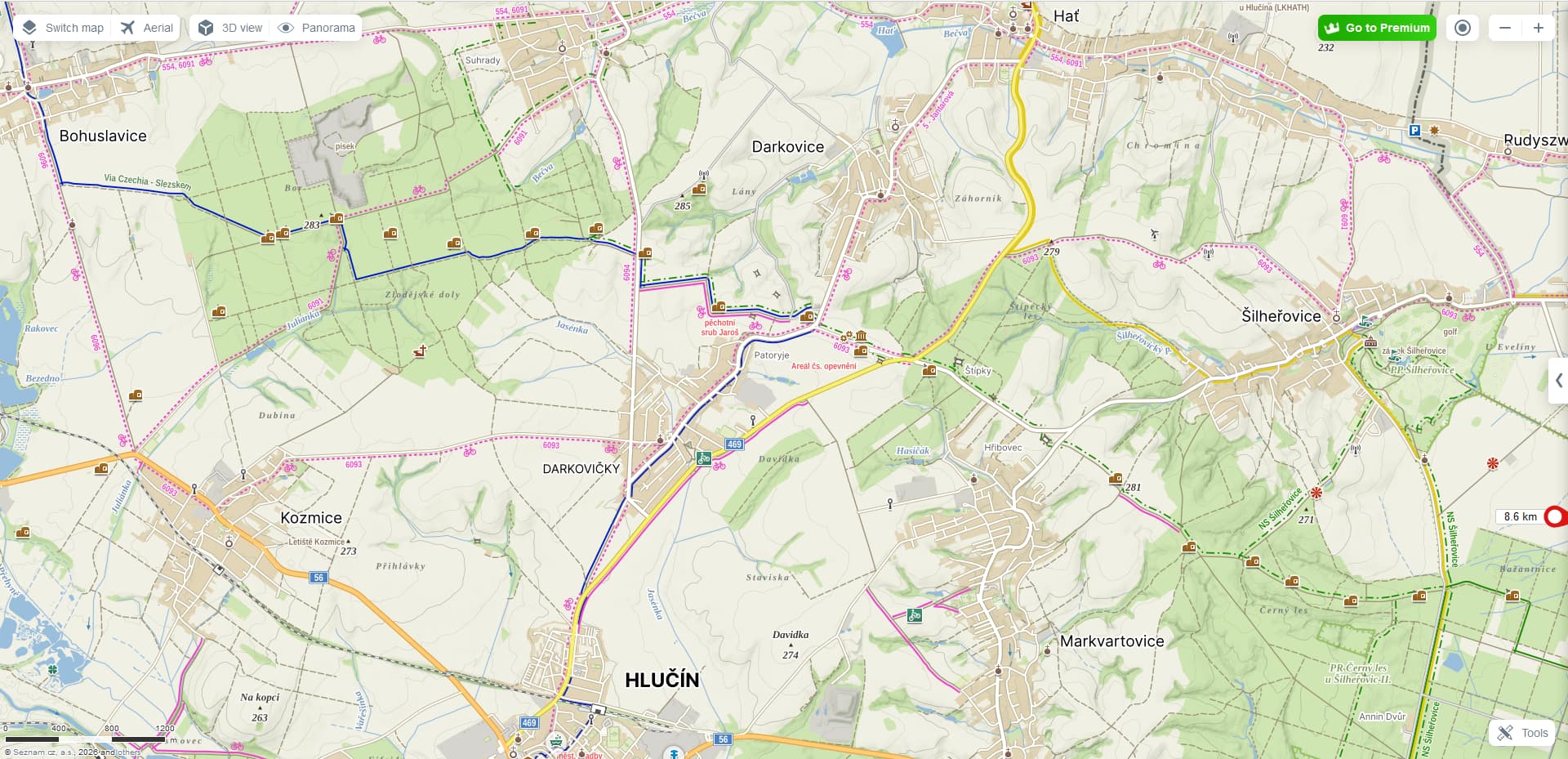
Instead the encountered German defensive positions seemed to resist destruction no matter how much they shelled or bombed it (the area has many bomb craters visible). Conversely accurate Germany artillery was destroying their tanks and trucks, the German counter barrage slowed any Soviet movment. The 1st UF was stalled in its approach and the generals where confused and worried (about Stalin, not Germans). Not that the Soviets did not know about the line. Indeed Emanuel Sramek (if I listed correct person) of the 1st Czechoslovak Independent Armored Brigade was involved in its planning; however it is possible the information was not widely disseminated. It was known (or discovered) there where unfinished gaps in the line and assaults where focused on those areas, but the gaps where located in heavily swampy areas along the Opava River. The progress was slow and what was expected to take 3 days took at least 9 days to achieve against a German army division that was short on men and equipment and had no reserves to call on. The fighting was intense, some areas suffered extensive damage with many casualties. The town of Hrabyně located on a strategic point overlooking the valley was almost totally destroyed by the fighting. A memorial and museum to battle (Slezské zemské muzeum / Národní památník války) is in this town. Many other towns and the city of Opava was heavily damaged with clear evidence of the battle visible today (simply walking around the forest it is easy to find fragments from 82 years ago).
Despite being slightly more than half finished with large gaps in the Opava-Ostrava line and major damage caused by the Germans themselves when they stripped many for parts to build the Atlantic wall, the fortification greatly contributed to German defense of the region, frustrating Soviet plans. Considering the weapons brought to bear also far exceeded the designers expectations, the blockhouses withstood them very well. The irony is the fortifications where built to stop the Germans, not the force meant to liberate Czechoslovakia from the German invaders!
By early May the Ostrava-Opava region including the massive steel works of Vítkovice was under complete Soviet control, but the 1st Panzer Army was able to escape despite casualties and make its way to Praha. The hoped for plan to capture the 1stPA failed. Ostrava itself was spared damage so post war reconstruction began quickly. Even my grandfather found himself trading food for items from the retreating Germans, and his home village later used abandoned German equipment for the towns fire department (the helmets were very useful).

Today almost all of the major block houses exist intact and nearly all are accessible internally (care must be taken!). They are a local point of pride in the technical ingenuity and strength of the fortifications, even though they were used exactly opposite of intended use. In comparison I toured the southern part of the Maginot line in France (Casemate de Marckolsheim Sud), a fortification line built some 10 years prior and the inspiration for the Czech system clearly visible in the French line. My September 2014 (and a previous 2004 trip) visit to the Opava-Ostrava part of the line discovered many clues to the vicious battles. Almost all of the forts are accessible today, most are open, a few are museums. They are easily found on internet maps and apps, Mapy.cz offers both web and iOS/Android apps. One can follow the progress of the battle too. Some block houses have no damage, while others show heavy damage from very specific direction so one can follow the battle in your head.
While the battle itself may be historically insignificant, the line of fortification post significant what-if questions. What if the line was fully intact and equipped with proper eternal support, would it have stopped the Soviets from breaching it? What if in 1938 the line was finished and England and France did not agree to Hitlers demands? Would it have stopped the Germans? If the Germans did not capture the line and use it to practice defeating the Majinot line, would there have been a Blitzkrieg?
Map and site for the event
The map shows the penetration at a large gap of not built forts in line at Stitina going to Hrabyne (at tip of arrows), which suffered massive damage.
The forts east of this point resisted longer, stalling the Soviet advance some.
I know of this because the village my father family is from is just 10klm south, name of Těškovice (it is on above map, close to left edge in middle). He heard and sometimes saw the horrors. For me it is also in remembrance to my adventurous uncle Vaclav who suddenly died just 6 weeks before my planned visit. He introduced me to this forgotten fortification in 1992 and started my curiosity and search for its history.