- Yes
- No

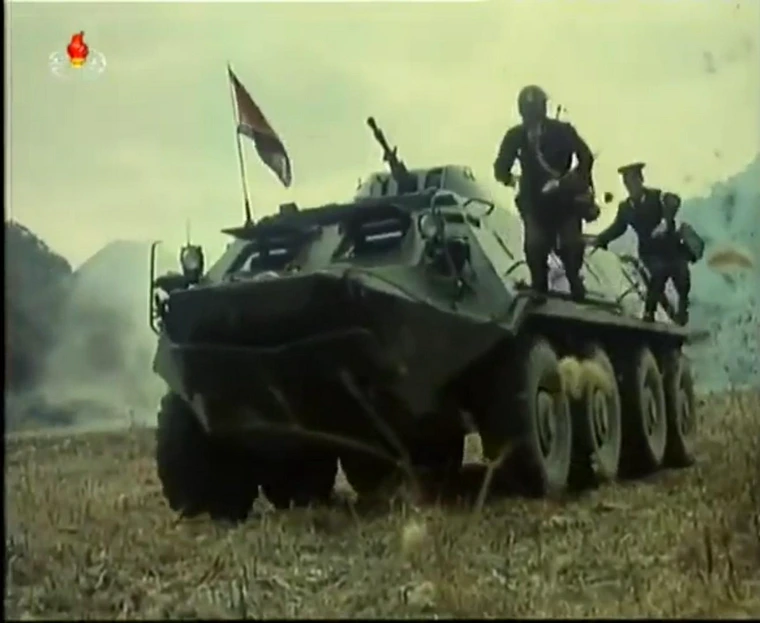
TL;DR: Soviet BTR-60PB, assembled locally in North Korea
History
During the Korean War (1950–53), the Korean People’s Army (KPA) was equipped primarily with T-34s — mostly the T-34-85, although some 76mm models were also used — and SU-76s. These were used to great effect at the start of the war, although their age quickly became apparent against the M26s, M46s, and Centurions used by American and British forces. An estimated additional 1000 T-34-85s were acquired immediately after the end of the war. In the mid-1950s, North Korea received their first T-54s, although initial deliveries were small in number. More substantial deliveries of T-54s, T-55s, and Chinese Type 59s came in the 1960s.
While the tank side of things was looking fine — albeit already beginning to age —, North Korea had virtually no APCs. At least some Soviet BTR-40s were in KPA service during the Korean War, followed by more substantial deliveries in the mid-1950s. Around this time, North Korea also supposedly received BTR-152s and BTR-50s from the USSR, although no images exist of these vehicles, and their existence in the KPA’s arsenal is uncertain at best.
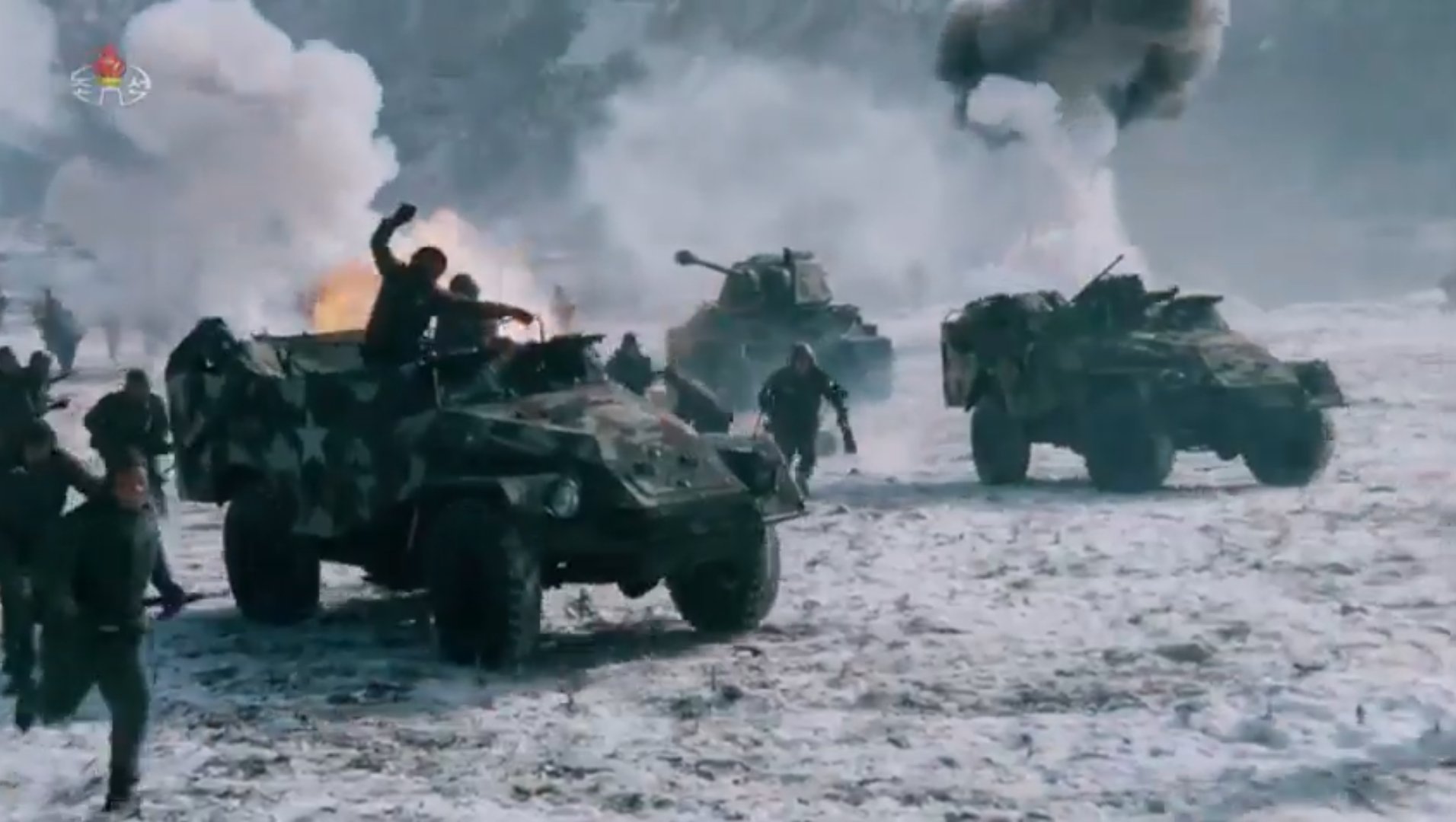
North Korean BTR-40s, painted to resemble American APCs in a film
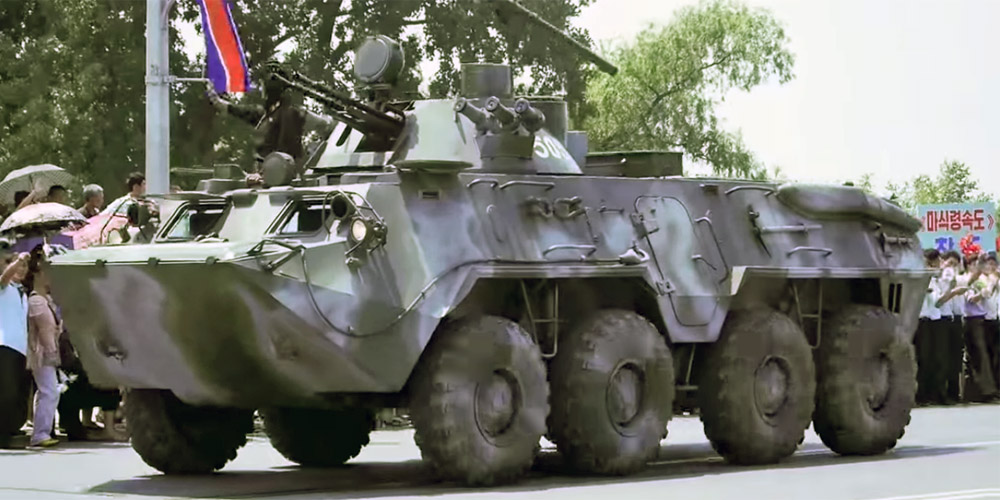
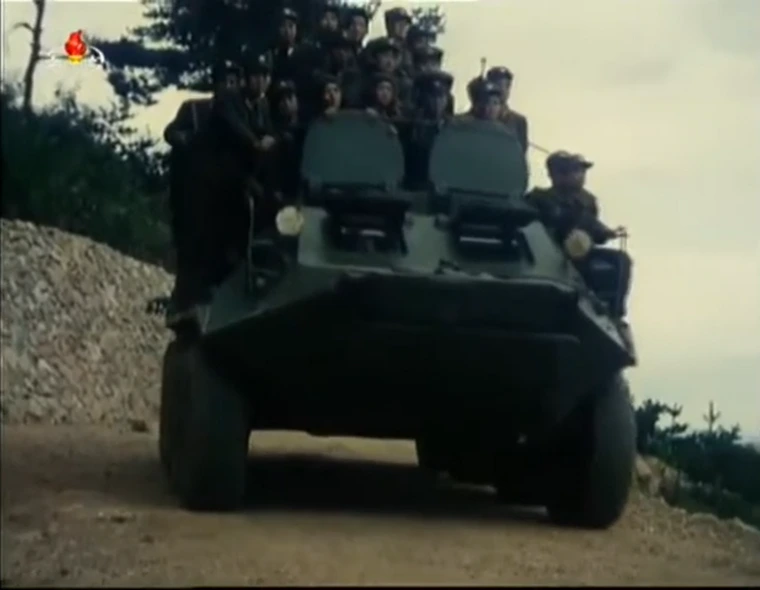
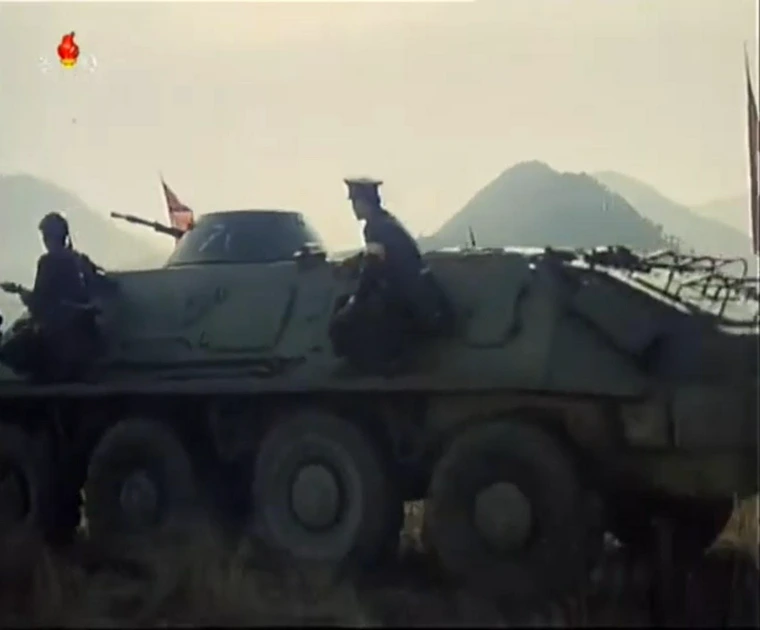
In the 1960s, the state ideology of Juche, stressing self-reliance, and the policy of Sŏn’gun, ‘military-first’, were beginning to be formulated. In the mid-to-late 1960s, the KPA underwent a large modernisation program, in which North Korea sought to emphasise their self-reliance. In 1967, they began domestic production of the Soviet PT-76B under the name 1967-model amphibious light tank 67 [1967년식 수륙땅크 ≪67≫]. Just one year later, they began domestic production of the T-55 under the name 1968-model heavy tank 68 [1968년식 중땅크 ≪68≫], and in 1969, began production of the BTR-60PB under the name 1969-model armoured personnel carrier 69 [1969년식 장갑차 ≪69≫] — or so they claim.
The 67 was likely only assembled from knock-down kits, which may have only begun in the early 1970s, although deliveries of fully built PT-76s from the USSR also very likely took place prior to that. In the case of the 68, full-scale production likely actually began in 1973, and was actually of slightly modified Type 59s — not T-55s. The idea that North Korea was producing copies of the BTR-60PB in 1969 is also doubtful. It is believed to be more likely that they were, like the 67, constructed from knock-down kits and paired with deliveries of fully built vehicles — although it is also plausible that no domestic assembly took place at all.
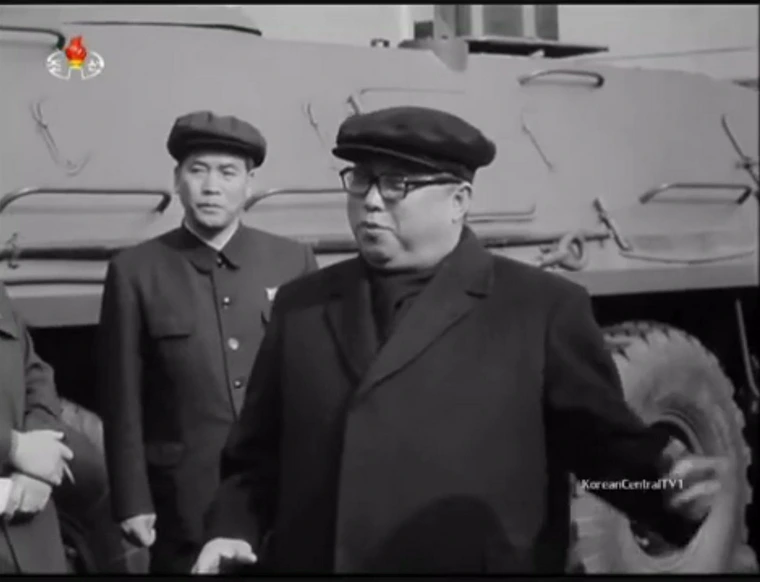
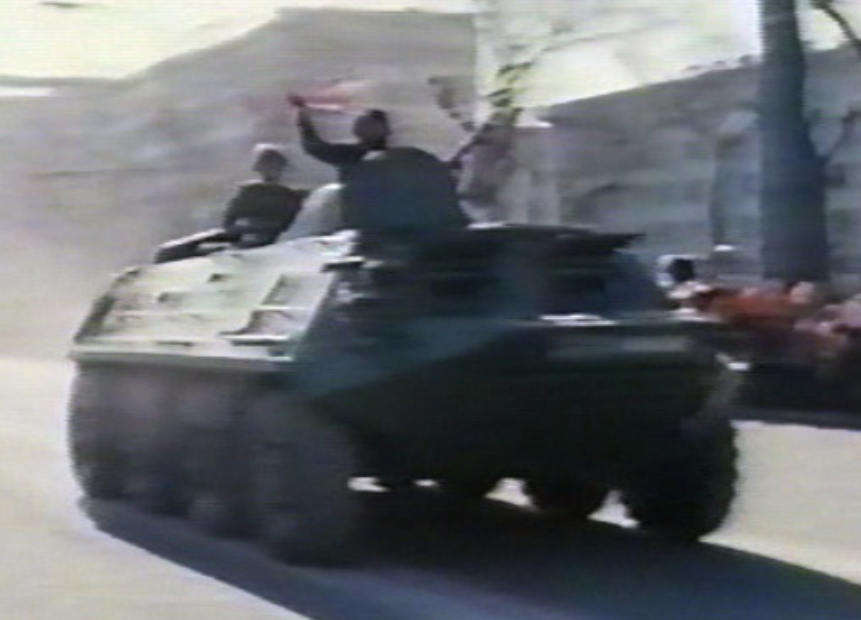
A 69 behind Kim Il Sung
The BTR-60PB model is the most numerous of the BTR-60 family, and has a one-man turret housing a 14.5mm KPVT HMG. Over 12,500 were produced by the USSR. The 69s are spotted very infrequently — almost never nowadays. It is unknown how many were bought / produced. They were completely out-shadowed by the 323 APC, a domestic derivative of the Chinese Type 63 (YW531A), first produced in 1973, and of which thousands have been produced. Despite being smaller than the 69, the 323 was better armed (equipped with a turret inspired by the 69’s, but with two 14.5mm KPVTs) and could carry more troops (10–12).
Although the 69 was limited in number, it was a huge stepping stone in the development of a number of other amphibious vehicles, as was the 67. The first bit of influence of the 69 was on the 323, which uses very similar firing ports and a very similar turret, albeit widened and up-armed. North Korea received around 32 BTR-80As from Russia around 2001 which, along with the 67, became a clear influence of the development of the ‘M2010’ 6x6 and 8x8 APCs. Although largely based on the BTR-80, some features from the BTR-60PB are still visible, including the firing port design (at least on early-production vehicles). The turrets are derived from that of the 323, which as mentioned above, are derived from that of the 69.

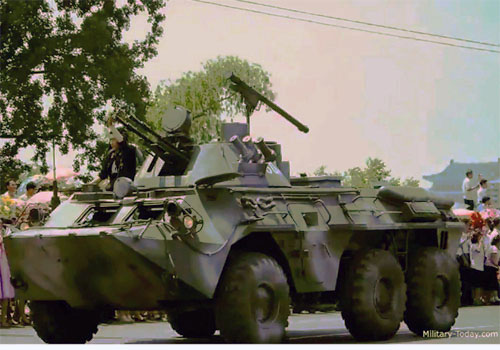
Domestic vehicles, all of which share some characteristics from the 69. Clockwise, from left-to-right: 323 APC, ‘M2010’ 6x6 APC, ‘M2010-I’ 8x8 APC
Characteristics
The 69 is armed only with a single 14.5mm KPVT heavy machine gun, in a one-man turret. This is capable of firing three belts: AP-I/API-T/IAI, with maximum penetration of 39mm @ 0° @ 10m; IAI/API-T, with a maximum penetration of 38mm @ 0° @ 10m; and API-T/AP-I(c)-API-T/IAI, with a maximum penetration of 49mm @ 0° @ 10m. 500 rounds were carried total, of which 50 are ready-to-fire. The gun elevates from -5° to +30°. The 69 also has a coaxial 7.62mm PKT, for which 2000 rounds are carried.
The 69 is lightly-armoured: the upper front plate measures 7mm at 86°, and the lower front plate 9mm at 47°. The sides measure 7mm at 0°, and the rear 7mm at 0°. The turret is similarly lightly armoured, measuring 7mm all around, sloped at 43° at the front, and 36° at the sides and rear.
The 69 has two GAZ-49B engines, each producing 90hp @ 3400rpm, for 180hp total. The vehicle weighs 10.3t, giving it a power-to-weight ratio of 17.5hp/t. It has a maximum speed of 80km/h forwards, and 10km/h in water.
Conclusion
The 69 would be a fairly unique addition to a United Korea Ground Forces Tech Tree. It is large and armed with only a single 14.5mm KPVT, likely meaning it would sit at a BR of around 2.0 (or lower) — lacking the anti-air capabilities and extra firepower of the Soviet BTR-152A, but being much more mobile. It would also be slightly anachronistic, although certainly not overpowered.
Specifications
Armament
- 1x 14.5mm KPVT
- 500 rounds
- Ammunition
- AP-I/API-T/IAI
- 39mm @ 0° @ 10m
- IAI/API-T
- 38mm @ 0° @ 10m
- API-T/AP-I(c)-API-T/IAI
- 49mm @ 0° @ 10m
- AP-I/API-T/IAI
- Vertical Guidance
- -5°/+30°
- 1x 7.62mm PKT (coaxial)
- 2000 rounds
- AP-I/API-T belt
- 13mm @ 0° @ 10m
Armour
- Hull
- UFP: 7mm @ 86°
- LFP: 9mm @ 47°
- Sides: 7mm @ 0°
- Rear: 7mm @ 0°
- Turret
- Front: 7mm @ 43°
- Sides: 7mm @ 36°
- Rear: 7mm @ 36°
Mobility
- Speed
- 80km/h on land
- 10km/h in water
- Weight
- 10.3t
- Engine power
- 180hp, 17.5hp/t
Other
- Crew
- 3
Images
Spoiler
Sources
Spoiler
The Armed Forces of North Korea — On the Path of Songun. Stijn Mitzer and Joost Oliemans.
무장장비관 견문록(2) 고속기동전과 전면타격전의 주역들:자주시보
무장장비관 견문록(1) ‘불새’를 쏘는 ‘무적의 첨단전차’:자주시보
Jane’s Armour and Artillery 1991–92. Christopher F. Foss. p. 439