History
Historical context:
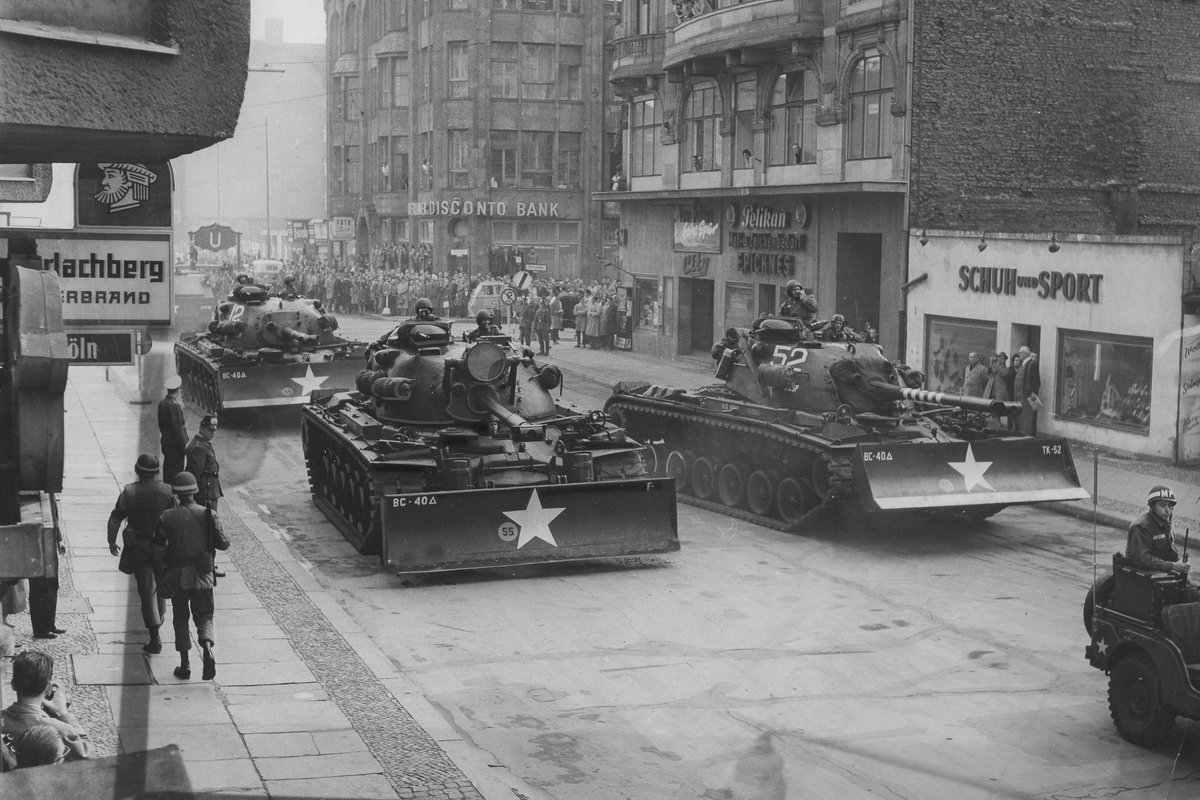
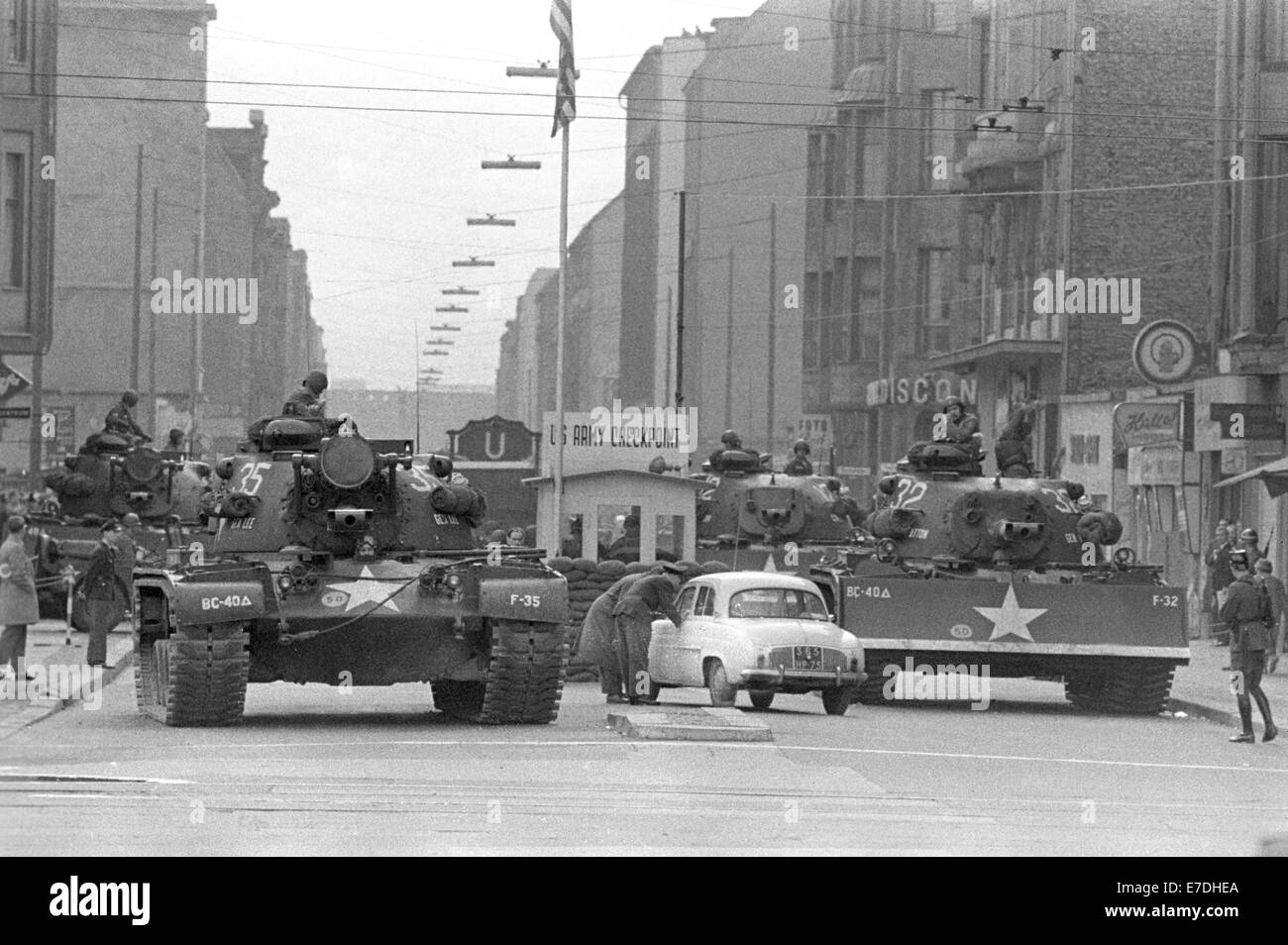
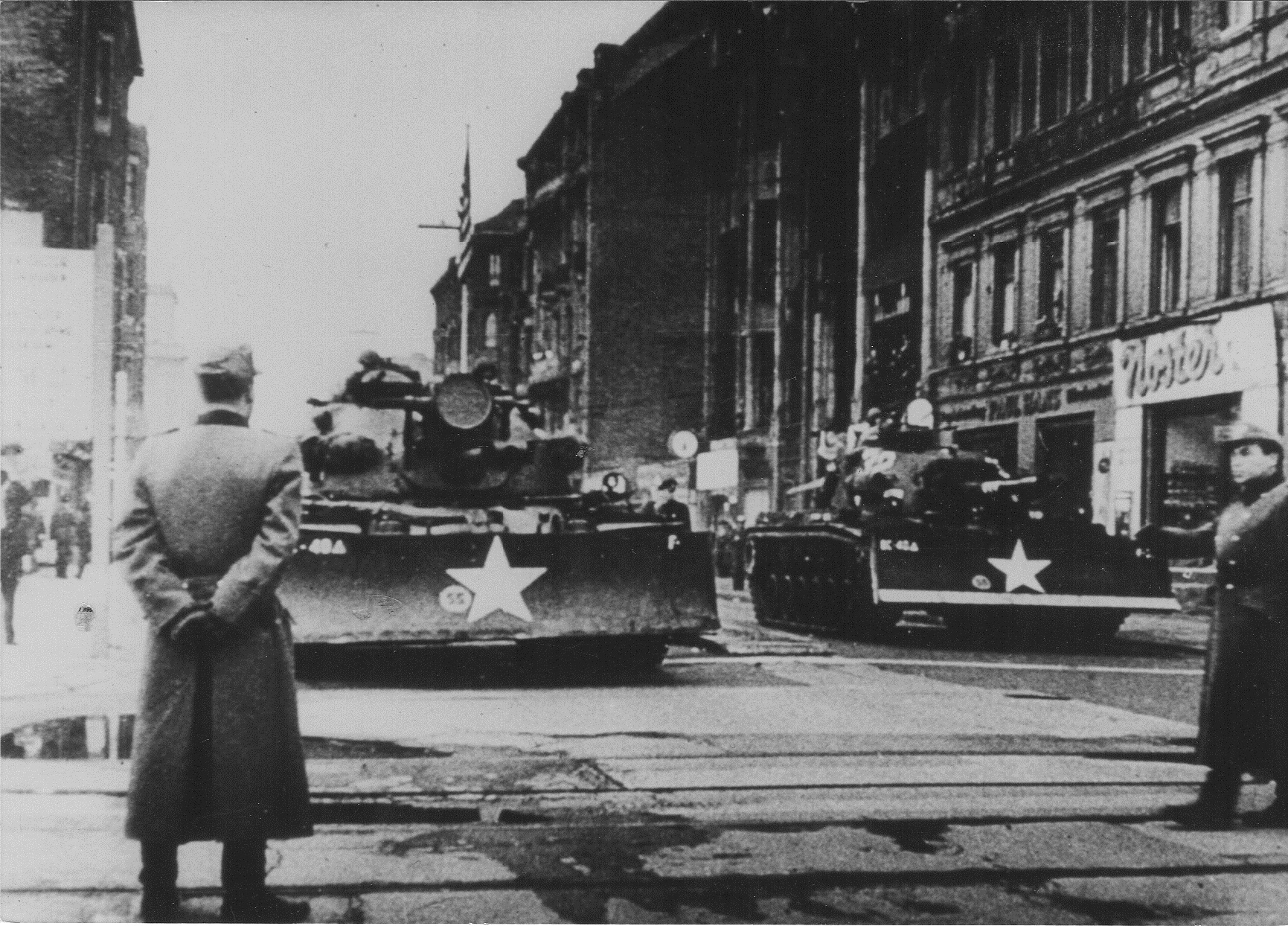
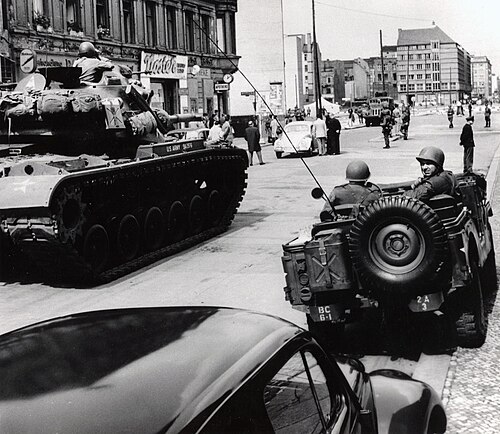
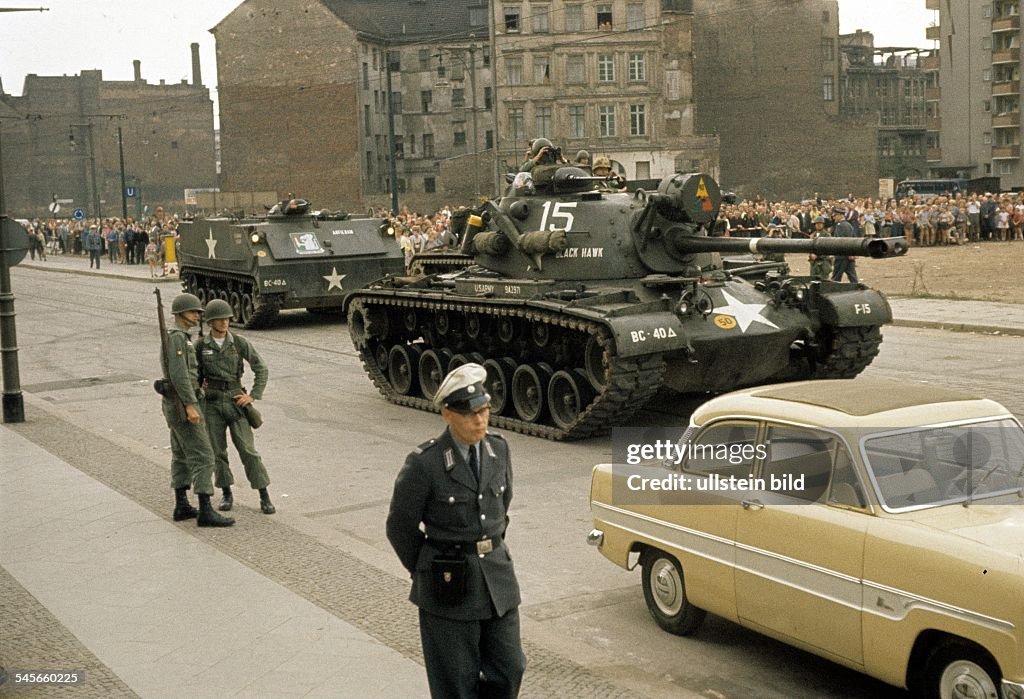
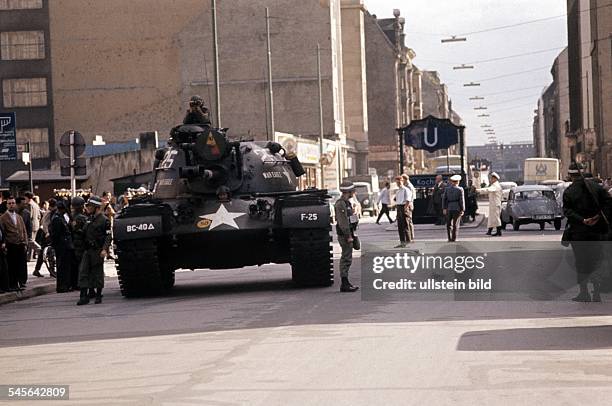
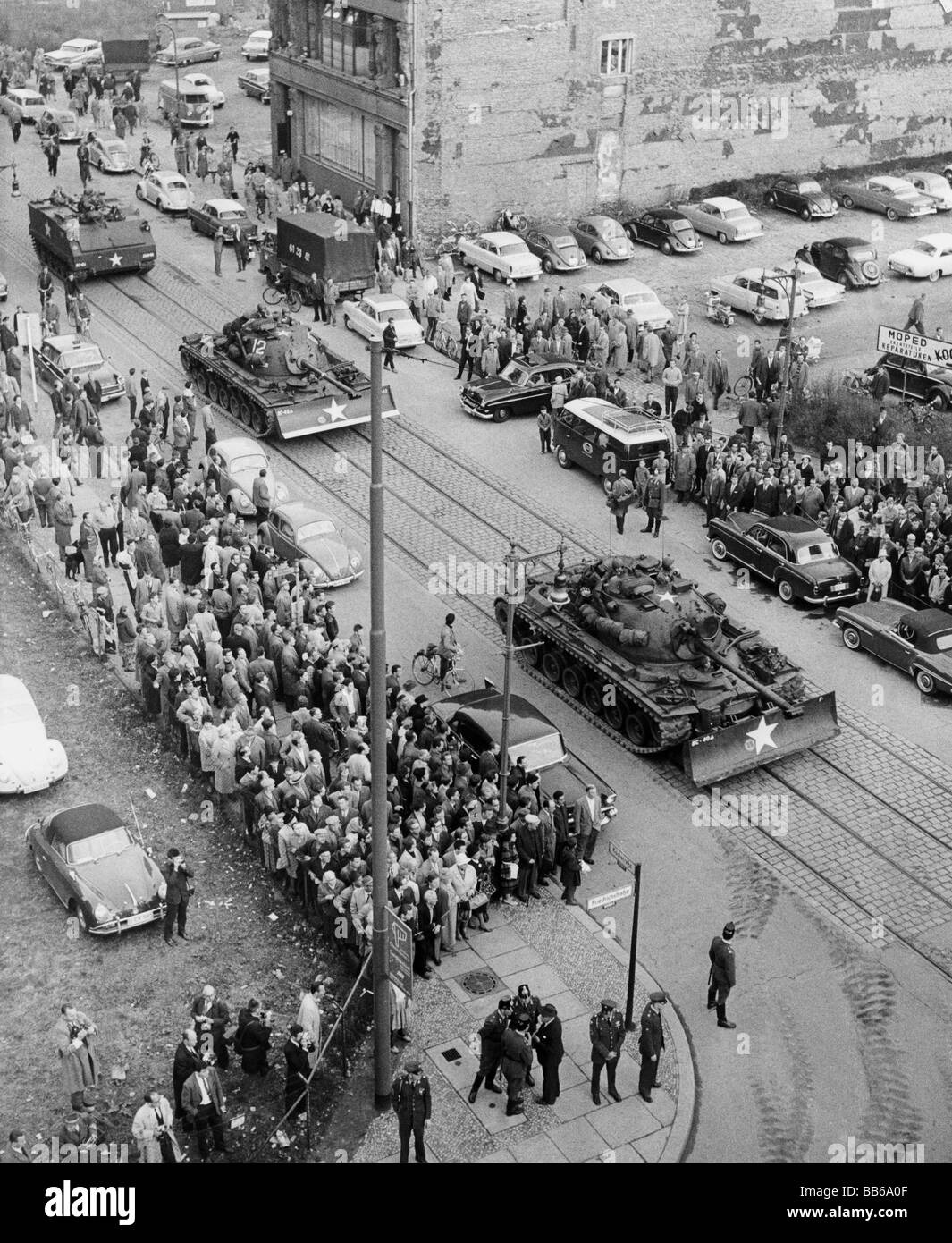
In 1961, one wrong move could have meant everyone’s worst nightmare: global conflict in the nuclear age. At Checkpoint Charlie, a standoff began on October 27th; it was one of the most critical points of the Cold War. It was the only time during the entire Cold War that American and Soviet tanks directly faced off against each other at point-blank range, ready to fire. The crisis brought the two superpowers to the brink of a hot war over allied access rights to a divided Berlin. Thankfully, the worst never came to pass because both sides agreed to pull back their tanks. The tanks briefly stationed at Checkpoint Charlie were M48A1s from Company F of the 40th Armored Division. They were equipped with Dozer kits and 18-inch spotlights.
Excerpt from: The Office of the Historian on the Berlin Crisis
NOTE: I did attempt to write my own version of this however it ended up being a jumbled mess that I wasn’t happy with, I then found this which did a significantly better job than I could.
"On the morning of August 13, 1961, Berliners awoke to discover that on the orders of East German leader Walter Ulbricht, a barbed wire fence had gone up overnight separating West and East Berlin and preventing movement between the two sides. The barbed wire fence was soon expanded to include cement walls and guard towers. The Berlin Wall would prevent the West from having further influence on the East, stop the flow of migrants out of the communist sector, and ultimately become the most iconic image of the Cold War in Europe. The United States quickly condemned the wall, which divided families and limited freedom of movement.
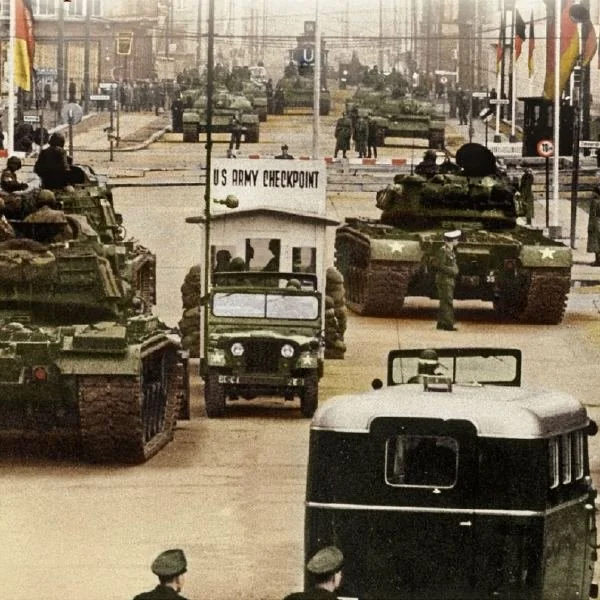
Shortly after the wall was erected, a standoff between U.S. and Soviet troops on either side of the diplomatic checkpoint led to one of the tensest moments of the Cold War in Europe. A dispute over whether East German or Soviet guards were authorized to patrol the checkpoints and examine the travel documents of U.S. diplomats passing through led the United States to station tanks on its side of the checkpoint, pointing toward the East German troops just beyond the wall. Concerns that U.S. forces would either attempt to take down the wall or force their way through the checkpoint led the Soviet Union to station its own tanks on the East German side. A wrong move during the face-off could have led to war, and any conventional skirmish between two nuclear powers always brought with it the risk of escalation. Instead, Kennedy made use of back channels to suggest that Khrushchev remove his tanks, promising that if the Soviet Union did so, the U.S. Army would reciprocate. The standoff ended peacefully.
The Berlin Wall remained in place until November 9, 1989, when the border between East and West Berlin was reopened and the wall itself was finally dismantled."
Source: Milestones in the History of U.S. Foreign Relations - Office of the Historian
The M48’s development and history:
The development of the M48 Patton main battle tank began in the early 1950s as a direct response to the escalating threats of the Cold War and to armor performance during the Korean War. The U.S. Army recognized that the existing M46 and M47 tanks were temporary solutions built on aging World War II design concepts. In December 1950, the Army contracted the Detroit Arsenal to design a completely new vehicle designated 90mm Gun Tank T48. This project departed from previous American tank design by introducing an entirely cast, elliptical hull and a hemispherical cast turret, which offered significantly better ballistic protection against kinetic energy penetrators than the flat, welded plates of earlier models.
Chrysler Corporation took over the primary engineering responsibilities for the T48 prototype program in 1951. To confirm the effectiveness of the radical new design, Chrysler constructed several pilot models for mobility and ballistic testing to be conducted at the Aberdeen Proving Ground. These prototypes retained the 90mm T119 rifled main gun, which was later standardized as the M41, and paired it with a stereoscopic optical rangefinder. Initial testing revealed that the vehicle’s engine and transmission required further improvements, but the cast-steel hull geometry proved remarkably effective at deflecting simulated Soviet anti-tank rounds, leading the Army to rush the vehicle into production before testing was fully complete.
In April 1952, the military officially standardized the design as the 90mm Gun Tank M48, and full-scale manufacturing commenced across multiple facilities, including Chrysler’s Newark, Delaware, plant and Ford Motor Company’s Livonia, Michigan facility. The early production variants of the M48 accommodated a four-man crew and relied on the Continental AV-1790 gasoline engine paired with an Allison CD-850 cross-drive transmission. While the firepower and protection met the Army’s requirements, these initial vehicles suffered from critical mechanical flaws, including a dangerously short operational range of only 70 miles due to fuel inefficiency and an improperly sealed hydraulic system that posed a severe fire hazard inside the fighting compartment.
To address these immediate issues, the Army authorized a series of design upgrades, leading to the development of the M48A1 variant in 1953. The most significant structural improvement introduced on the M48A1 was the replacement of the original low-profile, multi-hatch turret roof configuration with the M1 aircraft commander’s cupola. This new cupola featured five vision blocks for 360-degree observation, an integrated .50-caliber M2HB machine gun, and a mechanism that allowed the commander to aim, load, and fire the weapon entirely within the safety of the armored turret, resolving a major vulnerability observed in previous models. However, over time, this was undone as crews found the cupola to be cramped and uncomfortable.
The M48A1 production line also incorporated key improvements to enhance the vehicle’s reliability. Engineers modified the hull to accommodate an enlarged driver’s hatch, which had been a point of concern on the baseline model, and updated the transmission linkage to the CD-850-4B configuration to enable smoother shifting for the driver under combat conditions. Despite these modifications, the M48A1 still retained the original AV-1790 gasoline engine, leaving the vehicle highly susceptible to fuel fires and continuing to suffer from a severely restricted operational radius, requiring the use of external jettisonable fuel drums on the rear hull for extended maneuvers.
The production run of the M48A1 lasted through the mid-1950s and served as an important transitioning point for American armored doctrine. These vehicles were rapidly deployed to frontline units in Europe and East Asia, establishing the structural foundation for all subsequent main battle tanks. The design lessons gathered from the deployment of the unstabilized gun, and gasoline-powered M48A1 directly informed the mid-life upgrades of the 1960s and 1970s, during which these identical hulls and turrets were retrofitted with diesel powerplants and 105mm cannons to extend their operational lifespan into the late 20th century.
Vehicle info
Description of the vehicle
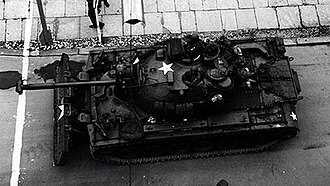
This M48A1 is equipped with a Crouse-Hinds 18-inch searchlight, an M8 Dozer blade kit, and multiple items belonging to the crew, ranging from bags in the rear of the tank turrets to an unknown cloth (could be some kind of cover or blankets) on the sides of the turret, along with other bags. All the tanks were inscribed with BC 40 (triangle) along with the number 7 (insert two-digit tank number). Additionally, they all used the white star emblem on the front of the hull or the dozer blade, as well as on the top of the turret just rear of the gun mantlet. These M48S also appear to have cut-off front fenders for an unknown reason.
Stats
Main gun:
1x 90mm M41 (ammo: 60)
1x 7.62mm M73 (ammo: 6000)
1x 12.7mm M2HB (ammo: 600)
Traverse: (main gun)
Horizontal: 360
Vertical: -9/+19
Elevation: (main gun)
Horizontal: 24 degrees/sec
Vertical: 4 degrees/sec
Mobility: (including dozer)
Weight: ~51 metric tons (aprox)
Speed: 28mph/ 5mph
Engine: Continental AV-1790-5B (810 hp)
Power to weight: ~15.88 hp to metric tons (aprox)
Turning radius: None (neutral steering)
Armor: (front/side/rear)
Hull: 110 / 76 / 35
Turret: 130 / 76 / 51
Equipment (functional only)
NVD: Driver only
IR spotlight: No
Thermal: No
Stabilizer: No
Dozer: Yes
Rangefinder: Yes
Laser rangefinder: No
Ammo: (identical to the M48A1 already in game)

Sources
90mm Gun Tank M48 Patton 48
M48A1 | War Thunder Wiki
Berlin Crisis of 1961 - Wikipedia
Standoff in Berlin, October 1961 | Article | The United States Army
M48 TM 9-718B
Osprey New Vanguard 31 - Steven Zaloga, Jim Laurier - The M47 and M48 Patton Tanks (1999)
The M48 Patton Main Battle Tank - The Army Historical Foundation
M48 Patton Tank - First Division Museum
- Yes
- No