- Yes
- No
Hello everyone, and welcome to this new suggestion.
Today, I am presenting a new weapon designed for French aircraft, particularly the French Air Force’s Mirage 2000s: the BM 400 modular bomb.
During the 1980s, several countries began developing specialized air-to-ground munitions designed to maximize their effectiveness against specific types of targets. These included cluster bombs, intended to attack multiple targets or saturate a designated area, and anti-runway bombs, developed to damage or disable enemy airfields.
Building on its experience in the development of specialized munitions, including the Bélouga, BAP-100, and BAT-120 bombs, Thomson-Brandt began working on a new modular weapon. The objective was to create a versatile bomb capable of carrying different types of submunitions, allowing its configuration to be adapted to the requirements of each mission.
This initiative led to the development of the BM 400 (Bombe Modulaire de 400 kg, or 400 kg Modular Bomb). The weapon consists of a cylindrical main body fitted with a tail section designed to stabilize it during flight. Inside, it carries three submunition modules, each weighing approximately 90 kg. Depending on the mission, these modules can be configured as SMAP anti-runway submunitions or SMAB anti-armor submunitions.
Each module is equipped with its own parachute, which slows its descent after deployment and allows it to cover a designated area.
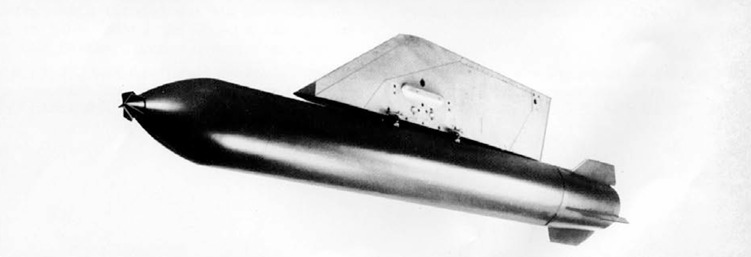
Operational procedure
The BM 400 is compatible with several conventional bombing modes, including CCIP, CCRP for level-flight bombing, and toss bombing.
Before releasing the weapon, the pilot selects the desired deployment altitude, with a minimum setting of 80 meters, as well as the interval between successive submunition releases. Once released, the BM 400 follows an unguided trajectory toward the target area. When it reaches the selected deployment altitude, the bomb opens and begins releasing its three modules sequentially, according to the interval set by the pilot.
Each module then descends under its own parachute before detonating upon impact with the ground. The resulting explosion scatters fragmentation and deploys the submunitions in a 360-degree pattern. Each module is estimated to cover an area of approximately 30 square meters, allowing the weapon to engage targets distributed across a designated zone.
BM 400 technical specifications
- Length: 3.20 m
- Diameter: 0.320 m
- Empty weight: 120 kg
- Maximum weight: 390 kg
- Payload: Three interchangeable submunition modules, approximately 90 kg each
- Available configurations: SMAP anti-runway or SMAB anti-armor submunitions
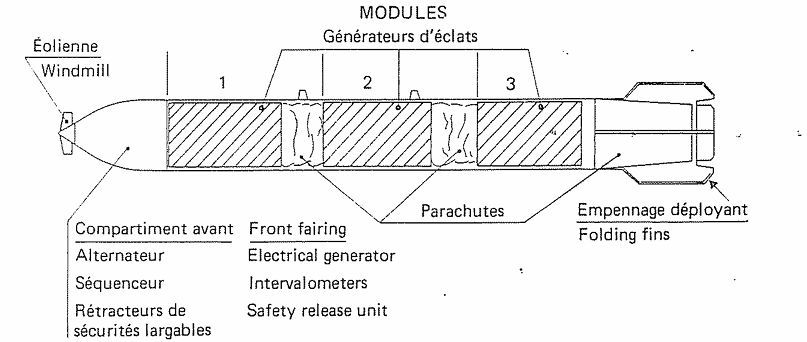
Unfortunately, there are not many images of the cluster bombs used by France; the BM 400 is no exception, with almost no images available.
The BM 400 would be an interesting addition to the French aircraft arsenal when the cluster munition will be added, particularly for the Mirage 2000 series. Its modular design and interchangeable payloads would offer a different approach to specialized air-to-ground weaponry. Unlike the BAT, BAP-100, and Bélouga, the BM 400 would introduce a distinct submunition delivery system, expanding the range of available options for attacking armored targets or disabling enemy airfields.