- Yes
- No
N.B. This is not the World War II-era 1939 South Dakota-class fast battleships. This was a 1920 class of super-dreadnoughts, whose names the 1939 class reused.
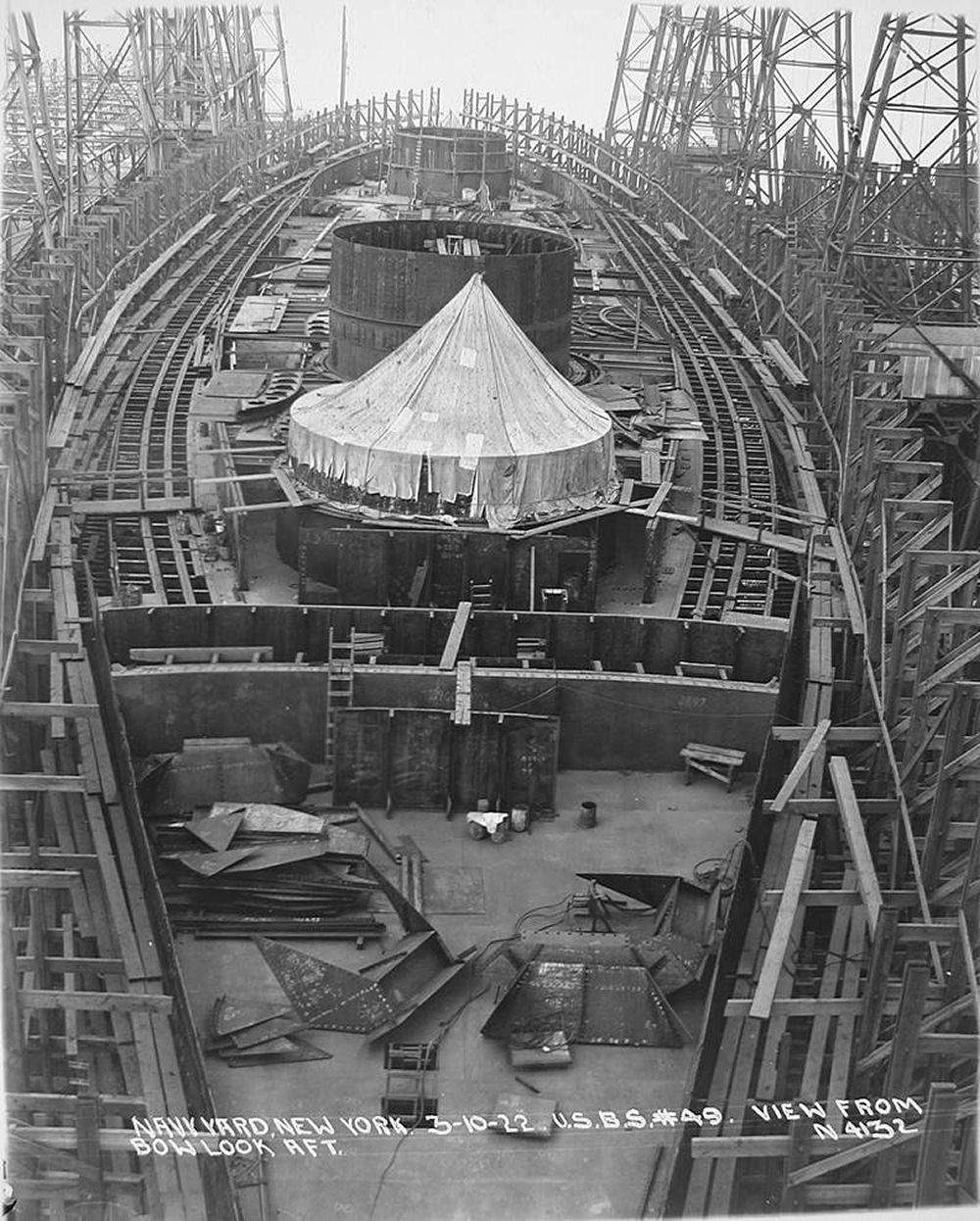
USS South Dakota (BB-49) under construction in 1922, a few months before cancellation; not to be confused with USS South Dakota (BB-57) (source: File:BB-49 PCU South Dakota.jpg - Wikimedia Commons)
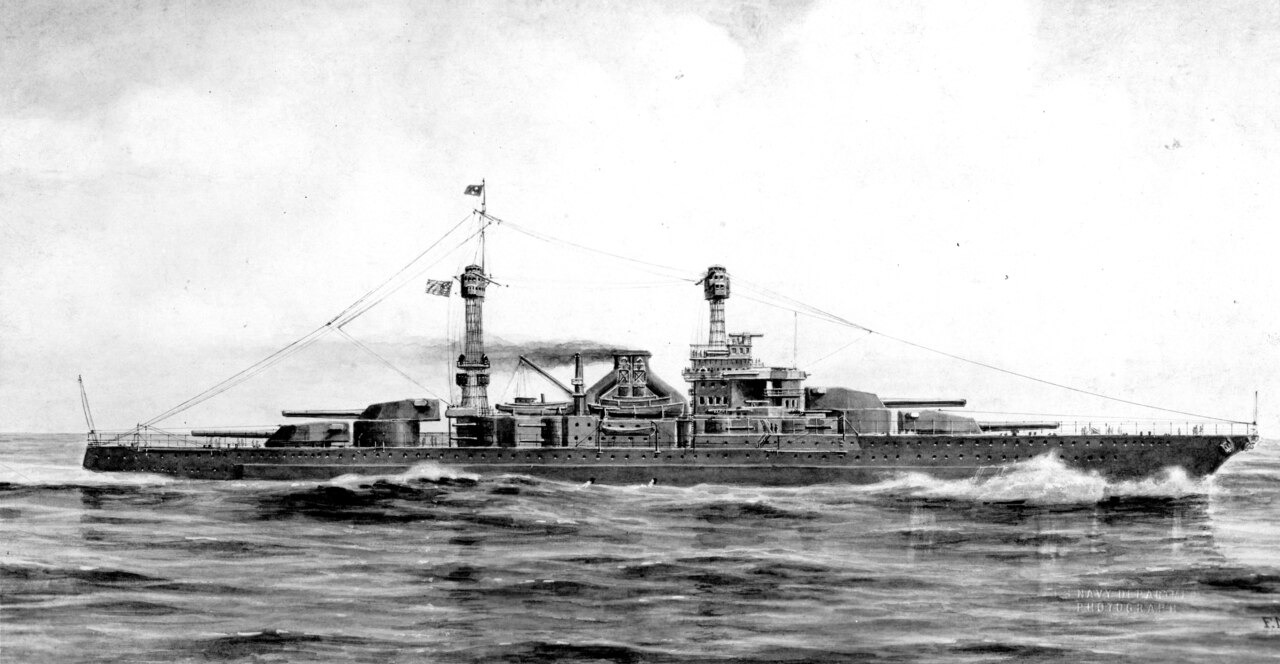

Artist’s concept of the 1920 South Dakota-class (source: File:NH 44895 South Dakota class battleship (BB 49-54).tif - Wikimedia Commons)
TL;DR: class of six battleships with twelve 16-inch guns and decent armour; laid down but ultimately scrapped due to the Washington Naval Treaty.
The 1920 South Dakota-class battleships were a group of six partially-completed battleships that were constructed in the 1920s. Designed to be an all-round improvement over the Colorado-class and a contemporary of the Lexington-class battlecruisers, Friedman called them “the ultimate development of the series that had begun with the Nevada”. They boasted twelve 16-inch guns, 13.5 inches of belt armour, and a speed of 23 knots. Unfortunately, the Washington Naval Treaty imposed restrictions that limited US battleship construction, and the South Dakotas were broken up and scrapped on the slipway. They would be the last super-dreadnoughts build by the US Navy, with its successor, the North Carolina-class, conforming to the new fast battleship concept. Several of the ship names, including that of the lead ship, would be reused for the World War II-era South Dakota-class fast battleships.
As the only US twelve 16-inch gun battleship class to be laid down (and hence meeting the current criteria for inclusion), they would be a good addition to fill out the US bluewater tree’s top tier lineup. Compared to the Iowa-class, it gains superior main firepower at the cost of speed, armour (mainly in the barbettes), anti-air ability, and slightly less penetration, so a BR of around 8.0 would be more appropriate. It would be most logical to place it after the USS Colorado as it was a continuation of the Colorado-class.
History
In the early 20th century and prior to World War I, the US Navy wasn’t particularly well funded and failed to meet the General Board’s recommendation of construction two battleships per year. However, the events of World War I exposed the US Navy’s weakness, and the Battle of Jutland both demonstrated the effectiveness of battleships and provided valuable experience for constructing future vessels. Therefore, Congress authorised funds for building four battleships in FY 1917 and three battleships each in FY 1918 and FY 1919. The FY 1917 battleships would be the Colorado-class (although only three were completed, with the fourth, USS Washington, being cancelled and the 75% complete ship sunk as a gunnery target), while the six newer battleships would become the 1920 South Dakota-class.
The 1920 South Dakota-class was to be an enlarged and improved version of the Standard-type battleships. The General Board wanted a speed of 23 knots to keep up with the British Queen Elizabeth-class and the newer Japanese battleships, and twelve 16-inch guns as an improvement in firepower over previous US battleships. An initial plan called for six twin turrets, but the three superfiring forward turrets would add too much weight, and after gunnery trials on the USS Pennsylvania proved that triple turrets were a viable design, plans were changed to use four triple turrets instead. BuOrd also wanted the new battleships to be better protected than their predecessors, but changed their mind when seeing how much that would increase the displacement. Sloped armour was also considered, but rejected due to insufficient studies at the time. There was much debate over whether to use 5-inch or 6-inch guns as the secondary armament, but when the initial design was sealed in January 1917 the 5-inch guns were chosen, although they could be changed to 6-inch guns later without too much trouble.
Although the first group of three battleships were intended to be laid down in late 1917 or early 1918, the German U-boat threat meant resources were diverted to constructing destroyers, merchant ships, and ASW vessels. Therefore, construction of the new battleships was delayed, and the design was refined during that time. The secondaries were switched to the 6-inch guns, and many new armour schemes were considered.
Six ships of the 1920 South Dakota-class were laid down: USS South Dakota (BB-49), USS Indiana (BB-50), USS Montana (BB-51), USS North Carolina (BB-52), USS Iowa (BB-53), and USS Massachusetts (BB-54). The first ship to be laid down was USS North Carolina (BB-52) on 12 January 1920, while the last was USS Massachusetts (BB-54) on 4 April 1921. However, the Washington Naval Treaty limited the US Navy’s total battleship tonnage and limited individual ship displacement to 35,562 t, which the South Dakotas exceeded. Work was stopped on 8 February 1922, and the ships were ultimately cancelled on 17 August 1922. The guns were transferred to the US Army for use as coastal defence guns, and the boilers and armour plates were reused on other battleships.
Specifications
Priority is given to data in “Ships’ Data, U.S. Naval Vessels”, which may conflict with other sources like Friedman.
Complement: 137 officers, 1404 enlisted, 75 marines
Length: 208.5 m overall, 201.2 m waterline
Bean: 32.3 m
Draft: 10.1m
Displacement: 43,893 t designed
Power and propulsion: 12x boilers, 4x turbo-electric generators, 4x shafts; 60,000 shp (45,000 kW)
Speed: 23 knots (43 km/h)
Armour:
- Belt: 203-343 mm
- Barbettes: 114-343 mm
- Turrets: 127-457 mm
- Conning tower: 203-206 mm
- Deck: 89-152 mm
Armament:
- 4x triple 16-inch/50-calibre Mark 2 guns
- Rate of fire: 2 rpm
- Projectiles:
- Mark 3 AP:
- Projectile weight: 957.1 kg
- Explosive content: 26.1 kg Explosive D
- Muzzle velocity: 853 m/s
- Mark 3 AP:
- Ammunition load: 1,437 total
- 212 rounds in each turret
- 62 rounds in the shell handling room
- 138 rounds in the turret stool
- 12 rounds in the shell hoists
- 48 rounds in Turret 2 on the third deck
- 541 rounds in shell rooms on the first platform deck
- 212 rounds in each turret
- 16x single 6-inch/54-calibre guns (n.b. this is the same gun used on the Omaha-class light cruisers)
- 4x 3-inch/50-calibre guns
- 2x 21-inch torpedo tubes
Sources
- South Dakota-class battleship (1920) - Wikipedia
- “Ship’s Data, U.S. Naval Vessels” by the United States Navy
- “U.S. Battleships: An Illustrated Design History” by Norman Friedman
- https://www.history.navy.mil/our-collections/photography/us-navy-ships/battleships/south-dakota-bb-49.html
- USA 16"/50 (40.6 cm) Mark 2 and Mark 3 - NavWeaps
- USA 6"/53 (15.2 cm) Marks 12, 14, 15 and 18 - NavWeaps