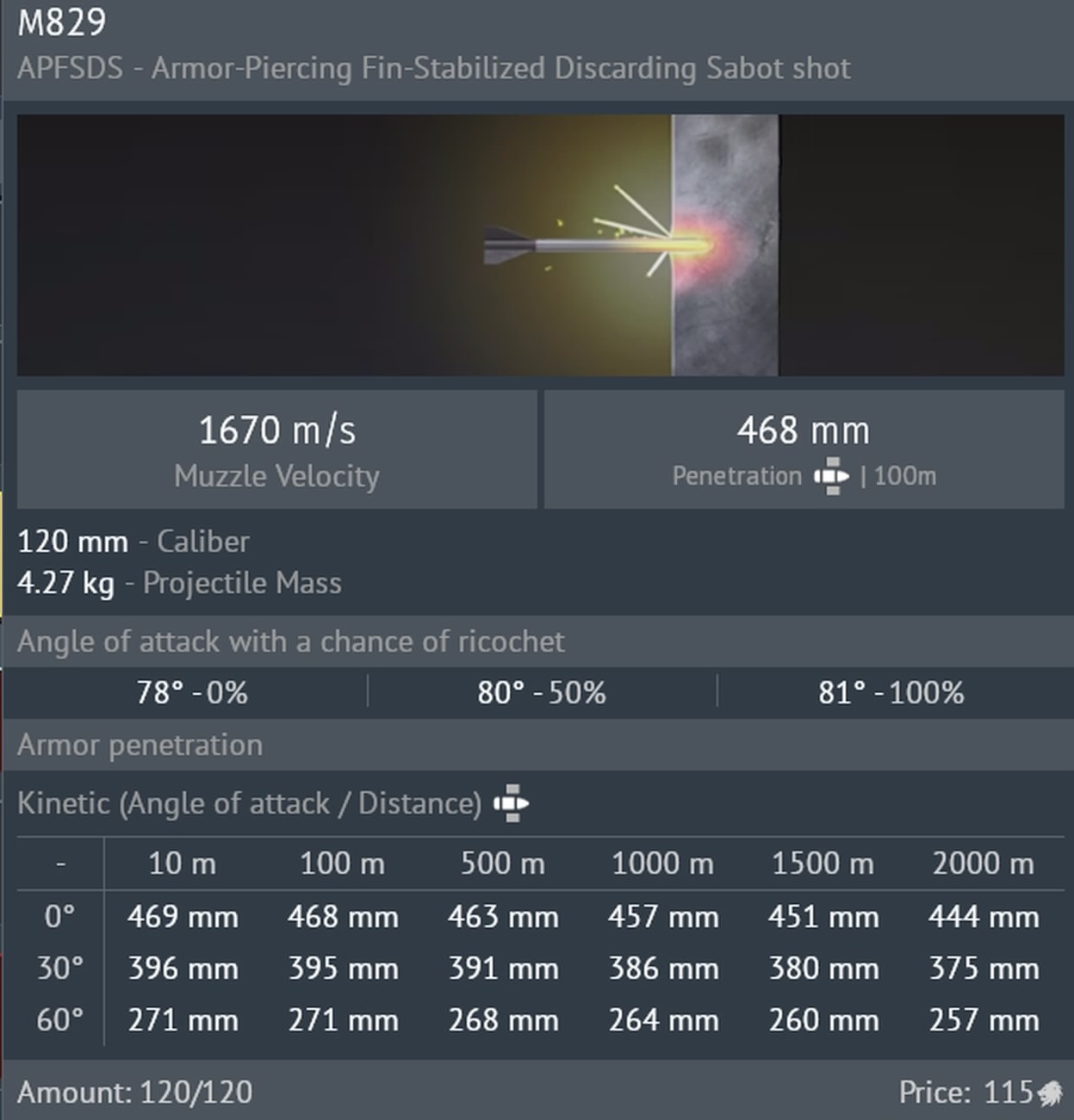
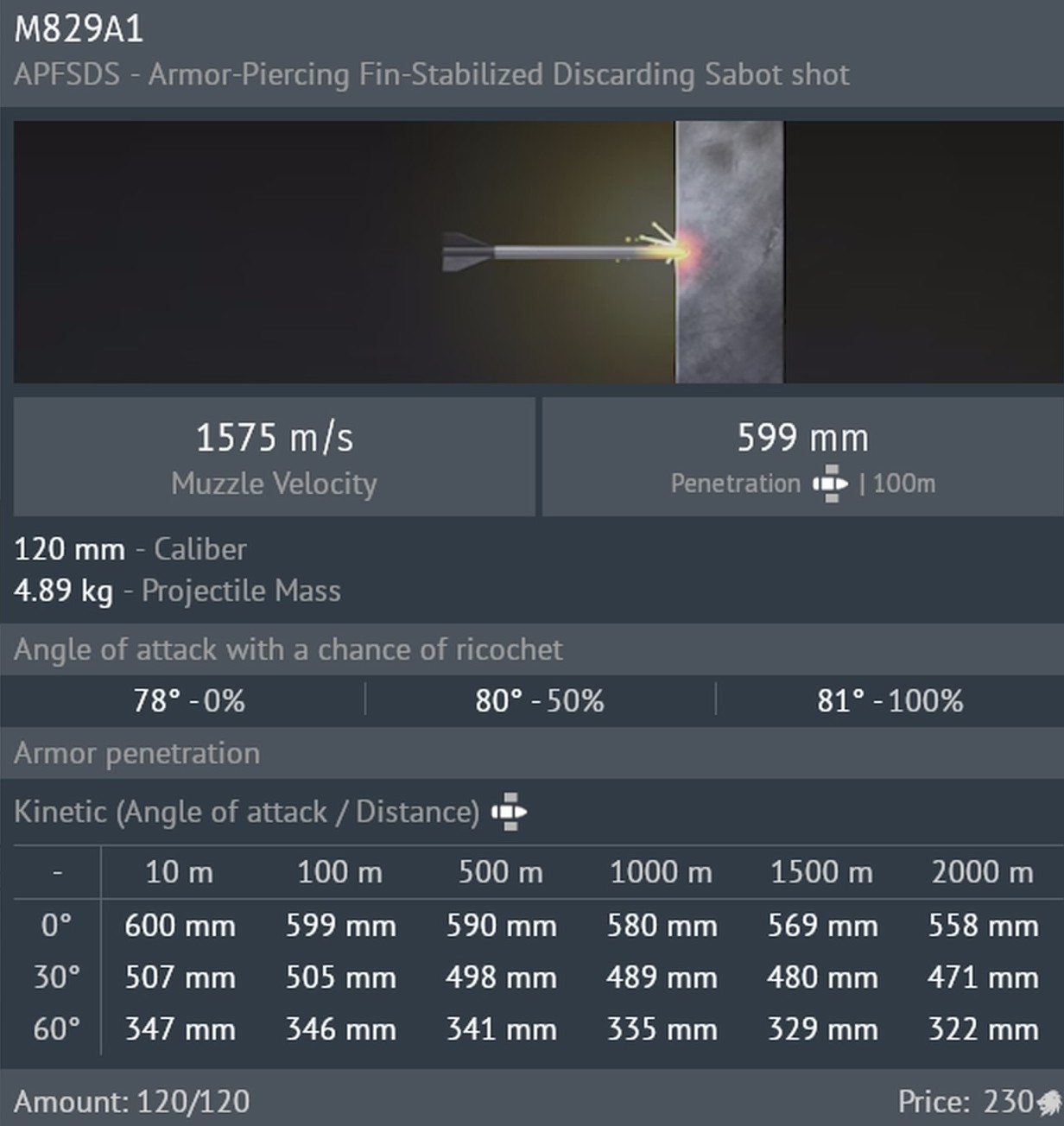
Completely disregarding what y’all are arguing about, I’d like to point out that the m829 and m829a1 have much higher penetration values than in game in that “anti armor munitions” figure that you attached.
Firstly, the m829. The figure states 525mm penetration at 2km with 1660m/s muzzle velocity. As shown above, in game the m829 round has 10m/s higher muzzle velocity but the penetration is set to 444mm at 0° and 257mm at 60°. I don’t know if the figure refers to a certain angle of attack but either way the in game value is wrong when put against the figure shown.
Secondly, the m829a1. The figure states 650mm penetration at 2km with 1660m/s muzzle velocity. In game the m829a1 has a muzzle velocity of 1575m/s as shown above which is 85m/s slower than what’s shown in the figure. The penetration value is also much lower in game compared to the figure
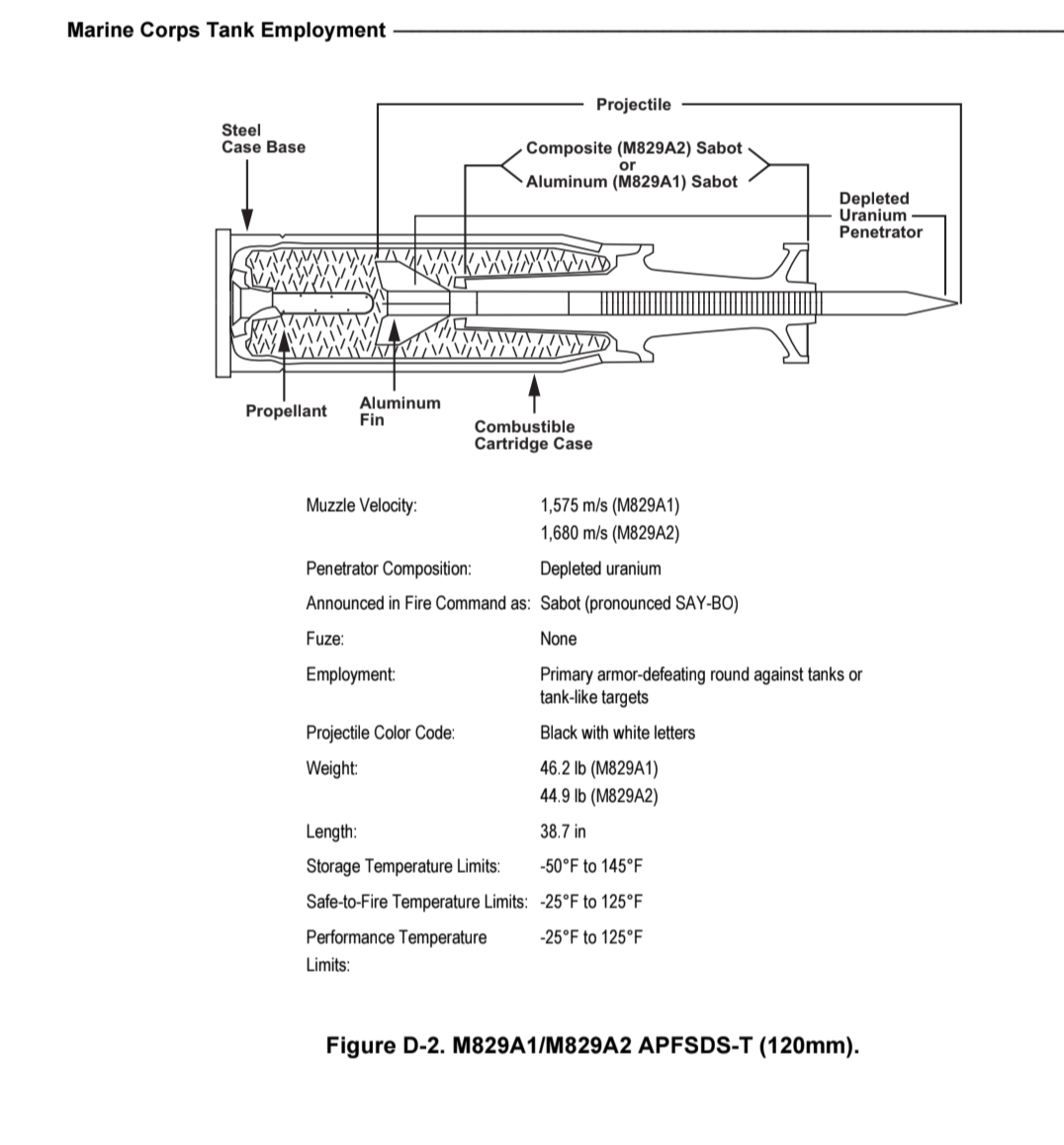
However, I did find a Marine corps tank employment distribution statement that have figures for the m829 and m829a1 that suggest the muzzle velocity of both rounds are correctly modeled as well as the m829a2.
https://www.marines.mil/Portals/1/Publications/MCWP%203-12%20Marine%20Corps%20Tank%20Employment.pdf?utm_source
Penetration values without context are not useful. Here’s why:
For conventional AP shells, penetration drops somewhat linearly against sloped armor. A simple rule of thumb is that a shell rated for 120 mm of penetration against flat (0°) armor will only penetrate about 60 mm of armor sloped at 45°.
APFSDS behaves differently. Long-rod penetrators are much better at defeating angled armor because they “normalize” on impact and are less affected by slope. Instead of losing half their penetration at 45°, they retain much more of it. A modern APFSDS round with 120 mm of penetration at 0° might still penetrate around 85–95 mm at 45°.
On paper, a 45° RHA plate doubles its effective protection compared to flat armor. This is why you sometimes see very high penetration figures such as 700–800 mm quoted for APFSDS rounds: those numbers often refer to penetration of armor at high obliquity (like 60°). When converted to a flat-plate equivalent, they look enormous but that’s not really the way it is.
It doesn’t.
Sources refer to line-of-sight penetration at a certain angle of attack at 2000 meters, not penetration at the vertical.
That specific source also isn’t a primary source, it’s superseded by other most authoritative sources.
It’s the russian privilege