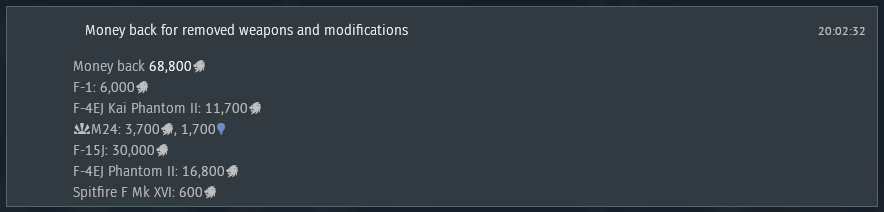
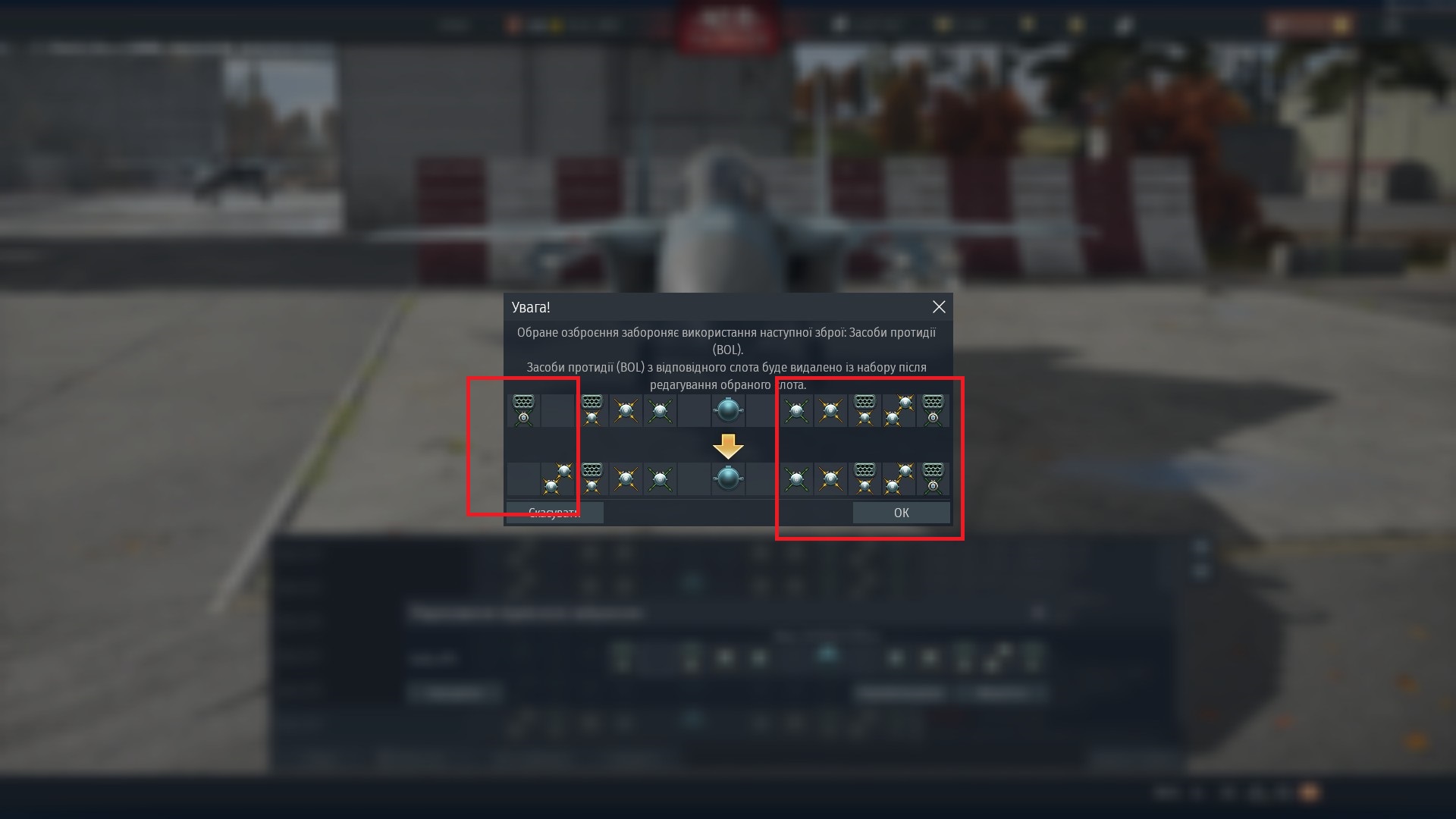
Trying to figure out what these were. I can’t find anything about it in the changelog but maybe I’m just blind. I’m pretty sure the M24 was smoke grenades…
Type 10 loses all its speed in one small turn and then fully brakes and stops. I haven’t seen Leo’s do that they tend to loose speed yes but not to the extent of Type 10 where it will literally come to a full stop
The fuze used was the ZtZ S/30 — a clockwork time fuze originally developed circa 1938 for 7.5 cm+ Flak ammunition, adjustable from roughly 1.5 to 29.5 seconds running time. It had to be adapted for this application because the WGr.21’s spin rate (around 1,200 rpm) was much lower than the 8.8 cm Flak shell it was designed for (around 3,000 rpm) — a detail confirmed independently on a WWII ordnance-collector forum, not just tertiary sources. In service it was generally preset (by ground crew, before the sortie) to detonate somewhere in the 600–1,200 m band from the launch point, with a commonly cited standard setting around 1,000 m, giving a blast/fragmentation radius on the order of 30 m.
to me this should mean it needs the full distance selection, also because the wurfgranate 21 was used for ground attacks sometimes.
For the Wfr.Gr.21 / BR 21 (strongest of the three)
D.(Luft)T. 2110 G-2, Teil 8C, Heft 1 — “Bf 110 G-2 Flugzeug-Handbuch, Teil 8C: Sonderwaffenanlage, Heft 1: Rüstsatz M 5: 21 cm BR.” This is the official Luftwaffe aircraft handbook section for the 21 cm BR installation. Verified: it’s listed and downloadable as a watermarked PDF at museumalkmaar40-45.nl (under D.(Luft)T.), a Dutch collection that lists 12,000+ Wehrmacht manuals and hosts 3,700+ PDFs free for research use. This is the single best starting document for you.
The deutscheluftwaffe.de archive’s 21-cm-Wurfgranate document set. A DCS forum thread on BR 21 ballistics points to this archive as holding a run of wartime documents on the whole BR 21 topic, including a tactical instruction sheet (“Angriff mit 21 cm Granaten”) that gives the actual engagement arithmetic: launch at 1,200 m, rockets overtake the aimed-at aircraft after 4.4 s and detonate a further 1.1 s later, roughly 295 m ahead of it in the middle of the formation, with a mean rocket speed of 250 m/s and a mean flight time of 5.5 s. That 5.5 s figure is your hard primary datum on the time-fuze setting, and it’s consistent with the 600–1,200 m band. The original site is down but the transcription survives in the Internet Archive; the forum poster noted the site’s author holds the full documents and is worth contacting.
D.(Luft)T. 2190 Fw 190 D-9 — Sonderwaffenanlage handbook, also referenced in that thread for installation and firing-circuit details.
L.Dv. 487 — “Geschoßzünder (Flak)”, the Luftwaffe fuze manual, for the ZtZ S/30 and its variants (S/30 Fg., S/30 Fg.1). Michael Hiske’s site has the transcribed sections; the text confirms the fuze is transport-, load- and bore-safe and contains a time-settable clockwork mechanism for producing an air burst, with arming occurring at a setting of 10°–15° from the cross, corresponding to 100–250 m from the muzzle. Note: Hiske’s server currently returns a 401 to automated fetches, so open it in a browser directly.
L.Dv. 4402/5 — “Die Munition der Flakartillerie, Teil 5: Munition der 8,8 cm Flak 18, 36 und 37” and L.Dv. 4414/1 (fertigen/zerlegen of the same). These give the S/30 in its native 8.8 cm Flak application, which is the baseline you need in order to reason about the spin-rate adaptation for the rocket. Both are on the Alkmaar site.
L.Dv. 4000/10 — “Munitionsvorschrift für Fliegerbordwaffen, Teil 10: Handbuch der Munition für Fliegerschußwaffen” (1942 edition, PDF on Alkmaar). Too early to cover R4M, but the standard reference for Luftwaffe airborne ammunition and fuze nomenclature.
H.Dv. 119/984 — Schußtafel für den 21 cm Nebelwerfer 42 mit der Wurfgranate 42 Spreng. The ground-launch firing table for the parent projectile. Useful for cross-checking propellant and ballistics, not the air-launch fuzing.
For R4M and R.Z.65, I have not found a surviving German service manual online. The R4M reached troops only in spring 1945 and it’s likely no full D.(Luft)T. entry was ever issued or survives in digitized form. Your realistic primary route is the Bundesarchiv-Militärarchiv (RL 3 series, RLM/GL-C Technisches Amt files) and the DWM/Heber development correspondence.
Primary-adjacent — Allied technical intelligence
These are Allied officers writing from captured hardware and captured documents, so they’re one step removed but often carry fuze-strip detail that no surviving German manual does.
TM 9-1985-2 / TO 39B-1A-9, “German Explosive Ordnance (Bombs, Fuzes, Rockets, Land Mines, Grenades and Igniters),” 1953. This is the key one for all three of your rockets — it’s the Army/Air Force compilation covering German rocket and fuze types, and it’s the stated source behind the Warbirds Resource Group’s R4M data page. Available on Internet Archive and various PDF mirrors.
TM 9-1985-3 / TO 39B-1A-10, “German Explosive Ordnance (Projectiles and Projectile Fuzes),” 16 March 1953. Companion volume; this is where the ZtZ S/30, AZ and Dopp.Z families are described in English. Good scans at archive.org (details/TM9-1985-3) and a full PDF at stephentaylorhistorian.com.
British Orford Ness / Aberporth R4M trials. After the German surrender the Allies collected German weapons for evaluation, and the R4M was among the types test-fired at Orford Ness and Aberporth. The irgon.org page on this cites the underlying reports and also covers the design history — Heber/Osterode and DWM Lübeck-Schlutup, with much of the ballistic work done by Dr. E. Schwarz’s section, and the March 1945 Erprobungskommando 25/29 trials. Follow its footnotes into the British report series.
CIOS/BIOS/FIAT report series generally, for German fuze manufacture (Thiel clockwork mechanisms especially). Worth a targeted search rather than a specific citation from me — I haven’t verified a particular report number for these three rockets.
Secondary
Dierk Hensel, “Zeitzünder S/30” (available via Yumpu). This is the most substantive technical piece I found on the fuze itself, and it’s from the ordnance-collector/EOD literature rather than popular history. It records that the HWA specified from about 1938 a settable fuze for calibres 7.5 cm and up that would work reliably at altitude independent of air pressure and avoid the poor shelf life of powder-train fuzes, that the ZtZ S/30 met this with a Thiel-system clockwork settable between roughly 1.5 and 29.5 seconds, and that it became the standard German fuze in such volume that around 20 million were still on hand in January 1945. It also documents the wartime material substitutions (brass → Bondur light alloy → steel → zinc casting) that make dating individual examples messy.
German Wikipedia’s R4M article (mirrored at wiki.de-de.nina.az), which is unusually well-sourced and is where the AzRz 2 designation, the lead azide/lead styphnate detonator pellet, the 8 g Zdlg 34 N.P. booster and the HTA 41 composition come from. Its footnote 1 chains back to the DWM/Heber development history — chase that citation.
jagdgeschwader4.de’s R4M page, for the 5-second self-destruct delay and the explicit statement that the effect depended on the mine effect of a direct hit rather than fragmentation from a near miss.
Secret Projects Forum, “Panzerblitz and Panzerschreck puzzle” and “German Unguided Rockets, Projects & Prototypes.” These are where the R.Z.65 fuzing detail lives — the RaZ 51 nose percussion fuze, the correction that RZ 65 could alternatively use AZ 65, ZZ 1577 or a Dopp.Z, the correction on charge weight to 130–190 g HE, the six angled venturi (black powder) versus seven angled plus seven straight (smokeless) motor distinction, and the note that the Föhn system’s 7.3 cm R.Sprgr derived from the RZ 65 with the fuze moved on top of the warhead instead of occupying its nose. Treat this as high-quality but unverified: the participants are clearly working from documents, but they don’t cite document numbers, and they contradict each other in places. This is precisely the material I’d want you to replace with a Merkblatt for the 7,3 cm R.Spr.Gr.
Eduard’s “Gustav Part Two” (info.eduard.com, 02/2024) and Nevington War Museum for operational/installation context (15° mount angle, one tube per wing on Bf 109 G-6 and Fw 190 A-8, 320 m/s, 1,200 m effective range, first combat use 29 July 1943 by JG 1 and JG 11 against the Kiel/Warnemünde raid). Useful for framing, not for fuzing.
ww2aircraft.net, “Fw-190 bombs or rockets” — the source for the spin-rate adaptation claim: HE ammunition with a time fuze, mostly a ZZ S/30 preset to 1,000 m, converted for the rocket’s lower rotation (around 1,200 rpm versus roughly 3,000 rpm on an 8.8 cm HE shell). A 2006 forum post from a knowledgeable poster, no document cited. Flag this as the weakest link in my earlier answer and the thing most worth verifying against L.Dv. 487.