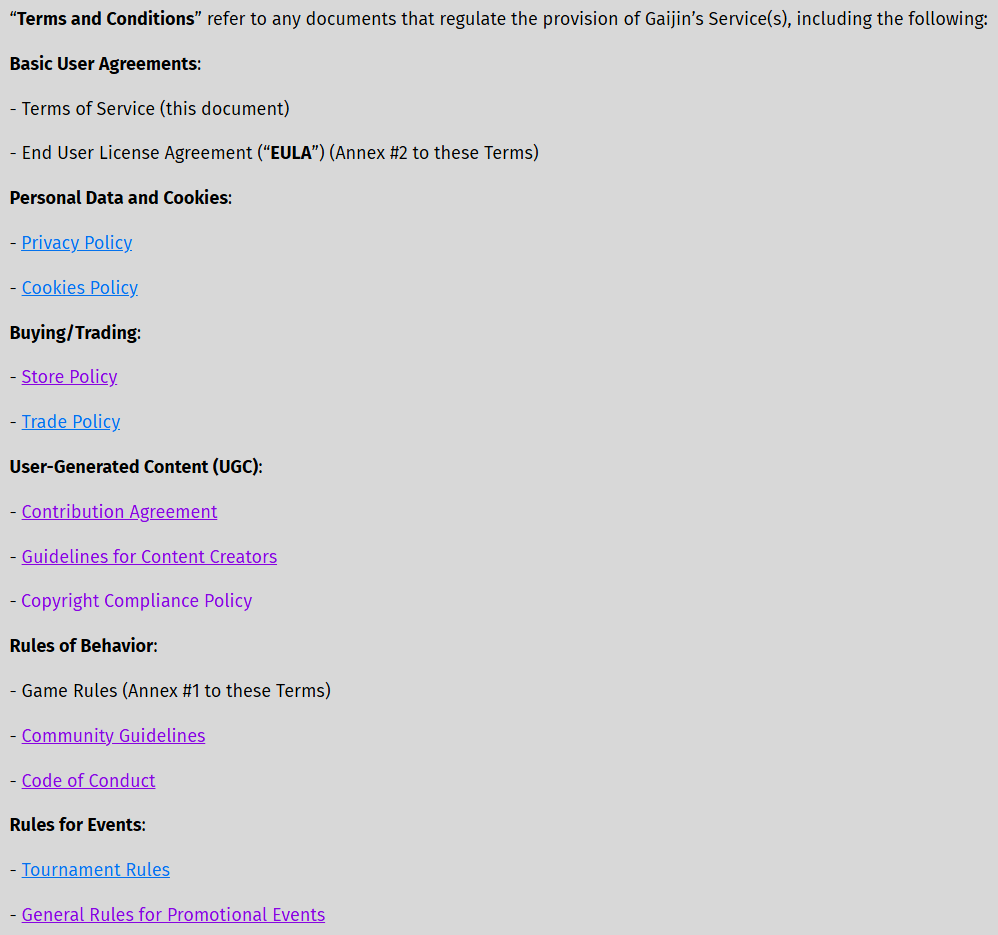
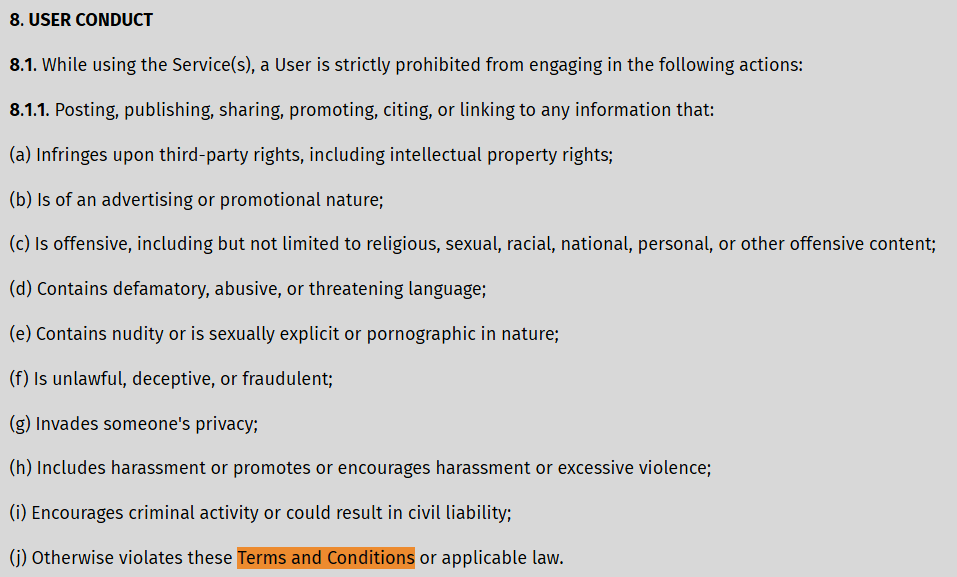
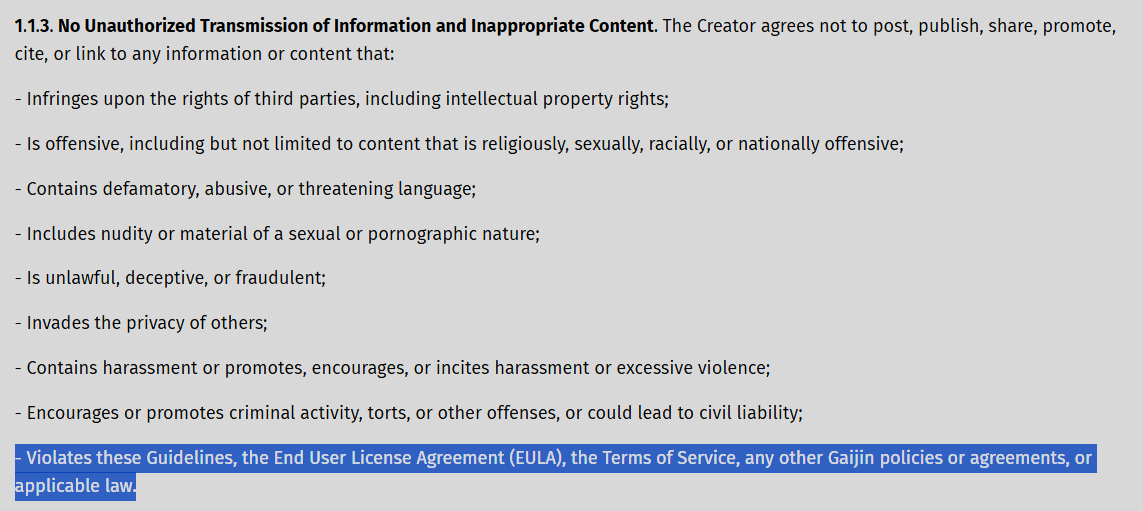
On top of this; any time a rule mentions “or otherwise goes against the terms and conditions” (or something to that effect) it also references the “forum rules” (that is actually named the “common rules” and is part of the community guidelines)
Bigger screenshots
The start of the common rules document also mentions “and other Service(s)” and later details " Capitalized terms not defined in this document shall be interpreted as provided in the EULA and Terms of Service." where in the ToS the term is defined as " “Service(s) ” refers to any digital products or offerings provided by Gaijin, including but not limited to Website(s), Game(s), mobile applications, software, online platforms and other services such as the Gaijin Store and Gaijin Marketplace and any other services or features offered by Gaijin through digital platform." where the word games is one of the things listed.
So technically everything listed in the community guidelines was (and still is) also enforceable in-game.
New/current docs below:
The first sentence is what i assume is refered to as applying in this case. The “Users are prohibited from discussing methods to harm or exploit the Game(s)” part, where any calls for mass negative reviews would imo fall under “harming the game”.
I personally read the section you quoted as referring to sharing those things in game both in the sentence before your quote and also the part after it referring to the game rules section of the ToS, so for example if there is a youtube video that calls for mass negative reviews then linking to that video in-game would be a violation.
I don’t think we’re actually in any real disagreement except possibly on this point. A person could have said, before this TOS, that they wrote a negative review to HELP the game, to encourage it to be better. Gaijin might not accept that appeal, but they could have made it.
In fact I’d say most people who were public about participating in review bombing in the past at least thought they fell into that category. To them it was a valid form of player protest without walking away from the game or community. Now, as of today, it’s explicitly not according to the revised agreement we all just agreed to.
(Also, just to be clear, I was pointing out that Stona was quoting from the superseded 2023 community guidelines document, which now only exists here on the Forum guidelines page, as it was removed from the main Gaijin legal page and replaced as part of the last wholesale revision of the legal document set (EULA/ToS/Conduct Code) in 2025. So for instance, there is no longer any rule “3.11” in the current community guidelines, instead it just references the code of conduct (which is one of the docs that changed today). But as we still see the old 2023 rule numbers cited regularly by moderators here, it’s reasonable to assume the 2023 guidelines version would still additionally be in force on this site.)
I can agree to the point of there being some sort of subjective interpretation.
But negative reviews does inadvertently and objectively hurt the game through lowering visibility resulting in a fewer number of new players joining and subsequently also decreasing the long term profits.
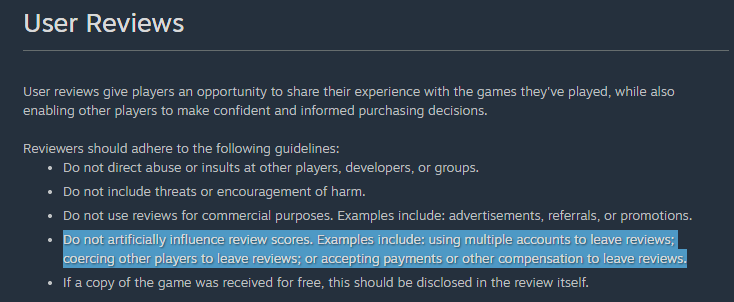
Leaving a negative review in of itself isn’t against the rules, it’s the act of encouraging others to do so or participating in coordinated attempts to manipulate ratings/reviews that is against the rules. I would assume this includes thigs like using bots to create reviews for example.
In fact, Steam itself has something similar in it’s rules:
Im not entirely sure how this relates to the initial argument of explicit vs. implicit Gaijin rules, but I will indulge. Your example seems to indirectly put = between “contains WT footage” and “is WT related content”, and I dont exactly think that holds true. YouTube video does not automatically become WT related merely because WT footage happens to be playing in the background. Someone could be discussing, say, the elections in Ghana, economics, history, or literally any unrelated subject while using WT gameplay as visual background but that wouldnt make it WT related and thus automatically subject to Gaijin rules, even if implicit.
What matters is the subject matter and content of the video, not merely what someone happens to use as stock footage or visual background. A few years ago, it was quite common for YouTubers to discuss politics, internet drama, or other unrelated topics over Counter-Strike surfing footage. That did not somehow turn those videos into Counter-Strike surfing videos.
Conversely, if the video were promoting a bot service for automatically researching vehicles or earning SL and it used Counter-Strike surfing footage as the background, it would be WT as the actual subject matter would still concern WT and conduct specifically prohibited by its rules even if the footage used for “eye candy” isnt WT related.
Existence of hypothetical circumstances where a YouTube video could legitimately result in a suspension does not “clearly” demonstrates that Gaijin generally reserved the right to regulate players actions on YouTube. It demonstrates only that some conduct occurring on YouTube may independently fall within specific prohibitions of the EULA/Code of Conduct, and Gaijin explicitly stated which one.
That is very different from establishing a general right to regulate whatever a player happens to say or do on a third party platform merely because it concerns WT from implication.
So, devil’s advocate again, in that example you have nothing to tie a player ID you could suspend. A video of talking about WT over a picture of my pet cat, if that’s all you have to go on, doesn’t offer the handle you need for sanctions so even if you did say bad things about WT no action can be taken.
Conversely, let’s pick another thing in Code of Conduct s2 rather than the review issue… Say “discussing controversial historical events”… I’m pretty sure if I ran a popular TikTok series over video of my gameplay where I’m ranting on crazily about… (Pick controversial historical event here)… Gaijin could very well say they don’t want their product associated with that and suspend me.
Or, let’s say I’m a supporter of a government hostile to the United States and I post endless Twitter videos which show my ingame supercut specifically blowing up current US tanks and saying, “this is what awaits you when you invade us”… Gaijin could well say that’s a player code of conduct violation even though it doesn’t happen on a Gaijin website. That to me is the simplest explanation of the phrase “personal content.” YMMV
Sorta, but I think that actually supports my position.
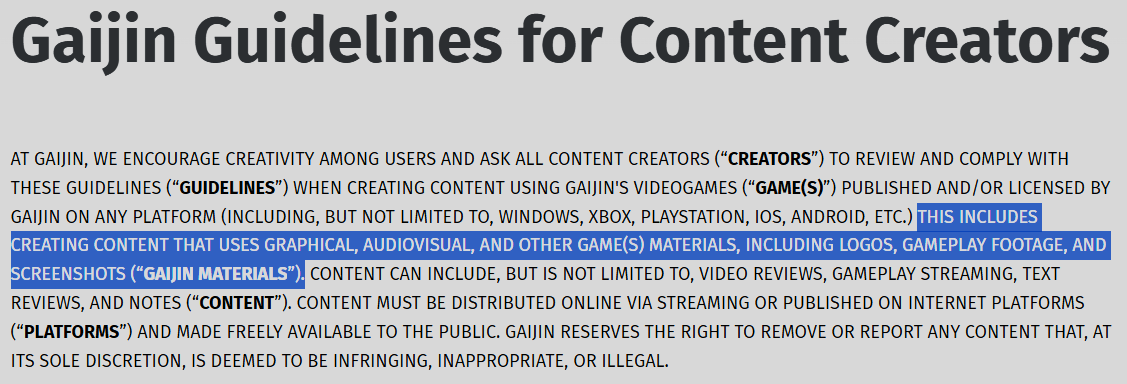
Guidelines explicitly establish a framework for content creators using Gaijin Materials on any platform.
And notice what they actually regulate: content using gaijin games/materials, with “Gaijin Materials” defined to include logos, gameplay footage and screenshots. That does not mean that any unrelated subject matter discussed in a video containing WT footage thereby becomes WT related for the purposes of the Code of Conduct.
If someone makes a video about the elections in Ghana while using WT gameplay as eye candy, the video obviously uses Gaijin Materials. Therefore the Content Creator Guidelines may apply to the use of that footage. But that does not automatically turn the discussion about Ghanaian politics into WT related content, nor does it mean that every rule concerning player conduct now applies to whatever the creator says in the video.
So I think we are actually back to the distinction I was originally making, that being Gaijin explicitly states when and to what extent its rules apply beyond its own platforms.
Not to mention gaijin clearly, once again, demonstrated they know perfectly well how to explicitly state that a set of rules applies to content created on “any platform” when that is what they intend.
Whether Gaijin can actually identify a YouTube/TikTok account and associate it with a particular player account is question of enforcement, not a question of what is actually prohibited by the rules. The fact that a violation might be difficult to attribute to a particular player does not determine whether the underlying conduct falls within the scope of the rule (not to mention issues with account identification are not what I argued about. I was using the example to illustrate the distinction between the subject matter of the content and the footage used as background, not to discuss how easily Gaijin could identify the creator).
Historical events and “invade us” examples, I understand the point, but “gaijin could say they do not want their product associated with that” is different from establishing that they actually have a contractual right to suspend the player for it. Also, “we dont want our product associated with that” is not in itself a contractual prohibition. A company may dislike or distance itself from something a customer says, but that does not automatically give it a contractual right to sanction the customer for saying it. Otherwise, virtually any speech that Gaijin considers sufficiently damaging to its image could potentially be reframed as a violation simply because the speaker happens to be a player.
If the argument is that “personal content” is intended to cover third party platforms whenever the content is deemed sufficiently connected to War Thunder, sure, but it hinges entirely on the premise that gaijin would extend its scope implicitly when it was demonstrated they can extend the scope of rules explicitly.
If you want to insist that “personal content” extends gaijins scope to your examples, sure, but then you have to explain why they would leave that extension implicit rather than state it explicitly, as they have done for other rules.
“Personal” can simply distinguish content created by the player from official Gaijin content tho. That is also “simple explanation”, arguably even more simple than yours.
Anyway
I am not insisting that my interpretation is the only possible. But based on the wording and structure of gaijins documents, i think the evidence points towards it being the correct one.
Cant help but think that this would Streisshand effect and risk another major player revolt ngl. a lot of WT content creators (we all know who) have their channels live off of gaijin controversy for views, they would jump on that in a heartbeat.
Gaijin isnt ignorant to how much of a sewage pile this playerbase is at times, they mostly know the limits of what can be gotten away with.
Sure, but that is an argument about what gaijin might strategically choose to do, not than what their rules actually say.
If Gaijin intended to prohibit organizing boycotts on third party platforms, one would expect them to explicitly extend the rule to those platforms, just as they have explicitly done elsewhere when extending the scope of their rules.
In fact, the fact that such a rule would have potentially significant consequences for content creators is another reason one would expect that scope to be stated clearly rather than inferred from “personal content.”
Im not gonna try and question legalese with a literal lawyer but it does look like as far as gaijin can really go without risking anything if the wrong person actually reads TOS and kicks up a stink.
they sort of do this with content creators on the program to some degree, thecodmineman did say he got in trouble for his “war thunder is dying of slop” video. which is fair enough, this are financially backed (via creator code purchases) content creators by gaijin so if they say anything too damaging, true or not, its in their best intrests to have a way to boot them off.
There are other games? WT hits me right in my 'tism (diagnosed) button as a military equipment geek even if it irritates my realism clause something terrible.
RN I have something like 19 games up and ready to go…and play them maybe 2hrs a week. I don’t want to think how much money I’ve fed The Snail…I just hope I get one of those fancy engraved gold bricks around His reflection pool once he becomes a Transcended Being.
I’m rn only playing Hollow Knight and FTL: Faster than Light until the SL crates drop. But I still pray to the snail and have put at least $100 into WT(that may not sound like a lot but it’s more than I e put into every other game I’ve played combined)
How are you allowed to ban someone for “review bombing” when the only platform with public reviews is Steam? You have no control over their platform so the threat is empty.
So the way i read and understand this; the video itself and any content in it must adhere to the ToS/CoC/EULA/etc as soon as the creator uses WT materials in the video.