So then why did you say that there was no claim?
Bad phrasing, I meant that Mach 3 isn’t a commonly claimed/well known attribute of mica-VL, mbda have never claimed that.
If it were Mach 3 capable in VL, it would also be Mach 5 capable.
No it does not
Sources are contradicting each other, so i try to get something that fits in the middle, but it means extremes such as a gain of speed of 1000m/s with drag included or the famous “750m/s max speed” are left out. The first because some phrasing can be left to interpretation, and the second because despite being a primary source, it was written in a context where MICA VL’s capabilities were understated, not to mention that we don’t know if we are refering to MICA IR or EM, so interpretation once again.
It’s not perfect, because gaijin physics aren’t perfects, but considering what we know it seems like a reasonable equilibrium. Maybe one day something will definitely prove that MICA is on weeds and can accelerate to 1000m/s with drag taken into account, or maybe an other source will show this missile was in fact a 112kg piece of garbage that can’t even reach Mach 2.2 and is somehow slower than a Stinger, but in the meantime, i will go with an in-between that seems more reasonable
That still doesn’t change the fact that I have not really seen anyone abandon this Mach 3 number nor this 30G at 13km (when measured horizontally in respect to the ground). This 30G number is under aerodynamic performance in a later MICA VL brochure and for all we know could just be a G value for a given altitude.
I’ll copy paste the relevant part of another post I made in the Rafale thread.
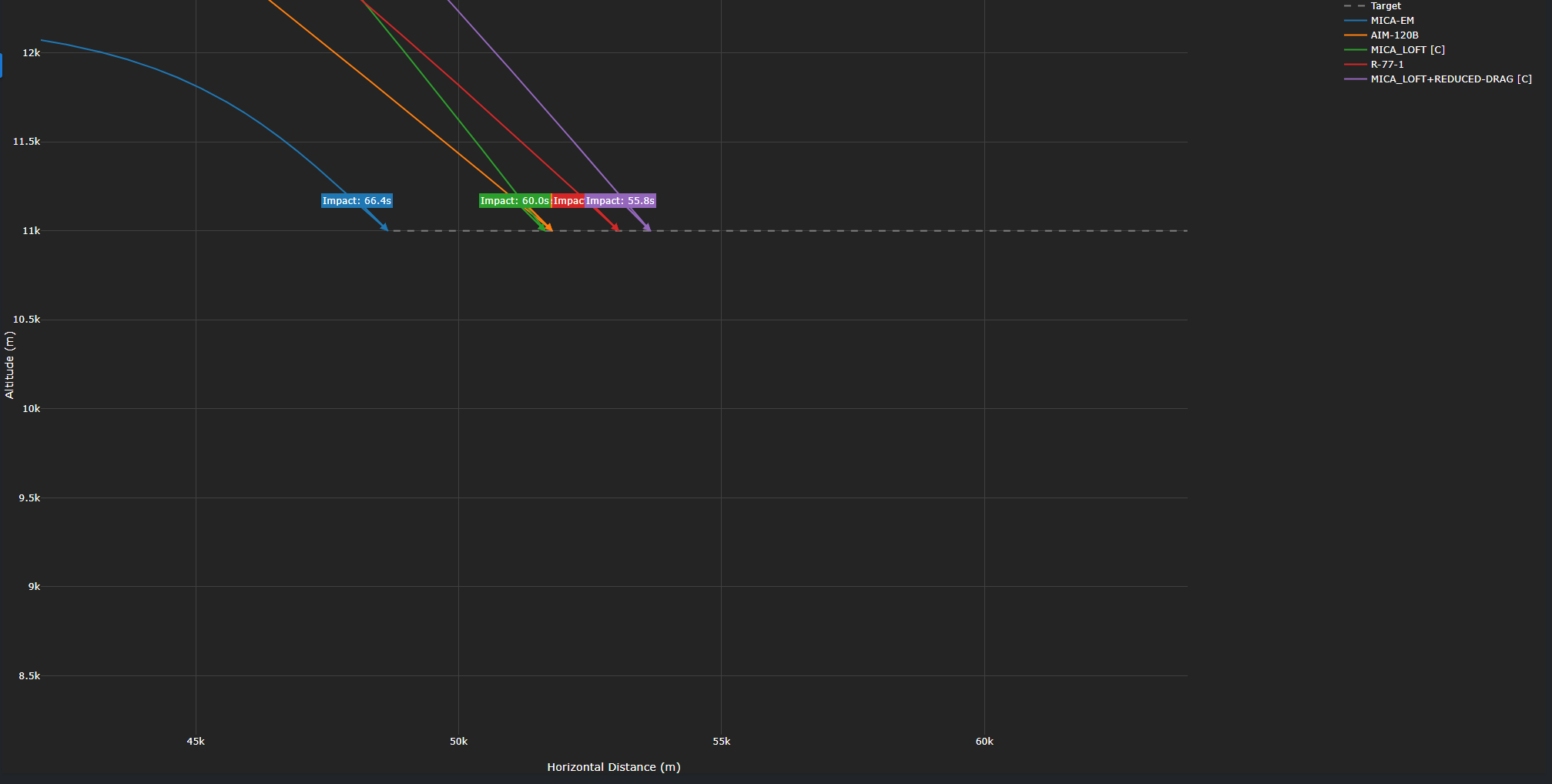
Represented here is the time to impact for 4 missiles on symmetrical Mach 1.6 engagement with a missile launch range of 80km. The blue missile represents the current MICA as it exists, the orange is Aim-120, and red is R-77-1. The other two MICAs represent modifications to the base missile; the green is simply the current MICA but with AMRAAM lofting profile and no self destruct, and the purple is the same but with its diameter reduced and a 1.4 drag coefficient which mimics a suggestion earlier in the thread.
Simply changing the lofting profile brings its long range performance directly in line with AMRAAM. Changing its diameter and drag makes it superior to the R-77-1 at range. And guess what…none of them will meet the Mach 3 vertical launch set point or the Mach 1.2 retained energy set point at 13km from a sea level to sea level launch. These are the set points that DirectSupport wants the missile to reach based on stringing together an old MICA VL brochure and data on the Magic II.
In order to approach those the 1.2 retained speed requirement, the missile drag has to be further reduced. In order to meet the Mach 3 set point and the 1.2 setpoint the lofting profile, thrust, and drag has to be changed.
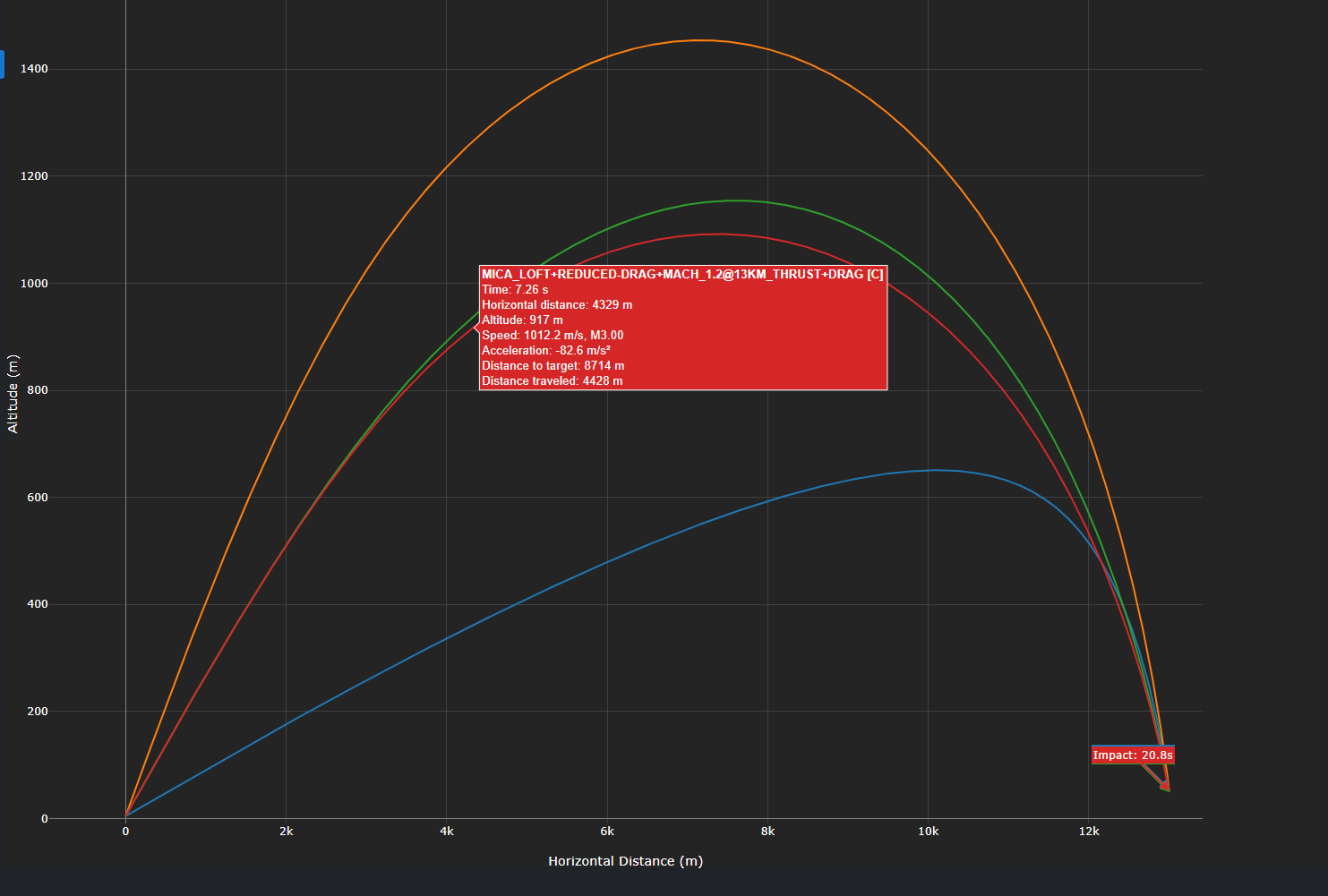
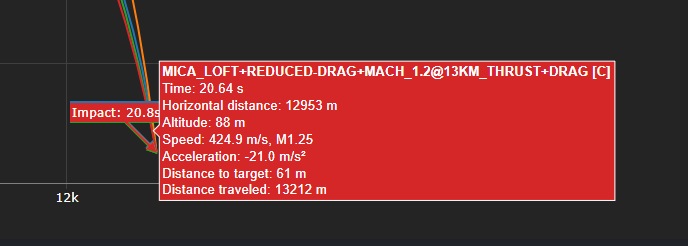
The missile in red represents one that meets both requirements. Green is only modeled as further reduced drag to meet the final setpoint and blue is standard MICA.
How would these missiles look in game? Well lets go back to our BvR scenario.
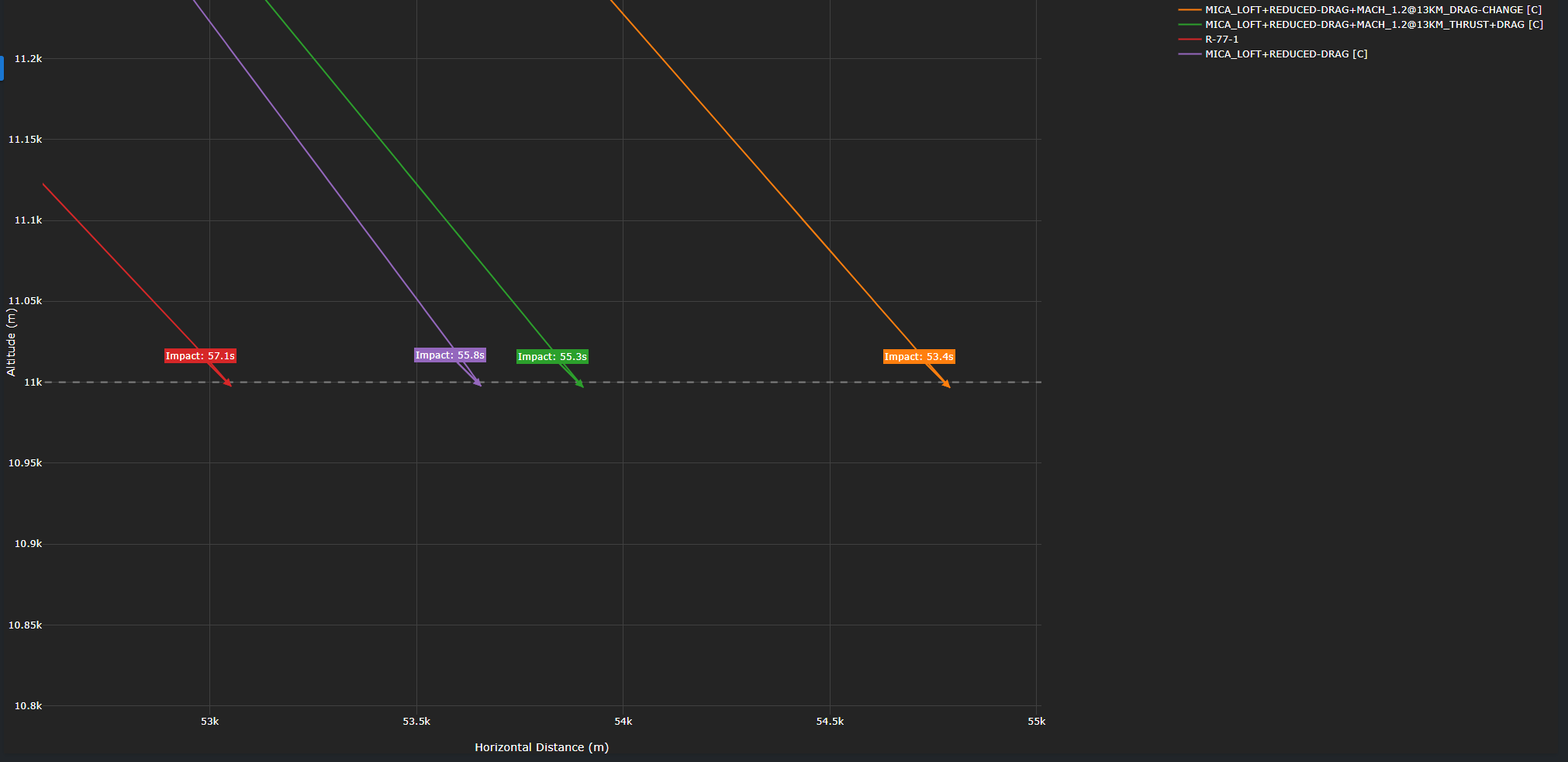
Every version of the modified MICA ends up having a time to impact that is less than the R-77-1 which is currently the best missile in the game as far as straight line BvR kinematics.

The story doesn’t get any better at close range either. Improved MICA would have an even shorter time to impact at close ranges. It would be a 10% improvement over current MICA and R-77-1.
Now even if we ignore the Mach 3 claim but keep the 1.2 Mach at 13km figure… what do you think happens to the missile performance? In order to get that value the drag of the missile would have to be significantly decreased.
I understand his claims and wants. Mach 3 is not feasible for mica VL, it’s only been mentioned once in a random secondary source.
The G-pull at distance is definitely a fair metric, and has been used in the past to model mica in game to my knowledge. The issue I believe is that mica can’t pull hard enough with fins. Because its speed at 12km is only going to be about Mach 1.
The actual minimum requirement figure is 30G at over 12km. Edit : also could apply to the IR or EM, this is not stated, as always when it comes to most MICA brochures
Mach 1.2 and 13km is just interpretation by @DirectSupport because he assume that over 12 km means at least 13km, and also assumes that the missile needs to go at Mach 1.2 to achieve 30G. I personally don’t know how fast the missile would need to go to get this G load value tho.
Fireball assumes around Mach 1 I believe
This also isn’t necessarily the way that 30G is achieved; more likely you fire at a target further away, and then see its speed mid way through. As if you had fired at an oncoming target.
Mach 1.2 comes from magic 2.
Mica however is much closer to super 530D/F, so that would be more relevant in comparison. However those are much larger.
Yes, but in reality the body lift and fin layout is very different from the magic 2*. It’s indeed closer to the 530 in shape, but that would also indicate a required speed much higher than say the magic2, so well over Mach 1, since the 530 is a missile that only picks up high G capacity at higher speed
with 1.65 Cx, 160mm diameter and the fixed engine, it’s subsonic past 10 clicks
And i honestly don’t mind it. First because i don’t know what speed it needs to be to hit 30G, anything less makes me raise an eyebrow however, one because it would be abnormally draggy, and 2 because it would basically be dead weight by the time it reaches 12km. I can paint a missile hitting 30G at transsonic speeds, however at medium subsonic speeds it means the control surfaces would basically not answer to the good old rules of physics (and it would question the installation of TVC in the first place)
Indeed, however mica is much lighter, and the proportions for the chord wing are different.
Not at all, TVC is for fast reaction of the rail and at low speeds.
The design of the mica is such that the fins produce AoA, and the body and chord wings produce the majority of the lift. Abit like ASRAAM.
Is there a similar graph for super 530 sitting around anywhere?
I wasn’t really in the reporting community when the 530 was reported, you’ll have to ask other people
1 Like
Do you really think it has GPS and knows exactly how much metres it travelled before self explosion? This is Gaijin’s doing. MICA and SRAAM both shouldn’t have this.
1 Like
Well, MICA does have Inertial navigation, which would be able to estimate the range its traveled as it knows speed and time.
SRAAM, I assumed was some game limitation regarding battery life or something from back when it was first added. Though it needs a total overhaul as its underperforming by crazy amounts. Though again. Distance can be estimated if a speed is known and it has a basic timer. GPS is not required for guessing distance traveled
If this would get brought up, I think MICA-EM would be awesome even at high speed launches.
I am just taking the claims at face value. Personally I think he has shopped for the highest possible values and the most generous interpretation of his sources.
There is a different MICA VL brochure that phrases the 50G and 30G claim differently.
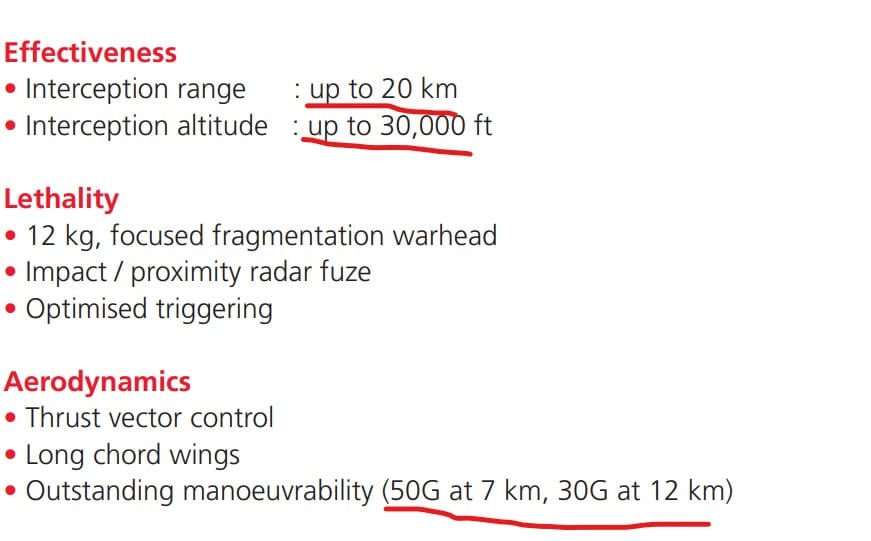
In this context it might be reasonable to conclude the G values correspond to altitudes and not horizontal distance at sea level. They might actually just be using the values from the air launched version.
But DirectSupport always assumes the maximum possible interpretation and lobbies for that. He always assumes that France consistently understates it’s weapons performance so we should always use the highest number he can find. He also ignores or downplays when they have overstated their performance
So I’m showcasing the missile performance if it is modeled the way that he wants it.
4 Likes
I see, that makes more sense