Pretty sure it’s missing almost 20 tons, ridiculous :(
Edit: Thinking about it they might add it soon and just not give it it’s more accurate armor value.
Pretty sure it’s missing almost 20 tons, ridiculous :(
Edit: Thinking about it they might add it soon and just not give it it’s more accurate armor value.
yea it might be, just the estimates ive seen its at least 10 tons probably more considering how much different the Turret is compared to Mk3,
But 75 tons overall seems more reasonable just due to most western militaries kind of caping out their weight gain at that number, and then trying to find ways to reduce it below that
Where my SLERA Gaijin, I know David_Bowie put in a report a few years back about the how the NERA is modeled incorrectly for KE Protection but it got put away in the vaults like normal, never to be seen again
Yeah it’s a bit ambiguous but I bet our Israeli fans have this covered.
Lots of things are modeled incorrectly and for the armor value most of it seems to be plain non efficient Chobam.
But I think we can get the AIM-54C to have some sort of range discrimination mechanic somehow.
Unless there is a document specifically stating that it uses LFM to help with the ranging Limitations of HPRF, they just aren’t gonna accept it,
You can try as theres a good amount of evidence that states it has Range Discrimination as well as a Frequency modulated transmitter,
which to a logical person means LFM because its HPRF,
Butttt unless its in the simplest english, it will be labeled not enough info
I agree that proving the exact waveform would be harder. Our report shouldn’t rely on “HPRF + range discrimination = definitely LFM” as an argument, because that is still an inference unless we find a source for it.
At worst we can work the single strong point of public sources: The AIM-54C as having improved, range-discrimination and target discrimination. In-game, however, the AIM-54C appears to be modeled mainly with Doppler-speed gating and without an explicit range-discrimination/range-gate mechanic comparable to other ARH missiles.
The requested fix should not be “prove and implement LFM specifically,” but rather “model the documented range/target-discrimination” in some form which is not modeled right now.
There is however just exactly this, the very next page of the “HPRF with range discrimination” one:
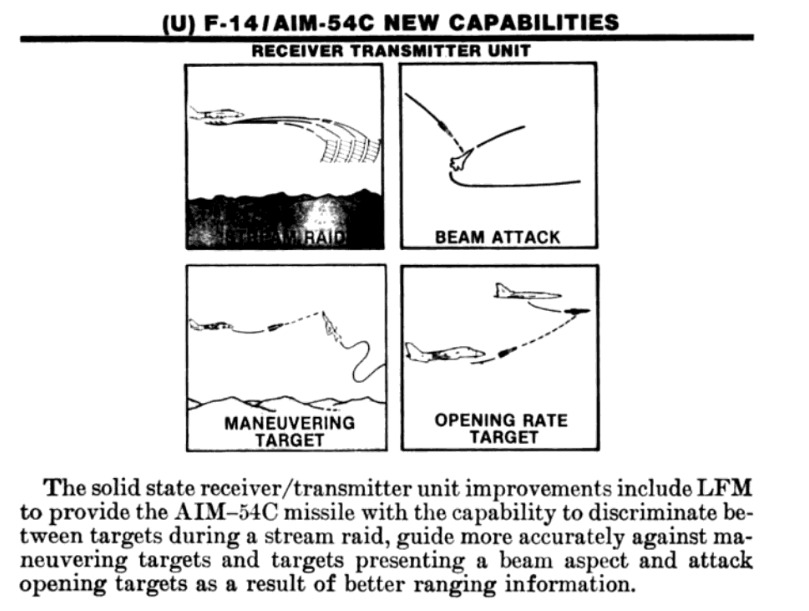
Anyways all this info has already been presented, and this is the only response so far I think:
https://community.gaijin.net/issues/p/warthunder/i/HiVBh7p8b6JR
This is not a bug. The AIM-54A also used a pulse Doppler seeker; however, since that seeker relies solely on HPRF, it lacks all-aspect tracking capability. Therefore, the AIM-54C added LFM to ensure tracking capability against targets performing beam maneuvers. This does not mean the AIM-54C’s performance is underestimated; rather, the AIM-54A’s performance was overestimated. This is because the AIM-54A is also capable of tracking beam-maneuvering targets.
Furthermore, this report contains no specific figures regarding the performance the AIM-54C+ should possess. Simply stating that it is “better than before” is meaningless; developers need concrete figures to implement this.
So it seems LFM is already accepted to be in use with the AIM-54C, for the tracking capability of beam aspect targets, but I don’t agree with the rest. Although I need to do some in-game test to confirm, I don’t think either Phoenix have beam aspect target tracking capability, maybe only in look-up scenarios or high altitude, where there is simply no 0 velocity clutter, but you wouldn’t need ranging information to do this.
Idk about the specific figures or whatever, because if you look at any of the missile seeker stats for ARH missiles, they are all copy paste/standardized for most part. So asking for specific figures is kind of irrelevant, considering those specific figures aren’t seemingly based on real values to begin with, unless there is more radar parameters somewhere not covered by the datamines.
He found that document too but it’s not a primary source as it was during developpement. It’s a nice supporting source though.
well shit
We are not using the same arguments nor sources nor conclusion though.
Also the INS/datalink/dead-reckoning part is already in-game.
The burn time and thrust differences are minimal and only change drastically with altitude. To utilize the MK60 more effectively you’d likely need to be at a high speed and launch it from a higher altitude IRL.
War Thunder does not model total thrust and burn time changes dynamically - to achieve the same characteristics and launch profiles as the AIM-54A they would give it a similar thrust and burn time and that static number would cause the same issues as the existing Phoenix. Long burn time, slow acceleration, overperformance at sea level, underperformance at high altitude.
The issue is not that the motor could benefit us from a different thrust and burn time, rather that Gaijin’s implementation of it would neuter those advantages.
No, this has nothing to do with the loft profile issue. The AIM-54A overperforms at sea level when launched flat and level as well as when lofted. It is a raw overperformance of total impulse at sea level because it was adjusted to hit a high flying target when launched from medium altitudes at a longer range. It is a specific Phoenix Scenario that they assume took the entire battery lifespan, so the missile is configured for only that scenario.
Likewise, almost all other ordnance in the game is modeled for a little bit lower altitude and with more data, specifically the R-27 series are pretty decently modeled for that and thus overperform at sea level as well. The massive thrust and acceleration makes people feel those a lot more, though. The MK60 equipped Phoenix will not enjoy the same advantages because there just isn’t sufficient evidence that the motor burns for 20s instead of 30 with the same overall impulse as the MK47 in identical conditions.
When testing burn times in static chambers a variety of atmospheric conditions are used for the testing, we would need data showing the max thrust and burn time at a variety of pressures (altitudes) and temperatures. We do not have that.
That is fair from an implementation/evidence perspective, but I think you are exaggerating and misinterpreting my point a bit.
I am not saying the Mk 60 should automatically get a major buff without source data. My point was conditional: if the Mk 60 had a shorter, harder burn with similar total impulse, then its advantage would not necessarily appear as a huge increase in total impulse on paper. It could show up through burn timing, earlier acceleration, higher loft efficiency, and reduced drag losses at altitude.
Even with a simplified static motor model, burn timing still matters because the missile is flying through an atmosphere where drag changes heavily with altitude and speed. A shorter, harder burn can still produce different practical results from a longer, weaker burn, especially during lofting, because the missile reaches its climb and coast conditions differently.
Also, I never said the Phoenix issue was only a loft-profile issue. My point was about the loft/drag/energy tradeoff as a whole. If the missile is tuned around one specific reference shot, that same tuning can cause it to overperform at sea level even in a flat launch, while still underperforming in other altitude/energy conditions. That does not make loft irrelevant; it just means the problem is broader than loft alone.
I agree that War Thunder’s simplified motor modeling could neuter or distort the real advantage, especially if the Phoenix is tuned around one specific reference scenario. But I do not agree that this has nothing to do with loft. Loft profile, burn timing, drag, and altitude performance are all linked, both in-game and in real life factually.
So yes, without hard Mk 60 thrust/burn/impulse data, it is hard to force a specific implementation. But the general point still stands: similar total impulse does not mean identical practical performance if the thrust profile and loft/drag environment are different, even if the difference ends up being minor.
You can create a missile in-game and test this. As I said earlier, the AIM-54A in-game with MK47 is already overperforming. If they add the MK60 and keep the same aerodynamic drag values, yes, it could be beneficial. Yet then it would not fit the performance metrics expected of the Phoenix based on the launch data. They’d have to nerf the drag or adjust the thrust / burn time until it did, and you are effectively making the same missile.
Whether that results in a slightly better or slightly worse missile is anyones guess because we don’t know how Gaijin would correct it. The current Phoenix overperforms at low altitude as it sits, so benefits from getting out of the high drag lower atmosphere are already sullied by that fact.
It might just be a revised lofting algorithm. Phoenixes IRL can loft way higher then they do in game; up to over 30 kilometers altitude.
Being at a higher altitude, or climbing more shallow could either be ways to obtain a higher top speed.
Having a sharper loft IRL then in game could also explain it’s overperforming low altitude performance, due to math around drag and launch speed, sharper lofting angles at low altitude launches can be a little bit worse compared to slighter ones. Particularly in warthunder due to how it’s lofting target calculation works to account for closure rates.
I agree from an implementation perspective. If Gaijin tunes the Phoenix around one specific reference shot, then a different Mk 60 thrust profile could easily be flattened out by later adjustments to drag, thrust, or burn time until it matches that chosen scenario again.
But that does not disprove my original point. A different thrust profile does not automatically mean a huge buff, but it also does not mean “same total impulse = same practical performance.” Burn timing, loft, drag, and altitude are linked, and a shorter, harder burn could matter if it were modeled accurately.
So yes, without hard Mk 60 thrust/burn data, we cannot force a specific implementation. I am not arguing for a free buff. I am only saying that the OTHER real motor profile could behave differently from the Mk 47, even if War Thunder’s simplified tuning might end up hiding or cancelling that difference.
So AIM-54 got a buff
good
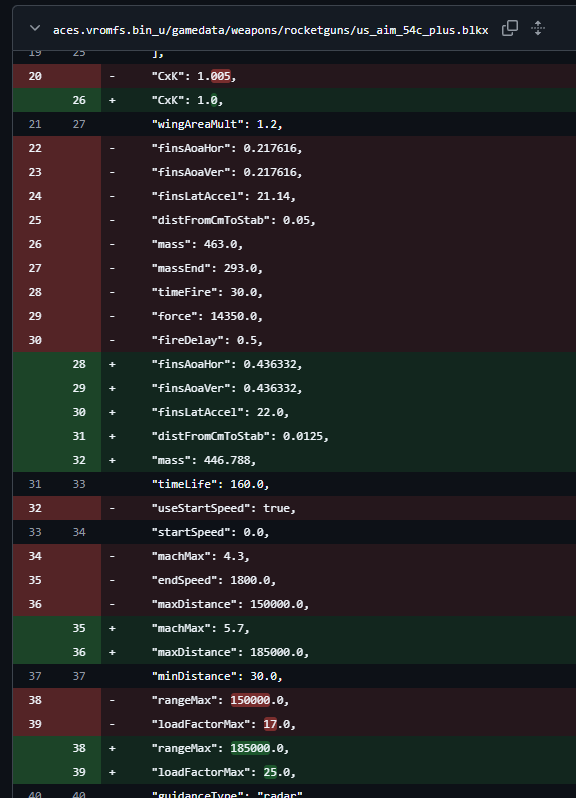
shorter booster with higher top speed, and 22(?)G’s, holy buff, we eat good.
25G’s for the 54C, 22G’s for the 54A, interesting
However nearly every missile has had a warhead nerf, and AIM-54 is the biggest loser here, going from 54kg eTNT to 33kg.
There were some.fuse changes as well
What is the average top speed achieved by AIM-54 in game?
So is the aim-54c’s seeker effectively all aspect pulse doppler, or is it still front aspect continuous wave that is only hitting those beam and rear aspect shots with support from the F-14’s radar?