It was more out of curiousity to see how it might affect a missile with more energy.
I’d also be curious to see what might happen if you increase the loft angle to something like 45 deg, seeing as according to the NASA sim, that left the missile with a slightly lower peak Mach number, but over 100 seconds of Mach 3.0+ flight, or what might happen if you add the energy management code from the AMRAAM’s guidance autopilot I mentioned earlier alongside your adjusted loft code:
seeing as the AIM-54’s are likely to still be wasting energy during their trajectories currently as they’re cleared to use 100% of max G load immediately once control surfaces are unlocked in-game.
45000ft 1.2M 45°
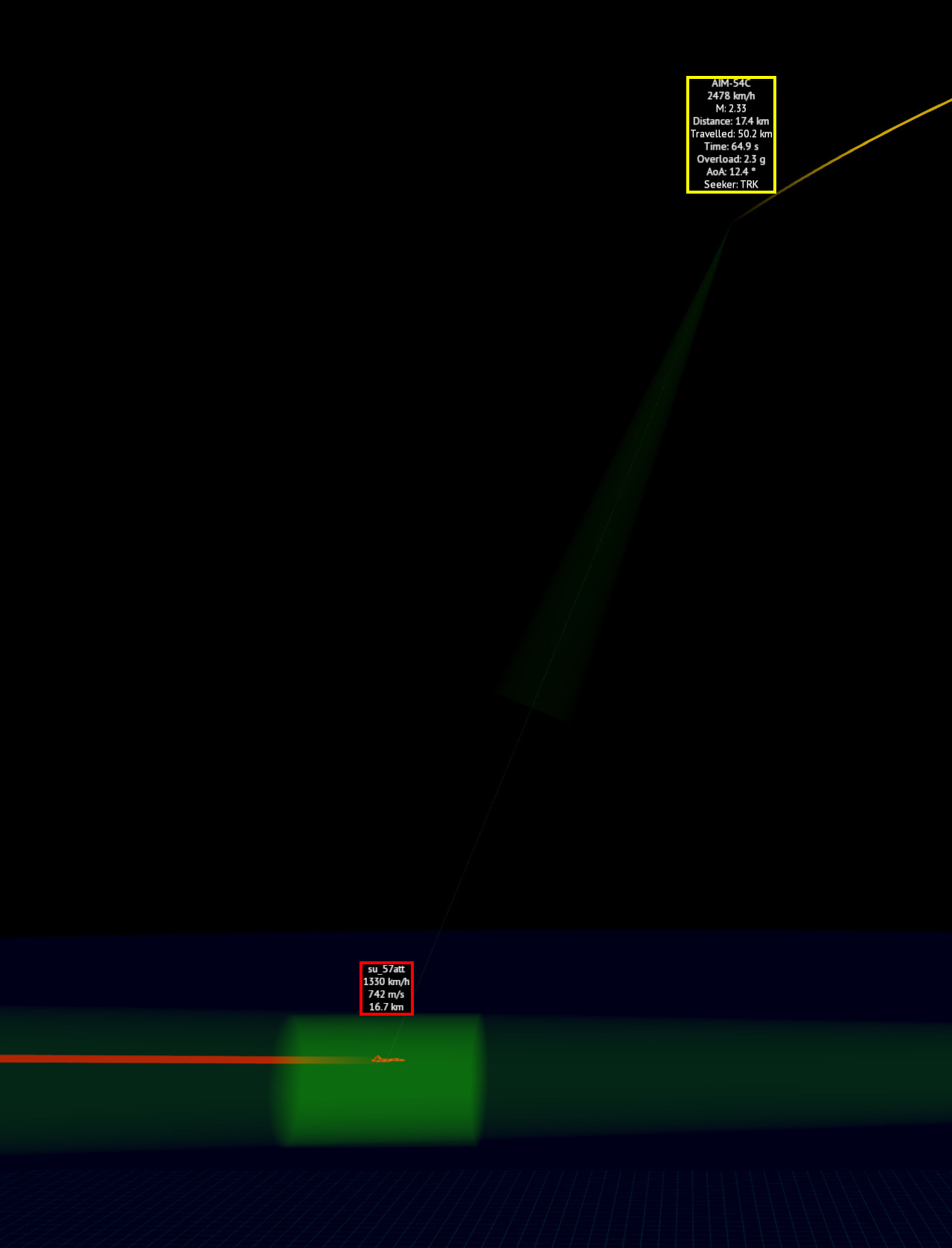
The AIM-54C here had all guidance codes removed and was fired as a rocket for testing. Phoenix can fly to Mach 4.12, which is higher than NASA’s test. Due to the influence of the rocket’s center of gravity, the missile will gradually turn downwards during flight. It is not clear whether this dynamics is accurately simulated in the game. Therefore, the longer the flight time, the greater the gap between the rocket flight trajectory and the real missile.
Missing some details on launch conditions for that question. You’re also better off stating Mach number at the desired altitude. For the most part, you can test this yourself in-game as well, just load a custom match with a single enemy bot or a friend, and just mimic your desired launch conditions, then use sensor view in the replay.
The reason I was asking for stuff from dark_claw is that I dont know how to make my own custom missions like he does for testing, so I cant test modified missiles.
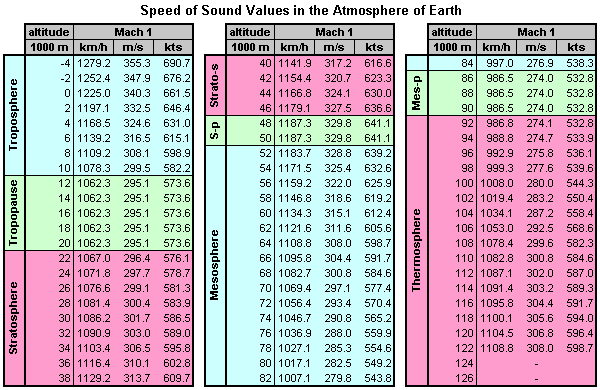
In fact, a speed of 340mps at an altitude of over 10,000 meters is approximately M1.15. I think the phoenix launched at M1.15 can reach the M4 when launched above 14,000 meters.
Realistically speaking, for WT, I dont think testing above 10km alt or above M1.5 is particularly useful unless there’s a known test to try to compare it to, or if you’re trying to find the in-game limits of a missile.
Maps are simply too small and the F-14 simply doesn’t have the grunt in the engines to get above M1.5 in a reasonable amount of time.
In a more reasonable (for WT maps) launch condition of M1.0 at 9000m vs a 8.3km target, the peak mach number was M3.02, and impact velocity was a measly M1.97 for a ~46km launch. Flight time was around 41 seconds.
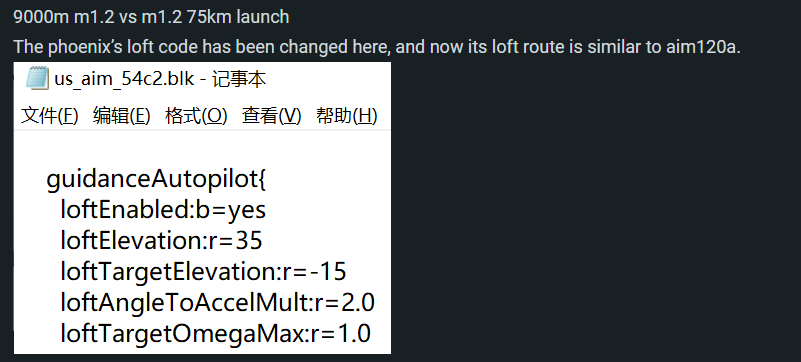
This specific test is actually interesting as it shows just how influential a better loft profile would be for the AIM-54C, as your test with the modified AIM-54C loft at very similar launch conditions (M1.2 9km vs M1.0 9km) shows vastly improved kinematics (M2.26 impact velocity against a 75km launch vs M1.97 impact velocity against a 46km launch).
I mean, the loft code is a definite issue, its just not the ONLY issue, but we’ve known the AIM-54 to be underperforming in many ways pretty much since it was added, particularly the 54C.
Very interesting, thanks for testing these out! So looks like a ~36% increase in impact velocity with your 35° loft vs the games 17.5° loft with those specific launch parameters and range to target
Random bit of curiosity, could you test the same M1.2 9km launch but do a 10° manual loft along with the 35° loft code you made, and maybe a 45° loft test too? I’m curious about how a 45° loft might effect it, and how much a manual loft might change the results as well.
Sorry for asking you to test all these things, and thanks for performing all these tests, I don’t know how to do it myself. I wish I knew how, there’s so many things I wanna test lmao.
It’d be interesting to see how the AIM-54C with 35° improved loft profile and the AIM-54C with the current in-game loft profile fares against the other ARH missiles when compared to this chart you posted as well:
With the 35° improved loft profile it has considerably more energy at impact than the rest of the missiles seen here from the looks of it, but with the current in-game loft, I’d guess they’re likely similar.
I think that will be more significant when launched at sea level, and it will be affected by loftTargetElevation and loftTargetOmegaMax. If max altitude reached by loft in 35 and 45 degrees are similar, then 45 degrees loft won’t benefit from less drag from the higher altitude.
I think the max loft altitude is determined by loftTargeElevation and loftTargetOmegaMax, the loftElevation only affects how aggressive it is on reaching the desired altitude.
With -15 degrees as loftTargetElevation, assuming missile is trying to keep target -15 degrees below horizon, this will yield a max loft altitude delta of ~19km, which remain unchanged for both 35 degree and 45 degree launch that were conducted. This explains why kinematics remain mostly unchanged when loft angle is increased.
My hypothesis is, to get more kinematics out of 45 degree loft, loftTargetElevation need to be -18 degrees or a bit higher, which yield a max loft altitude delta of 23km. The missile will try to climb to 23,000+9,000 (target altitude) = 32,000m when launched against a target at 9000m altitude, instead of previous 28000m.
loftTargetElevation=-20 should yield ~25km altitude delta, which means missile will try to climb to 34000m when launched against a 9km target.
Something else im interested in is the implementation of energy management code like every radar missiles after the AIM-7F except the AIM-54’s got.
Code:
Energy management code from the AIM-120:
Missing energy management code for the AIM-54:
I mentioned this a few times, but I think the AIM-54’s are flying much less optimized flight paths due to them having access to 100% of their fin deflection regardless of time to target. This likely leads to much less “smooth” trajectories, which wastes energy.
Another thing is energy management code likely limits how much the missile will try to adjust to every small flight trajectory change of the target.
Yes, more aggressive pull up maneuver can reduces time spent in lower altitude, thus reduces energy loss due to drag.
Manual lofting on Phoenix is very useful because of what you mentioned.
Where as Phoenix was supposed to be very aggressive at climbing even when launched horizontally, as seen from IRL footage.
Also, sorry, I read your post wrong. For the first part, yes having 100% fin deflection during entire flight will waste more energy since minor avoidance maneuver of target will cause Phoenix pull hard to compensate.