the aim-4g suffers this issue as well for some reason (from side-rear aspect), the only way ive found to make them reliably hit is shooting from above them to avoid it skimming on top of them
For the sake of curiosity, I inputted the stats of the AIM-4E in stat shark, and the results are not as bad as you’d think…
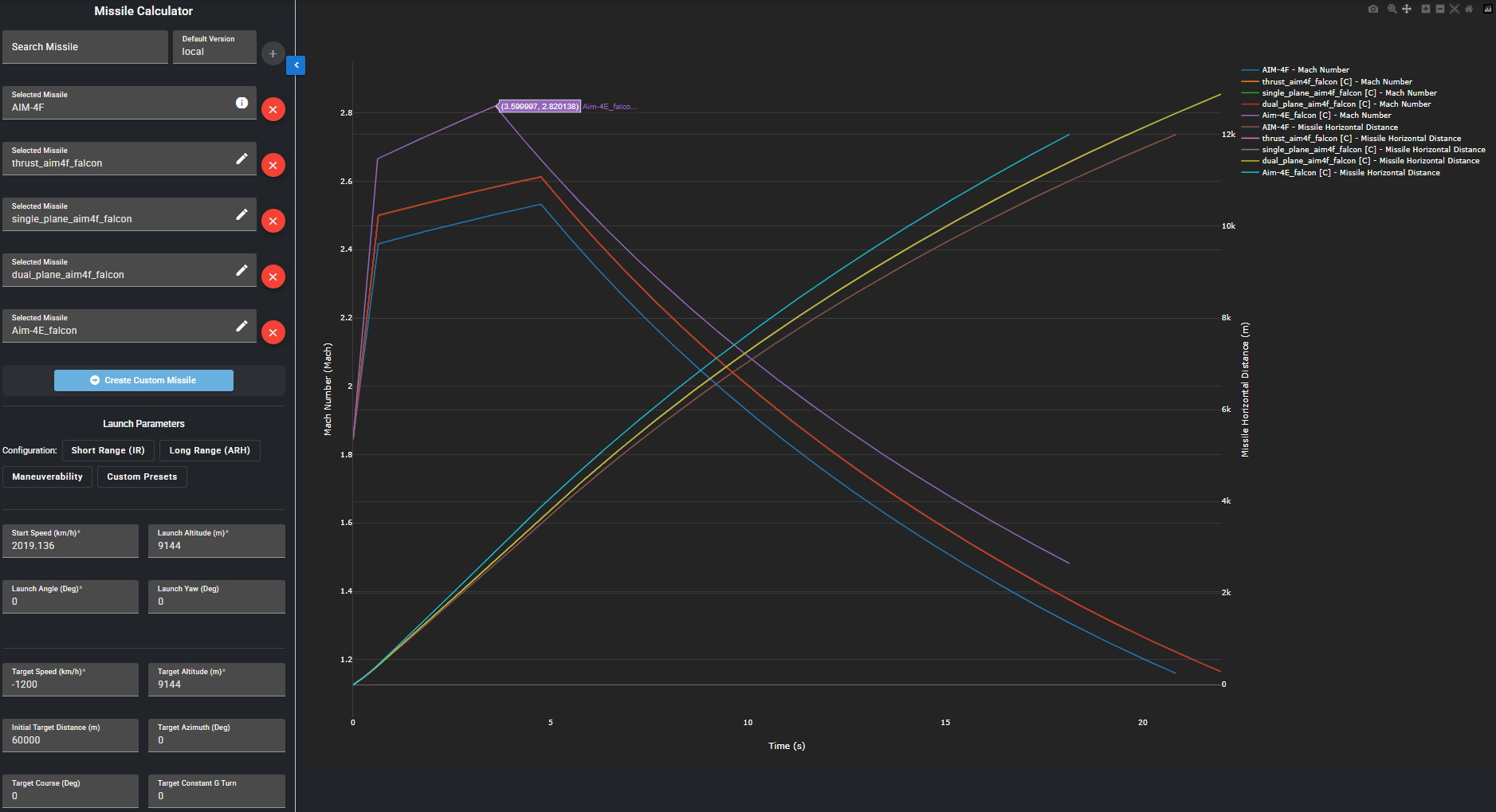
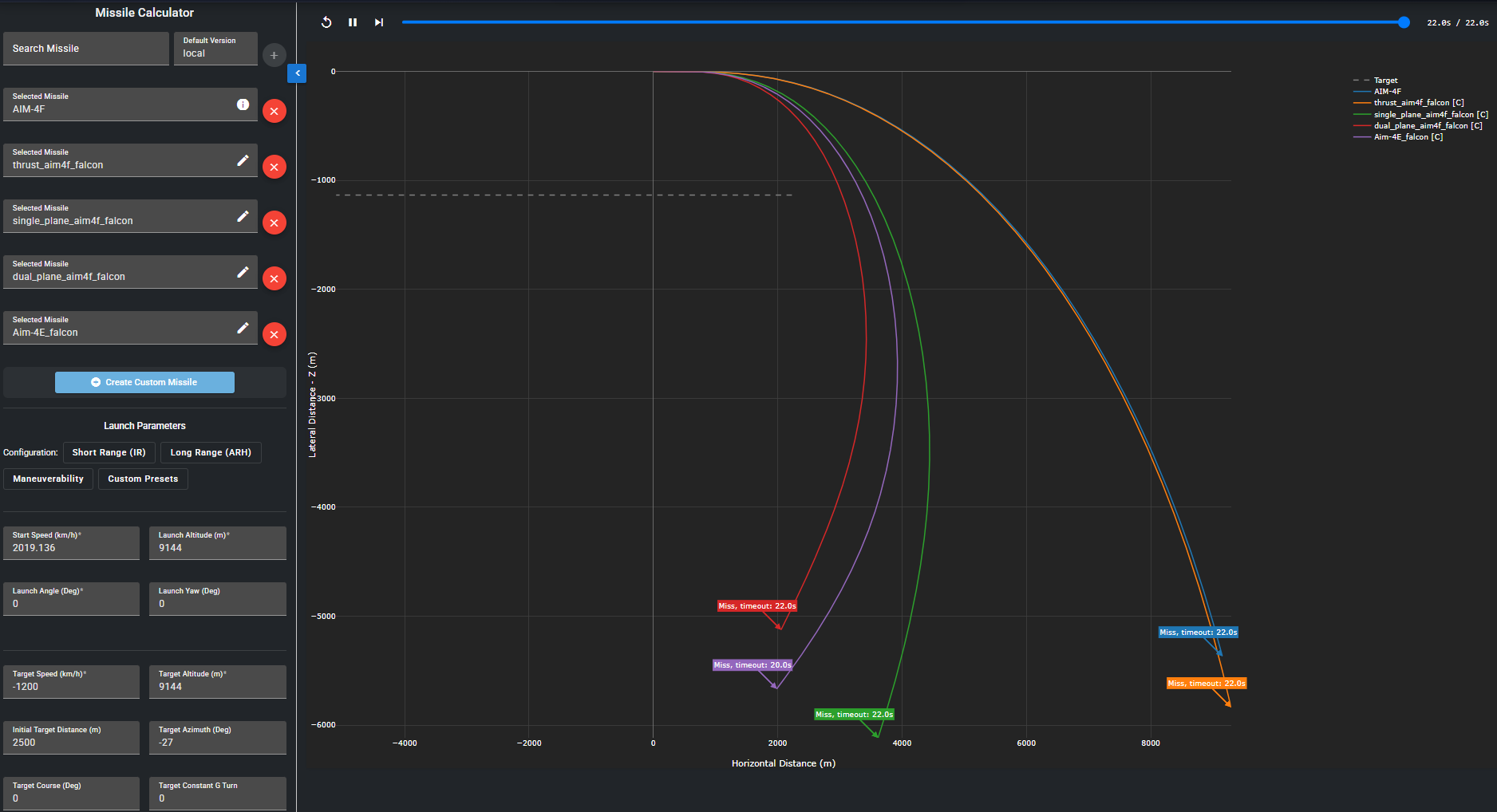
For starters, the AIM-4E missile is noticeably lighter than the AIM-4F, at 63,5kg vs 68,9 kg, showing that all the circuitry to add home on jam, chaff filtering and saclos functionalities had an important weight penalty.
Like on the corrected aim-4F, there is a HUGE discrepancy between the thrust of the boost stage while it’s fixed to the test stand at sea level (4550 lbf / 20239.4 N), and the actual thrust it must have to reach the speeds measured in test launches (5841 lbf / 25982,49 N) - this can be partially explained by them using an over expanded nozzle that gains efficiency at speed, although the ISP is so excessive (280 /s) some of the thrust probably should be split towards the sustainer. The sustainer on the E has a shorter burn time than the F, but the overall result is that the E is faster.
The drag coefficient on the the E is MUCH smaller than the ingame AIM-4F, going from 2.025 to 1.64 , to get the best possible match with the speed over time graph on the SMC for the first 10 seconds, but as it has a slightly shorter battery limit than the F (20s vs 22s) the overall distance covered is the same as the ingame version of the 4F.
According to the table, the AIM-4E already used dual plane manoeuvring like the AIM-4F. This means that the load factor showed on 0 roll angle manoeuvre graph is actually underrated by 41% versus testing, and that the turning radius is actually not that far off than that of the dual plane 4F, even though it has a lower g limit of 24,6 vs 27,2 on the corrected F. The ingame version is a joke by comparison.
TL DR, the aim-4E in real life is a fair middle ground between the faster but less manoeuvrable AIM-4A/C/D, and the slower but more manoeuvrable AIM-4F/G, but it doesn’t matter unless it’s implemented correctly and the pulse radar guided missile bug is fixed.
3 Likes
How are you getting that? Curious as i want to see what the AIM 4D would be like in game as its the best Service IR falcon for war thunder
Typical mission table, 30000 feet. Goes from mach 1.85 to mach 2.82 at burnout (3.56 s), to mach 2.71 after 5.5 s, and mach 2.19 after 8.6s. The only way to get that rate of deceleration is by reducing coefficient of drag from 2.025 to 1.64, although to be fair i haven’t tried reducing the fin area to see if it changes the parasitic drag (and the aim-4e does have a smaller fin).
Note i’m being conservative, since the table indicates mach 1.94 after 12.8 s, but reducing the drag to hit that speed in statshark would make it a bit too fast in the first 10 seconds, which is where it matters.
Aim-4d by comparison at 30000 feet goes from mach 1,2 to mach 2,87 in 1,4 seconds (much better delta v and acceleration), to mach 1.69 after 10.3 seconds - average 4.1 g deceleration, compared to the 3.87 g average deceleration of the aim-4e, or the 3.26 g of the aim-4F.
4 Likes
Fair, yeah ive had issues matching the AIM 4D exactly on statshark bc either its too slow at points or too fast but my best source on flight performance is the SMC and CS so its a bit of gambling
I wouldn’t call it gambling, just a compromise. For example aim-4d smc states that at 30000 feet missile goes from mach 2.87 at t+1.4 seconds to mach 1.69 at t+10.3 seconds, so you adjust the drag coefficient until the missile slows down from M 2.87 to M1.69 in 8,9 seconds, and then adjust the thrust so the missile reaches mach 2.87 when launched at mach 1.2. The speed curve won’t be one to one perfect againt the smc, but it’s close enough given that statshark is neither a supersonic wind tunnel simulation, and that it’s probably really difficult to get real missiles to perform within a fraction of the second nowadays, let alone back in the 60’s.
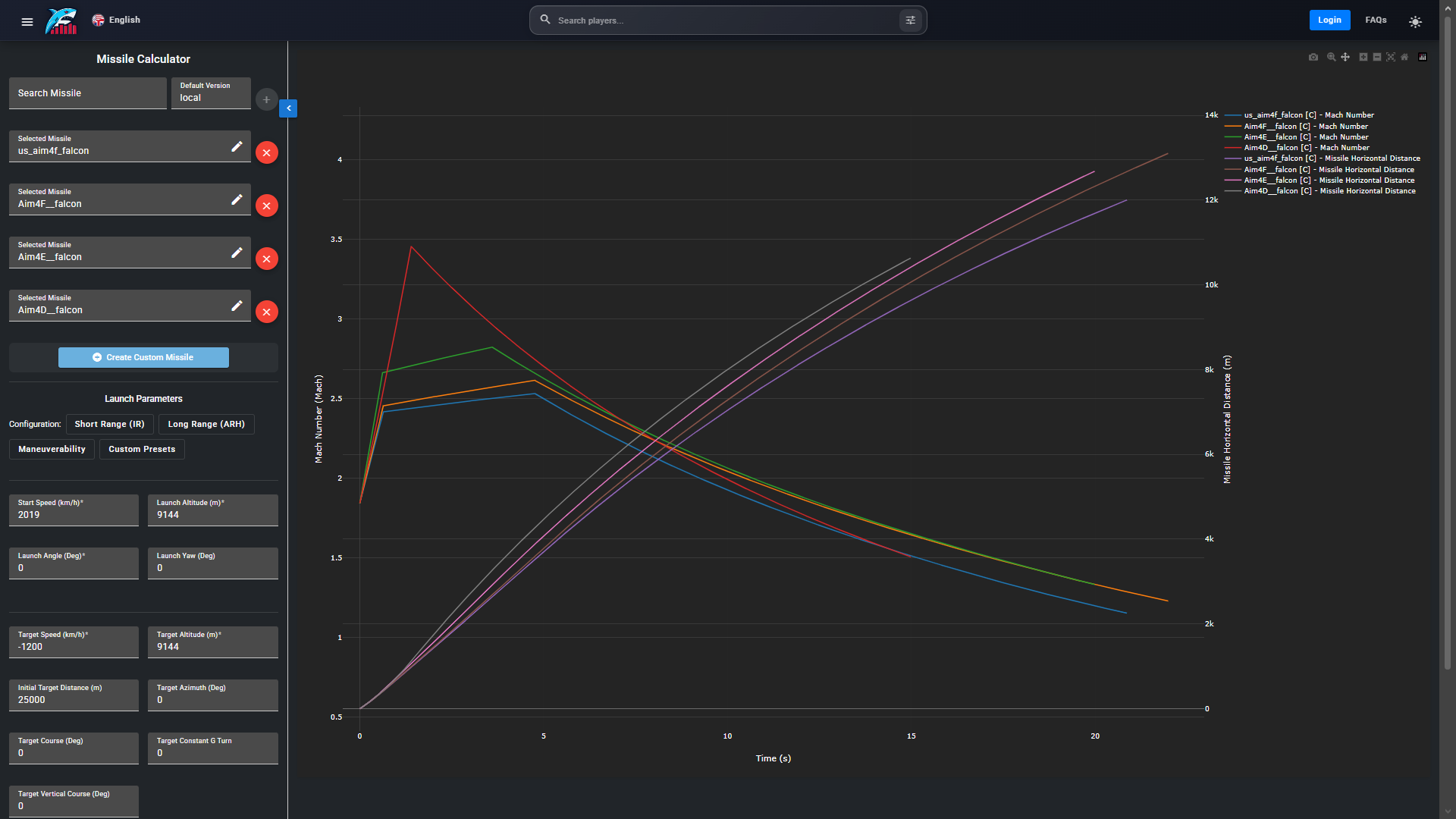
I accidentally deleted the statshark data I had stored so I had to redo the custom missiles (with some tweaks here and there), but if you want a comparison between the aim-4s (ingame version is us_aim4f_falcon):
Straight line speed and distance, 30000 feet
Straight line speed and distance, sea level
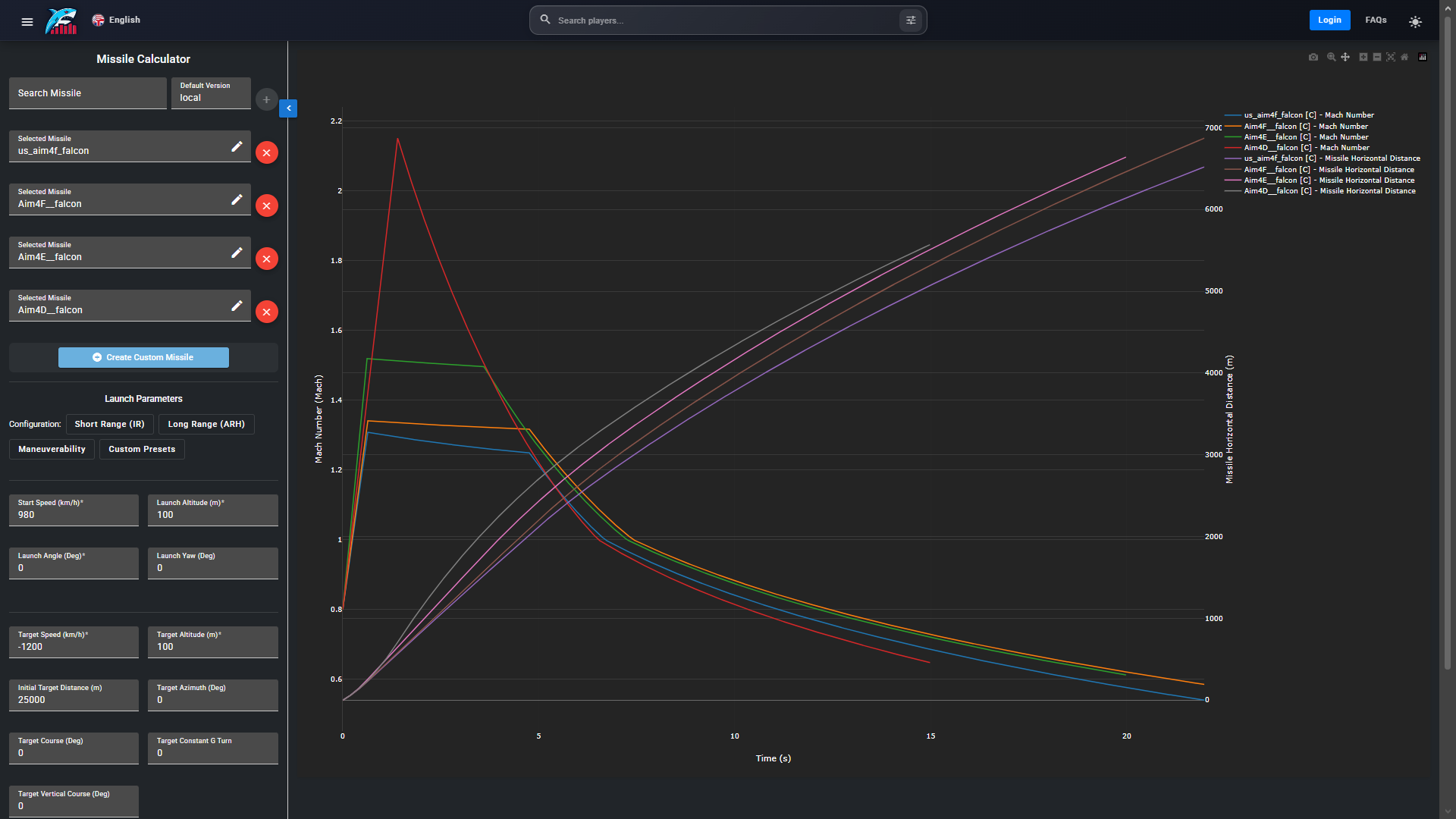
Thrust and delta -v makes aim-4d go faster and farther until it hits the time limit, but relatively low drag and longer flight time makes aim-4f reach a slightly longer distance.
Turning radius 30000 feet
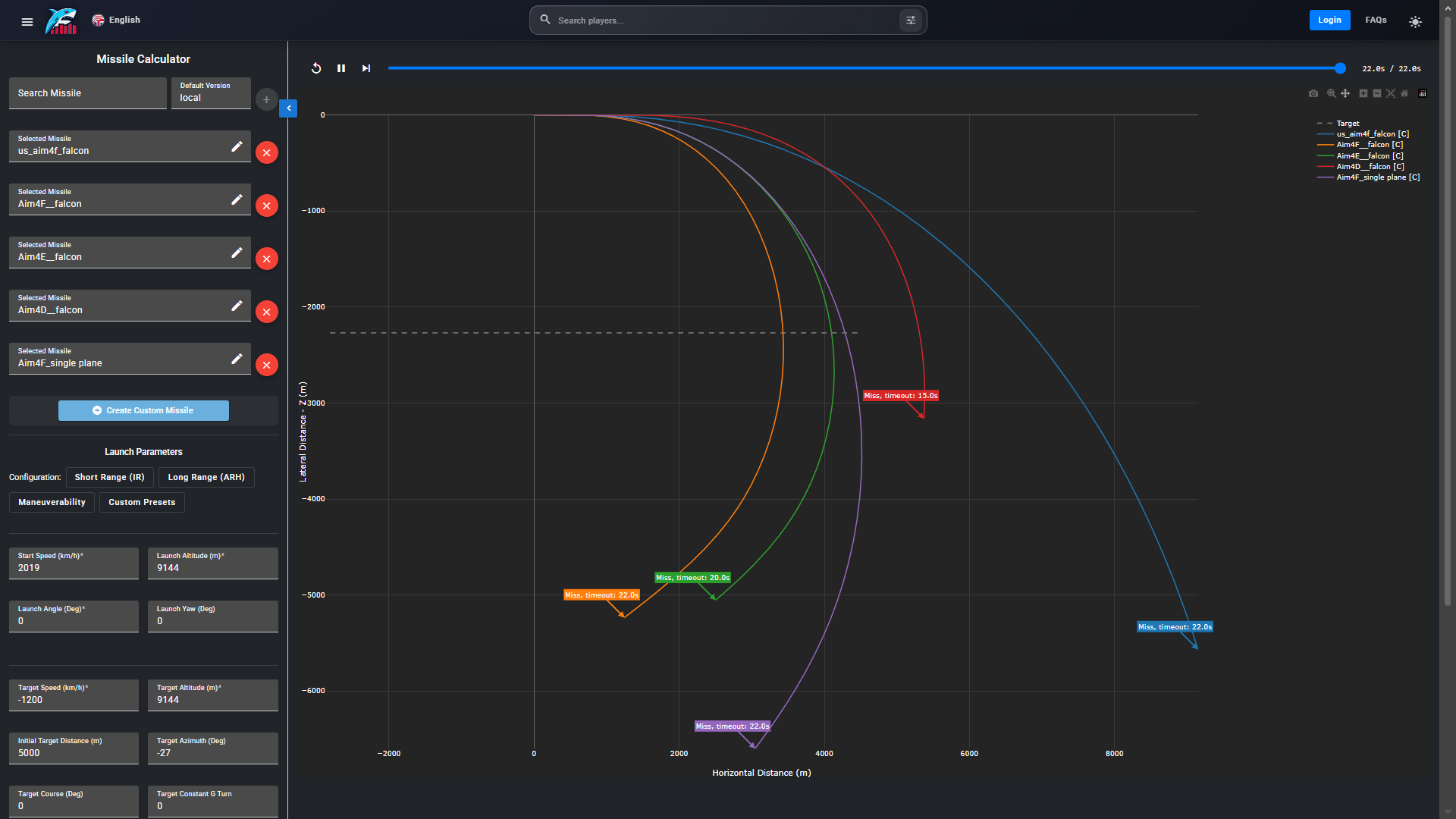
Turning radius sea level

Since by convention warthunder assumes all missiles are manoeuvring in single plane, I added in purple a version of the 4F that obeys that standard. Turns out that wing area multiplier affects everything, from parasitic drag to induced drag to the speed the missile can react to, so i slightly reduced to wing area multiplier in the 4e to account for the lack of leading edge extensions (maybe i should have changed the cg distance to stabilizers instead?). But if the AIM-4D has the 1,4 wing area multiplier that’s in the datamined spreadsheet for the 4C, then the energy bleed caused by a tight turn is really extreme.
would you be able to compare that to conventional IR missiles?
9D, 9J etc
Comparing turn radius sea level
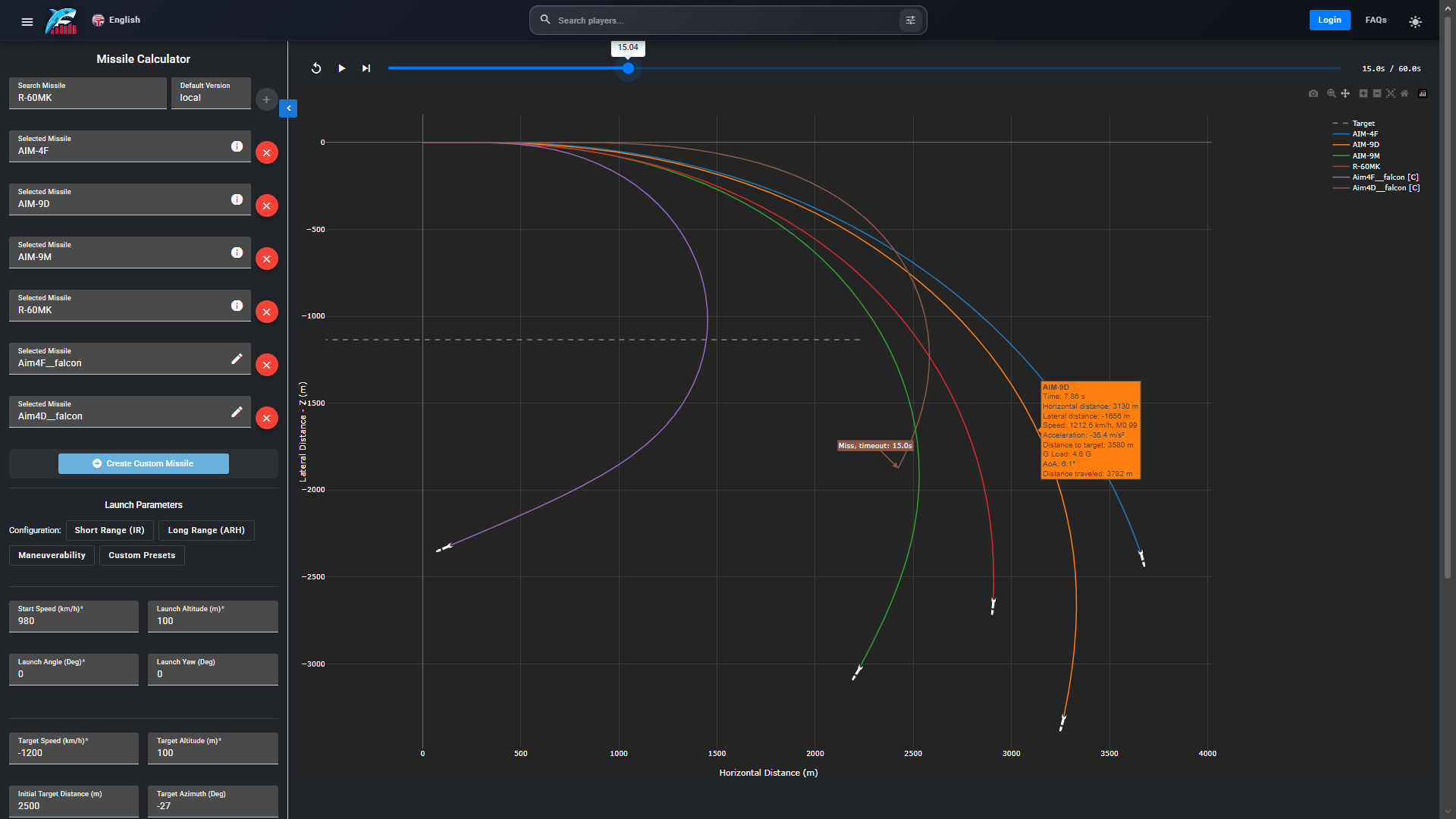
The energy bleed and the guidance only starting after 1.4 seconds really hurt it (unless I’m wrong on the latter staying the same between 4C and 4D), so taking advantage of the uncaged seeker to give it the proper lead angle before firing seems essential.
As for straight line speed and distance, sea level
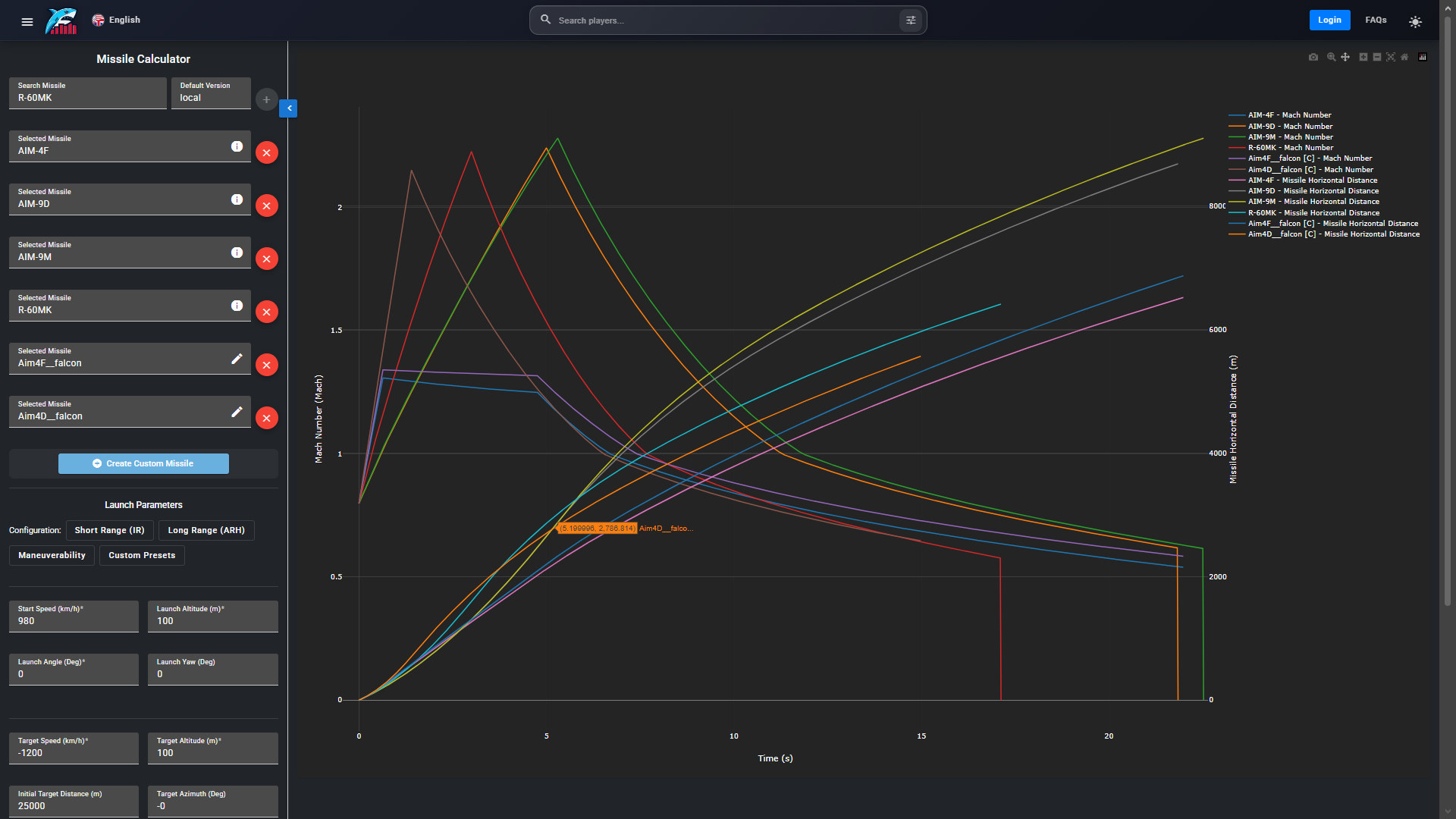
Aim-4D has the shortest range overall, but is the fastest until the 3.78 second/2158 meters mark, where it’s overtaken by the r-60mk, and stays ahead of the aim-9D and aim-9M pair until the 5.2 s / 2787 meters mark. The launching altitude and speed changes up the values a bit, but the overall trend stays the same.
2 Likes
Well the AIM-4D CS and SMC doesnt say anything about it not having guidance for the initial boost phase while AIM-4C does
AIM-4D CS & SMC
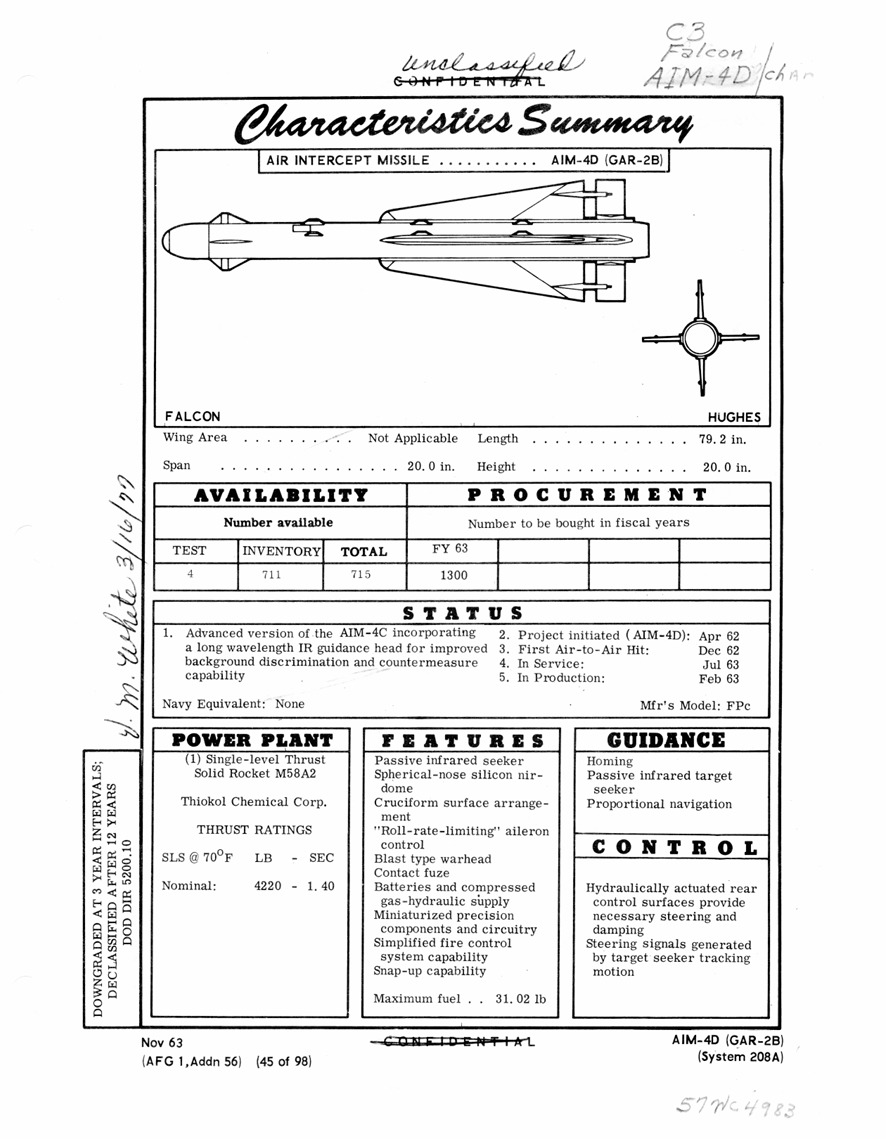
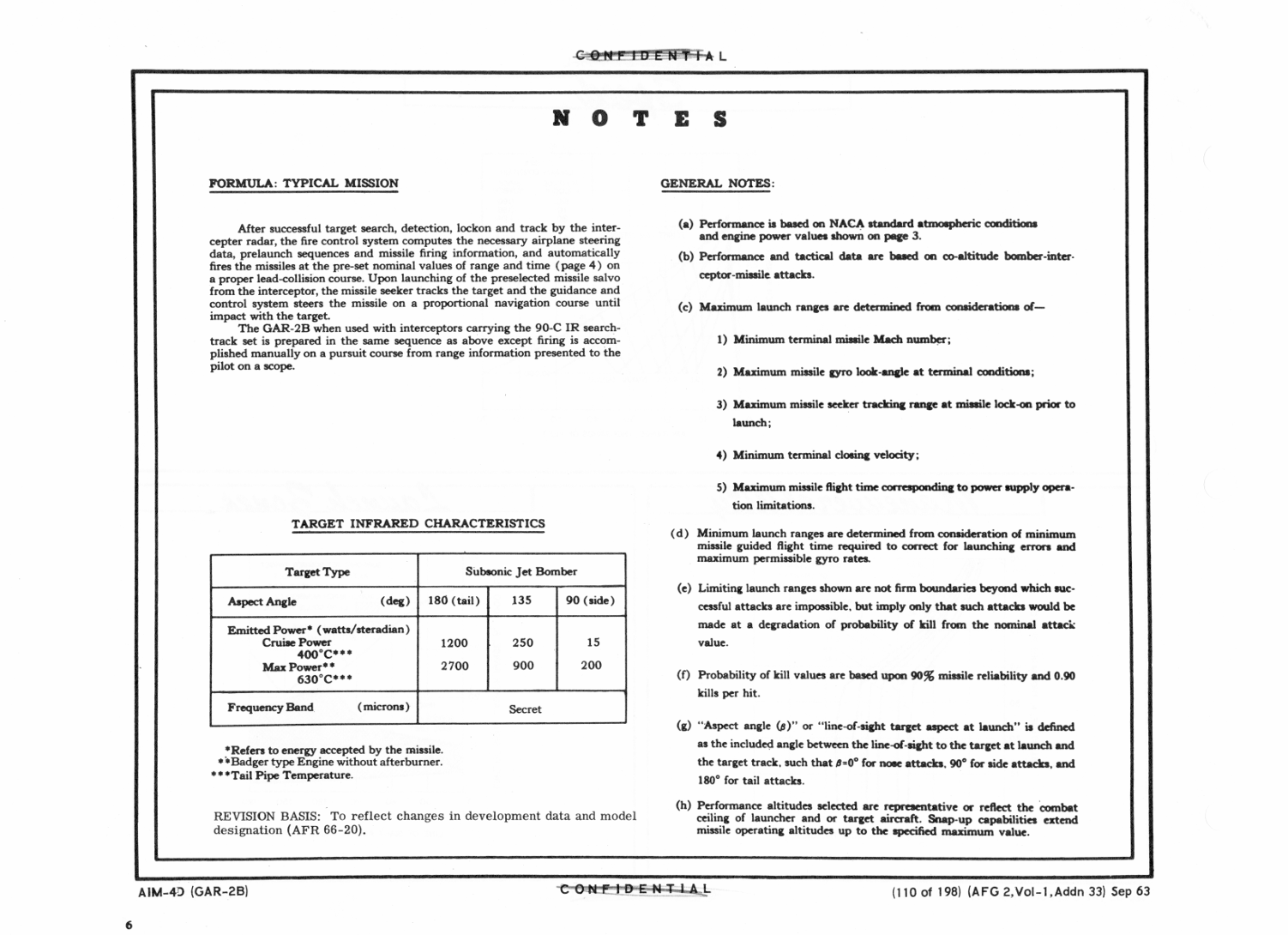
AIM-4C CS & SMC

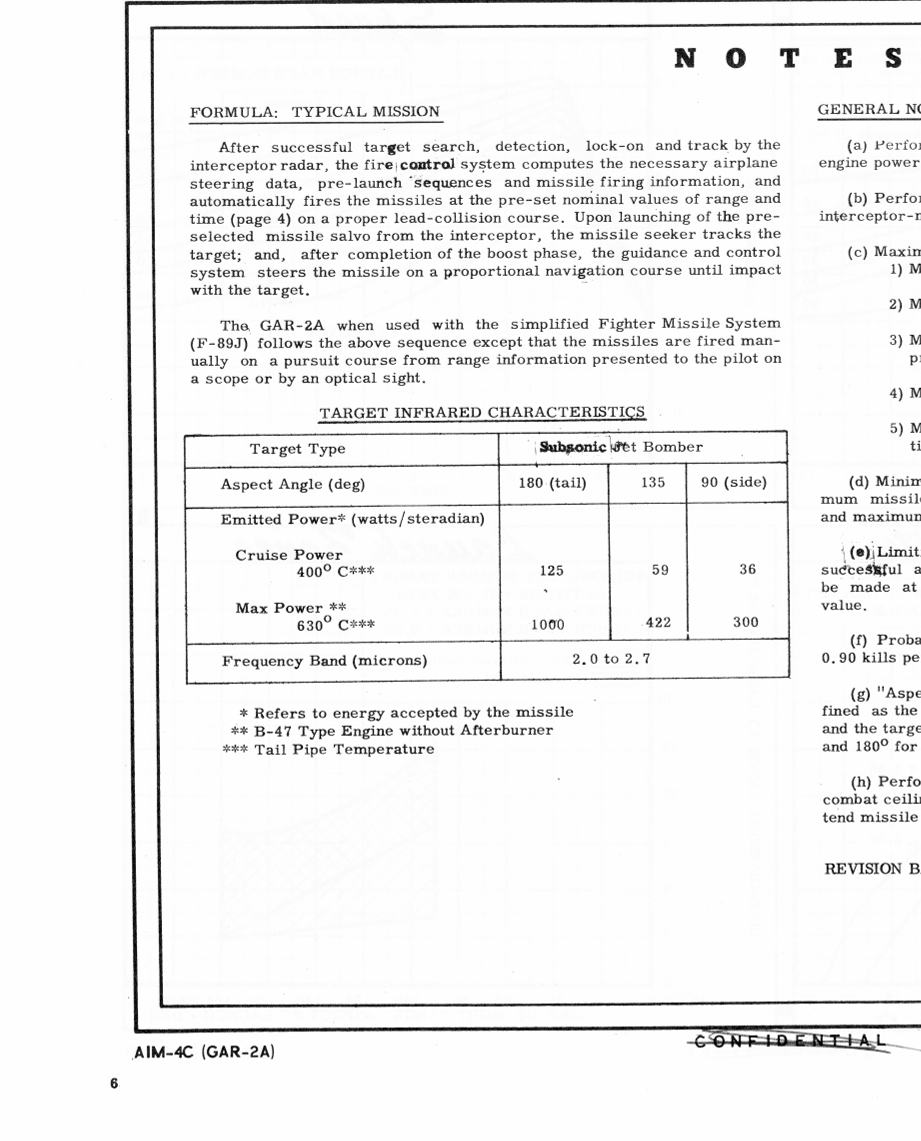
Its provided in the J35F manual, guidance delay is roughly 0.5 seconds for pitch and 1.5 second for Yaw and roll

I believe the AIM 4D has a 25 second guidance time instead of 15 second btw
I assume that “pitch” guidance here refers to the pitch angle of the aircraft that’s launching the missile, rather than the pitch angle of the missile relative to the horizon. Regardless, since warthunder can’t really separate pitch from yaw and roll guidance in missiles, using a 0,5 guidance delay seems reasonable. The 25 second guidance time is also technically possible since most falcons’s battery lasts for about 120 seconds, but the smc does repeatedly state that 15 seconds is the max permissible missile flight time both in the mission tables and the performance charts, so the 25 seconds guidance time seems unlikely. Regardless, 15 or 25 seconds time limit doesn’t make a real difference for the aim-4d because as you can see below, the drag to weight ratio is so high that it goes subsonic before the time is up even if it’s launched at 30000 feet and mach 1.85 (switched things a bit with the magic 2 and the red top).
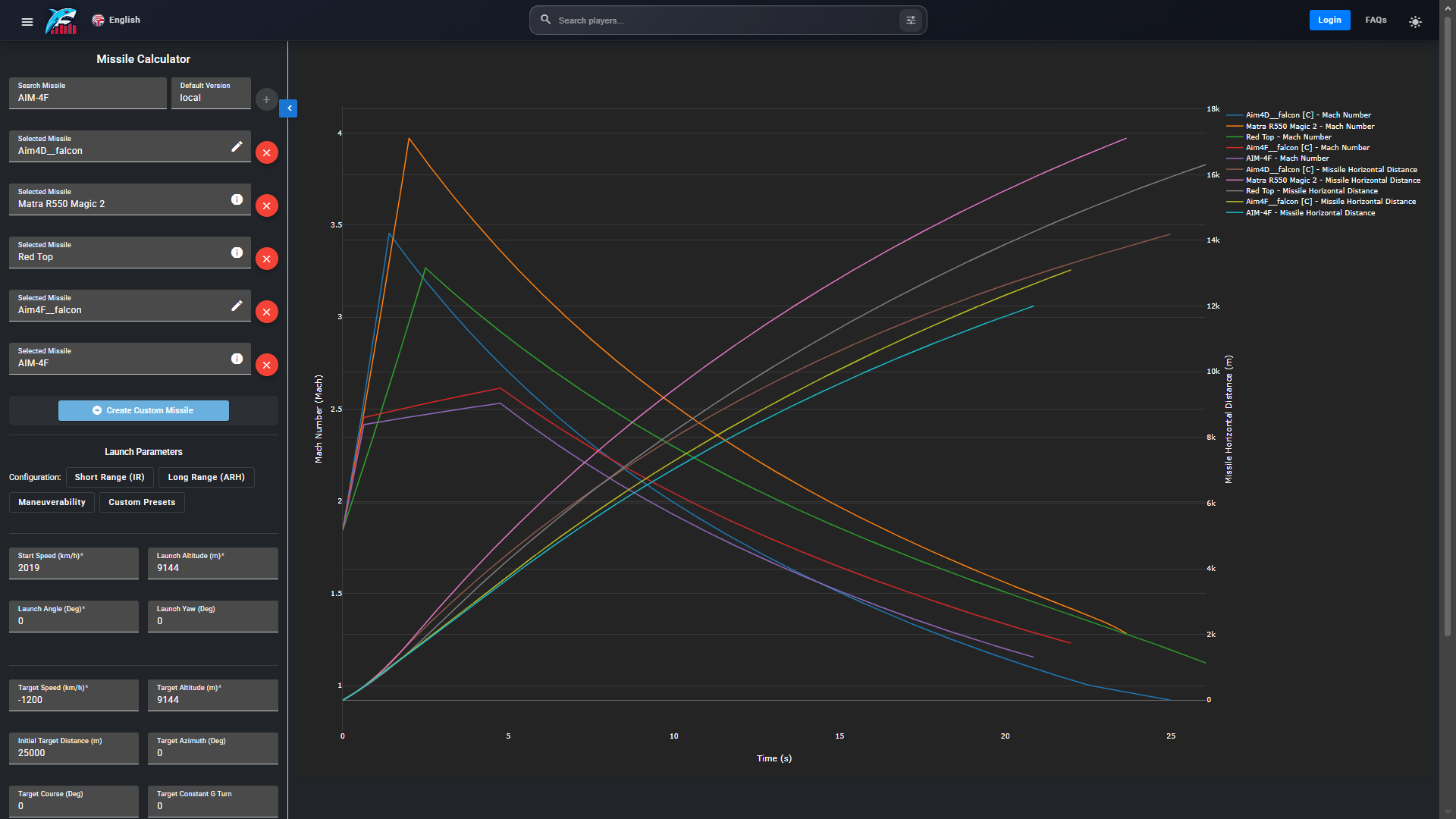
The turning performance of the aim-4d at sea level below now looks very different because besides reducing time before guidance can start, i also reduced maximum fin AoA. You see the aim-4a/c/d has an issue with the fins not being able to overcome high dynamic pressures that isn’t really possible to replicate in war thunder, so having the correct performance for 30 000 feet was making it turn way harder than it should at sea level; i ended up compromising a bit so that it’s about 10% better at sea level (within a margin of error), even if it’s 20% worse at 30000 feet, but at least the energy bleed isn’t quite as bad.

Could you do a mach 1.14 launch at 30,000ft to compare it to the SMC?

could you compare it to the aim-26b?
If you want to compare the graph, peak speed is mach 2,81, mach 2,25 t+5 seconds, mach 1,69 t+10 seconds, mach 1,35 t+14 seconds, mach 1,09 t+18 seconds - i think it only really starts to noticeably slow down vs the real thing after after the 10 second mark.
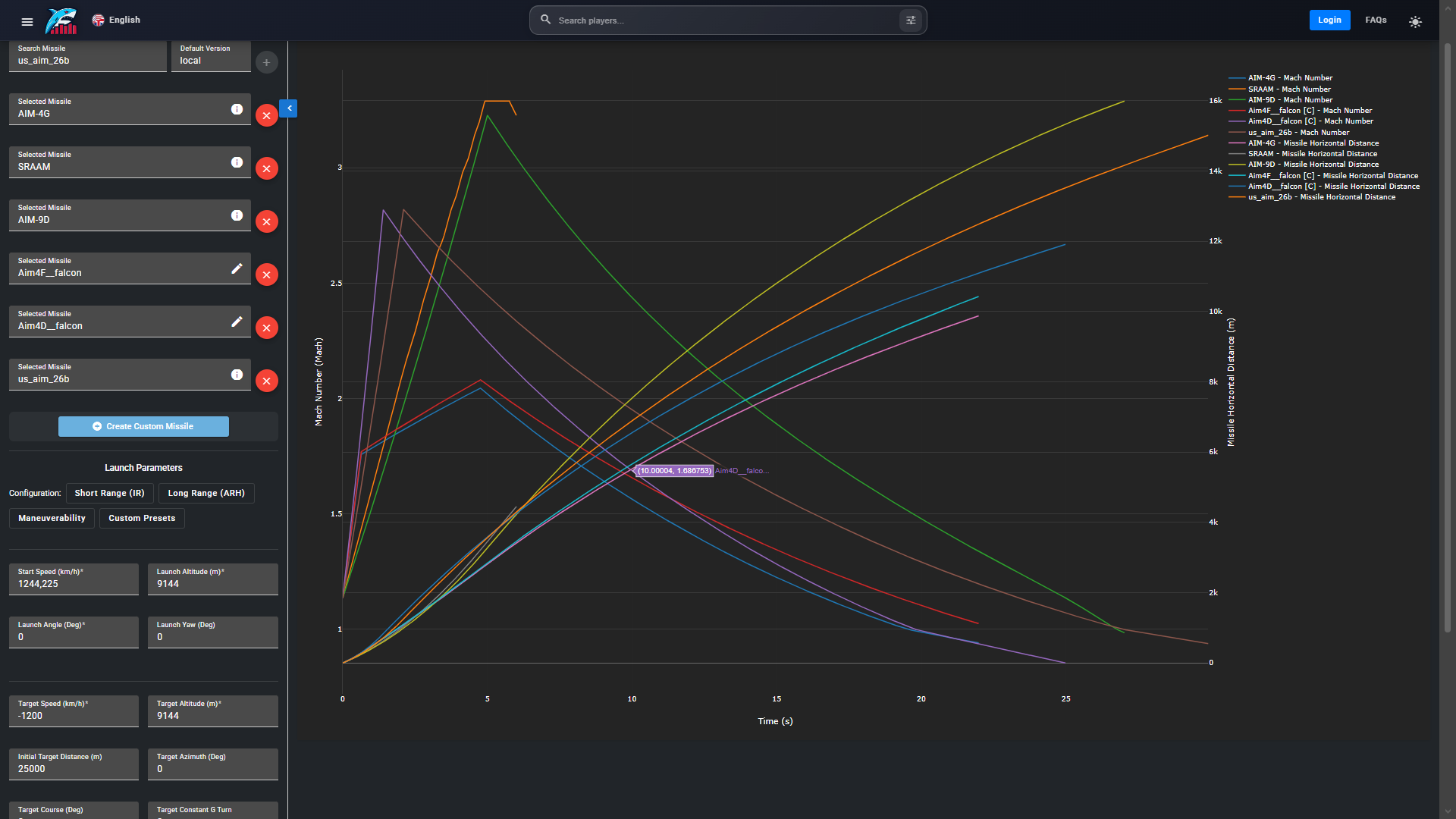
@McStrawBerry Aim 26b (ingame) has about the same acceleration but goes farther because of the lower drag per weight - too bad that they didn’t reduce the guidance time delay when they replaced the nuke with the conventional warhead.
what about the aim-9j and aim-9e ? they seem kinda similar in peformance
what relevant information could one get from this(for the aim-4h)
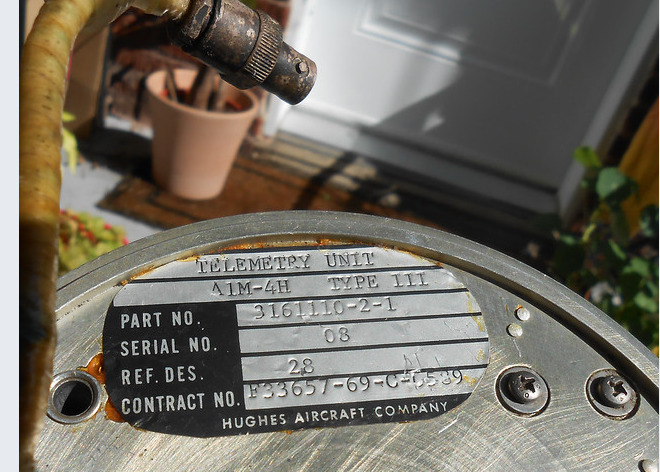
Avionics reverse-engineering: 60’s Hughes telemetry unit - Page 1
1 Like
Nothing, i’m afraid. Unless i missed something, that’s a device used to measure telemetry data of a aim-4H missile test. Any information you could get from it is presumably already mentioned in this paper describing a similar telemetry device for the aim-4F/aim-4G
https://apps.dtic.mil/sti/citations/ADA055339
The real interesting differences between aim-4d and aim-4h would presumably be inside the seeker head itself (assuming it has irccm), the operation of the laser proximity fuse, and in the operation of the missile autopilot (assuming it got upgraded to dual plane and/or given more powerful actuators compared to the aim-4a/B/C/D baseline), and would at most show in the data recorded during a launch. The telemetry unit itself is only bespoke to make sure it’s compatible with the circuits inside the aim-4h.
The document above might be really interesting to the person that disassembled the telemetry unit, since it does have drawings of the logic circuits which he can then compare with the circuits he is physically seeing. I learned enough to realize why pulse guided missiles need a range gate and how the home on jam and target reacquisition functionalities work, but maybe he can have a better understanding of what the missile can or cannot do.
2 Likes
AIM-4A and AIM-4C might be coming next update if it’s the F-101B

btw AIM-4A/C have been in the files for a long time
5 Likes
My guess is that it’ll be the cannon armed variant because having nothing but 4 aim-4s is like being completely unarmed
1 Like