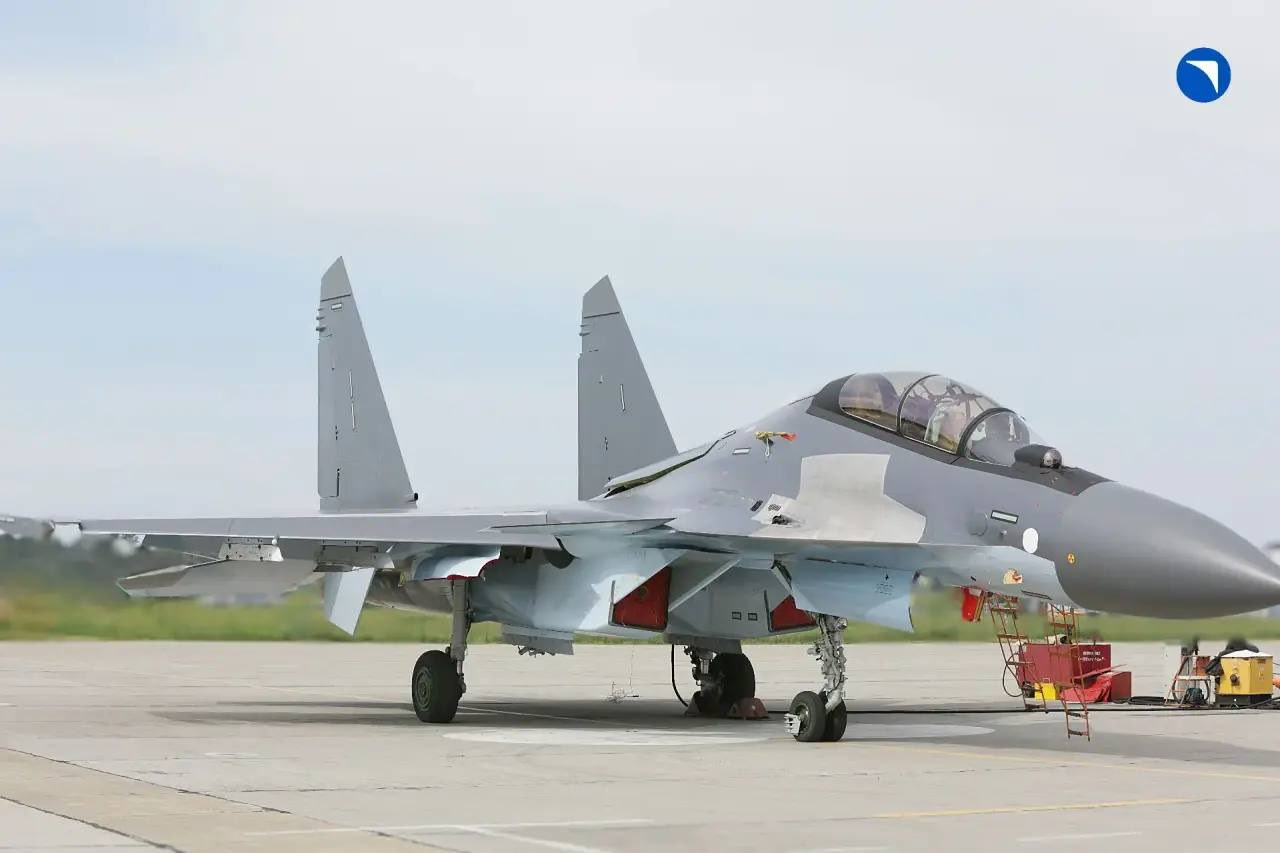
The shape of the pod matches the AN/ALQ-131 but the F-16 is pretty far away it’s difficult to confirm
2 Likes
I can’t think of anything else that matches the shape so closely, so yeah I would say AN/ALQ-131 too


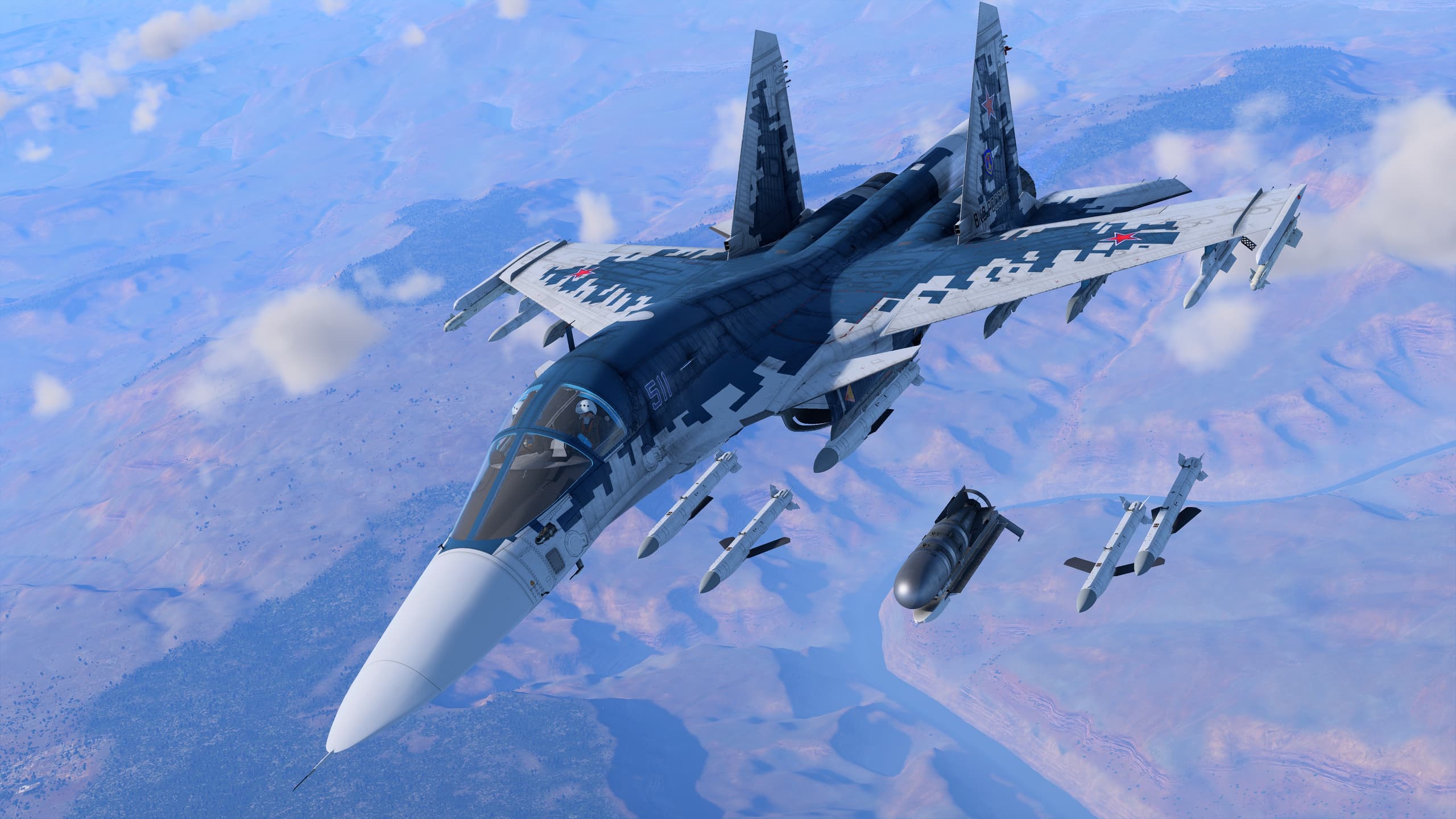
full thesis paper for development of n011m and n035 tracking algorithms, towards the end there is a flight test data of a n011m on a Su-30mki in 2003 and no35 on a su-35
M10250.zip (10.8 MB)
Some interesting notes, courtesy of ai for translation and summary:
Spoiler
1. Radar System
The radar described is an airborne multifunction radar designed for fighter aircraft.
According to the dissertation, its functions include:
- Air target search
- Ground target search
- Sea target search
- Target tracking
- Missile guidance
- Illumination of targets
- Navigation
- Terrain following
- Weather mapping
- Electronic reconnaissance
These are described as standard requirements for modern fighter radars.
2. Purpose of the Research
The main engineering problem was:
increase angle-measurement accuracy while expanding radar field of regard from approximately ±60° to approximately ±120°.
Traditional systems have:
- Mechanical antenna
- OR electronically steered phased array
Both have drawbacks.
The proposed solution combines:
- Electronic beam steering
- Mechanical antenna steering
into one tracking system.
The dissertation repeatedly calls this
combined beam control
3. Radar Type
The radar uses a
Passive Electronically Scanned Array (PESA)
(the Russian abbreviation ФАР).
The phased array is mounted on a two-axis hydraulic gimbal.
Advantages:
- Instant electronic steering
- Large mechanical field of regard
- High tracking precision
4. Beam Steering
Instead of relying only on electronic steering:
Electronic steering:
- tracks targets rapidly
Mechanical steering:
- re-centers the antenna
- stabilizes beam during aircraft maneuvers
- allows tracking well off aircraft nose
The dissertation states this expands azimuth coverage to
±120°
and elevation to approximately
±60°
5. Radar Scan Limits
Electronic scan:
approximately
±60°
Mechanical steering:
adds another ±60°
Combined:
approximately
±120°
This allows nearly the entire forward hemisphere to be covered.
6. Radar Accuracy Parameters
The dissertation gives several engineering values.
Beam positioning accuracy
Approximately
4 arc minutes RMS
Beam steering resolution
1 arc minute
Beam switching time
Approximately
0.2–1 ms
Mechanical positioning accuracy
Hydraulic encoder accuracy
about
1.1 arc minutes
Total tracking error
Total RMS tracking error combines:
- receiver noise
- antenna quantization
- inertial navigation error
- hydraulic encoder error
- target angular scintillation
The dissertation derives the total error statistically.
7. Radar Tracking
The tracking loop includes
- beam stabilization
- Kalman filtering
- extrapolation
- coordinate transformation
- inertial navigation correction
The radar predicts target motion rather than simply following measured positions.
This reduces lag.
8. Kalman Filter
One of the dissertation’s major contributions is the use of a
modified Kalman filter
for angle tracking.
It compares:
- α-β filters
- modified Kalman filters
under
- fighter maneuver
- target maneuver
- simultaneous maneuver
The Kalman filter consistently reduced tracking error.
9. Aircraft Motion Compensation
An important topic is compensating for
- roll
- pitch
- yaw
using inertial navigation.
The dissertation notes that
errors and delays in the inertial system
become significant during high-G maneuvers.
10. Coordinate Systems
Three coordinate systems are used.
Aircraft coordinates
Fixed to aircraft.
Antenna coordinates
Fixed to radar.
Earth coordinates
Navigation frame.
Coordinate transformations are continuously performed between them.
11. Mechanical Drive
Hydraulic gimbal characteristics include
Azimuth:
±60°
Roll:
±120°
Step response:
about
0.25 s
Maximum slew:
approximately
60°/s
and
120°/s
depending on axis.
12. Radar Targets
The modeling includes
Aircraft
Missiles
Ships
Helicopters
Civil aircraft
Typical maneuver parameters are provided.
13. Tracking Errors Considered
The dissertation models:
Receiver noise
Angular scintillation
Aircraft motion
Gyroscope delay
Mechanical misalignment
Target maneuver
Atmospheric turbulence
Discrete update interval
14. Multi-target Tracking
The radar is intended to
simultaneously track
up to approximately
10 targets
while continuing search.
The beam rapidly jumps among tracked targets electronically.
15. Simulation Studies
Chapter 3 contains computer simulations investigating:
Fighter maneuvers
- rolls
- turns
Target maneuvers
- weaving
- turns
- acceleration
Close air combat
Both aircraft maneuver simultaneously.
Metrics include:
- RMS tracking error
- dynamic tracking error
- stability
16. Flight Testing
Chapter 4 is devoted to flight experiments. The table of contents identifies three major flight-test campaigns:
- Tracking stability during a fighter “barrel roll” maneuver, including the flight-test methodology, results, and conclusions.
- Angle-measurement accuracy at medium ranges, again with methodology, results, and conclusions.
- Accuracy during simultaneous fighter and target maneuvers, followed by conclusions from the flight experiments.
The introduction also explains that the work was validated through bench tests and flight-development tests of airborne radars operating against air and ground targets. It states that the methods and algorithms were used in development work for the Su-30MKI and Su-35E (Irbis) radar programs, and that the concepts were evaluated during state and factory flight testing between 2004 and 2009.
17. What the Flight-Test Data Shows
From the portions available:
The flight testing verifies:
- Stable target tracking during aggressive aircraft maneuvers (including barrel rolls)
- Accurate angle measurement at medium engagement ranges
- Successful tracking while both the fighter and target maneuver
- Agreement between the mathematical model and measured flight-test performance
The dissertation presents these results as validation of the combined mechanical/electronic beam-control concept, rather than as operational performance claims.
og doc is in russian, you have to OCR it if you don’t speak it
4 Likes
George N confirms no N035 on SM2
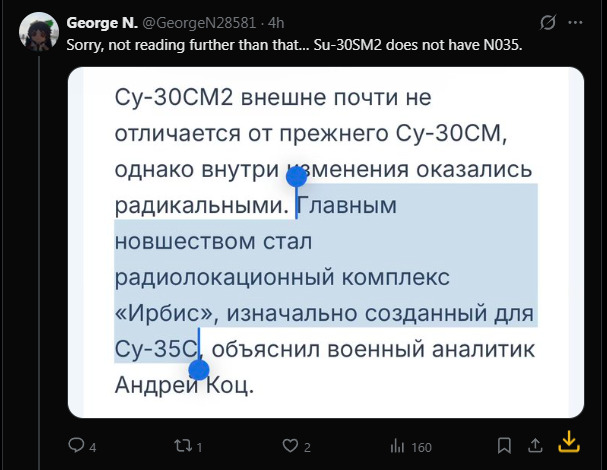
7 Likes

5 Likes
Was it George that was working at sukhoi/UAC?
Yes, George is the UAC engineer everyone on the Forums loves.
Here’s a link to his profile
5 Likes

3 Likes
what is even better
my message that i linked was in response to yours
2 Likes
Now you just have to convince gaijin
2 Likes
And for them to, effectively, kill the jet and make it slightly better than regular Su-30SM (because I’m damn sure that AL-41 are next on the chopping block)
Oh well, we still can hope for Su-35S to come and do it thing… right?
Irbis removal has been accepted for so long, gaijin takes ages to take action. Also it confirmed to be fitted with al41f
1 Like
AL-41F-1S is at least in testing, and according to the documentary new SM2 airframes are already produced with modified intakes and engine mounts to fit them in. In reality SM2 was never really needed in-game, regular SM was strong enough for the top tier.
Actually i am curious if new SM2s with dark radomes are fitted with AL-41s or not.
Fighterbomber complained that white radomes made Russian jets very noticeable in the sky if the weather is clear, up to tens of kilometers. Maybe that’s the reason why new SM2s use dark radiotransparent paint
1 Like
gets provided primary source informations
“Secondary sources are not accepted”
marks as not a bug
1 Like
wait and see they correct it in the same patch with new airframe to make people grind.
Well, words of someone allegedly working in UAC is anything but a primary source.