TLDR:
Gripen specifically is modeled as stable in the game when its not IRL, so there are some drag/lift coefficients that wont be correct due to the canards inaccurate movements.
IRL when flying straight the canards often have to point down to make the plane not turn, and when turning a bit they are mostly straight and mostly used to keep the aircraft stable but let the instability turn the plane for it. so they aren’t really angled upwards that often IRL as they are in game.
I am aware of this, but the devs stated that the Gripen is not modeled as unstable and the fly-by-wire limits only exist for these types of aircraft in dampening SAS mode at the moment. Without dampening and in full real you can pull the stick as much as you want and at no point does the aircraft exhibit departure symptoms that can be expected when an aircraft is on the verge of stalling such as asymmetrical yaw or wing rock.
I understand this, that is not what I was discussing. There are specific lines of code in-game that are not related to turn rates, drag, or lift coefficients and instead dictate the departure and post-stall behavior of the aircraft.
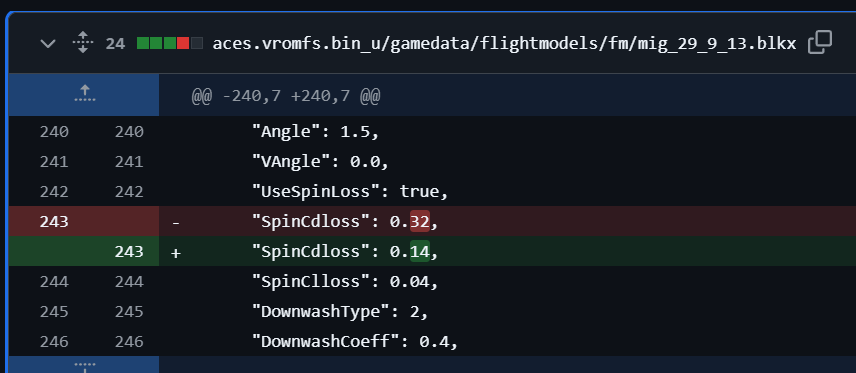
In regards to the MiG-29, the post-stall recovery was improved without altering the flight model in any other manner;
These lines of code are left so conservatively for the F-16 and the Gripen, J-10, JF-17, and other new gen4 fighters that they can do cartoon style cartwheels never seen before on non thrust vectoring airframes and recover faster than if they did have thrust vectoring. It’s quite absurd.
The Gripen imo has the worst FM in this regard as nothing you do can make it truly stall or depart from controlled flight. If you manually force it into a spin (quite difficult task), it is possible to recover from just 500m in most cases.
Here is an example of a situation that should not be recoverable for an F-16, instead they are able to utilize nearly 2x the AoA allowable in real world conditions without departure and get away with it because there are no signs of departure, period.
The same goes for the Gripen currently and it’s just a few lines of code that affect these parameters.
Or have i fundamentally misunderstood how to measure AoA?
Isn’t it the nose’s deviation (in degrees) from direction of travel?
So the Gripen in that video, traveling horizontally and not sinking or climbing would have the same angle of attack as it would have angle relative to ground (as direction of travel is parallel to the ground)
you would have placed a protractor behind the plane 10 meters away, it would have been 50 degrees at all
The flight vector should be placed on the center of mass, not the tail
But my point still stands, the FBW wont give more than what the plane can do.
It’s probably modeled wrong in game due to them having to model that function while also having a stable instead of unstable aircraft. Thus making it to stable in situations it shouldn’t be.
Gripen is losing altitude in the entrance of the maneuver, maintaining speed at loss of altitude. AoA initially is ~35 degrees from picture view or closer to 30 degrees from the actual ground and gets lower as video goes on and he begins to pull out of the maneuver.
It is not a consistent low speed AoA pass, it just appears to be on video.
There is no need for this, they can model departure symptoms for the fully stable Kfir Canard, Mirage 2000, even on the MiG-29 and Su-27 departure symptoms are modeled even with the aircraft acting unstable in the correct conditions. They are not modeled at all for the F-16, Gripen, J-10, etc.
There simply is no excuse for it, modifying the flight model files for user missions with the CDK results in correctly performing aircraft without drawbacks and without bricking mouse aim instructor. These are made up excuses from the devs for seemingly no reason.
The display should move up and down, so you can see the beam/target relatively to your plane. Now it does not move, only the beam, causing it to have a limited use.