Wow, the Ki-44 really was an incredible aircraft, even without the more powerful engine upgrade.
Alright, I checked the fantastic source material in the replies for the original old forum suggestion.
This is of particular interest:

It is a translation of a series of documents (all in japanese) posted above it, and clarified a couple things - for one, the data in this image

about the Ki-44-III’s wingspan is wrong. The wingtips were extended by 700mm each, thus leading to the higher 19m2 wing area. Elevator and rudder were enlarged. Takeoff and landing performance stayed the same (and therefore so did low speed maneuverability).
Engine is a Ha-45-21 as we have now in the Ki-84. Ha-145 was likely a provisional name for this engine, while the Ha-45-11 was just named Ha-45.
At this point the engine that would later be named Ha-145 (a Ha-45-43) didn’t exist yet. Also, extremely confusing naming with the army and navy having their own, plus the unified naming scheme on top of that.
And about the new engine cowling with individual thrust ejector exhausts - since the Ki-84 had the same engine and was in development at this time, they would be very similar.
3 Likes
Thank you for this information. As soon as I return from vacation, I will immediately correct the suggestion about the Ki-44-IIIa. I would do it right away, but it’s almost impossible on the phone
1 Like
Understandable, mobile makes it quite annoying to make these large edits. Have a good vacation!
1 Like
It is a translation of a series of documents (all in japanese) posted above it, and clarified a couple things - for one, the data in this image about the Ki-44-III’s wingspan is wrong. The wingtips were extended by 700mm each, thus leading to the higher 19m2 wing area. Elevator and rudder were enlarged. Takeoff and landing performance stayed the same (and therefore so did low speed maneuverability).
The information isn’t “wrong” per say. The Data for the aircraft is extremely hard to find, the table was most likely made without the knowledge provided from the interviews. Almost every other source says 19 m², so it’s still something to take into consideration. Lineins also told me that it wasn’t a perfect translation, so that’s important to remember as well.
Yes, every source says 19m2 but didn’t say exactly how that was achieved. You can make the wings longer, or you can make the distance between the leading and trailing edges bigger (like in my little paint sketch).
This was more complicated by that small table saying the wingspan stayed the same, which has to be wrong - at least that number specifically. Wingspan went up and so did wing area, and I haven’t seen anything to make me doubt that statement. Making wings longer is a tried and true method for making an aircraft takeoff and land more easily.
Sure, the translation isn’t perfect but it doesn’t have to be, and we can gather pretty concise information from there.
Well done on the remade suggestion, and thank you for incorporating my corrections!
It is better, but the engine model is still wrongly listed - I don’t think the Ha-45-43 existed at that point in time and was likely just a -21, like in the in-game Ki-84s.

I know this, but when the Ki-44-III was made and tested, the Ha-45-43 simply didn’t exist exist yet. It was a very late war engine and the Ki-44-III’s testing and design stage happened at the same time as the Ki-84 prototypes started flying. Ha-145 was likely a provisional designation for the Ha-45-21, while the “Ha-45” was the -11, in the army designation system.
A 2 stage, 3 speed supercharger is quite big, it wouldn’t fit in the Ki-44’s airframe without making it quite a bit longer or doing some big internal changes, more on that below. Coincidentally that’s pretty much the same engine as on the J6K1 in-game and in x-ray view you can see that there’s a LOT more (empty) space behind the engine.

Ki-44-II

J6K1
The Corsairs also have a 2 stage 3 speed supercharger.

The one drawing of the Ki-44 that we have doesn’t show it being any longer:

And repositioning the oil and fuel tank to make space wasn’t mentioned anywhere in the translated documents, which is a massive change to the Ki-44’s design and would be pretty weird to omit.
There’s another issue, which is power output. A 2 stage, 3 speed supercharger-equipped engine isn’t gonna lose much power with altitude, but this is exactly what is claimed about the “Ha-145” - scroll up a little to the big user-translated comment that I posted.
An excerpt from a book claims the Ha-145 made just 1450hp at 6400m, while at this same altitude the in-game Ki-84s will do ~1600-1650hp with their Ha-45-21 (single stage, two speed supercharger) depending on speed. Funnily enough, the Ha-45-42 in the J6K1 at the same 6400m is making ~1660hp.
One of the documents I have on the N1K2-J, with the same Ha-45-21 as the Ki-84s, claims 1625hp at 6100m.
With all this in mind, I simply don’t believe that it was a Ha-45-43 with a 2 stage 3 speed supercharger, and Ha-145 was instead a provisional designation for the Ha-45-21, which was later changed. It making 1450hp instead of 1600+ up high was likely due to it being an earlier version of the Ha-45-21 that didn’t make as much power up high, maybe because it had to use reduced RPM/throttle settings; the J6K1’s engine might be underperforming in-game at that altitude and the Ki-84 might be slightly overperforming, but hey I’m not telling that last part to gaijin. Or maybe Nakajima just had a better intake system than Kawanishi did.
And on top of that, IF it was a Ha-45-43 with a 2 stage 3 speed supercharger, its top speed would be at a much higher altitude than just 6400m - J6K1 has a very similar engine and its top speed is at 10000m. Meanwhile, all the Ha-45-21-equipped planes have their top speeds at altitudes very close to 6400m, with all the Ki-84s having theirs at 6000m; the document on the N1K2-J I referenced above puts its top speed at 5600m (maybe Nakajima really has a better intake design than Kawanishi for these two aircraft!).
3 Likes
Apparently just “Ha-45” meant Ha-45-21 in IJA, but it could well mean a derated engine.
I’m not certain what kind of supercharging system Ha-145 had, but indeed it had 3 critical altitudes. The bottom says that - - - line indicates expected performance.


2 Likes
Every time the Ha-45-43 is mentioned, it’s as a 2 stage 3 speed model so I have no reason to doubt it, and your chart confirms this. In either case, I really don’t believe it could be the 2 stage supercharger model engine due to all the reasons I outlined above.
1 Like
Also to clarify this: there were derated Ha-45-21s, and it’s very clearly said that it was rated for 2000hp (at low altitude) so it can’t be the earlier Ha-45-11 either.
1 Like
I like heavy modified early war planes as you basically push the design concept to areas where it’s not supposed to be. The Ki44 is not may favourite Japanese plane but I would use this.
+1 seems like a good folder vehicle
yes please!
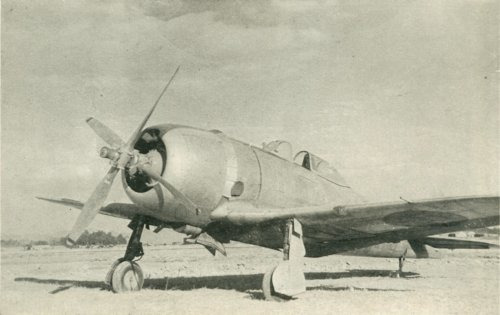
This photo does not show the Nakajima Ki-44-III but the experimental prototype Ki-44-II.
1 Like
I thought it was an early Ki-44-I when they had big concerns about propeller torque?
As I understand it from the sources, it’s a Ki-44-II. It was certainly designed to address torque concerns and to improve the performance of contra-rotating propellers. Nakajima hadn’t previously used them.
Ah okay.