- Yes - In the Tech Tree.
- Yes - Event/BP.
- Yes - Premium.
- Yes - Squadron
- No - I would not like to see HMAS Kimbla in game.
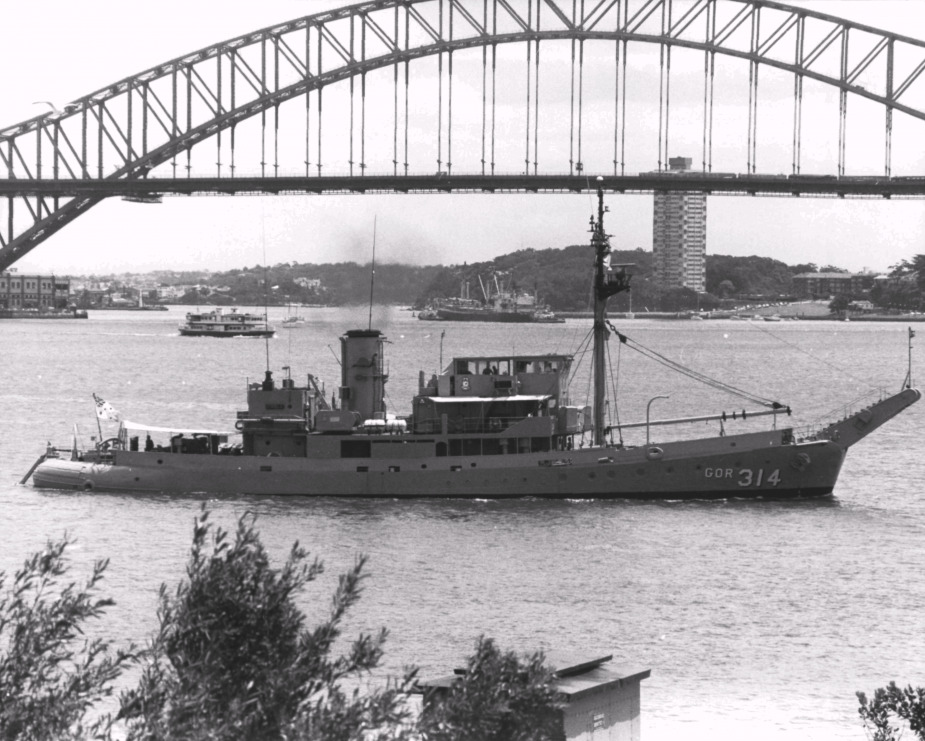
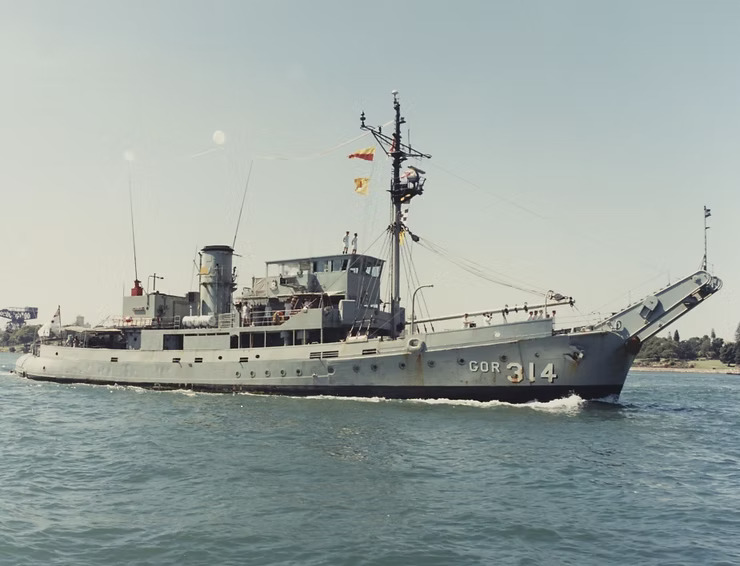
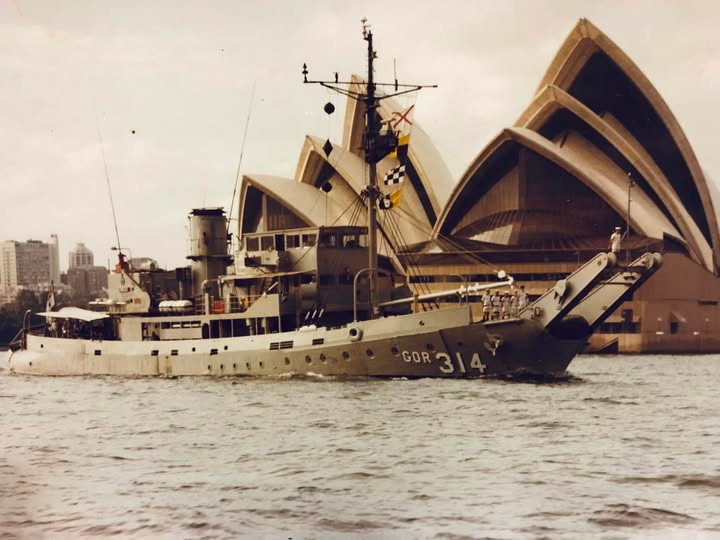
HMAS Kimbla leaving Sydney after conversion to an oceanic research vessel, she has a new pennant of GOR 314 (~1960)
Background:
With the Royal Australian Navies (RAN) Net-class Boom Defence Vessel (BDV), HMAS Kookaburra being almost completely worn out after decade of heavy use and destined for the reserves, a replacement was need to keep the RAN at four BDVs, one for each major port. Three of the more modern Bar-class had been commissioned during the war, and were considered a suitable design.
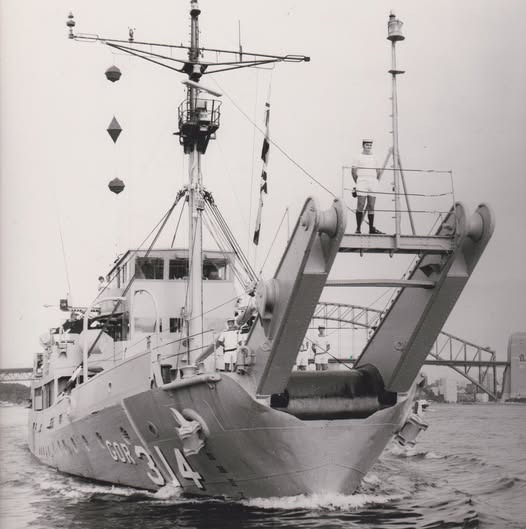
As such a new vessel, drawn of the lines of the earlier Bar-class craft was to be built. Changes to the design included lengthening and broadening the hull, giving more usable interior space. As the Bar-class was a British design made to operate in cold Atlantic ports, changes to the accommodation were made allowing for greater crew comfort during operations in the warm pacific, this was not done in the earlier BDV’s due to the rush in their construction during WW2. The armament was also altered, as the main gun of the older vessels, the QF 3-inch gun, was seen as outdated, heavy, and crew intensive. A 40mm Bofors was fitted in the same position instead. Other armament was the same, but the light MG armament of Lewis guns were not fitted.
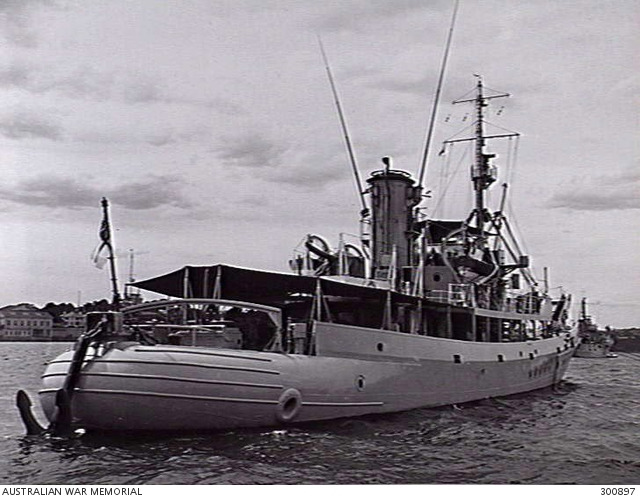
HMAS Kimbla’s stern, her large anchor & 40mm Bofors are visible, (~1955)
History:
HMAS Kimbla was laid down on the 4th of November 1953 at Maryborough, Queensland, by Walkers Shipbuilding LTD. She would launch here on the 23rd of March 1956, fitting out and commissioning three days later on the 26th of March. At this time the RAN’s BDV fleet was reduced to only two vessels, the Bar-class HMAS Koala and Karangi, with the Bar-class HMAS Kangaroo and Net-class HMAS Kookaburra both in the reserves.
Initial operations for the HMAS Kimbla included around North Australia and New Guinea, laying and maintaining moorings, however she wouldn’t last very long in these operations, as she would be converted into a oceanic research & survey vessel in December 1958. This was done as the HMAS Kookaburra, which had been converted into a survey ship in late 1956, had been decommissioned on the 3rd of December 1958, and a replacement was needed.
The RAN’s newest BDV had been chosen for conversion, as the BDV role of A/S and A/T net laying was seen as impractical, especially with equipment designed for WW2 nets. At this time, HMAS Kookaburra, Karangi, and Koala were in the reserves, while HMAS Kangaroo was acting as an accommodation ship. This left the Kimbla as the sole BDV left in active service within the RAN.
As part of this conversion, all of her guns were removed, with the 40mm Bofors gun being replaced by a deckhouse, the two 20mm Oerlikon mounts on the bridge wings were simply removed without anything taking their place. Survey equipment was also fitted, but the Kimbla already had powerful winches fitted, and as such not much needed to be modified.
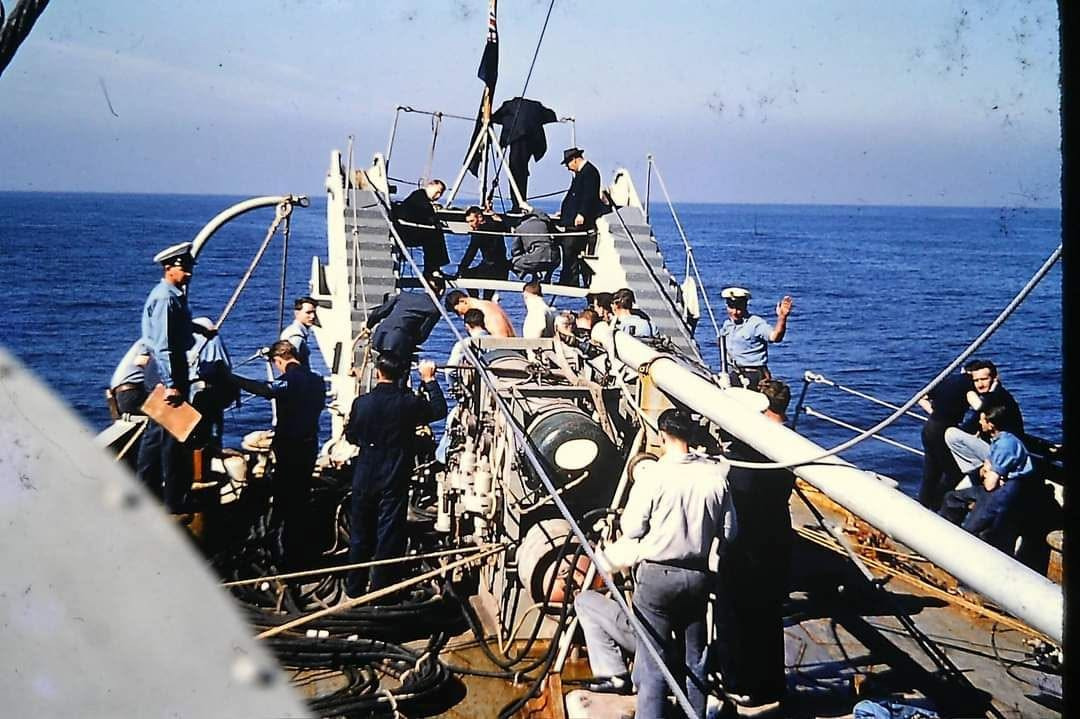
HMAS Kimbla’s first survey duties included around the Lord Howe Islands between January and March 1959, before moving back to operations off Australia. This work was interrupted by the crash of a Fokker Friendship passenger aircraft, which hit the sea off Mackay, Queensland on the 12th of June 1960, killing 29. As Kimbla had a large forward winch, which was originally used to haul nets, but was now fitted with recovery gear, she was assigned to recover the aircraft from the bottom in company with the HMAS Warrego. Kimbla also recovered a Vickers Viscount, which had crashed into Botany Bay, NSW on the 30th of November 1961, killing 15.
During her oceanic research and survey duties, it was found that her already slow speed of only 11kt could now only be reached with the help of the tide and wind, and as the slowest ship in the RAN’s fleet, she was nicknamed the ‘Snail’. Her crew would embrace this, and would often fly a large flag depicting their namesake mollusc. Her slow speed greatly assisted operations, as she could sail at only 3kts without sustaining damage to her engines, an optimal speed for survey work.
HMAS Kimbla recovering an F-111 off New Zealand, (1978)
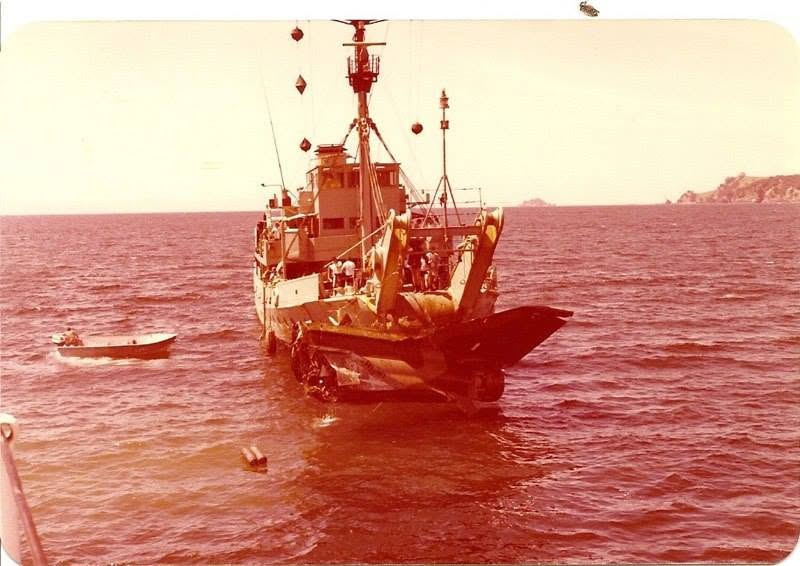
Her operations during this time included sea trials for the RAN Research Laboratory (RANRL), Commonwealth Scientific & Industrial Research Organisation (CSIRO), and the NSW Department of Mines. This included charting current and sea temperature around East Australia, as well as work placing moorings off Sydney and Cronulla at a depth of 75-100 fathoms. Her operations to recover crashed aircraft continued however, as in October 1962 she would recover a RAN Sea Venom off Jervis Bay, and recover an RAAF F-111 that crashed off New Zealand in 1978.
During a large storm on the 31st of August 1979, Chief Petty Officer Rodney Jackson was blown overboard, off Port Phillip Bay, Victoria, and was never found despite a large air and sea search. In another large storm, this time while between Sydney & Wollongong, she would endure a 46 degree roll.
By the mid 1980’s, her time was coming to an end. Her engines could only reach 9kts, and her hull was heavily worn from three decades of use. Her final voyage in 1984, she would measure surface data in the Tasman Sea, to allow comparison between samples and images taken from the space shuttle Columbia. HMAS Kimbla would decommission on the 15th of February 1985, having steamed 363,038nmi at an average speed of 7kts.
She held the honor of being the last RAN vessel to be powered by steam reciprocating engines, beating out the River-class Frigate turned survey vessel, HMAS Diamantina, which was decommissioned in 1980. She also was the longest commissioned RAN ship at the time, being commissioned for 29 years of service. Her service length record was broken by the HMAS Success, which served 33 years from 1984-2019.
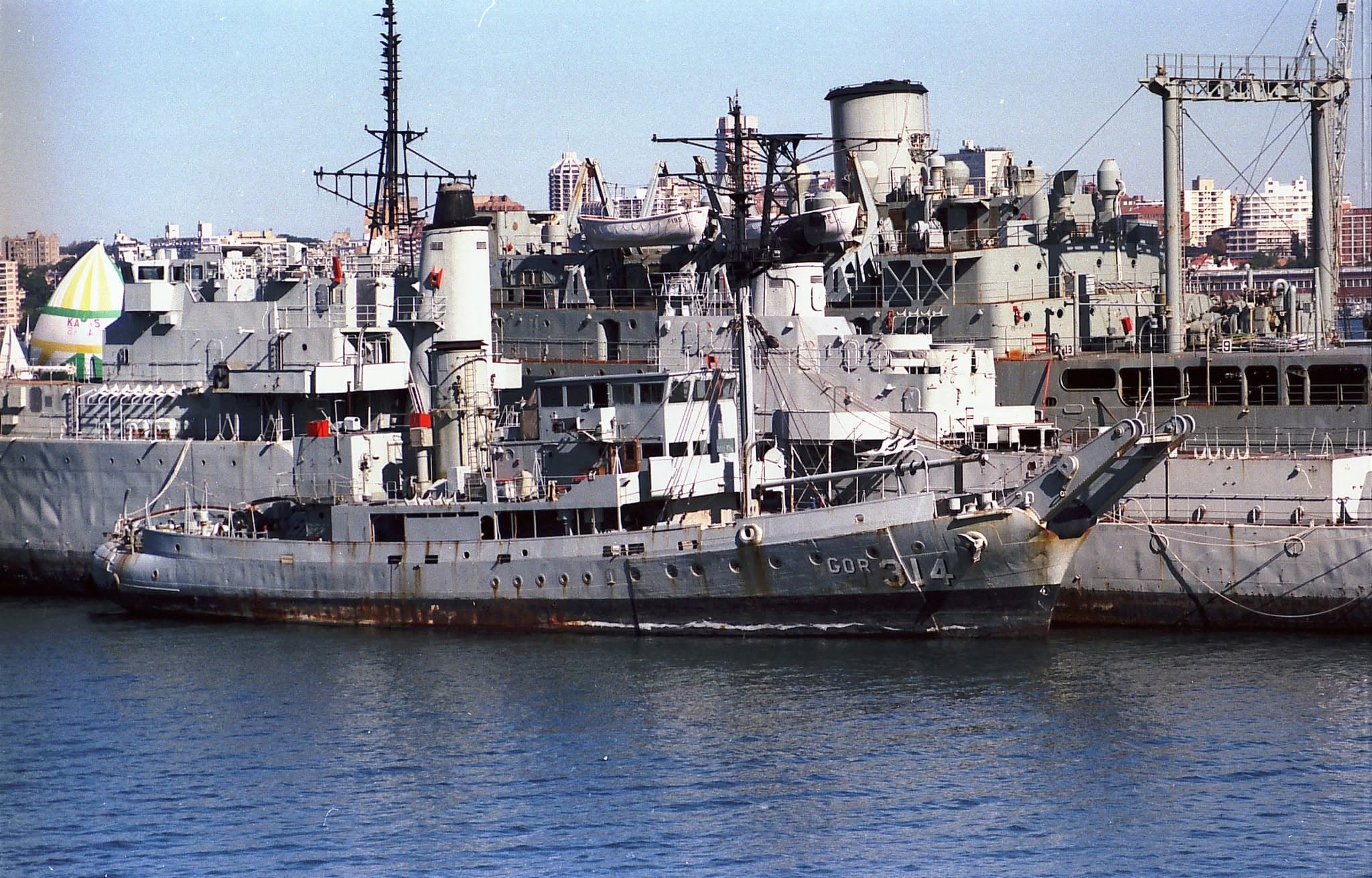
HMAS Kimbla was placed in mothball before being scrapped by early 1990.
| General Characteristics: | |||||
|---|---|---|---|---|---|
| Name: HMAS Kimbla | |||||
| Country: Australia | |||||
| Type: Boom Defense | |||||
| Class name: Modified Bar | |||||
| Year of commission: 1956 | |||||
| Refit: 1956 | |||||
| ----------------------------------------------------------------------------------------------------------------------------------------- | |||||
| Dimensions: | |||||
| Length: 179 ft (54.56 m) | |||||
| Beam: 32 ft (9.75 m) | |||||
| Draught: 12ft (3.66 m) | |||||
| Displacement: 733t standard | |||||
| ----------------------------------------------------------------------------------------------------------------------------------------- | |||||
| Propulsion: | |||||
| Powerplant: Coal fired triple expansion steam generating 850ihp (633.8kW) across one screw | |||||
| Speed: 11kt | |||||
| Endurance: 216t of coal | |||||
| ----------------------------------------------------------------------------------------------------------------------------------------- | |||||
| Armament & sensors: | |||||
| Compliment: 40 | |||||
| Primary armament: 1x1 40mm Bofors Mk.VII | |||||
| Secondary armament: - 2x1 20mm Oerlikon | |||||
| Tertiary armament: -nil | |||||
| Radar: - nil | |||||
| Sonar: - nil |
HMAS Kimbla tied up in Mothball next to HMAS Vendetta and Supply, (1986)
Extra Photos:
Sources:
G.Ross, G.Colin (1977). Warships of Australia. (p.243)
https://seapower.navy.gov.au/history/units/hmas-kimbla
HMAS Kimbla - Wikipedia
https://www.nepeannavalmuseum.org/post/hmas-kimbla-a314