Here it is:
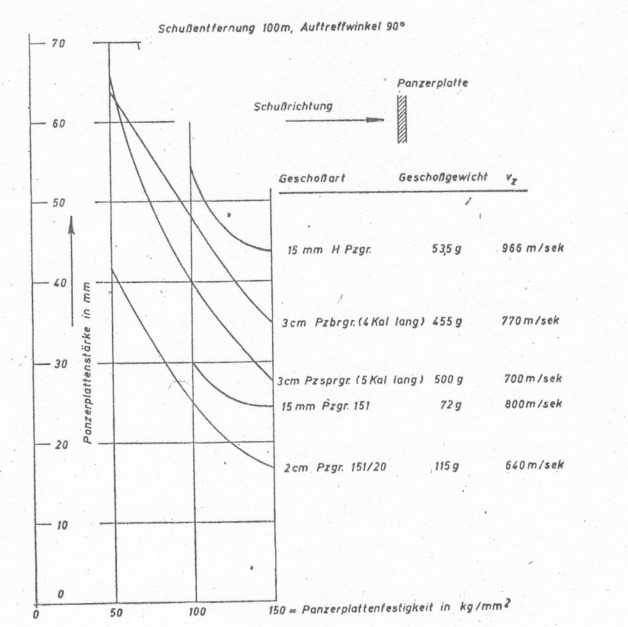
So the sharp pointed, 20mm AP round, with bakelite cavity, penetrates only 17mm of 150kg/mm² armor at 100m but a whopping 42mm against the soft 50kg/mm² armor.
So it’s actually 2.47x times more against soft armor.
Meanwhile the 30mm APHE round penetrates roughly 27.5mm against 150kg/mm² but 65mm against 50kg/mm², 2.36x more.
So I actually remembered it wrong.
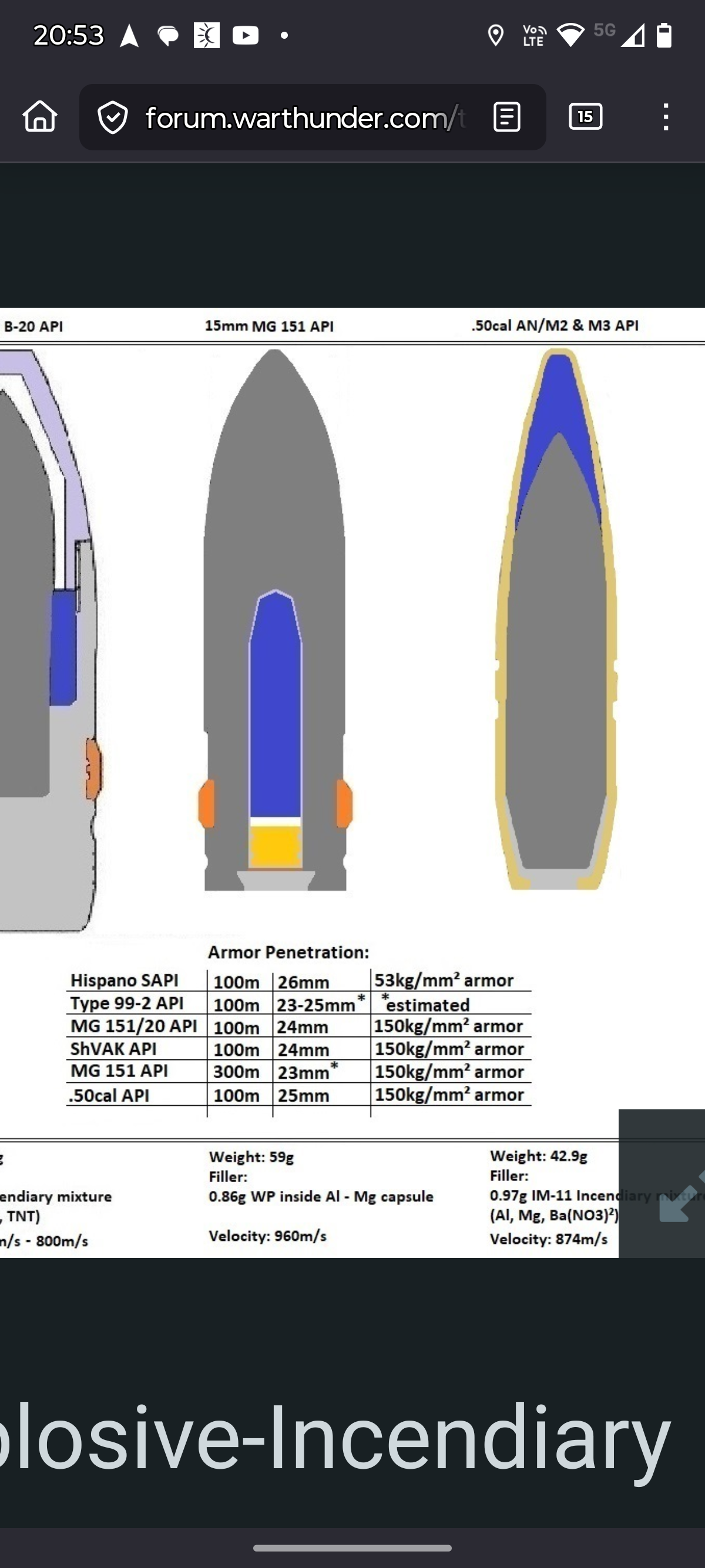
This of course makes the claim of Hispano SAPI penetrating only 26mm against 53kg/mm² (ship consctuction steel) very questionable.
The more reasonable number would be 36mm, so it could have been a typo.
If we go by 36mm and convert it to 150kg/mm² then it would be roughly 15mm, so similiar to 20mm Ball. Which could be possible, considering that the sharp nose doesn’t grant a big advantage against very hard armor and is enough to penetrate almost any armor inside a plane.
But it still seems odd, considering the rather high velocity of Hispano shells compared to MG 151/20 AP.
If we go by 46mm instead, we end up with roughly 19mm instead. Even though it very much looks like 26mm in the image.
Of course the SAPI shell is just the regular HEFI shell body with an armor piercing head screwed in.
So the thin walls will probably crack and break on impact with thick armor.
SAPI has 3mm thick walls, MG 151/20 AP 5mm.
Plain AP round suffer pretty heavily against 150kg/mm² armor, so the 30mm AP-HEI shell with aluminum cap has an advantage here.
Hence why 15mm AP-T only penetrates 25mm like a US .50cal AP, even though it has the potential to penetrate more, if the armor is softer.
MG 151/20 API is supposed to penetrate 24mm because the shell is much more hardened than AP and APHE. But this wouldn’t give it an advantage against 50kg/mm² armor.
So if we consider the same 42mm penetration like AP against soft armor, the ratio here is just 1.75x.
Almost the same as for the 30mm AP-HEI shell.
If we use DeMarre the 15mm AP-T would be able to penetrate 56mm soft armor compared to 20mm AP. Converted to hard armor, using the 1.75x modifier for non compromised shells, we end up with 32mm.
So 15mm AP-T penetrates 25mm but has the potential to penetrate 32mm, if it wasn’t shattering against 150kg/mm² armor.
Now I was going to do the same with Hispano SAPI but then I realized something.
Due to the construction of the shell with the screwed in AP nose using a regular shell body it’s likely that the shell will deform in some form, maybe even mushroom on impact.
Thus the low penetration against soft armor might just be a symptom of the shells construction.
Not to mention the incendiary filler, which will detonate the shell on impact, if the shell deforms and enough energy is transfered to start the reaction.
Early SAPI models were completely filled and carried around 12g or more flash powder.
Later models replaced the top most section of the shell with a detonator instead.
But this could actually make the shell less sensitive, thus delay detonation for a brief moment.
Since instead of immediatly compressing the mixture, the detonator would first be crushed, which in term then ignited the incendiary mixture.
Anyway. Comparing both AP and SAPI using DeMarre results in roughly 62mm of theoretical penetration against soft armor but Hispano AP would have the exact same value.
Using the value for compromised AP, this means roughly 26mm penetration against 150kg/mm² armor.
That would be the Hispano AP penetration and this perfectly matches with the value found in a German aircraft ammunition overview table from 1944.
So it’s actually hard to say how much SAPI would penetrate, but it most likely would brute force it’s way through at least 15mm of armor.
Notes: DeMarre between 20mm and 30mm AP indicates a big discrepancy.