So in practice the Fulcrum in game turns like the flawed 9.12 but bleeds speed as if it was actually pulling the same AoA as a fixed version? Pretty laughable that there’s been a report for that accepted 4 months ago and nothing’s changed yet…
https://community.gaijin.net/issues/p/warthunder/i/Ndr4CMnV9zdG
2 Likes
Do not forget the aircraft is missing a massive amount of thrust at take off per RD-33. I will post my finding on that and maybe even share the true uninstalled thrust of the RD-33. Depending how much Gaijin wants to act up on this model as we move forward into the end of this quarter.
Additionally, the aircraft is missing its Soviet blended wing configuration “aerodynamic integral design” 60% of the lift is generated by the wings while 40% is generated by the entire fuselage.
When the aircraft pitches the percentage that the fuselage generates increases.
The MiG-29 can maintain this lift (vortex lift) at extreme angles with its leading edges that are even present at the nose of the aircraft. Vorticity generation that Su-27 does not have.
A very high lift to drag ratio that many top tier fighters in-game are not equipped. Its speed bleed is less than you would expect, but you are still essentially correct. Lacks the historical pitch authority and control, but bleeds speed and lift as if it somehow did.
Additionally, the MiG-29 has a lower in Maximum G overload in-game under the Su-27 which I am sorry to say (my favorite jet) is laughable while the Su-27 can never pull 9gs over 21,000kg or will quite literally per manual, fall apart.
The MiG-29 should be better ALWAYS over the Su-27 in that domain.
4 Likes
god i just spent the last hour flying the MiG-29 in a event where historically loadouts were required so R-27Rs with R-60Ms, just showed much the R-27ER is a crutch to it in its current form lol, with its mega sad flight model and no R-73s
4 Likes
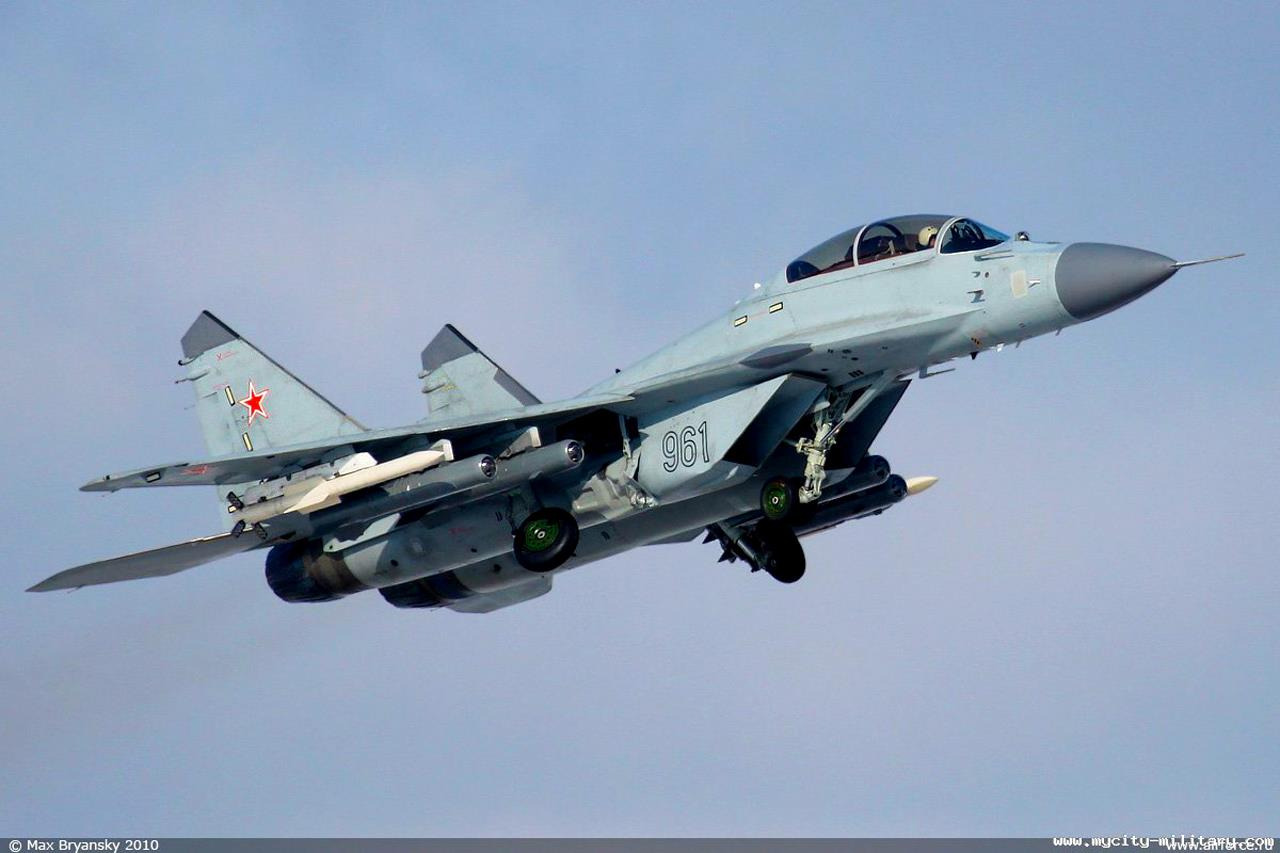
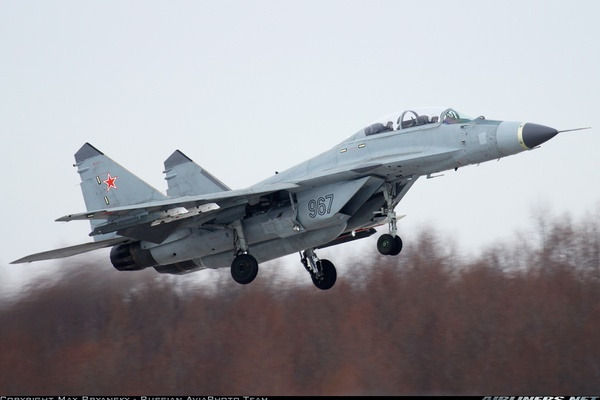
Two test MiG-35s 9.61 and 9.67 built for the Indian MMRCA back in 2009 from converting two 9.41/9.47 MiG-29Ks, given the airframe number #961 and #967 each. Both would later in 2011 be converted back to MiG-29Ks after the competition ended and both airframes would be lost in crashes in the future.
2 Likes
r-77 wrong launch limits on 29 smt (hopefully this happens for other planes as well)
https://community.gaijin.net/issues/p/warthunder/i/jpne3ffDEDVa
1 Like
Also scan zones are wrong but idk how to report this without using the yemen zhuk manual which has the image that is shown on this post.
Idk where to find another source for that image other than that manual, and idk if that manual is allowed to be used in bug reports. It has no classification statement, but it does say this

also zhuk should have a much better notch/detection speed than it does in game rn, but its the same for basically all tippy top tier radars currently so there’s no use bug reporting it. It’s actually basically the same as irbis
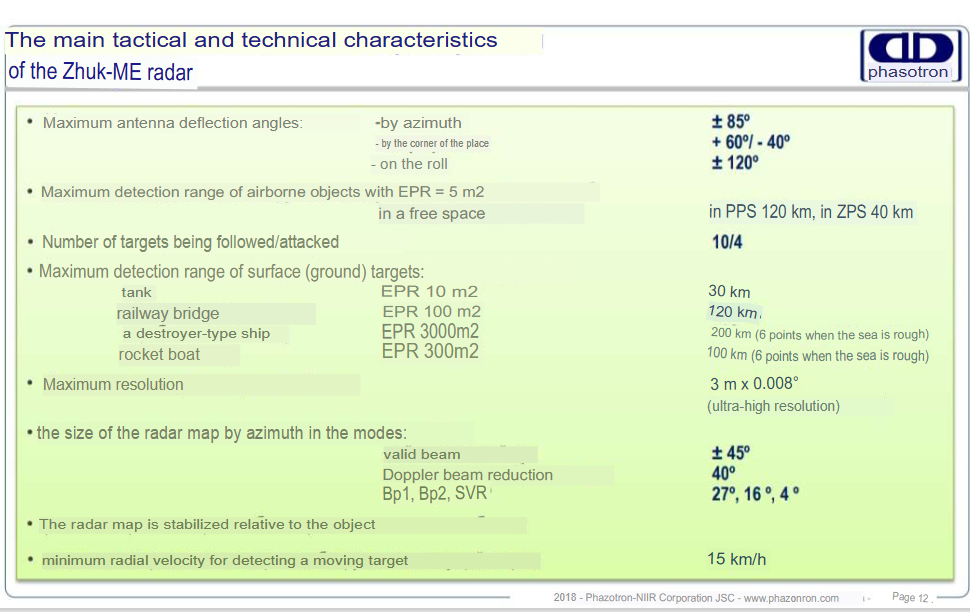
The 15 km/h is under the section for ground mode characteristics, so we can’t really say that applies to air targets.
1 Like
ah. well then ig irbis is still the one that has the lowest for specifically air targets under 50 km with 5 m/s
Wait, where? Because on a picture that Kizvy posted i don’t see any “air to ground mode”
It does not really say that explicitly, but if you look at it, the first 3 bullet points are about airborne targets, the rest are about ground targets. So in the very least we can’t be certain that the 15 km/h figure applies to air targets.
Also, there is another pdf about the MiG-29 (called MiG-29 pocket guide or something like that) that I can’t post here, but it had much higher notch windows for air targets (minimum of around 150 km/h).
Well, this document is divided by independent blocks of info, for example above the block with velocity you see block with the terrain mapping characteristics and it is not an A-G mode iirc, it is a terrain mapping mode.
Is it for Zhuk-M or for N019 radar?
Zhuk-ME
Can anyone check if the MiG-29N still has the N019E or has it been replaced by the N019ME and if it still has the RVV-AEs?
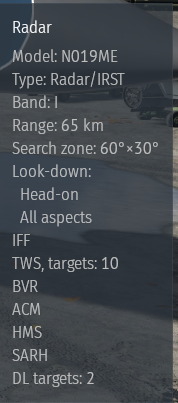
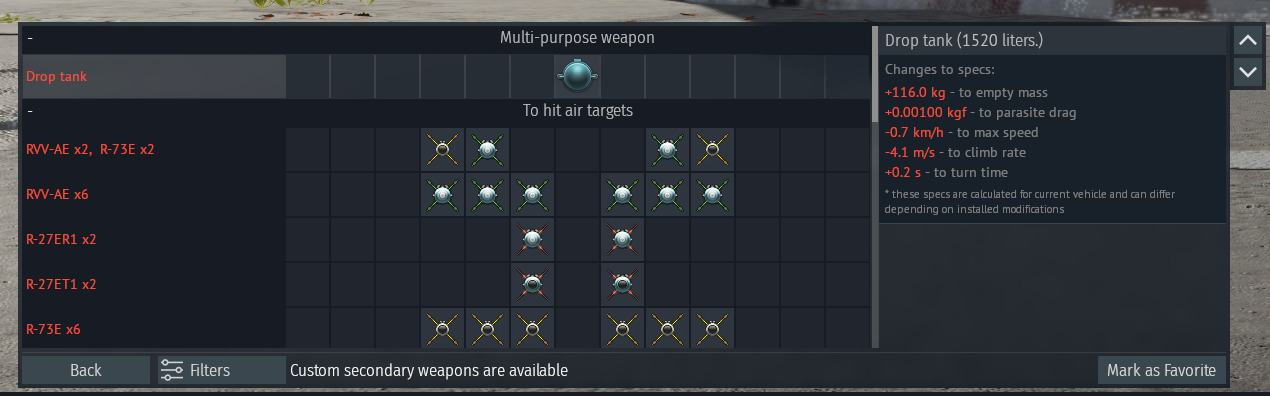
Now they just gotta copy it over to a 9.13 model and rename the radar to N019M and folder the plane under the SMT and call it MiG-29S
slightly less painful to play. Still worse than the SMT though
All MiG-29’s RD-33 Are Severely Underperforming Thrust
"For standard day/sea level conditions the approximate static thrust ratings are as follows:
G/GT: NPM (Normal power mode) Maximum AB thrust: 8,300kp"
Source: GAF T.O. 1F-MIG29-1 Pages, 1-2 (MiG-29G/GT FLIGHT Manual)
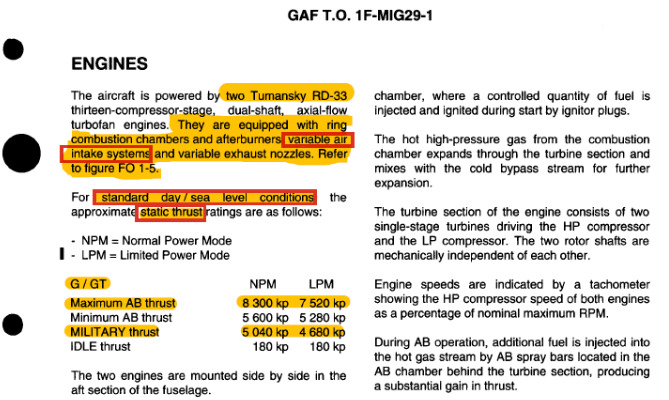
These are not raw thrust values from the aircraft manufacturer’s engine vendor as it makes no logical sense to do without specifically stating so in the flight manual. To carelessly place only uninstalled thrust would kill many pilots at take-off operating under a multitude of varying gross weights/payloads during ground operations such as take-off. That is why static thrust @ sea, standard day serves as the universal certified baseline that is guaranteed by the aircraft manufacturer. This is to ensure that aircrews do not perish in a ball of flames at the end of the runway, of course.
Please note how in GAF T.O. 1F-MIG29 the engines are described being equipped variable geometry intakes giving the reader a hint that the thrust ratings that follow are regarding installed thrust.
The Definition of Static Thrust At Sea level, Standard day
“Take-off thrust is commonly considered to be the static thrust quoted by the manufacturer. The static thrust is the thrust measured with the engine stationary, as would be the case when the aircraft is initiating the take-off roll.”
“Note that the take-off thrust is usually taken to mean the sea-level static thrust and is equal to the gross thrust at sea level…”
“This relation is reasonably accurate up to Mo=0.3. Note that the take-off thrust Fto is usually taken to mean the sea-level static thrust (Vo=0) and is equal to the gross thrust at sea level. The take-off thrust determines the take-off characteristics of an aircraft.”
Source: Theory of Aerospace Propulsion 1st Edition - Pasquale M. Sforza Pages 395-396 & Theory of Aerospace Propulsion 2nd Edition Pasquale M. Sforza Page 475.

All installation losses imposed by the air vehicle have already been mathematically corrected and adjusted with correction factors applied by the aircraft manufacturer to represent operational use. This is regulated and certificated in airworthiness trials. There is no such thing as “channel loss” in aerospace propulsion engineering or in airworthiness certification. I suppose the Gaijin was attempting to refer to duct loss or air inlet distortion, which would still be covered under installation loss whichever is the case.
To verify aerospace propulsion engineering textbooks, international civil & military industry standards all one needs to do is simply calculate the aircraft’s thrust to weight ratio (TWR) using the operational manual’s static thrust @ sea level, standard day & gross weight.
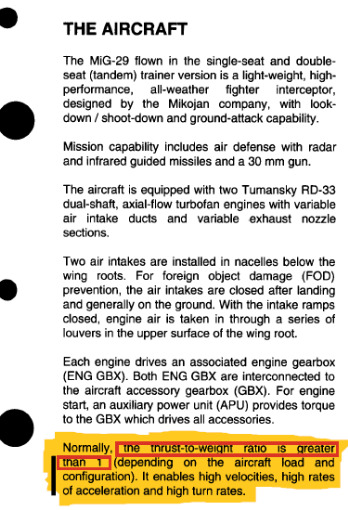
The MiG-29 Product Index 9.12 (VVS) Thrust-to-Weight Ratio ≈ 1.14
"When the engines are operating in the “Full afterburner mode during takeoff. (H=O, V=0), the thrust-to-weight ratio of the aircraft is 1.14.”
Source: ПРАКТИЧЕСКАЯ АЭРОДИНАМИКА САМОЛЕТА МИГ-29 Страница 179 (PRACTICAL AERODYNAMICS OF THE MIG-29 AIRCRAFT Page 179)
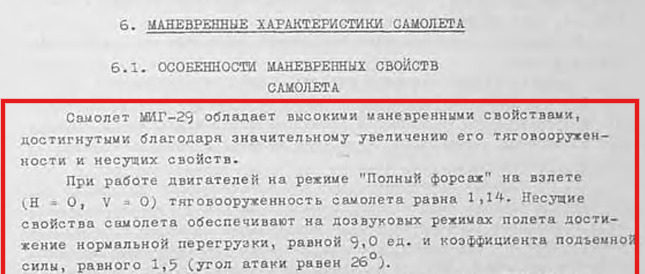
The MiG-29 Product Index 9-12G Thrust-to-Weight Ratio ≈ Greater than 1
“Normally, the thrust-to-weight ratio is greater than 1 (depending on the aircraft load and configuration). It enables high velocities, high rates of acceleration and high turn rates.”
Source: (MiG-29G/T Manual) GAF T.O. 1F-MIG29-1 Pages, 1-4 Change 4
Thrust to weight ratio is determined by take-off thrust (static thrust @ sea, standard day) & gross weight (operating weight & full internal fuel). Take-off thrust is critical in determining baseline flight characteristics.
Using product index 9.12G’s gross weight from the manual:
Index 9.12G Gross Weight = 14,454 kg
RD-33’s Static Thrust @ Sea, Standard day (take-off thrust) = 8,300kgf × 2 = 16,600kgf

Index 9.12G Gross Weight = 14,454 kg
RD-33’s Static Thrust @ Sea, Standard day (take-off thrust) = 8,300kgf × 2 = 16,600kgf
Thrust-to-Weight Ratio (TWR)
Take-off Thrust / Gross Weight = 16,600kgf / 14,454 kg ≈ 1.15
This aligns with both operational/flight manuals of the Soviet (VVS) MiG-29 Index 9.12 & the Luftwaffe (NATO) 9.12G.
The 8,300kgf thrust rating of the RD-33 is 100% installed thrust.
That 0.01 difference is not a performance distinction in reality. it’s simply a reflection of how manuals round gross weight figures. The MiG‑29 product index 9.12G was essentially the same aircraft, but NATO documentation may have used slightly different baseline weights (MiG MAPO carried out the update to NATO standard using different avionics, equipment, measurement standards etc.).
Now, please refer to the take-off thrust of the MiG-29G in-game at this very moment & calculate TWR using the aircraft gross weight (operating weight & full internal fuel).
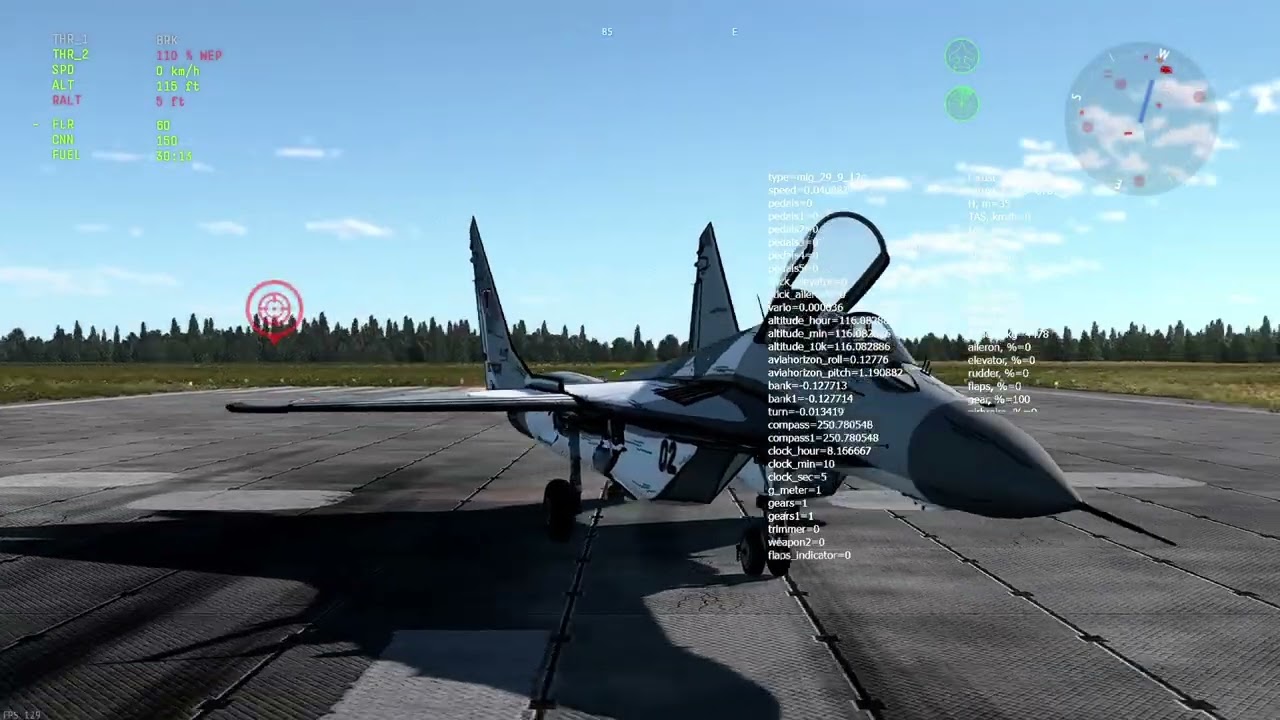
Each RD-33 is underpowered at take-off @ 6,787kgf for each RD-33.
6,787 kgf x 2 = 13,574 kgf
The thrust-to-Weight Ratio (TWR) of the War Thunder MiG-29 product index 9.12G:
Take-off Thrust / Gross Weight = 13,574 kgf / 14,454 kg ≈ 0.94
All MiG-29 in-game are severely underpowered the moment they spawn on the runway & since take-off thrust determines overall flight characteristics thus setting the baseline for an aircraft’s entire performance envelope directly governing acceleration, climb rate, turn capability, and maneuvering limits, it is inappropriate for us to state that these aircraft are performing anywhere near a historical reality.
MiG-29 9-12G (All MiG-29) Severe Lack of Operational Thrust // Gaijin.net // Issues

Completely ignored 3 aerospace engineering textbook definitions for static thrust, seal level standard day
Lol now we are not allowed to calculate thrust to weight! Or any calculations I should say. Lol…
9 Likes
I don’t understand why you think the values for the engines in the manuals are installed just, most of the time they are for uninstalled thrust as the bug report manager said
Do the math kid.
Besides textbook definition of static thrust at sea level or comprehend that all aircraft and their engines regulated by the FAA, DoD and ICAO. The MiG-29 is ICAO compliant. You have zero idea what I am talking about, but its ok. Engines and aircraft are all certified to fly in what is call Airworthiness certification. They cannot fly without meeting these requirements.
Lol what logical reason you think it would be the uninstalled thrust?! For real my guy. Yeah, let me just take-off with my aircrew and passengers under any given gross weight not knowing what the installed thrust at take-off is whatsoever so we can all end up dying in a ditch at the end of the runway.
But anyway, do the math
What is the thrust to weight ratio of the MiG-29? You have all the manuals don’t you?
Then tell me the gross weight. You can simply verify any fighter jet by taking the stated thrust in the manual, its gross weight and calculating its TWR to see if it matches up.
You can calculate the MiG-29 TWR in-game right now. Its .94… Is that historical?
What installed thrust would equal 1:1 in the Mig-29 in your mind??
There is only a small window…
8,300kgf…
1 Like