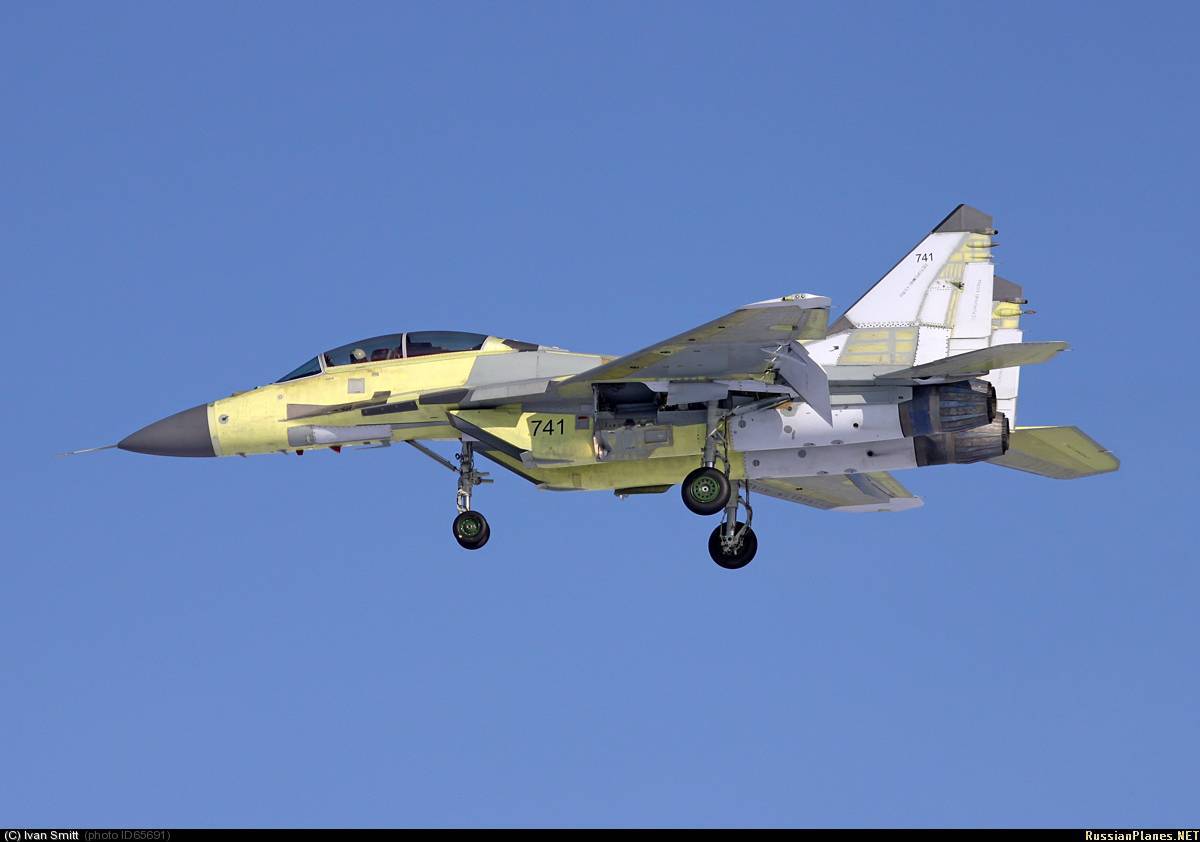
I will find the source I read a while back about materials used in earlier mig29s as opposed to composite materials in later variants. I just do not think it should be too much of a difference in FM performance and same fuel loads.
Its not a mutant bro lol. Its actually my favorite Mig29 in game. Its like a NATO version of the Mig29 to me. I just fly it like a tomcat or standoff platform.
Yeah, I am sure that one is nothing but composite materials. But the SMT is from what year again? The Russians definitely used more composite materials. It would be insane if they did not.
Another point is if extending the range was so important to Mikoyan to the point of enlarging the airframe, why wouldn’t they use more composite materials than once used in older versions??? They had to.
Yes, it is undeniably heavier, but how much would much of that weight should be really felt?
The fact is that on April 26, 1986, a new MiG-29M 9-15 airframe appeared. He corrected all the shortcomings of the previous ones and has an empty weight of only 500kg more. Whereas the maximum takeoff is 22.5 against 15 at 9-12. But the tests and fine-tuning of the car fell on the collapse of the USSR and Russia did not buy the MiG-29 in the future. And the MiG-29 SMT is a fairly cheap upgrade of the old airframe
What does it mean there were no Composite Materials!?..It’s just that every year on new modifications, the percentage of KM application increases…MiG-29(9-12)-early series…
composite materials (KM) based on glass and carbon fibers (fabrics, prepregs) – power panels of the upper surface of the fuselage, engine nacelles and tail;
three-layer panels with KM sheaths with reinforcement made of fiberglass and carbon fiber and paper honeycombs or foam are applied – steering surfaces, hatches and sashes, linings and partitions (where concentrated forces operate, light reinforcements made of aluminum alloys are embedded in them);
-On MiG-29 aircraft, panels of composite materials are marked with an “X” sign. In this picture, the car of the first series, it had such signs on the vertical tail and engine nacelles. Photo: A.Y. Oblamsky…
The SMT uses the 9-13 airframe. MiG29M (9-15) and uses composite materials, but the extra features it has (redesigned wings to allow 8 pylons, redesigned larger intakes etc.) make it still slightly heavier tan the 9-13 (400kg heavier, 600kg compared to 9-12). But, unlike the SMT, the engines are stronger and especially not as much low speed limited on the M.
R-73 lacks rollerons, improving drag. The R-73 also has a longer body that is slender, with less draggy clamps and such.
The R-73 has similar acceleration to the AIM-9L in-game (130 m/s vs 127 m/s acceleration) and similar overall deltaV but it goes much further than the AIM-9L. This is because it is more aerodynamic. It doesn’t even have the same guidance time as AIM-9L, it’s only 25s.
Anyhow, the top speed of mach 2.5 is limited by the altitude for AIM-9L due to drag, it can only achieve this at higher altitudes. The R-73 likely can go faster but the stat cards do not tell the whole story.
Of course, this was all expected from a missile that was put into service in the 80s when being compared against one from the 70s which (by then) already used an outdated and lower efficiency motor pulled from the AIM-9D sidewinders.
so, my question is, what improvement does the SMT have in manufacturing techniques that Mig had surely developed over the years leading up to the SMT?
Interesting thing I just heard. That Mig and Sukhoi never really built a single aircraft. But only designed aircraft. Hence the name “Design Bureau” and other state-owned companies were responsible for the materials and ultimate construction.
Is this true?
In the West, the companies itself such as Lockheed was responsible for research and development of our fighters. If true about the Soviet Union, I think that was a terrible mistake.
TsAGI (Central Aerohydrodynamic Institute) came out with the basic aerodynamic design / theory that led to the development of the Su-27 and MiG-29. The same was done in the US wherein specifications are put out for the requirements of a fighter aircraft, but less strict requirements for the layout and design of the fighter are included in these requests.
In this case, the US puts out request for suggestions and proposals to meet a set criteria whereas Russia’s TsAGI requests fighters meeting certain specifications be built on the principle of a certain design concept.
What does guidance time have to do with aerodynamics. Can we get a source on the aerodynamics of the R73 compared to the Aim9?
Additionally, if the R73 is so aerodynamic, Why has no other nation capable of producing their own missiles configured theirs to resemble the R73 or outright copied?
China wants nothing to do with the R73 and all of their missiles are more akin the Aim9 and West.
The US still builds on the Aim9 design because it is a superior configuration over the R73.
Again, China who is far more technologically advanced than the VKS does not have a single missile in service with the same configuration as the R73 and has no interest in missile. Even though it supposedly has a magical 30km range…
No one cares for the R73. Especially the only two remaining superpowers.
What does VKS have to do with it? If the VKS is the customer, not the developer. And in what way is China more technologically advanced in terms of rocket dynamics?
Distance coasting (using the additional guidance time) should allow the AIM-9 to overtake the R-73 if it has better aerodynamics but it doesn’t. Rollerons are known to cause high drag, missiles such as Magic 2 got rid of them partly for this reason.
R-73 is a larger caliber missile than the AIM-9L but lacks rollerons and has TVC double canard design. It has a slimmer body. The fact that both have similar T/W ratio and burn time but the R-73 has nearly double the maximum distance it can travel is a huge pointer towards improved drag.
Many nations continue to use the R-73 design, and at the time it was so ahead of it’s time that nations made great efforts to take a step beyond it. So when these programs culminated in the development of the MICA, IRIS-T, ASRAAM, AIM-9X they all out-performed the R-73 and took a huge step / leap towards surpassing it.
They already had the R-73 on their Russian fighters, no need to copy it when they can simply start a program akin to the West to build something better.
The AIM-9X is a fairly large step away from the traditional AIM-9 configuration. Not sure what “AIM-9 configuration” means to you in that case. Went from canard to tail control with TVC.
Except that they had the R-73 already, and saw promise in continuing to produce and develop what they already have for export as well as taking from the superior IRIS-T and other Western designs to develop a superior missile and get ahead. No sense in taking all that time to produce something that is already outdated.
I don’t want you to get muted or in trouble, so I’d avoid any political discourse with these conversations especially when referencing China and Russia.