Martel AS-37AR antiradar missile

Missed a few aircraft off your list;

Used by

  • Buccaneer S.2B / S.2D (AR & TV)
  • Nimrod MR.1 / MR.2 (AR & TV)
  • Vulcan B.2 (AR)
  • Sea Vixen FAW.1 XJ476 (AR & TV - trials only)
  • Victor B.2 (AR - trials only)
  • Harrier GR.1 (AR - trials only)
  • TSR.2 (AR & TV - planned)
  • Tornado GR.1 (AR & TV - planned, unclear if tested at any point)
9 Likes

Nope, not to be added in the current state of the game and the dominance of CAS.

+1 to be added when other antiradiation missiles come. probably comes when the multivehicle sams are brought

they wouldn’t add it to the current state of the game but when devs see it fit, keep that in mind

1 Like

This is intentional on my part, since this suggestion concerns the French technical tree. I grant you that the same should be done on the Commonwealth side.

This isn’t necessarily true. 7 years after the Martel entered service both France and Britain sought a replacement, Britain ended up developing the ALARM missile which served until around 2013. While France opted for the ARMAT, a missile that used the body of the Martel but had a better seeker and nearly double the range of the Martel, and operated on the Jaguar, Mirage F1, Atlantique, and the Mirage 2000.

But after both the ALARM and ARMAT were retired then neither country ended up developing another anti-radiation missile.

1 Like

Henri de Waubert de Genlis, test pilot for dassault, published online a fascinating article about the trials and tribulations of dassaults dealings with the iraq air force, with particular focus on the development and testing of the ARMAT, based on the Martel as-37 radar missile, before and during the iran iraq war.

Codenamed “bazaar”, it begun development because france needed an all french version of the martel missile after the UK had blocked it’s export to iraq. I’ll sum up ARMAT’s features as described in the article:

  • No inertial guidance, missile stops tracking if radar stops emitting
  • Narrow band 3 element seeker replaced by broadband 4 element seeker
  • Radars with similar operating characteristics have to be discriminated by flying very precise, pre planned approaches
  • 150kg Proximity fused warhead, detonating in a 5 meter radius
  • Pilot can tune the seeker to the desired frequency inflight
  • Effective range between 15 km and 100+ km, depending on launch conditions
  • On launch, missile pitches up to a 45º degree climb and after reaching cruise altitude levels off to towards the target.
  • Sustainer motor is turned on 32 seconds after the missile is launched, missile reaches supersonic speeds before burnout
  • Once the target is at a 70º angle beneath the missile, the autopilot pitches down to dive towards the target at an 80º angle or near vertical attitude.
  • 540 kg missile, with a nominal time to hit the target of about 3 minutes.
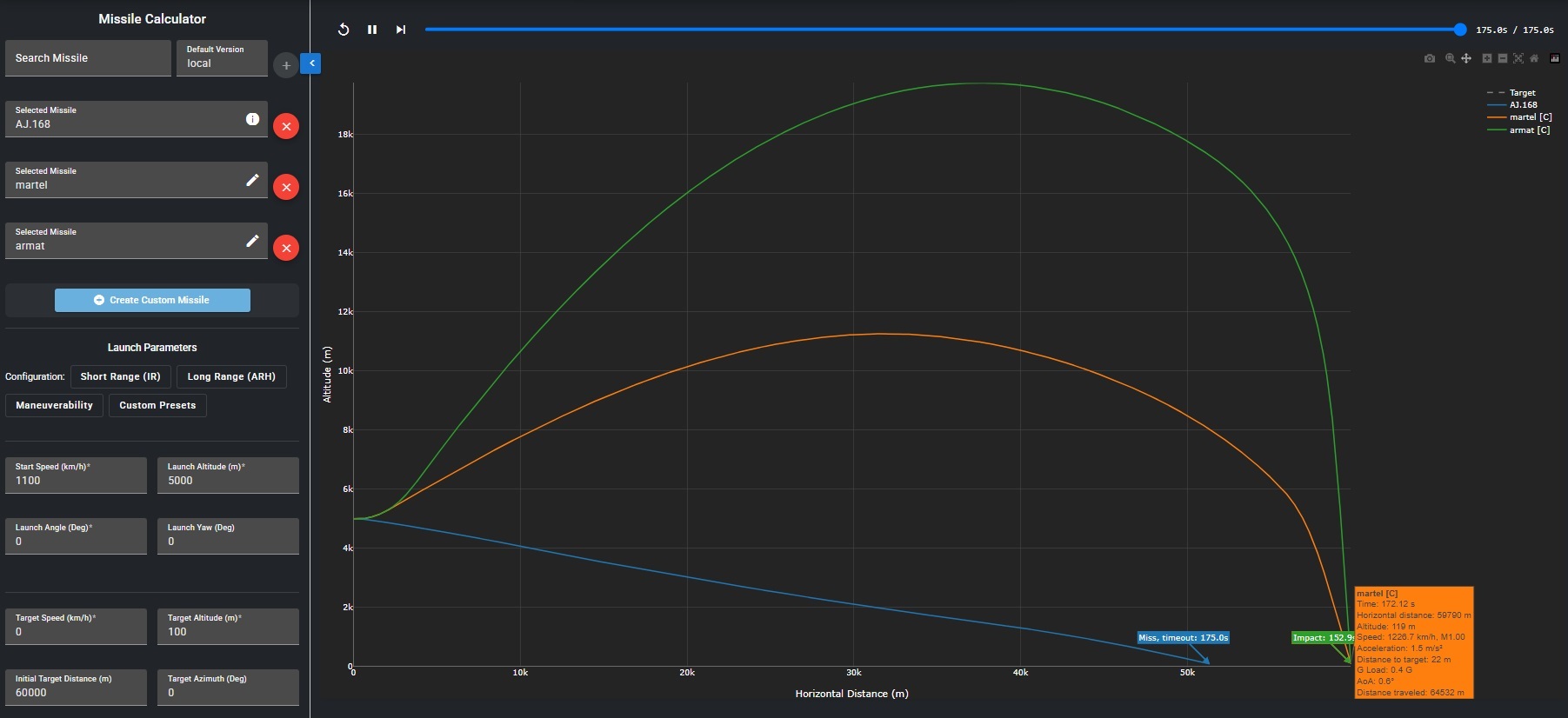
  • Trial launch from an aircraft flying at 1100km/h, 5000 m of altitude and 60 km away from target, target reached after 2 minutes and 32 seconds.
2 Likes

I found an 1976 article talking about the AS37 martel. Not much information, but it claims that:

The missile’s trunk is common in both variants, and so is the composite solid-propellant "Basile” boost motor. The integral booster, which burns for 2.4 seconds, is ignited at the moment of missile release to allow launches to be made from very low levels. The British requirement specified a 50-7,000-foot firing envelope altitude for AJ168, but the French AS.37 can be launched at up to altitudes of 45,000 feet.
The anti-radiation variant has a larger sustainer motor—the"Cassandre,” which burns for 22.2 seconds and gives the missile a range of at least 15 nautical miles for a low-level launch from an aircraft flying at Mach 1.

https://www.usni.org/magazines/proceedings/1976/november/weapons-systems

Honestly, this makes more sense to me than a sustainer rocket that burns for 92 seconds, unless that’s specific to the aj 168 version.

It also makes think there’s a mistranslation in the articles I mentioned above; instead of “sustainer motor is turned on after 30 seconds”, they probably meant “sustainer motor burnout 30 seconds after launch”, which makes a lot more sense, given that the same article says that the “bazaar” comfortably outrun the mirage F1 that launched it. It’s a pity there’s no published impulse figures, but assuming thrust is the same, going from 22.4 to 29.6 seconds gives an extra 32% of delta v to the sustainer vs the original martel.

This by itself doesn’t explain the range increase, so my assumption is that when it was launched, the original as.37 martel simply levelled off and flew in a straight horizontal line towards the target before diving on it; when upgraded to armat spec, it was given the ability to loft and glide to maximize range.

Found a blog post about as37 martel and armat with some interesting details about it’s operation:

  • Known target frequency but unknown location: Sensor searches a 90º sector until it finds and locks the target before launch
  • Known location but unknown frequency: Antenna stays pointed to a fixed azimuth/elevation, sensor searches through it’s available frequency band, and locks onto the strongest detected emission before launch.

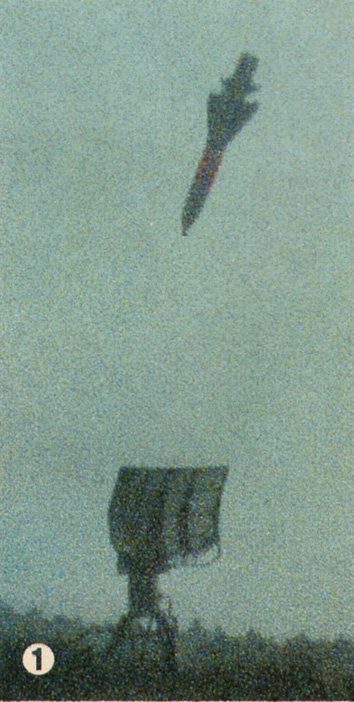
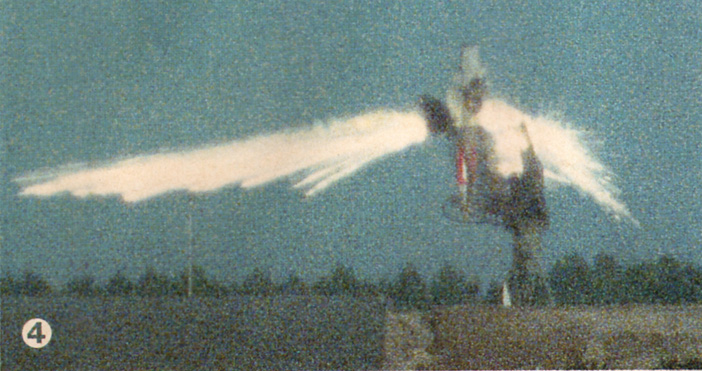
I assume that when it was upgraded to armat spec, the sector amplitude was increased to allow for the near vertical attack profile, as shown in this demonstration published in 1994.
bis_dga_martel_1_sd
bis_dga_martel_2_sd
bis_dga_martel_3_sd
bis_dga_martel_4_sd

We also know it was used to destroy iranian mim-23 hawk batteries from 73 km away, and lybian SA-6/2K12 cub search radars, so at least it should cover those radar bands.

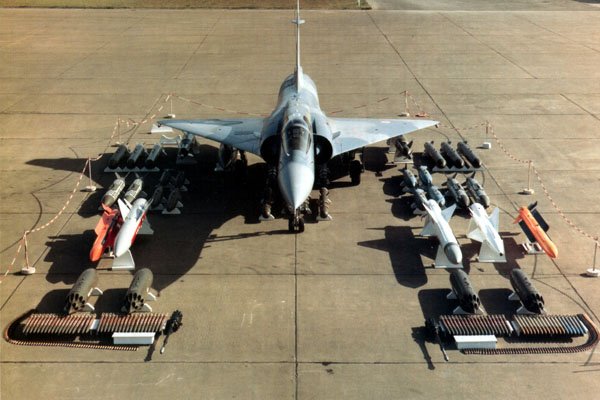
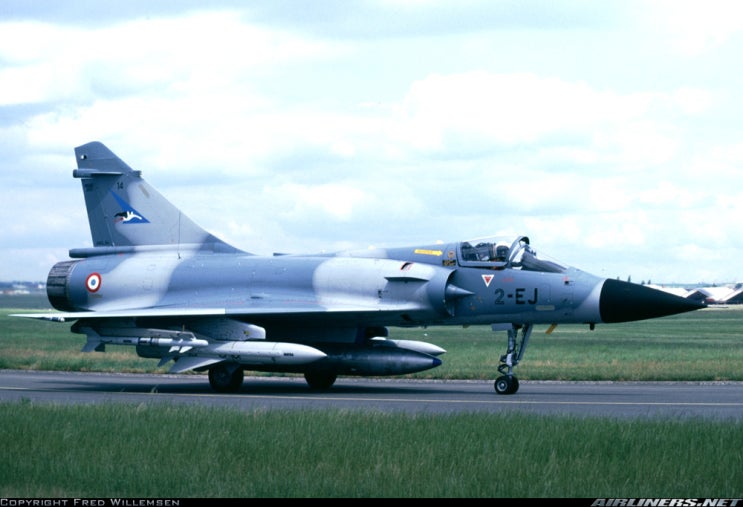
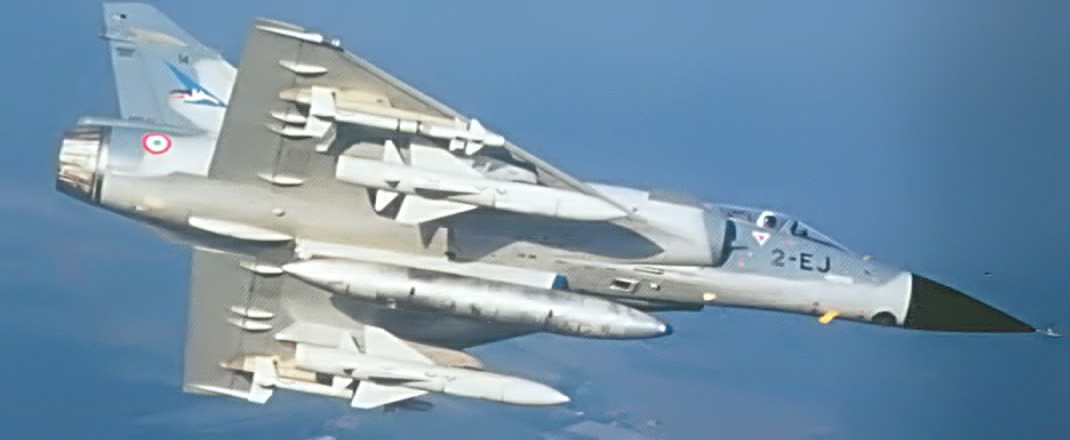
And the op should also add the Mirage 2000 to the list of planes that can carry the martel/armat , it uses the same hardpoints as the fuel tanks or the exocet missiles.
pub_dassault_m2000_1
1873688

1 Like

It would seem both Martel (TV) and Martel (AR) use the same boost motor, but different sustainers.

The Martel (TV) sustainer burns for 92 seconds and the Martel (AR) sustainer burns for about 20 seconds.

The two radar bands Martel covered were

  • Band 1: 2.7 - 3.7 GHz (roughly E, F Band)
  • Band 2: 0.8 - 1.3 GHz (roughly C, D Band)

The British also believed that France had developed an improved seeker covering I band, but this isn’t confirmed.

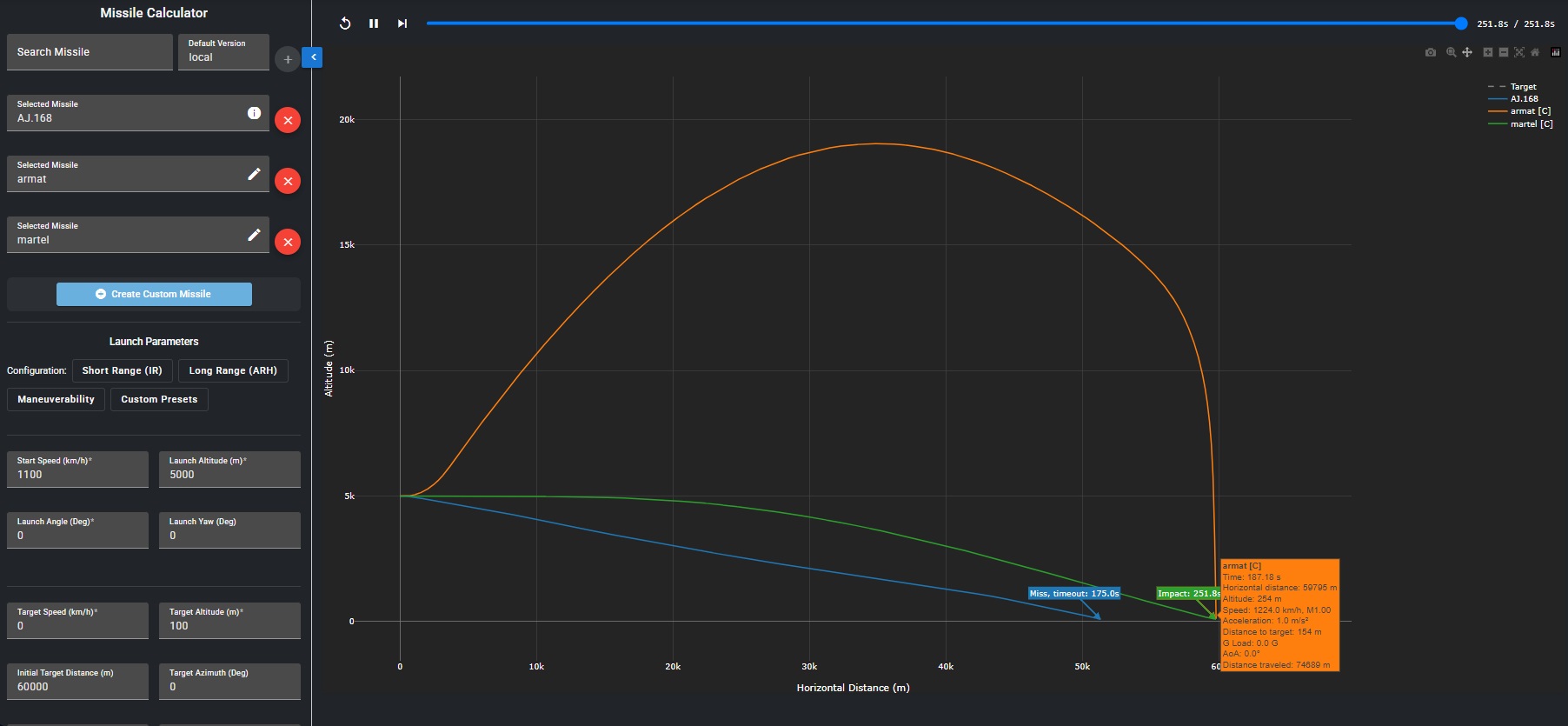
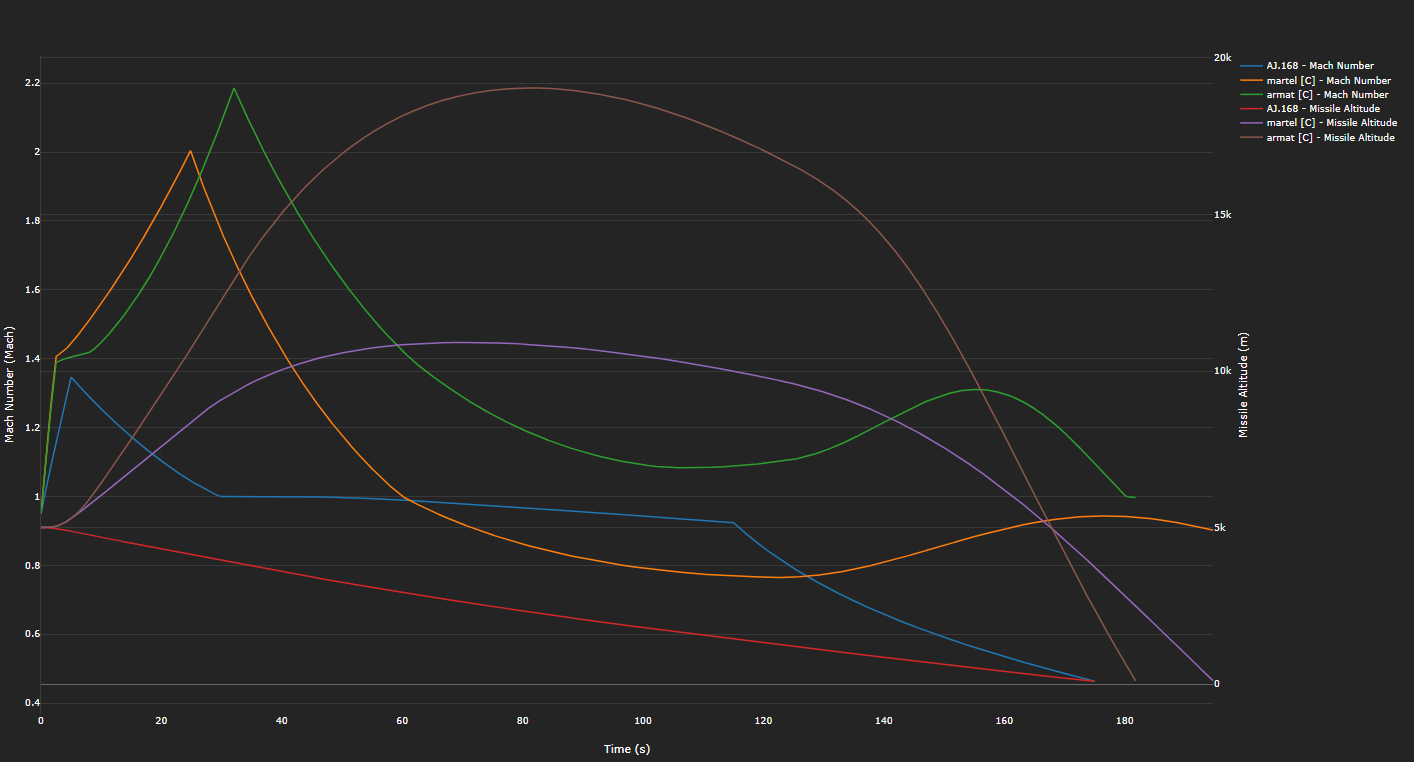
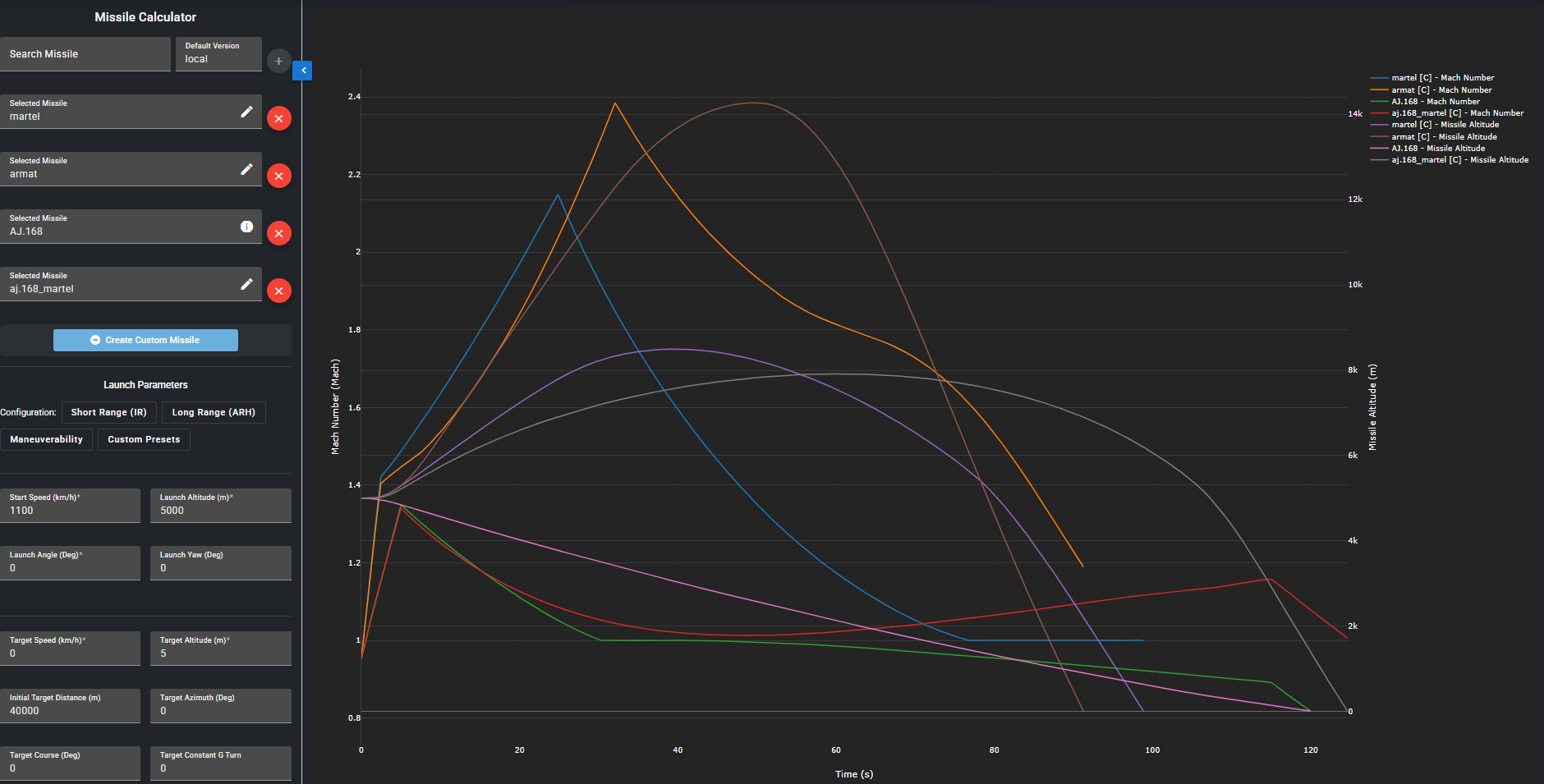
So i did some tests on stat shark, using the AJ.168 as basis.

  • For the Martel version, I tweaked the sustainer motor so that it has 22,4 second burn time and 10 kN of thrust, thus maintaining the specific impulse, reduced overall missile weight from 550 to 530 kg, and gave it pseudo cruise trajectory by adding an 8 degree loft profile.
  • For the armat version, i increased the burn time of the sustainer to 28 seconds while keeping the thrust, increased the overall missile weight to 550 kg to maintain specific impulse and mass after burnout, and tweaked the guidance for a 45 degree loft profile

And the result is that if I replicate the trial launch conditions in stat shark, the armat reaches the target in 3 minutes and 7 seconds, which is still not quite as good as the 2 minutes 32 seconds of the real life equivalent (which probably has a better trajectory), but getting pretty close.

By comparison, the martel is flying so slowly it’s probably going to be intercepted before reaching the target, and the aj.168 doesn’t reach the target at all, showing how the lofting profile alone can make a huge difference - although it might not matter depending on the maximum distance allowed by warthunder.

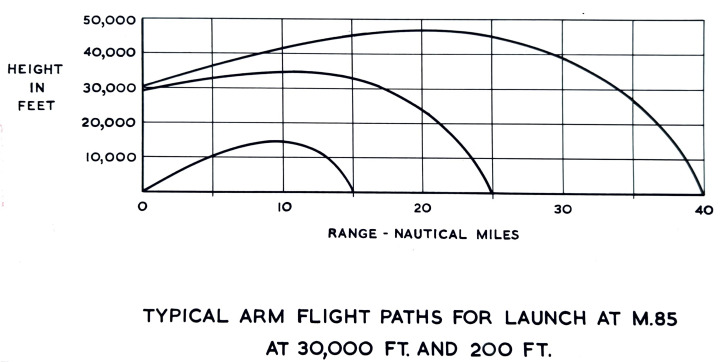
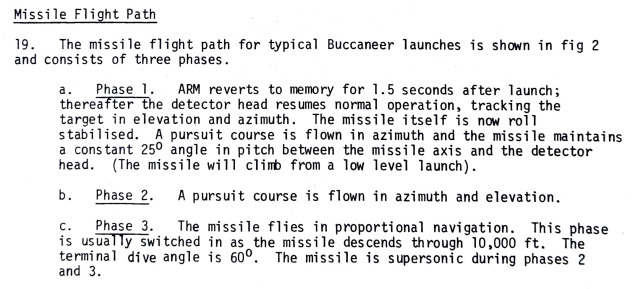
AR Martel maintains a constant climb angle of 25° (measured between the missile axis and the target). There are the typical flight paths it follows. Final drive onto the target is at 60° to horizontal.
image

Honestly some of those sound like a downgrade from Martel

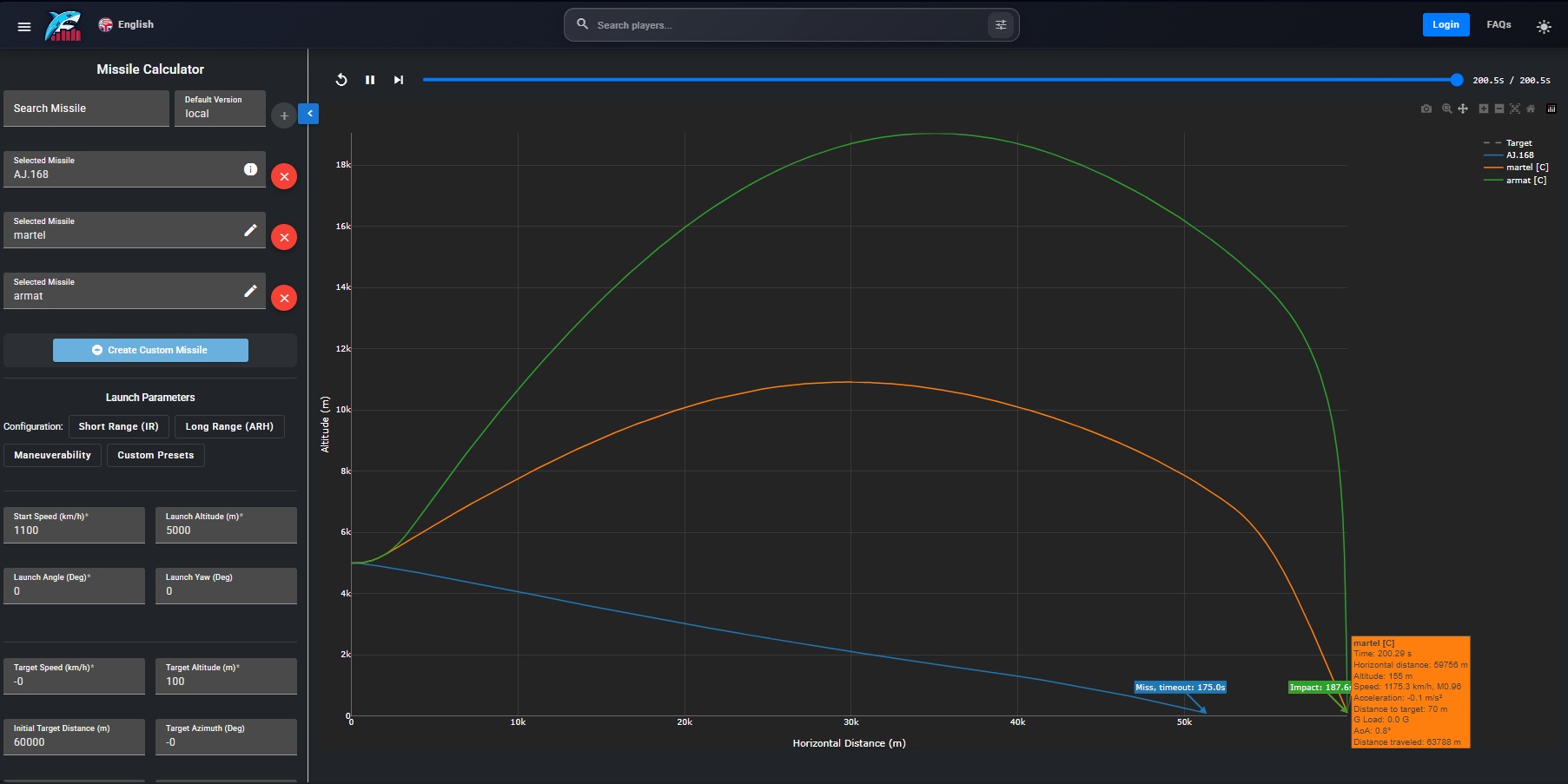
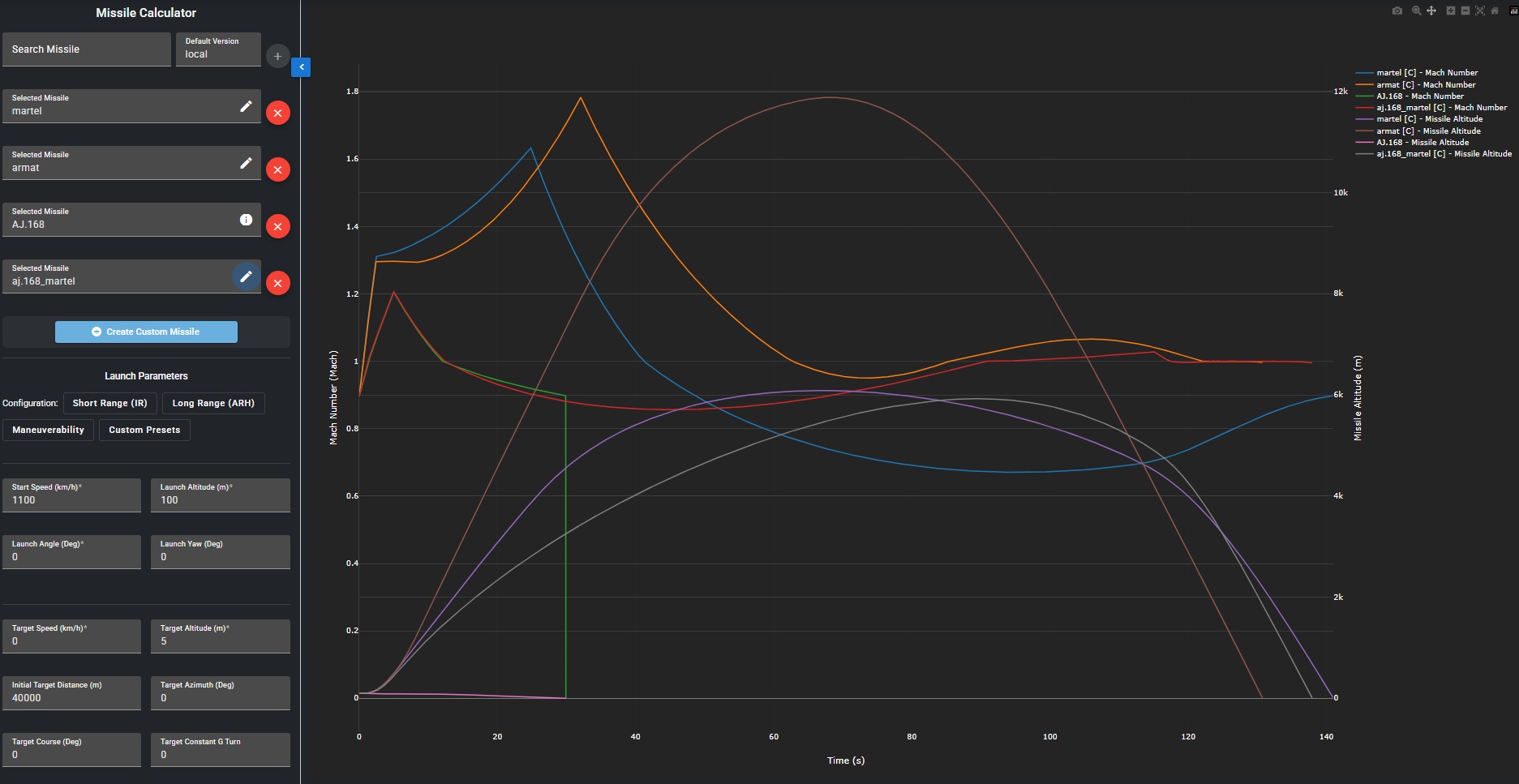
Redid the comparison using a 25º loft profile for the martel. Armat reaches the target in less time (and should be 35 seconds faster), and stays supersonic for practically the entire flight while martel becomes subsonic halfway through.

So the improvements of the armat over the martel seem straightforward; flight adjustable broadband seeker with wider azimuth/elevation limits and longer detection ranges, more powerful sustainer motor, more agressive lofting trajectory.

Interestingly Martel should be sub-sonic in the climb, but supersonic in the level out and terminal dive phase.

That’s impossible, the booster rocket alone is enough to make the missile supersonic when launched at 1100km/h / mach 9, and it must slow down in the level out phase once the sustainer rocket cuts out. Maybe it becomes supersonic in the steep dive, but even the armat in this comparison slows down as it dives because of the increasing thickness of the atmosphere - that said, it’s possible the ingame aj.168 i used as basis has way too much drag compared to the real thing.

Can confirm that reducing the drag coefficient from 1.025 to 0.84 does the trick, both to get the armat to reach the target in the given time and to allow the martel to reach the speed of sound in a dive, after a supersonic climb and subsonic cruise.

I’m just saying what the various manuals / reports say. That would imply the missile is not supersonic during phase 1 of flight.
image

I should have expected quirks from an Anglo/French collaboration… The missile behaves pretty much like stated on the manual if you swap in the rocket booster and the sustainer from the aj.168, keeping the 25º loft profile and reduced weight. It gets better performance (shorter travel time + faster impact speed) than the french as.37 version when launched from sea level.

But loses it’s advantage when launched from altitude.

So there’s at least 4 different missiles with the same chassis:

  • Aj.168 Tv guided (17200 N 5 s booster, 2000 N 110 s sustainer, 550kg)
  • Aj.168 ARH (same as above, 530 kg)
  • As.37 martel ARH (36000? N 2,4 s booster, 10000? N 22.4s sustainer, 530 kg)
  • As.37 armat ARH (36000? N 2.4 s booster, 10000? N 28 s sustainer, 550 kg)

There was no British specific anti-radar version of AJ.168. Both Britain and France used the same AS.37 anti-radiation missile.

I took a quick look at the aj.168 specs posted on the forum. For starters, the ingame version has the wrong specifications, in warthunder the booster stage lasts for 5 seconds instead of 2,5 seconds, the sustainer stage lasts for 110 seconds instead of 92 seconds, and the overall missile weights 550 kg instead of 574 kg.

Second, while the trajectory modelling in warthunder/stat shark is limited, it seems very difficult for any missile to be able to reach supersonic speeds in a dive that started from subsonic speeds, especially in the thick lower atmosphere. So if the ARH version of the martel has a 22,2 second sustainer rocket that flames out before the climb is finished, it’s bound to be supersonic in the climb and either stay supersonic or subsonic the rest of the flight. The only way for the martel to climb subsonically and then dive supersonically is if the sustainer motor trades thrust for burn time, only cutting out after the missile starts losing altitude - and it’s the aj.168 that has the slower burning sustainer.

Third, the armat missile tests state clearly that.

Pour cette deuxième mission capitale pour l’avenir du Bazar”, la société Matra déploie les grands moyens : tous les responsables du programme sont là. En plus de l’équipe technique, sont présents Philippe Turpin, responsable chez Matra de tous les contrats avec l’Irak, et Jean Paolorsi, directeur emblématique et très respecté ,des programmes de missiles air-sol de Matra. …
… Le résultat de ce deuxième tir est donc un succès, avec encore une bonne précision d’impact, au grand soulagement des observateurs visuels “privilégiés”, qui rentrent en véhicule quelques heures après sur la base de Qayyarah-Ouest. L’enthousiasme est de retour et le dernier stress s’évanouit avec le pot improvisé qui s’ensuit. Jean Paolorsi est ravi d’avoir entendu le bang sonique de son missile qu’il avait toujours cru, jusqu’alors, parfaitement subsonique.

So even matra’s technical director thought the improved version of the as37 martel was still subsonic through most of it’s flight…

Regardless, i think the version i made is close enough, with the only real question remaining being the exact thrust and isp values of the different rocket motors, but i think that answer is probably hidden in some microfilm archive owned by MBDA.