History
As the pilot M4 Sherman, originally designated the T6 Medium Tank, was developed to replace the M3 Lee and completed in September 1941, it proved successful and was accepted with recommendations for numerous modifications that would later lead to the standardization of production vehicles. As a result, on December 11, 1941, the welded-hull production version was designated the M4, while the cast-hull version became the M4A1.
The first production run of the M4A1 Sherman began in February 1942 at Lima Locomotive Works under a British contract. As specified in the recommendations, these early-production M4A1 tanks incorporated several changes from the original T6 design, such as the elimination of the side doors. The first production tank, carrying British War Department number T-25189, was taken over by the US Army at Aberdeen Proving Ground for testing purposes, where it spent its service life with the US Army. It could be visually distinguished from later examples by its T6-style upper hull castings, with the openings for the side doors welded shut.
The second tank, T-25190, featured a newly revised hull casting with the side doors completely eliminated. Both vehicles were equipped with the short-barreled 75 mm M2 gun fitted with double counterweights, since the improved M3 75 mm gun was not yet available.
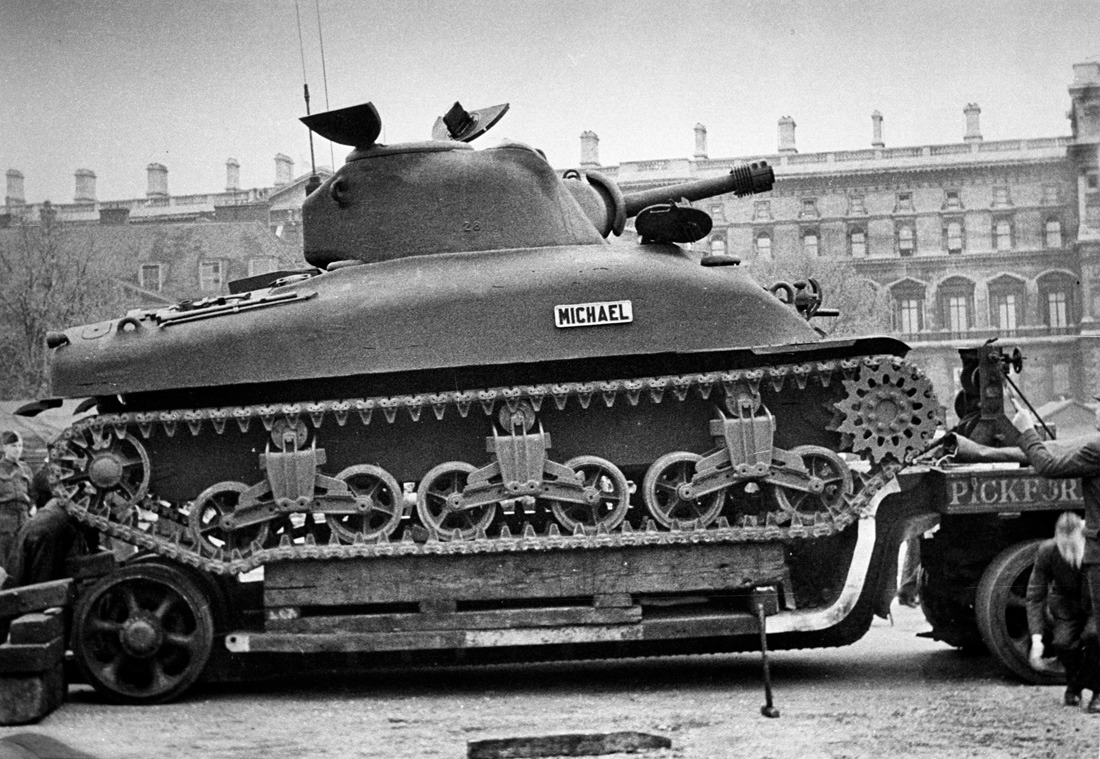
T-25190 was shipped to Britain bearing the name “MICHAEL” painted on its sides in honor of Michael Dewar, head of the British Tank Mission, who had led negotiations with American factories for British tank production. It arrived in London on May 8, 1942, where it was displayed at Horse Guards Parade before later serving as a test vehicle throughout the war. Eventually, the tank was retrofitted with the newer M3 75 mm gun.
The vehicle was extensively used to identify and resolve technical problems before later production Shermans entered combat service. “Michael” was listed in the Lulworth Camp Report as being constructed of “mild steel,” and a triangular warning plate marked “UNARMOURED” was attached to the right side of the hull. It remains unclear whether the tank truly possessed weaker armor due to the mild steel construction or whether the markings simply indicated that it was not considered combat-ready. Nevertheless, British evaluations concluded that, despite its defects, the Sherman was a superior fighting vehicle compared to the M3 Medium Tank. British authorities also recommended to US Ordnance that the majority of the main gun ammunition be relocated from the high sponson racks to storage bins on the hull floor.
Eventually, the remaining production M4A1 Shermans, known as the Sherman II in British service, made their combat debut at the Second Battle of El Alamein in October 1942. The Sherman proved more reliable and comfortable for its crews than the Crusader tank, paving the way for its successful service among Allied armored forces throughout the war.
“Michael” survived the war and was eventually added to The Tank Museum collection, where it remains today as the oldest surviving Sherman tank in the world.