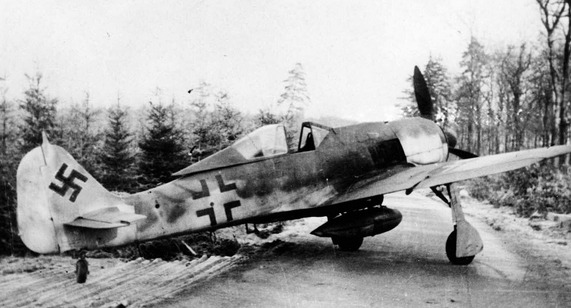
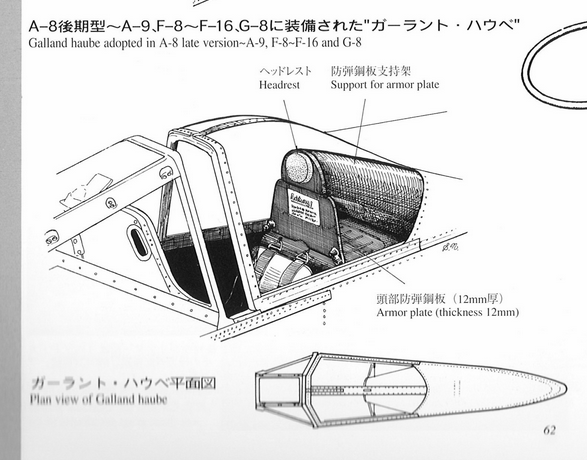
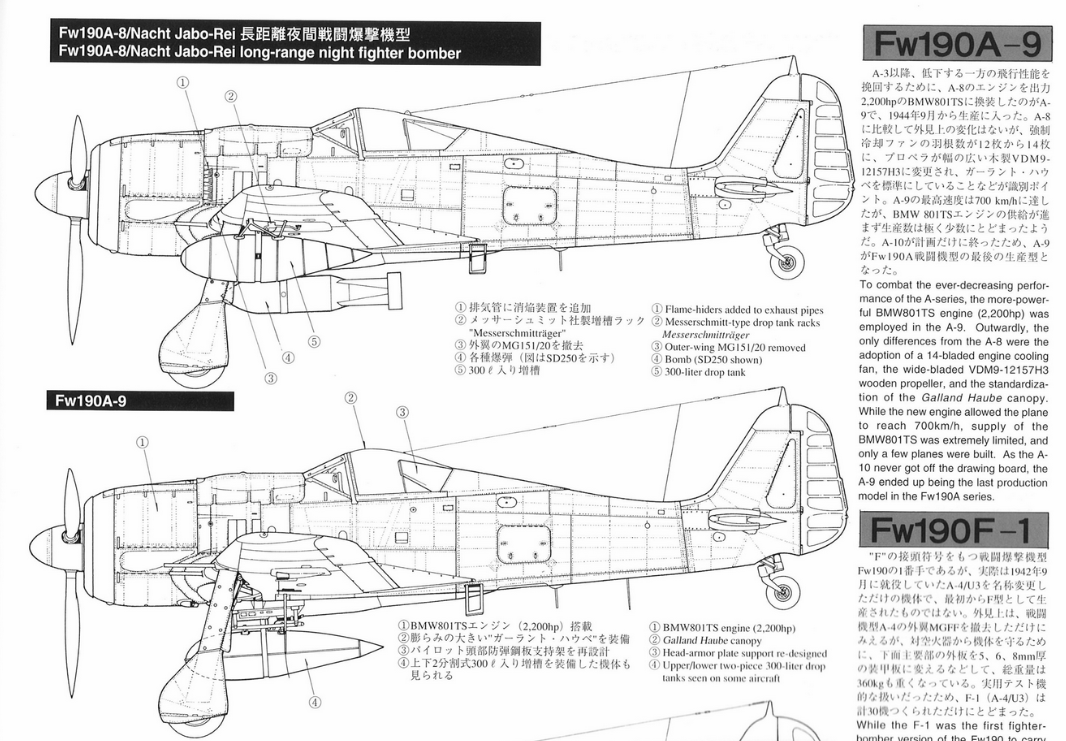
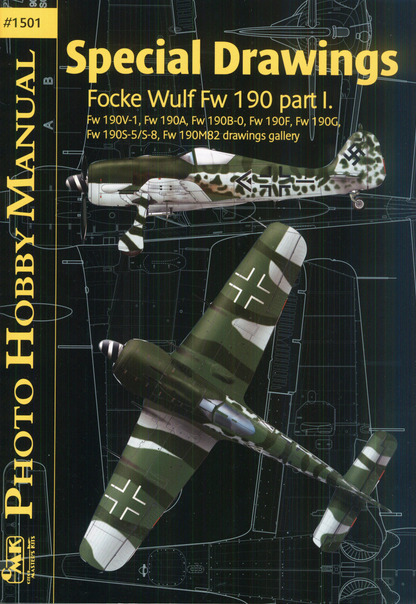
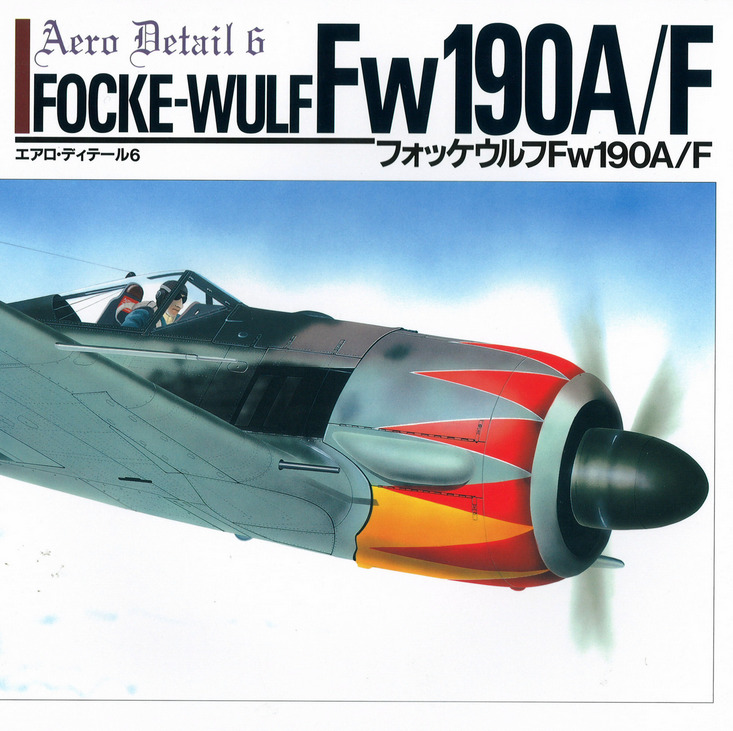
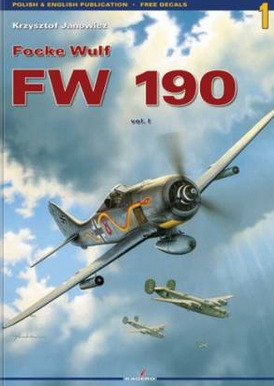
The Focke-Wulf Fw 190 A-9 was the last major radial-engined development of the famous German fighter, introduced in late 1944 as part of the Luftwaffe’s attempt to keep the Würger competitive against increasingly advanced Allied aircraft. It was essentially an evolution of the earlier A-8, but fitted with the more powerful BMW 801TS radial engine, capable of producing around 2,000 horsepower. This gave the A-9 improved speed and climb performance at medium altitudes, the environment where the Fw 190 had traditionally excelled. To handle the extra power, the aircraft received a larger propeller, a strengthened airframe, and reinforced landing gear. Pilots also benefited from a slightly modified canopy that improved visibility. Armament remained formidable, with two 13 mm MG 131 machine guns and four 20 mm MG 151/20 cannons, making it a dangerous opponent in close combat and effective as a fighter-bomber.
Service and Fate
Spoiler
Despite these refinements, the A-9 arrived too late to make a strategic difference. Germany’s collapsing war industry meant production numbers were limited, and fuel shortages further restricted its operational use. In combat, it was still a strong performer at low and medium altitudes, but at high altitudes it was outclassed by Allied fighters such as the P-51 Mustang and the Spitfire Mk IX. The A-9’s introduction also coincided with the development of the “long-nose” Fw 190D and the Ta 152, which were designed to overcome the altitude limitations of the radial engine. As a result, the A-9 became more of a transitional design—an attempt to squeeze the last bit of potential out of the radial-powered Fw 190 before the Luftwaffe shifted focus to inline engines and high-altitude specialists. In the end, the A-9 represented both the peak and the conclusion of the radial-engined Fw 190 lineage, a powerful but belated fighter that reflected Germany’s desperate late-war innovations.
The A-9 was essentially a strengthened and more powerful evolution of the A-8, designed to squeeze the last bit of performance from the radial-engine Fw 190 line. Its larger propeller and reinforced structure reflected the demands of late-war combat, but despite its impressive specifications, it was overshadowed by the inline-engine “Dora” series and the Ta 152 high-altitude fighter.
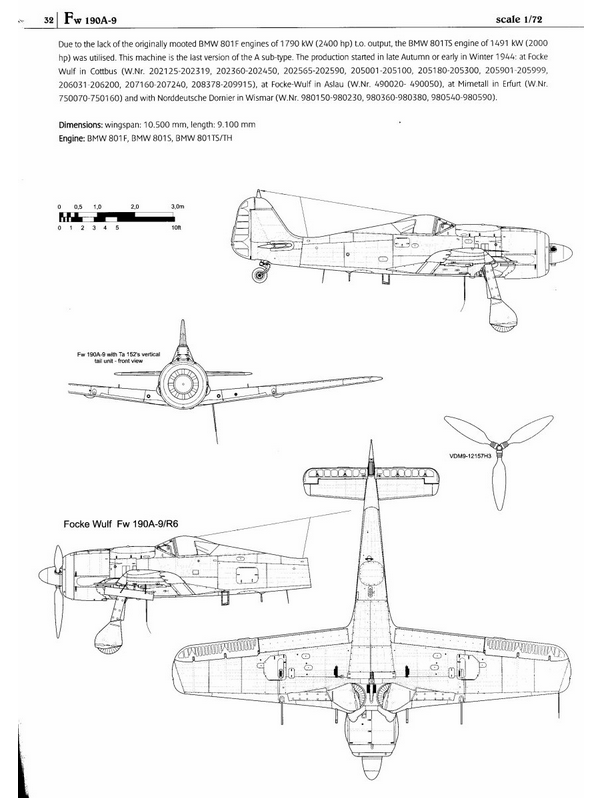
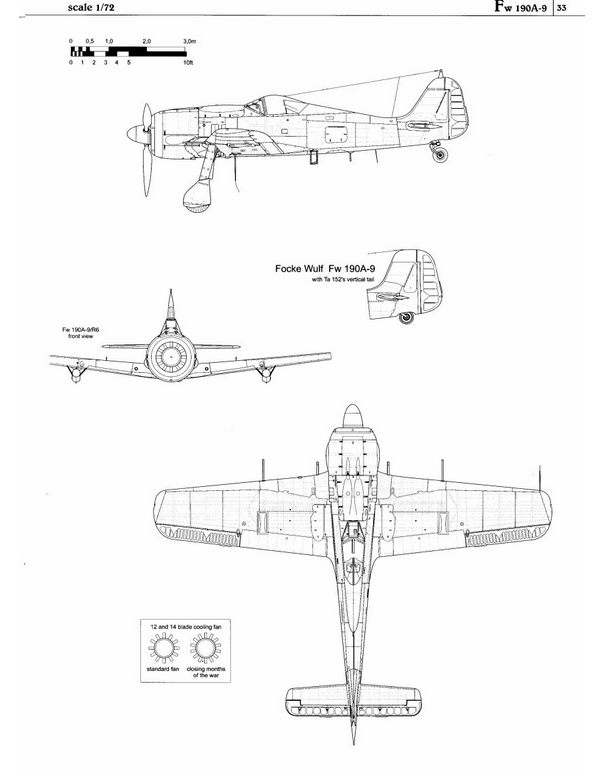
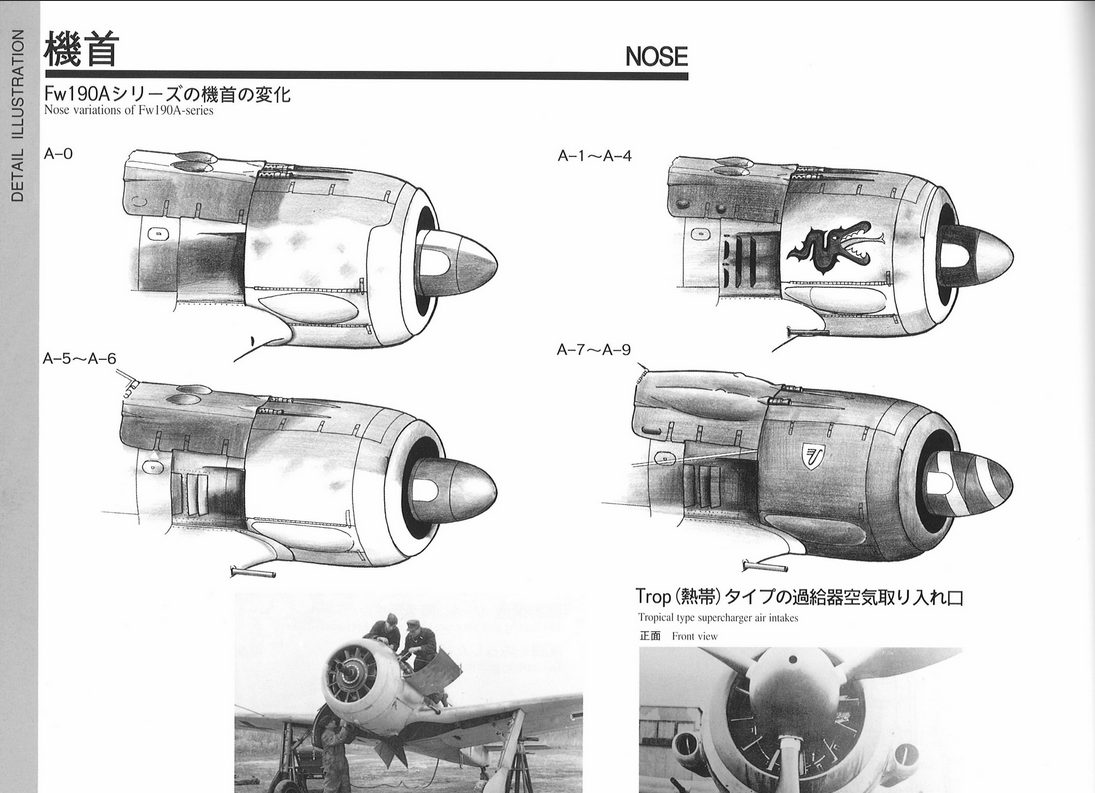
Art images from book:
Spoiler
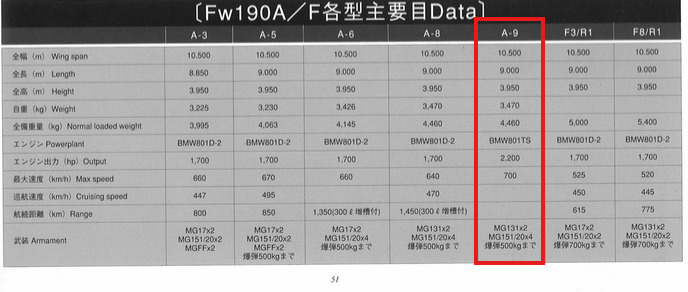
Specifications
General Characteristics :
Spoiler
Crew: 1 (pilot)
Length: 9.10 m (29 ft 10 in)
Wingspan: 10.51 m (34 ft 6 in)
Height: 3.95 m (12 ft 11 in)
Empty Weight: 4,000 kg (8,820 lb)
Loaded Weight: 4,900 kg (10,800 lb)
Powerplant: 1 × BMW 801TS radial engine, 2,000 hp
Propeller: Larger diameter, wooden or metal, designed to handle increased horsepower
Performance
Maximum Speed: 657 km/h (408 mph) at 6,600 m (21,650 ft)
Cruising Speed: 550 km/h (342 mph)
Range: 800 km (500 miles) combat radius
Service Ceiling: 10,600 m (34,775 ft)
Rate of Climb: 15 m/s (3,000 ft/min)
Armament
Machine Guns: 2 × 13 mm MG 131 (mounted above the engine)
Cannons: 4 × 20 mm MG 151/20 (two in wing roots, two in outer wings)
Ordnance Options: Up to 500 kg (1,100 lb) of bombs or drop tanks for extended range
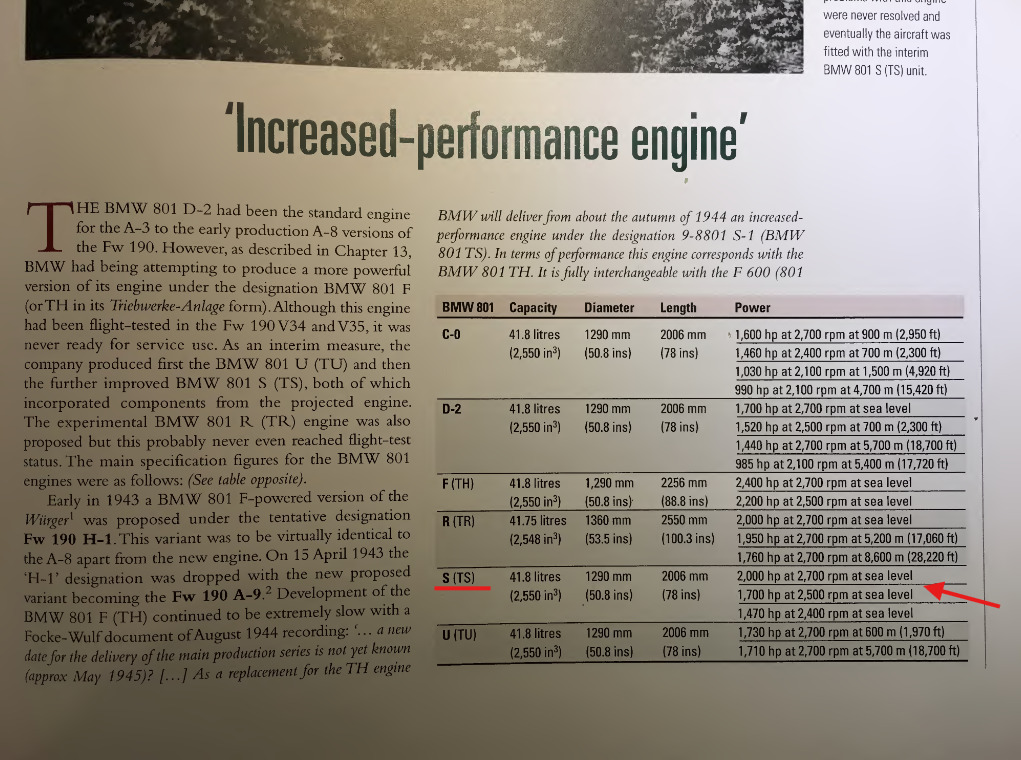
Have in mind that the engine data regarding hp output are in most sources limited to 2,000 hp. Over the years i found here and there some sources which claim that with “Sondernotleistung” (=actual WEP) the engine had 2,200 hp.
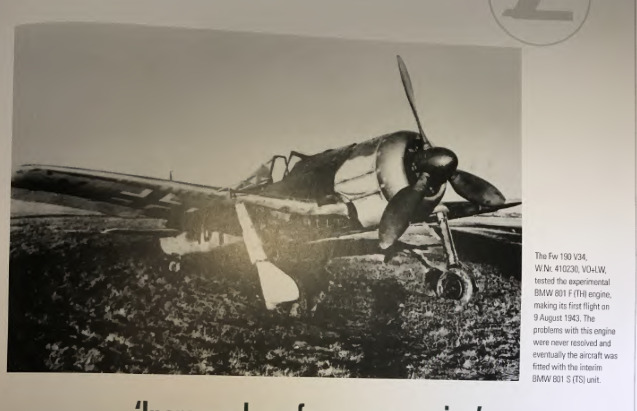
other sources say Fw 190 A-9 used a better BMW the Fw 190 A-9 V34 some sources claims used the BMW 801F (TH) with 2400hp at sea level but i have no information about it.
here more info about the Fw 190 A-9 BMW 801TS and other engines for the correct Fw 190 A-9 with 2000 HP that the Fw 190 A-9 used.
IIRC the A-9 was supposed to get a 801F as standard, but because of development and production delays typical of late war Germany, the 801S was used instead. Perhaps they could add two variants; an 2000hp A-9 (Early) with 801S and a 2400hp A-9 (late) probably would just be a 0.3 BR difference, but still.
I did see that the 801S could make 2200hp in “special-emergency” but I have no clue what that means, or how it would be different from normal war emergency power and such.
i support the idea ! +1
(like the Fw 190 D-14 with two different engines types ) they could add late / early one of Fw 190 A-9 for tec tree and other as event or battle pass / premium.
Have in mind that there are lots or reasons why the Germans used various terms for engine power output in specific stages of the war. Some of them are tied to bureaucratic necessities, different engines available for the same aircraft (just google "190 “Kraftei”) and different models of 190s.
So you face terms like “Erhöhte Notleistung” for A-8s/F-8s with or without C3 injection - or “Sondernotleistung” for WEP connected to increased boost / manifold pressure with higher fuel injection connected to time limits of 10 minutes for “later” engines - whilst both mean WEP.
If you or @Scärlett wants to have a rough overview about the used engines in the A-8/8 you might find this whole thread interesting:
As a side note: It boils down that Il-2 has/had? the same issues with devs not capable of reading documents in a foreign language.
For those of you trying to convince gaijin that their artificial overheating nerf of 190 Antons is just based on their ignorance you find also valuable links to actual FW data and handbooks in it.
@Detach0-0 - as you started an attempt to revise the engine nerf
you will find in the linked Il-2 thread evidence for the 10 minute WEP limit for 190s with later engines…
Technically seen the A-9 (without an interceptor air spawn) should be max at 4.7 in RB as the plane is way heavier than the 4.7 La-7 whilst the outer guns play just a minor role.
Based on the current state of Air RB (just look at the thread “Cannons do too much damage”) armor plays zero role if you get hit by ShVaks (Hi @KillaKiwi ) - and the current flight model of 190s is a real pain. Hope is way too often just a delayed disappointment…
am playing with Fw 190 A-8 my engine died twice i was confused why even i set my power at zero the engine temps slowly went down and yes the Fw 190 A and Fw 190 D flight model got nerfed i don’t know why the Fw 190 D-13 with hydraulically boosted ailerons is bad it should be better but it’s same like Fw 190 D-12 and D-9 .
Understandable - the F-8 was my “go-to” plane for completing BP tasks in Air RB (kill “x” players with a 1,000 kg bomb or more) - i stopped playing it:
You might try to circumvent the engine nerf by using MEC and shot off the engine for more than 30 seconds - in a lot of planes you can reset the engine with this trick 😎Let me know if it works…
I already linked the closed thread earlier and even asked in October 25 for an official feedback:
But i never got a feedback…
You might fight the links in this post also interesting (especially FM):
Came here to give a +1
Seeing as you enjoy German planes, could you possibly look into the Fw 190 F-9? An upgraded version of the ground attack F-8. It’s based on the A-9’s frame. Multiple were built.