you guys are really gaslighting yourselfs lol, sorry aim4f/g were not just a worse missile they feature a much more powerful longer burning engine to compensate for the added weight, early aim4 also had a comical warhead of 7.6 lbs vs 26 lbs of the aim4g/f.
Don’t know where you’re getting that they’re also significantly faster, that’s not how rocket dynamics work, it has a much weaker engine, it’s slower across all altitudes
they also feature much more primitive seekers
no, they had a LONGER burning engine that had very poor acceleration and a little more energy. the f-102 literally cannot go mach while level (according to the game stats, actual performance is always slightly higher), meaning a stronger burn would be much better than having a slow missile that can be flared in a larger time period.
it literally doesn’t even have sustaining engine, only g/f it was higher energy for extremely short amount of time, not sure why you guys think that translates to higher speed overall, or even in a short distance
I’d say the f/g had the stronger engine lol
did you even read my reply? which depicts the actual speed of each missile at different altitudes.
1 Like
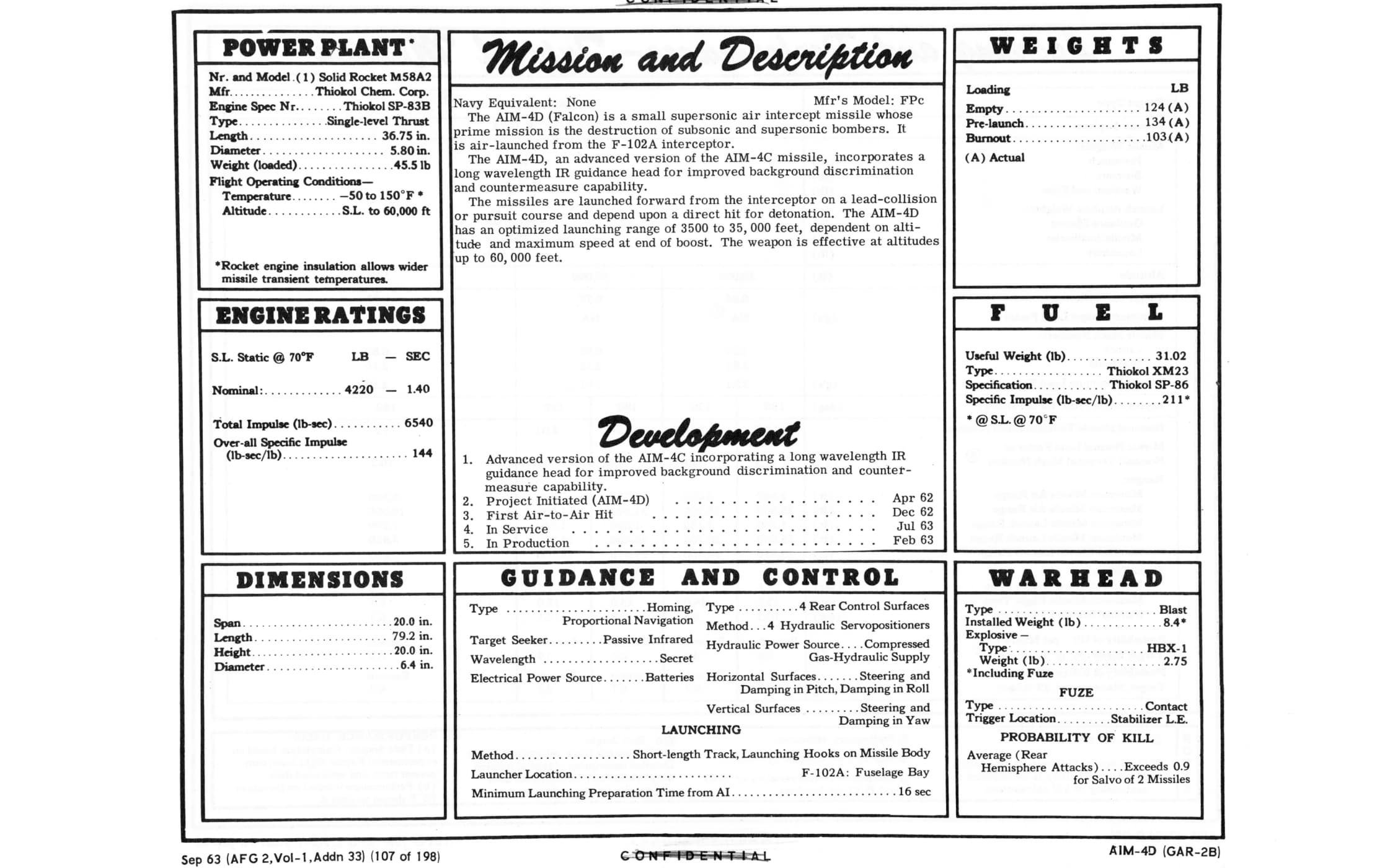
AIM-4D shared the same seeker as 4G
Arming America’s Interceptors: The Hughes Falcon Missile Family
"In April of 1962, Hughes began work on modifying the GAR-2A with a new IR seeker. The IR seeker, taken from the GAR-4A employed by the F-106, operated in the 3-6 micron range. This made the seeker far less susceptible to external interference.
By December of 1962, the GAR-2B achieved its first air-to-air intercept of a target. It entered production as the AIM-4D, following the Department of Defense’s new standardized designation system, in February of 1963, with service entry coming the following July. Apart from new production, Hughes remanufactured surplus GAR-1D and GAR-2A missiles to AIM-4D standard. The AIM-4D was unique among Falcon variants at the time insofar as its intended use was concerned. Hughes designed previous Falcon missiles to intercept enemy bombers. While the AIM-4D would replace earlier GAR-2A missiles on the F-101B and F-102, the USAF also intended to field the AIM-4D on tactical fighters beginning with the F-4 Phantom II, with an aim towards employing the missile in fighter-on-fighter combat. In this role, the AIM-4D would replace the USN’s AIM-9. As a result, the AIM-4D gained not only a new seeker head, but a moisture proof sleeve over the forward fuselage intended to make it suitable for external carriage on tactical aircraft not featuring internal weapon bays."
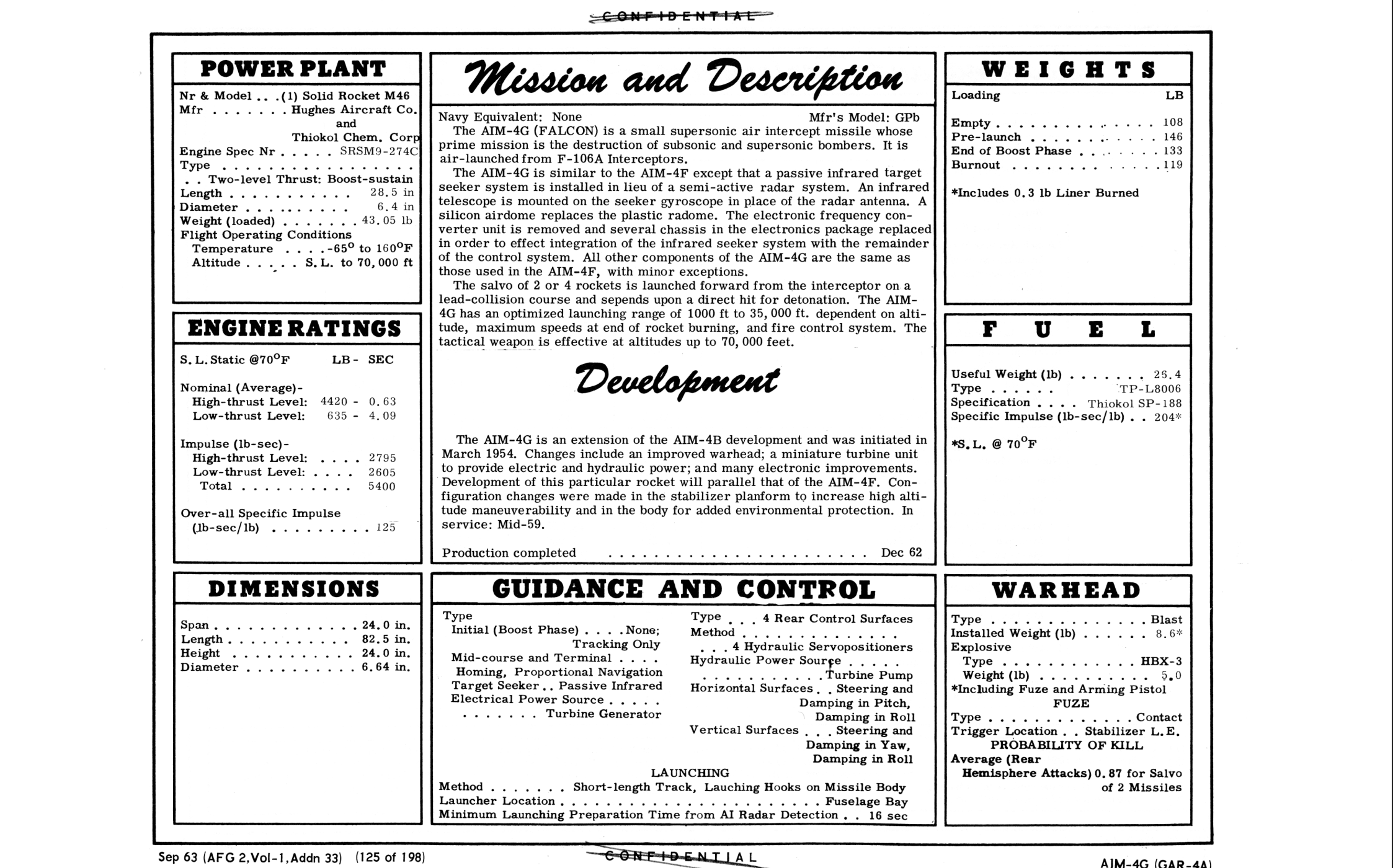
GAR-4A is the AIM-4G
1 Like
they shared different versions of the same seeker, the aim4g has an entirely different missile body, aim4d didn’t have the ability to slave to the radar. Also it was used first on the aim4g then shared with the older missiles.
Only 200 lbs more thrust (about 5% increase against AIM-4D baseline) for 0.63 seconds. Per the SMCs of the AIM-4D and AIM-4G, the 4D has greater total impulse, specific impulse and TWR than the 4G.
I have no idea where you’re getting those warhead masses from. The 4D has 2.75lb HBX-1 and the 4G has 5lb HBX-3. It’s smaller, but the difference is nowhere as big as you’re suggesting.